Much before the AI revolution threatened to disrupt India’s IT outsourcing firms, the proliferation of Global Capability Centres (GCCs) of global multinational corporations were already impacting them. For at first glance, GCCs involve in-sourcing and off-shoring of those activities previously performed by these IT firms.
This post will examine three questions. What is likely to be the impact of GCCs on the IT firms? What is the likely net impact of GCCs on the Indian economy? How would the GCCs be viewed politically in the era of protectionism and reshoring?
A useful framework to think about the issue is to view GCCs in two dimensions - who does the work (outsource/insource) and where it is done (offshore/onshore or reshore). This is likely to impact India in three measurable ways - substitution (insource work from IT firms to client-owned GCCs), expansion (offshore to the GCC those higher value added R&D and core functions that previously stayed with the parent), and linkages (creation of local supplier ecosystems around the GCC).
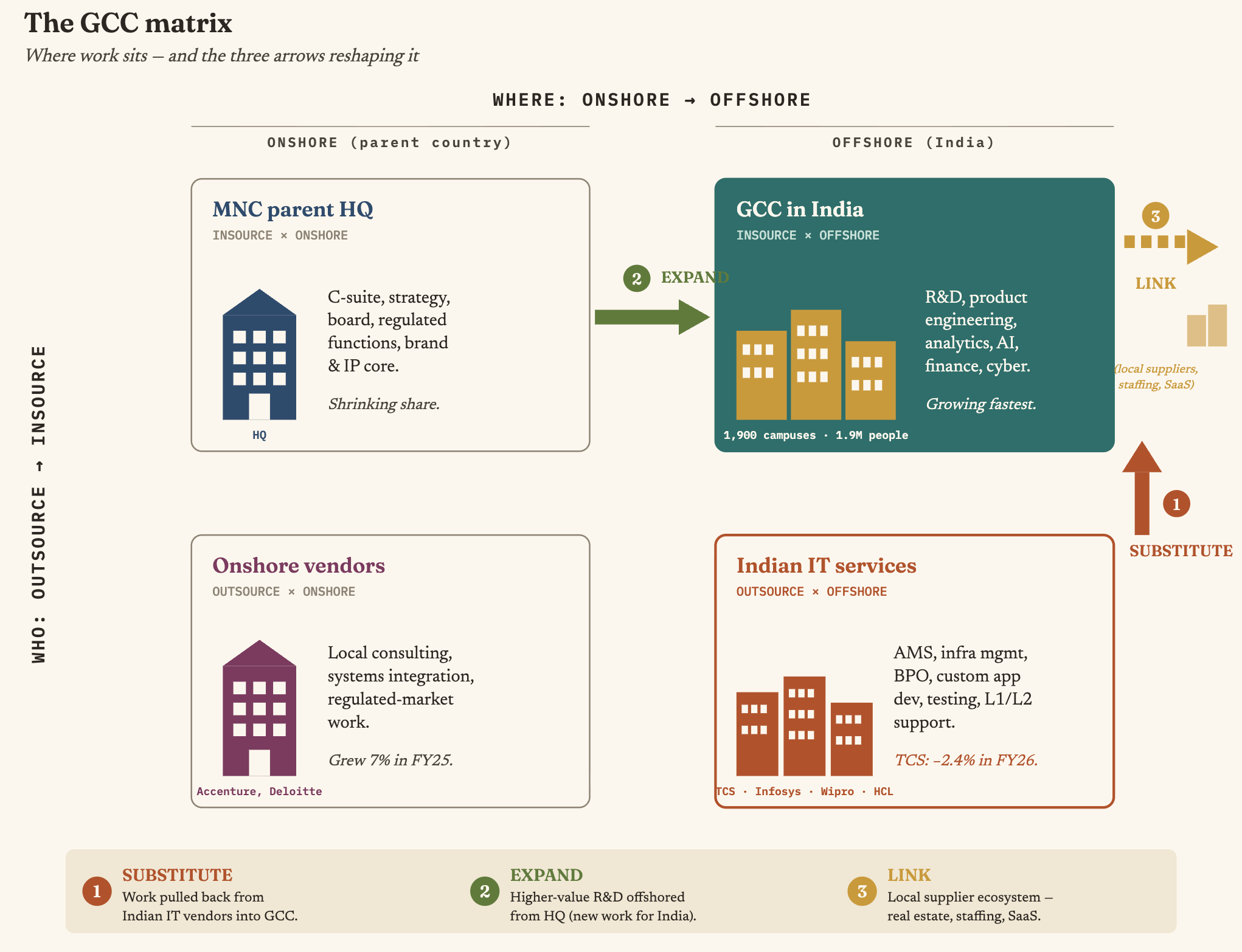
It can be argued that substitution is a direct threat to Indian IT firms, expansion is a new opportunity for India (though benefits are captured by MNCs), and linkages are significantly beneficial in terms of knowledge spillovers and new business for the local firms.
I used Claude to generate a taxonomy of activities with tasks that undergo substitution and expansion. For each activity category, the table outlines the parts of it done by the IT firms and GCC respectively, and their potential expansion areas.
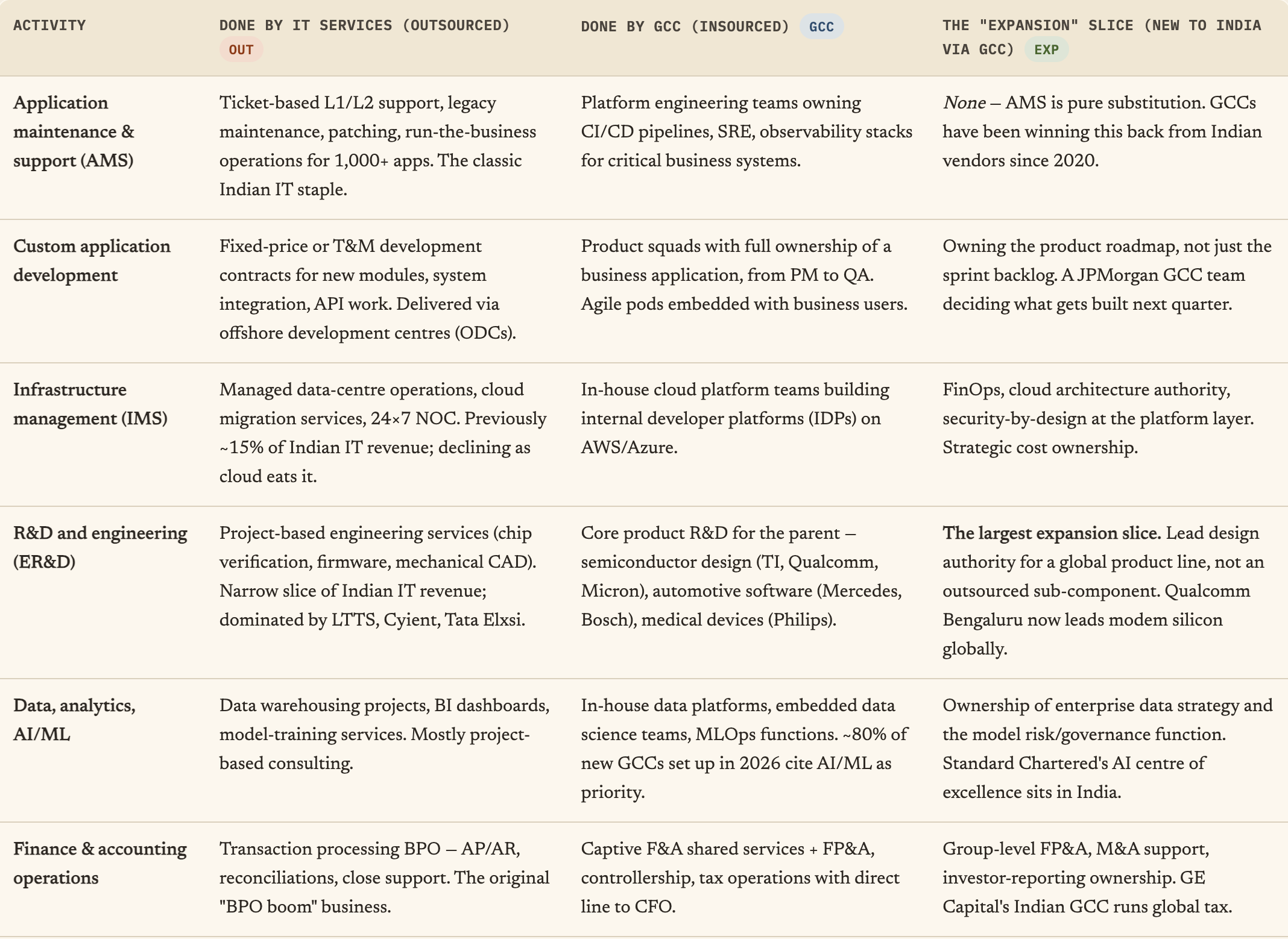
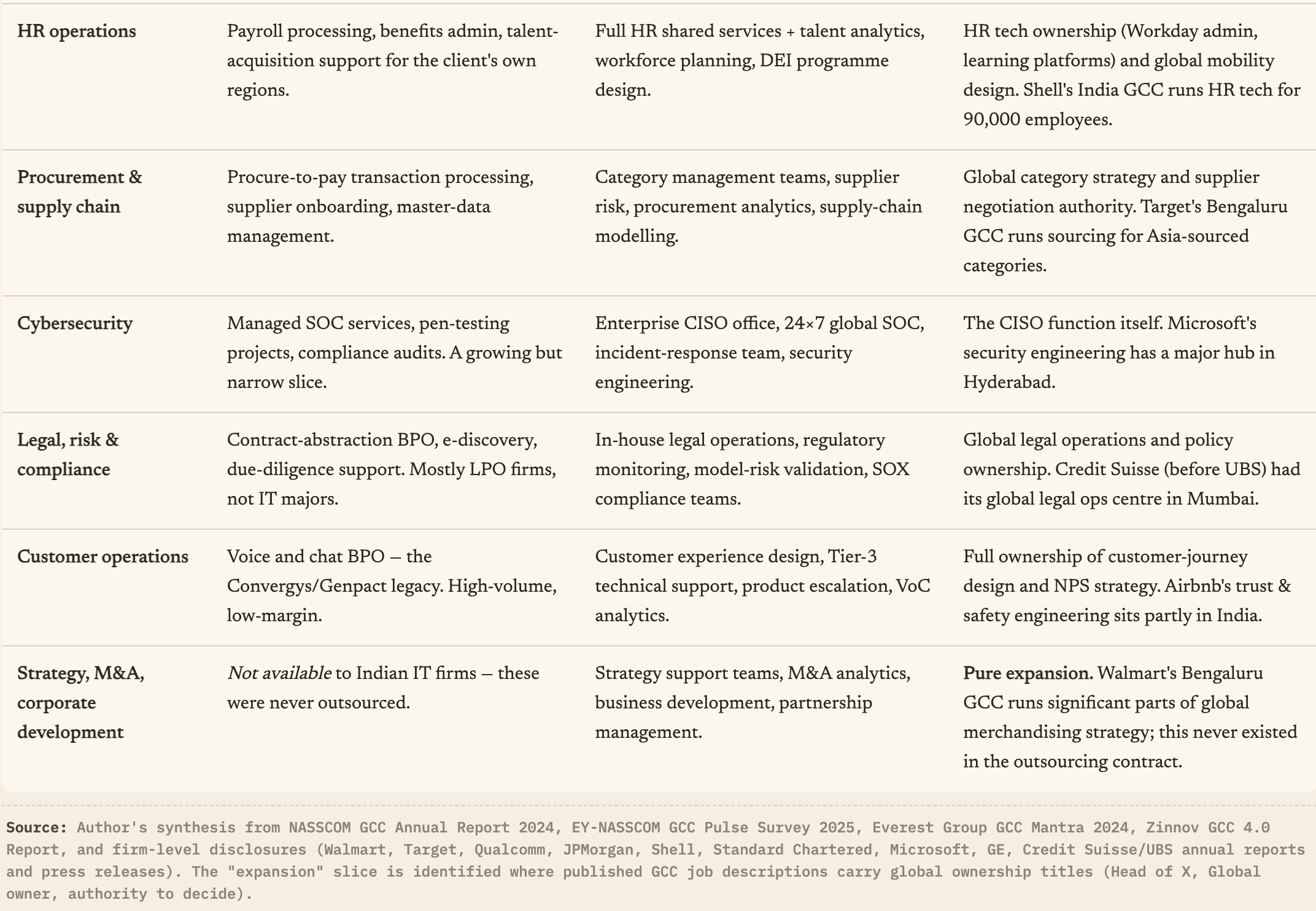
In 2024, the 1900 odd GCCs generated revenues of $64.6 bn, forming 32% of the total IT exports of about $200 bn. At such volumes, even if they are substituting a small share of their total revenues, it can be a major top-line drag on the IT majors.
While neat causal attribution may be difficult, there are several signatures of stagnation and even decline in the fortunes of the IT firms, and they predate the emergence of AI. At a headline level, TCS reported its first-ever annual revenue contraction in FY26, Wipro has shrunk for three consecutive years, and Infosys’s FY27 guidance of 1.5–3.5% is the lowest in two decades. In the three years till 2024-25, GCCs added more net headcount in India than the four largest IT services firms combined.
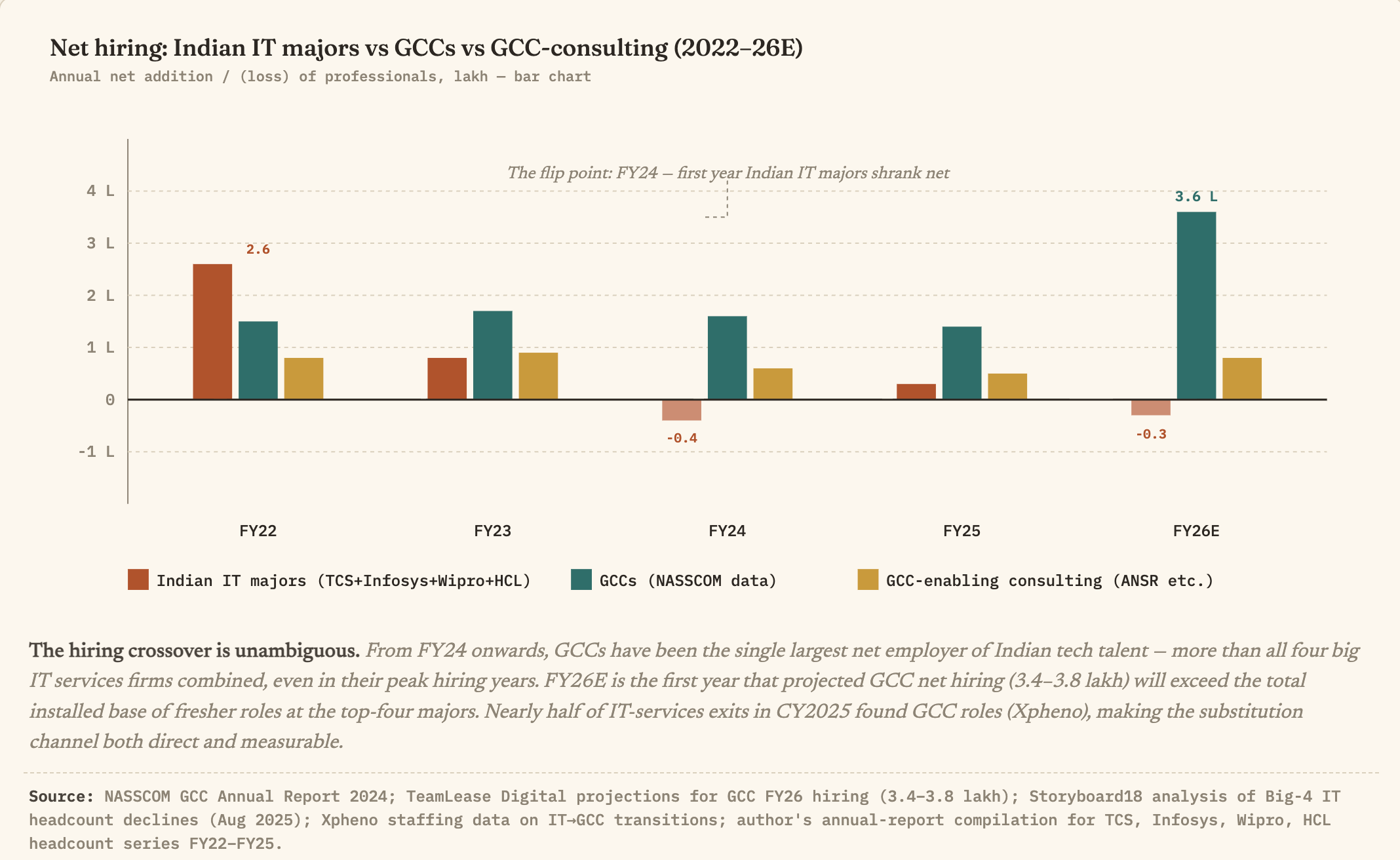
TCS, Infosys and Wipro have decelerated from double-digit growth in 2021-22 and 2022-23 to low-single-digits or outright contraction since then. While GCCs may be substituting their work, on the AI side, the likes of Accenture appears to have taken a head start in capturing the AI consulting work. Reflecting this, Accenture grew 7% in 2024-25 and has crossed $69bn in revenue.
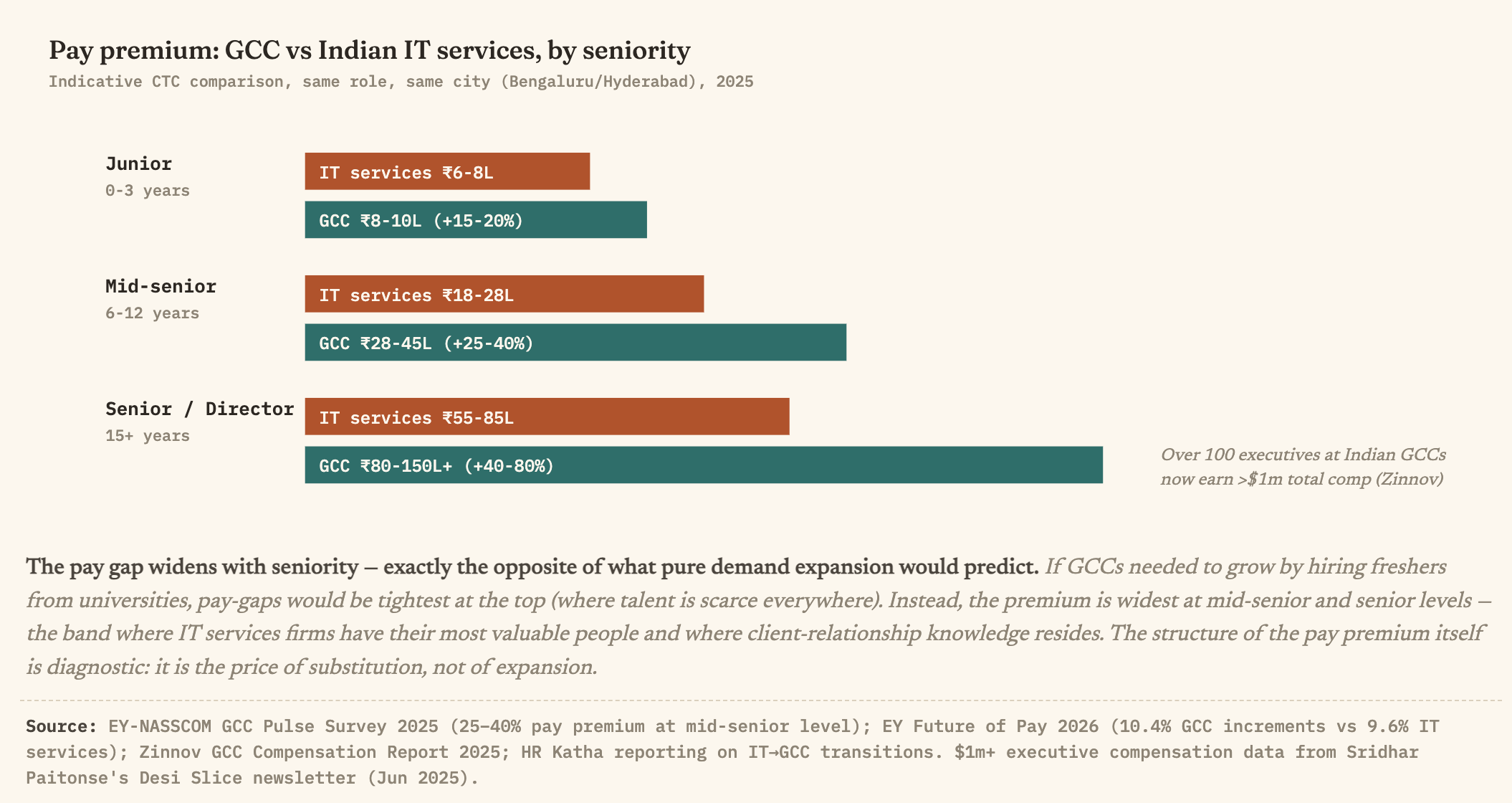
These trends are already reflected in the labour market. The GCCs are now hiring the same IT engineers from their previous outsourcing vendors, and at 25-40% higher pay.
The clearest proof that GCCs are taking share from Indian IT vendors (rather than only expanding the pie) comes from the labour-market. Employees of the IT majors (TCS/Infosys/Wipro) are now being hired by the GCCs of the same multinationals that used to be their clients, at 25–40% higher pay. There may be signs that the IT vendors are now suffering a talent drain to their former clients.
To summarise, Claude offered this assessment
Of the ~$65bn GCC revenue in 2024, roughly $35–40bn is expansion (work that would never have come to Indian vendors) and $25–30bn is substitution (work that was, or would have been, done by Indian IT services firms). That substitution slice is still only ~15% of total Indian IT services revenue, which is why the vendor firms are decelerating rather than collapsing. But at current GCC growth rates, the substitution slice compounds at 20%+ per year while the vendor base compounds at 3–5% — so the ratio reaches 25% by 2027 and 35%+ by 2030. That is when it becomes an existential risk to the current Indian IT services business model.
In the circumstances, for the Indian IT firms, the emergence of GCCs (and AI) bring down the curtain on the lower value added volume game of manpower outsourcing, and reveals that the only credible path is to compete on AI-first consulting at Accenture-like margins, which requires talent, human resource capabilities, and brand investments they historically avoided.
The linkages possible from GCCs are also likely to be significant. Apart from the support services, the GCCs will also catalyse a supplier services ecosystem that serve the main activities. Services sector ecosystems are unlikely to be in the nature of physical input-output linkages. Instead, they are likely to be in the form of various kinds of externalities.
The GCC’s local ecosystem is more likely to emerge through specialist technology vendors, subcontracting, employee mobility, start-ups, collaboration and the circulation of knowledge. The depth of the ecosystem depends on the nature of the GCC's activities, procurement practices, autonomy and connections to local firms.
For example, GCC’s performing like product engineering, R&D, advanced analytics or software-platform/product development, are likely to have greater spillovers than those performing highly standardised internal processing with limited technical autonomy or few local commercial relationships. Further, it can create demand for specialised services and contribute to the concentration of technical expertise that makes local firms more viable, supply a pipeline of employees who can be prospective entrepreneurs, etc.
There is evidence from studies on the impact of multinational IT firms in India of collaboration with local firms, knowledge flows and acess to resources and networks, innovation spillovers, productivity spillovers, and increased export intensity of domestic firms.
Given the objective of maximising expansion and linkages, there is a case for close monitoring of the nature of the GCC’s activities to guide policy making. Are the GCCs procuring technology and professional services, thereby creating creating domestic demand that goes beyond routine facilities, staffing, and support services? What is the level of sophistication of Indian suppliers, and are they are moving into higher value activities? The nature and number of startups established by employees of GCCs, and their trends? How many joint R&D, and university and startup collaborations, that promote local innovation networks? What are the trends with the productivity, exports, sophistication and product development capabilities of domestic firms that are associated with the GCCs?
The answers to these questions can be useful inputs to guiding policy making that advance the objectives on expansion and linkages. It is also an area where applied research partnerships with universities and think tanks can be helpful.
In any case, the overall impact of the emergence of GCCs on the Indian economy is significantly positive. The table below is likely an underestimate since it does not fully account for many of the externalities mentioned above.
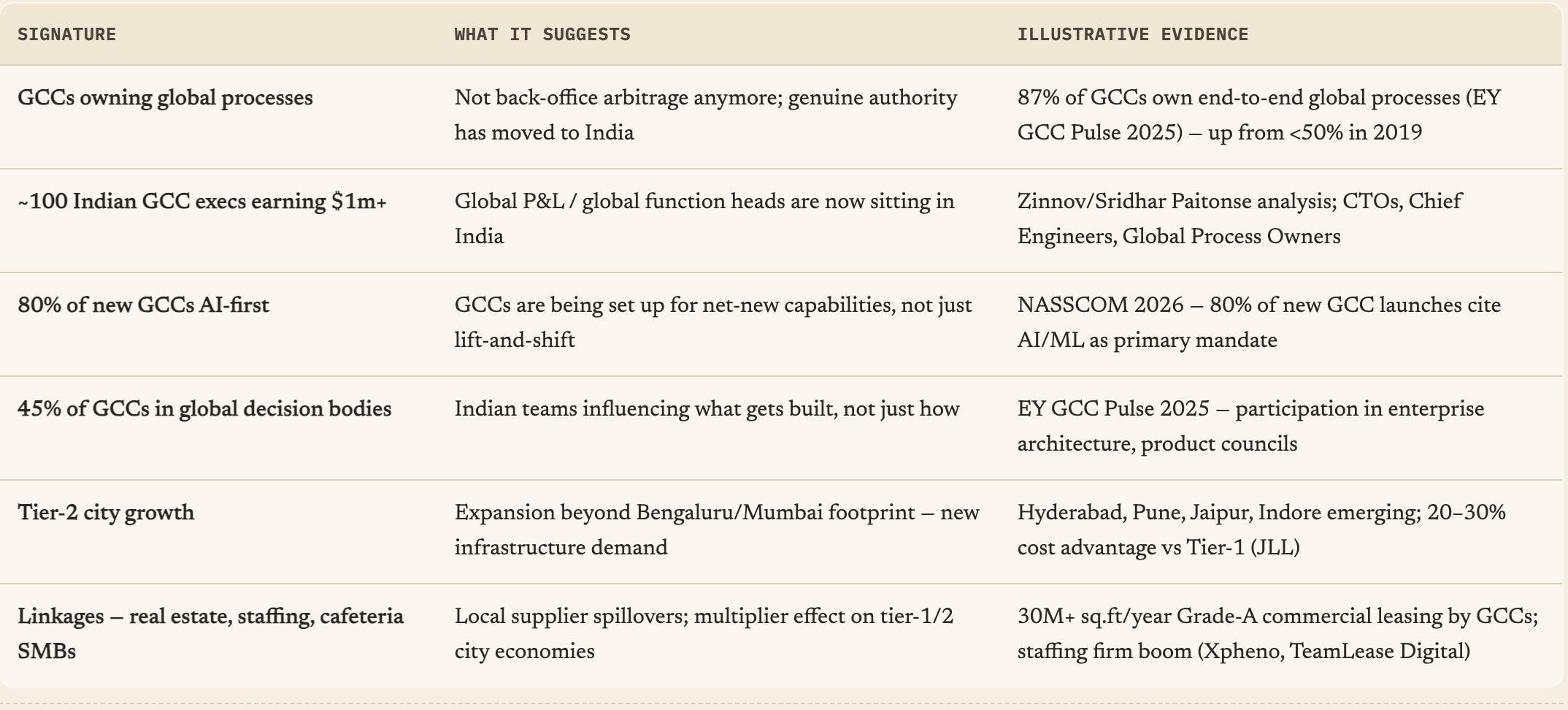
The real problem is likely to come from the third question about how the trend on off-shoring of activities through GCCs will be perceived in their parent countries. Hit by the China shock and weakening economies, advanced countries like the US are trying to reshore manufacturing base and protectionist measures are pervasive. In the US, these measures have extended to a crack down on visas for foreigners in the IT industry.
As the GCCs start to become a salient part of the revenues and employment of the MNCs, they will come to be viewed as a backdoor to send local jobs to countries like India. This is all the more likely at a time when good jobs are becoming scarce and youth unemployment is already high and rising in the US and elsewhere.
In this backdrop, a trend of off-shoring of IT services, which includes higher value added activities, even if within the same company, is certain to invite scrutiny and backlash. It is only a matter of time. Countries like India may have a far shorter window than imagined to capitalise on the GCC opportunity and make themselves indispensable parts of the global IT services supply chain just as China did in manufacturing.


No comments:
Post a Comment