Substack

Wednesday, July 24, 2024

Addressing the problem of retrospective and large tax and non-tax demands

Retrospective and large tax and non-tax demands are a widely discussed ease of doing business concern in the Indian context. There are recurrent examples of such demands by taxation authorities and other government entities. 

Consider this news report about hikes in lease amounts on two major properties in central Delhi.

The union government has revised the annual ground rent for land leased to several prominent five-star hotels in New Delhi — from thousands or lakhs of rupees a year to crores each — leading to at least two such hotels, The Imperial and The Claridges, to challenge the move in the Delhi High Court… The Land and Development Office (L&DO) under the Union Ministry of Housing and Urban Affairs in March this year issued demand notices for Rs 177.29 crore for The Imperial and Rs 69.37 crore for Claridges as revised ground rent from 2002 and 2006, respectively, until now. This, the L&DO said, was calculated with the rate of Rs 8.13 crore for The Imperial and Rs 3.85 crore per year for Claridges, an increase from the current rate of Rs 10,716 and Rs 8.53 lakh, respectively. The rates were 5% of the property value of the plots in 2002 and 2006, respectively, the L&DO notices said…

The 7.938 acre-plot on Janpath Lane on which The Imperial is situated was given on perpetual lease by the British to S B S Ranjit Singh with effect from April 8, 1932, with the lease dated July 9, 1937. The annual ground rent was to be revised after 30 years… In the case of Claridges, the 2.94 acre-plot of land on Aurangzeb Road, now known as Dr A P J Abdul Kalam Road, was given to Lala Jugal Kishore on November 12, 1936 on perpetual lease.

Several factors might have gone into the decision taken by the L&DO. I can think of some of the following factors commonly observed in such cases.

For a start, the current lease rents are so evidently tiny compared to the annual profits made by these commercial properties much less their value. Second, the L&DO’s actions would have been triggered by some deviations from the conditions in the perpetual lease agreements, and/or infirmities in the lease transfers, and/or lapses in the lease renewals and rent increases. Third, in most such cases, the parties indulge in bad-faith stone-walling and vexatious litigations to delay proceedings or indulge in fraud. Four, it’s also most likely that the leaseholders engaged in some irregular or even illegal action(s) (originating in the deviations, infirmities and lapses mentioned above) that were brought on record at some time and the process of addressing it/them had been initiated (perhaps years back). The final demand would have been the culmination of this administrative process. 

Finally, in most such cases there’s also the issue of some enthusiastic official pursuing the case zealously and expediting its disposal. Most often, this zealousness is accompanied by some or all of the four other factors. 

The newspaper report does not give any clue about which of these are relevant to the two commercial properties. 

From a reading of just the newspaper report, there are at least three problematic issues here. 

1. The sheer magnitude of the increase in demand is staggering - 8,12,900% for The Imperial, and 4413% for Claridges. Such astronomical increases for any statutory or commercial fees are hard to justify. 

2. The retrospective application of these levies is equally problematic. 

3. The finalisation of any such demands without following an elaborate process of consultations and a protocol without the permission of the next higher authority or the government itself is deeply disturbing. 

Such egregious demands are common among direct and indirect tax departments. It works something like this. One income stream of suspected tax evasion is detected, and tax is levied on that stream for the assessment year. The assessee is then retrospectively examined and tax demand is raised as late as law permits. This tax demand often ends up being in multiples of the assessee’s revenues or income itself. Worse still, similar suspected evasions across all other similarly placed assessees are identified and demand is raised. Finally, seeing one tax official do this, others join the fray and raise demands against their assessees. A massive tax bill vests on the assessment ledger of the tax department. Some assessees challenge the tax demand in courts. The whole demand gets locked up in litigation for years, even decades. 

It would be useful to analyse the history of such demand recoveries across government agencies - local governments, tax authorities, and so on. I suspect that a historical analysis of the actual realisations of such tax demands raised by agencies like the CBIC and CBDT in India will reveal negligible realisations. 

It’s therefore important that we address this problem by promulgating certain principles for the raising of demands by officials. 

Instead of pussy footing around the problem and issuing vague guidances that only add to the confusion on interpretation, it’s important to address the problem head-on and issue clear and direct guidance on this problem. It might be required to have omnibus principles like prohibitions on raising tax and non-tax revenue demands which lead to an increase of more than X% in the demand, or which are Y% of the total revenues (or Z% of the profits), or after N years of the assessment becoming due. The values of course will vary across sectors and departments (tax to local governments). These explicitly articulated principles should become integral to any agency that collects tax and non-tax revenues. 

Given the aversion in the executive to assume the administrative risk with decisions involving likely revenue loss (and large amounts at that), it’ll be necessary to capture these as legislative statutes. 

This will surely be exploited by unscrupulous businesses and individuals in collusion with officials and politicians. Therefore there should be a mechanism of escalations for demands above these values. The escalated authorities considering such demands should be mandated to apply the principles of ability to pay and the business risks posed by them. In cases of newly discovered assessment lines, the assessment should be levied only with the approval of the highest competent authority (and not any delegated authority). 

This should be complemented with the certainty of administrative actions against errant officials whose omissions and commissions led to the revenue leakages that necessitated the retrospective assessments. 

As an illustration of translating this intent to action, I have blogged here outlining some actionable principles in the context of GST administration.

Monday, July 22, 2024

The importance of access to "technical literacy" in industrial development

I have blogged here and here exploring the origins of the Industrial Revolution (IR) citing Joel Mokyr’s work. He has written about the sudden and miraculous explosion of science and technology in one part of the world and the creation of conditions for long-term economic growth, a development that cannot be explained by institutions alone. He points to the importance of culture - beliefs, values, and preferences that can change behaviour - in laying the foundations (in the 1500-1700 period) for the scientific advances and pioneering inventions that would instigate explosive technological and economic development.

In an excellent new paper, Réka Juhász, Shogo Sakabe, and David Weinstein highlight the importance of codification of technical knowledge in the vernacular was necessary for countries to absorb the technologies of the IR. They construct and use several novel datasets to study the diffusion of technical knowledge in the late nineteenth century. 

We find that comparative advantage shifted to industries that could benefit from patents only in countries and colonies that had access to codified technical knowledge but not in other regions. Using the rapid and unprecedented codification of technical knowledge in Meiji Japan as a natural experiment, we show that this pattern appeared in Japan only after the Japanese government codified as much technical knowledge as what was available in Germany in 1870. Our findings shed new light on the frictions associated with technology diffusion and offer a novel take on why Meiji Japan was unique among non-Western countries in successfully industrializing during the first wave of globalization.

The paper tests one of the main theories proposed by Joel Mokyr on why the IR happened in the UK and not elsewhere, the codification of engineering, commercial, and industrial practices (or “technical literacy”). 

It mines libraries and publications across the major languages to document such codification in the vernacular and how it changed over time in 39 countries between the late nineteenth and early twentieth centuries. It’s a truly impressive achievement. 

We build this dataset by scraping the catalogs of libraries for every major language, digitizing technical books for every major tradable industry, digitizing the synopses of all British patents issued between 1617 and 1852, digitizing bi- lateral industry-level trade data for Japan and the U.S., merging these trade data with extant trade datasets to create the first multicountry, bilateral, industry-level, trade dataset for the nineteenth century.

The authors establish four stylised facts about the global spread of the IR and the uniqueness of Japan’s nineteenth-century industrialisation, the Meiji Miracle. The first three are as follows:

The first stylized fact is that technology codification is extremely rare. After scraping thousands of libraries containing books in 33 languages, including the twenty most spoken ones, we find that in 1870, 84 percent of all technical books were written in just four languages: English, French, German, and Italian. People who could not read these four languages were likely technically illiterate because they had very few technical books in their vernaculars to read. For example, a person who could only read Arabic would only have been able to read 72 technical books in 1870. Libraries for other major non-European languages, such as Chinese, Hindi, and Turkish, have extensive collections of books but contain similarly small numbers of technical books. By contrast, speakers of major European languages would have had access to thousands of technical books. Put simply, for most of the world at this time, literacy in the vernacular was a ticket to reading social science and humanities, not reading science.

The second stylized fact is that the Japanese language is unique in starting at a low base of codified knowledge in 1870 and catching up with the West by 1887. By 1890, there were more technical books in the Japanese National Diet Library (NDL) than in either Deutsche Nationalbibliotek or in Italian, as reported by WorldCat. By 1910, there were more technical books written in Japanese in our sample than in any other language in our sample except French. How did Japan achieve such a remarkable growth in the supply of technical books? We show that the Japanese government was instrumental in overcoming a complex public goods problem, which enabled Japanese speakers to achieve technical literacy in the 1880s. We document that Japanese publishers, translators, and entrepreneurs initially could not translate Western scientific works because Japanese words describing the technologies of the Industrial Revolution did not exist. The Japanese government solved the problem by creating a large dictionary that contained Japanese jargon for many technical words… Beyond producing technical dictionaries, the Meiji government made substantial investments in codifying knowledge by paying for the large-scale translation of technical knowledge from the West. Our analysis of the institutional affiliations of these translators reveals that 74 percent of them were government employees, indicating the relative importance of the government in funding this public good… 

The third stylized fact is that per capita income in the nineteenth century fell with linguistic distance from English. We document that even after controlling for physical distance, countries that spoke languages that were linguistically close to English had significantly higher per capita incomes in 1870… it establishes the plausibility of the theory that interactions with England, either through physical distance-related activities like trade or linguistic distance-related activities like reading English or a close-cognate language, mattered for development in the nineteenth century. 

The fourth stylized fact points to a very striking conclusion - Japan’s spectacular ascension as a manufacturing powerhouse in a short period of around 15 years - and the importance of technical literacy in the diffusion of the IR!

The fourth stylized fact is that Japanese manufacturing grew suddenly and very fast after Japan succeeded in codifying knowledge. In 1868, the first year of the Meiji Restoration, less than 30 percent of Japanese exports were manufactured products; seventeen years later, in 1885, the share of manufactured exports had fallen to 20 percent. In other words, there is no evidence that the Japanese industrial structure shifted towards manufacturing almost three decades after Japan opened to the West and nearly two decades after the Meiji Restoration. However, ten years after Japanese authors and translators created substantial amounts of codified knowledge—publishing over a thousand technical books—the share of manufactured exports grew to 60 percent and stayed at this level for the next 40 years… this sudden increase in codified knowledge and the sudden increase in manufacturing specialization was unique to Japan in the 19th century. Thus, Meiji development didn’t gradually increase growth rates as institutions improved; rather, a very rapid increase in manufacturing happened only after Japan succeeded in codifying about as much knowledge as Germany had in 1870.

… we provide empirical evidence that late nineteenth-century Japan had high country-level productivity growth rates in international comparison, which were concentrated in manufacturing sectors. We thus show that the Meiji Miracle is indeed “miraculous” in comparative perspective… we find that Japanese productivity growth was higher in industries where the supply of technical knowledge was greater, but importantly, only after Japan became technically literate. Indeed, until 1890, Japan looked remarkably similar to the rest of the global periphery, and Asia in particular, in which comparative advantage shifted away from industries that heavily used British technology. 

Furthermore, we only find a relationship between productivity growth and the supply of technical knowledge in countries that codified technical knowledge, consistent with our mechanism. This lends support to the idea that broad access to technical knowledge, which at the time usually meant access in the vernacular if people spoke a vernacular that was linguistically distant from English, was a necessary condition for the diffusion of Industrial Revolution technologies and manufacturing growth more broadly. Moreover, our results suggest that for regions outside of Western Europe, the codification of technical knowledge was a complex public good that required state provision… Japan succeeded in producing many technical translations.

Together, we interpret these four stylized facts as presenting evidence that access to technical knowledge may have been a necessary (although not sufficient) condition for the spread of the Industrial Revolution… our results show that codified technical knowledge was almost non-existent outside of Europe. Thus, moving outside of the European culture of Enlightenment, the provision of technical knowledge required the state’s involvement due to its public good-like attributes.

The paper uses the example of Japan to illustrate the problems with the conventional wisdom about the diffusion of industrialisation. In Japan’s case, research has been focused on institutions, modern banking, railroads, subsidised firms, government facilitation, and trade. 

This careful work has not found large positive impacts of these policies on economic outcomes and sometimes finds the policies were counterproductive. For example, Sussman and Yafeh conclude that “the great majority of the Meiji reforms—including the establishment of the Bank of Japan and the introduction of ‘modern monetary policy, the promulgation of the Meiji Constitution, and the introduction of parliamentary elections—produced no quantitatively significant market response.” In the end, they conclude that only land tax reform and Japan’s adoption of the gold standard mattered to investors. Our findings thus offer a resolution to the puzzle of what drove the Meiji Miracle.

Our results point to the importance of certain public goods necessary for industrialization. These results are particularly helpful in placing the “Meiji Miracle” in a comparative perspective. That is, while the more standard modernization efforts of the Meiji government, such as the introduction of banking and railroads, certainly contributed to industrialization, given their fairly widespread adoption in other parts of the global periphery, which were characterized by more modest growth, it is unlikely they can give a full account. In contrast, our paper provides empirical support for the long strand of Japanese economic history that has emphasized the more unique aspects of the Japanese government’s efforts to adopt Western technology. In fact, our results suggest that the Japanese state may have been uniquely successful in relaxing key constraints to adopting Western technology…

Our reading of the historical record suggests that it was the severe, existential threat to the Japanese regime caused by the arrival of Western powers, which aligned the elite in support of a strategy of aggressive defensive modernization. Importantly, Japan did not discover the policy tools themselves. State support of technology adoption, particularly the translation of technical books, was a common strategy for regions hoping to emulate Britain. This has been observed from Bourbon France in the late eighteenth century to the Self-Strengthening Movement in China in the nineteenth century. Meiji Japan thus took the state-led technology adoption playbook developed elsewhere and deployed it at an unprecedented scale.

This is a powerful insight, one with great relevance even today. Imagine the countless students in polytechnics and ITIs, managers and workers in formal and informal enterprises, and entrepreneurs and tinkerers in general across India, most of whose learning happens in the vernacular language and who do not have access to their relevant technical literature. 

In this context, digital technologies can have a truly transformative impact like translating and having the latest technical literature made available in the vernacular. Here too government has an important role to play in co-ordinating and making available in a universally accessible manner the appropriate technical literature in the vernacular. There’s a compelling public policy case for the government playing an important role in enabling access to technical literacy. 

This insight is one more addition to the vast literature on the importance of knowledge documentation and its diffusion in social and economic development. This is an important but less discussed aspect in interpreting the history of India’s development. With its Vedic shruti tradition of verbal transmission of literature, India stands out as the only major civilisation with limited locally documented history and literature. This coupled with the exclusions imposed by the caste system evidently played an important role in restricting documentation and diffusion of knowledge. And this impact is manifest in the country’s industrial development and endures to this day. 

It also underlines the important role of governments in industrial development. It contradicts the widely held views among influential people that the best way to promote industrial development is to get the government out of the way. A more accurate description would be that governments have to proactively facilitate industrial development. Instead of getting out of the way, governments have to show the way! All history, including the recent experiences of East Asian countries, shows the critical and central role played by capable governments in bringing about industrial transformations. The widely varying roles of the government during the Meiji era is one more exhibit. 

To avoid the risk of reductionism with the interpretation of such research, I’ll argue that the diffusion of technical literacy allowed the Japanese to make good use of the investments made during the Meiji reform period in the development of institutions, infrastructure, financial markets, and in the promotion of domestic firms and trade facilitation. Without the latter, technical literacy alone would have achieved little. Technical literacy built on the foundations laid by the main Meiji era investments and reforms and delivered Japan’s spectacular industrial transformation in a short period. 

Saturday, July 20, 2024

Weekend reading links

1. Nigeria can lay claim to the dubious honour of being the worst-governed big country in the world and the most consistent global economic under-performer. The FT has a long read.

During the eight years Muhammadu Buhari was in office, Nigeria’s GDP shrank, in per capita terms, as he pursued ineffective economic policies with an interventionist theme. Decades before that, Nigeria fell to the so-called resource curse: though oil contributes a relatively small amount to the country’s GDP, it plays an overweening role in state finances, making up 80 per cent of government revenue.

President Bola Tinbu, who's entering his second year, has pursued a shock therapy policy of austerity, Tinbunomics, which involves cutting subsidies (the fuel subsidy of $10bn in a total budget of $34 bn) and two sharp devaluations. The result has been a tripling of oil prices and inflation climbing to a three-decade high of 34%.

Food prices are rising faster, putting even basic staples like rice, milk and maize beyond the reach of many and sending malnutrition levels soaring. The Food and Agriculture Organization estimates that 26.5mn of Nigeria’s 220mn people are food insecure with at least 9mn children at risk of wasting, a medical condition that stunts development. 

Desperate groups of hungry people have raided warehouses storing food. There have been deadly stampedes for the bags of emergency rations being handed out by some states, largesse that goes by the name of “palliatives”. Nigeria, which for years took pride in being Africa’s biggest economy, has tumbled to fourth place in dollar terms. Without a strong recovery, the IMF predicts it is likely to slip to fifth by the end of 2024, behind South Africa, Egypt, Algeria and Ethiopia — a huge blow to Nigeria’s self-image as “the giant of Africa”.
See also this article on how the IMF austerity policies resulted in riots and protests in Kenya. This is a good long read on Kenya by Ken Opalo.

2. John Burn-Murdoch has a very good insight into populism.
The most successful such parties in Europe — Fidesz in Hungary and the conservative nationalist Law and Justice in Poland — are left-leaning on economics while rightwing on social issues, positioning themselves squarely in the quadrant inhabited by most voters. In France, RN has moved in a similar direction, as has Geert Wilders’ PVV party, which now forms part of the Dutch government. Giorgia Meloni’s ruling Brothers of Italy party (FdI) is no crusader for free markets.
3. Fascinating article about how the high cost of elevators in apartment complexes in the US has become an example of the challenges with the broader construction industry in the country.
The problem with elevators is a microcosm of the challenges of the broader construction industry — from labor to building codes to a sheer lack of political will. These challenges are at the root of a mounting housing crisis that has spread to nearly every part of the country and is damaging our economic productivity and our environment. Elevators in North America have become over-engineered, bespoke, handcrafted and expensive pieces of equipment that are unaffordable in all the places where they are most needed. Special interests here have run wild with an outdated, inefficient, overregulated system. Accessibility rules miss the forest for the trees. Our broken immigration system cannot supply the labor that the construction industry desperately needs. Regulators distrust global best practices and our construction rules are so heavily oriented toward single-family housing that we’ve forgotten the basics of how a city should work. 

Similar themes explain everything from our stalled high-speed rail development to why it’s so hard to find someone to fix a toilet or shower. It’s become hard to shake the feeling that America has simply lost the capacity to build things in the real world, outside of an app... With around one million of them, the United States is tied for total installed devices with Italy and Spain... In Western Europe, small new apartment buildings of just three stories typically include a small elevator (and sometimes buildings of just two stories as well). These types of buildings have almost never had elevators in America, and developers are planning and building new five- and six-story walk-ups in some cities. When a developer in Philadelphia or Denver comes across a piece of land zoned for a few stories, elevator expenses are often one reason they build townhouses rather than condos — fewer in number and with higher price tags. 

Behind the dearth of elevators in the country that birthed the skyscraper are eye-watering costs. A basic four-stop elevator costs about $158,000 in New York City, compared with about $36,000 in Switzerland. A six-stop model will set you back more than three times as much in Pennsylvania as in Belgium. Maintenance, repairs and inspections all cost more in America, too. The first thing to notice about our elevators is that, like many things in America, they are huge. New elevators outside the U.S. are typically sized to accommodate a person in a large wheelchair plus somebody standing behind it. American elevators have ballooned to about twice that size, driven by a drip-drip-drip of regulations, each motivated by a slightly different concern — first accessibility, then accommodation for ambulance stretchers, then even bigger stretchers. The United States and Canada have also marooned themselves on a regulatory island for elevator parts and designs. Much of the rest of the world has settled on following European elevator standards, which have been harmonized and refined over generations... Not only do we have our own elevator code, but individual U.S. jurisdictions modify it further.

4. Another example of market failure, in the US home insurance market.

Higher premiums are being charged in states where regulators apply less scrutiny to requests for rate increases, compared with states where officials question the justifications offered by companies and try to keep rates low, the research shows. The effects of those state-by-state regulatory differences are only now becoming clear. In a separate paper, new data makes it possible for the first time to see what households pay for home insurance by county and ZIP code, across the United States. The average premium jumped 33 percent between 2020 and 2023, far more than the rate of inflation, the data show. But in some places, homeowners are paying more than twice as much for insurance, as a share of home value, than people who live elsewhere and face similar exposure to severe weather. As a result, America’s home insurance market is increasingly distorted, said Ishita Sen, a professor of finance at Harvard Business School who studies why insurance rates diverge from risk. In communities where insurance rates exceed the actual risk, homeownership can be unaffordable. And in places where insurance prices are too low, it encourages people to move into homes in areas likely to be hit by wildfires or other disasters that could deliver financial ruin, Dr. Sen said...
After big losses in those tightly regulated states, such as California, national insurers tend to raise rates in more loosely regulated states. In other words, homeowners in states with weaker rules may be overpaying for insurance, effectively subsidizing homeowners in states with tougher rules, she said. If California makes it especially hard for insurers to increase premiums, Oklahoma makes it much easier... the home insurance market is far less competitive than it might seem. After choosing an insurer, people often stick with that same company, even if their premiums go up, she said. Three insurers — State Farm, Farmers, and Allstate — collectively wrote more than half of all home insurance in Oklahoma last year.

5. Manufacturing for exports has replaced real estate as the primary destination for credit flows in China.

Net new bank loans to industrial borrowers reached $614 billion in the 12 months through March. That was six times the annual lending to those borrowers before the pandemic, as lending to industries has almost exactly replaced the loans that previously went to the real estate sector.

This shift to manufacturing is showing up in the trade surpluses.

China’s already formidable exports surged in June, China’s customs administration reported on Friday. But imports shrank, with Chinese companies and households becoming more cautious about spending money. The result was a record monthly trade surplus of just over $99 billion... China’s trade surplus last month broke a record set in July 2022, when the country’s factories and ports were racing to catch up with global demand after a stringent Covid-19 lockdown in Shanghai had crippled output throughout much of central China... Factories in China already make almost a third of the world’s manufactured goods.

5. Matt Stoller has a profile of JD Vance, the Vice President pick of Donald Trump. Despite this Republican and VC background, Vance comes out as a very interesting politician, a populist who tries to bridge the left-right divide and one whose professions appear to take on the rich power elites. 

This bit of bipartisanship could be regarded as sage advice for any incoming government anywhere in the world.
A lot of what will determine Trump administration and interest policy is who ultimately takes the reins and the senior roles in the Trump administration, because they're going to be the ones who are executing on this stuff… So when I think about how to solve how to put those instincts into policy, a lot of it's going to be getting the right people in some of these roles and making sure we don't get rid of some of the good people from the previous administration who are doing the right thing. So I think that's the question, how do we get proper personnel rights so that we can get policy right the next Trump administration?
6. I can't see many positives in having private equity investing in sectors like school education, neither for PE and not certainly for the schools. 

FT reports that in one of the largest European deals of the year at upto $15 bn, Bain Capital, Permira, and Veritas Capital are competing to buyout a majority stake in the London-based school operator Nord Anglia. The operator is currently owned by Swedish PE group EQT and Canada Pension Plan Investment Board (CPPIB). It has 87 international day and residential schools in 33 countries, including China, India, Middle East, and Americas, and has over 85,000 students up tp the age of 18 and 11,000 teachers and thousands of support staff. It added 10 schools over the last two years, mainly through acquisitions. 
Education has proved a popular sector for investment in the private markets.
A consortium led by the Canadian investment group Brookfield agreed a deal last month to invest in the Dubai-based education company GEMS. Meanwhile, the French investor Wendel earlier this month took a 50 per cent stake in the European primary and secondary school group Globeducate for €625mn, acquiring part of current shareholder Providence Equity Partners’ interest.

7. Nguyen Phu Trong, Vietnam's most powerful leader since Ho Chi Minh and who oversaw the country's emergence as a manufacturing powerhouse, passed away at the age of 80. 

Trong consolidated power into his hands during his tenure and weakened the other parts of Vietnam’s four-pillar leadership system — which includes not only his post as Communist party chief, but also the president, the prime minister and the chair of the National Assembly... As party chief from 2011 and the country’s president between 2018 and 2021, he played a central role in Vietnam’s economic rise. Vietnam has attracted billions of dollars in foreign investment from companies across the world, becoming an important link in the supply chain for companies such as Apple and Samsung. Trong deftly balanced Hanoi’s relationship with the global superpowers, maintaining close ties with the US, China and Russia. He forged ties with Vietnam’s former foe, the US, by upgrading the relationship between the two countries to a “comprehensive strategic partnership” — the highest level of diplomatic ties afforded by Hanoi. He also drew criticism because during his leadership the Vietnamese government tightened control over news media, social media and civil society. In 2021, he was elected party chief for an unprecedented third term after the party decided to exempt him from the two-term rule. His defining policy was an anti-corruption drive called “blazing furnace”, in which thousands of government officials were disciplined and many prosecuted. Two presidents and two deputy prime ministers quit after being accused of violations, triggering political instability that has paralysed government activity and affected economic growth.

8. A sample of big state interventionism likely in the UK under Keir Starmer

Sir Keir Starmer’s government looks set to be the most interventionist since the 1970s. He plans to force through housebuilding, nationalise the railways, create an industrial council and a state-backed energy company, roll back curbs on trade unions and usher in new employment rights. Renters will get more rights and there will be new state agencies — including a football regulator — added to the alphabet soup of acronyms.

9. China housing prices graphic of the day

Three years on from a crackdown on excess leverage in the industry, the official measure of new home prices is falling at its fastest pace in almost a decade while the number of foreclosed houses listed for auction in the first quarter increased 35 per cent from a year ago, according to the China Index Research Institute. Official figures show about 10mn of China’s 300mn migrant workers left the construction industry in 2022 and 2023.

Friday, July 19, 2024

More on the green transition challenges

This post is an assortment on the issues revolving around addressing climate change. The thrust of the post, as has been the view of this blog, is to strike a note of caution and highlight some of the serious challenges associated with the green transition that either get glossed over or do not get the requisite attention in the mainstream narratives. 

1. For a start, it should be the first principle that the green transition is going to be a very rocky ride, with the strong likelihood of the fossil fuel industry co-existing for a long time. 

As an illustration, in a sign of slowing energy transition, the FT points to BP raising its forecast for oil and gas demand

The report showed oil demand would be about 97.8mn barrels per day in 2035 under BP’s scenario that captures the current trajectory of the global energy system. This is up more than 5 per cent compared with last year’s projection when BP slashed its growth forecasts for both oil and gas. When net zero targets — the reduction of CO₂ emissions by about 95 per cent from current levels — are factored into calculations, the projection for oil demand is 80.2mn b/d in 2035, up 10 per cent on last year’s forecast. The oil demand projection is 76.8mn b/d by 2050 in the current trajectory, according to the outlook, compared with last year’s figure of 73mn b/d. The world currently consumes about 100mn b/d of oil. BP’s forecast for natural gas demand for 2035 under the current trajectory was 3 per cent higher compared with last year. The oil demand projection for 2030 was last raised in 2022, while gas was raised back in 2018.

In the ongoing first stage of the green transition, the low-hanging fruits with the green transition are harvested and the cost of technologies declines. However, the lower cost of green technologies is not sufficient for the green transition. There are at least three other requirements - the phase-out of the old technologies and the costs associated with them, the phasing-in of the emerging technologies (charging stations, grid management, evacuation lines, storage etc.), and the mass market affordability of the new technologies even with the dramatic cost reductions. 

There are formidable challenges to the realisation of each of these - costs have to be borne, market-making investments have to be made to catalyse markets, entrenched vested interests have to be swept aside, incomes have to rise etc. Even if governments can incentivise and convince investors to invest in the accompanying infrastructure, there’s only so much that can be done to bear the costs of the exiting old technologies and most importantly, ensure mass market affordability of the new technologies. These take time.

A realistic emission reduction path will have to follow the principle of affordability - the individuals, industries, and countries who can best afford the costs of the carbon emission reduction intervention should both bear the highest costs and should be the first to bear those costs. This would mean that the countries and individuals with the highest incomes, and industries with the highest margins should be made responsible for undertaking carbon reductions. 

2. As another illustration of the rockiness with the green transition, as this FT article informs, several large corporations at the forefront of the ESG movement, including Unilever, Shell, and Bank of America, are backing away from their emission reduction targets. 

Most have justified the failure to keep up the effort with a common complaint: political and regulatory factors outside companies’ control are slowing progress. These include a failure of standard-setting and clear regulation, insufficient government support, and delays in the rollout of new technologies… The missed targets matter because ambitions were for the most part relatively low to start with. The median goal of 51 major companies was to cut emissions just 30 per cent by 2030, the non-profit groups NewClimate Institute and Carbon Market Watch concluded in a joint study this year. This compares with the need to cut global emissions by 43 per cent by the end of the decade, which is what the UN body of scientists, the Intergovernmental Panel on Climate Change, says is needed to keep within the boundaries of ideally 1.5C of global warming above pre-industrial levels that was set down in the Paris agreement in 2015.

Fundamentally companies are quickly realising that it’s one thing to give lofty commitments, but an altogether different, even impossible, thing to walk the talk. 

Many companies set their goals without realising how much work it would be to meet them… in April, Unilever announced it would scrap its flagship goals to cut plastic pollution and preserve biodiversity. In some cases the group was “simply not ready”, recently appointed chief executive Hein Schumacher said. “When the initial targets were set we may have underestimated the scale and complexity of what it takes to make that happen,” he told journalists after a first quarter trading update… In some industries, technology is cited as a barrier to action. Barend van Bergen, chief sustainability officer at Roche, says that heating buildings and powering manufacturing processes in a clean way remains a “challenge” for the Swiss healthcare group… A surge in electric vehicle exports from China to Europe has meant automakers planning to shift away from combustion engine production have, in some cases, slowed their efforts. Europe’s largest carmaker Volkswagen no longer refers to its previous voluntary target to cut CO₂ emissions from passenger cars and light commercial vehicles by 30 per cent between 2015 and 2025.  Instead its new — delayed — goal aims to cut these by the same amount between 2018 and 2030… 

The availability of clean energy is another problem. The International Energy Agency warned this year that the global rollout of renewable energy capacity is being undermined by policy uncertainty, investment gaps in grid infrastructure, and barriers to obtaining permits. Kimberly-Clark, the US maker of Kleenex tissues and Andrex toilet paper, says “chronic grid delays” are slowing its transition to clean energy. This could make its goal of powering its UK production facilities with only renewables by 2030 more difficult to reach.. oil and gas companies increasingly argue that they cannot cut their overall emissions from fossil fuels faster than the rest of society. When Shell ditched its 2035 greenhouse gas emissions reduction target in March, chief executive Wael Sawan blamed uncertainty over “the shape of the energy transition and the pace of the evolution in different countries”… 

Bank of America is among a group of peers in North America to have watered down their climate policies following this. In the run-up to the Glasgow climate conference in 2021, the bank made a flagship pledge to no longer directly finance new thermal coal mines, new coal-fired power plants or Arctic drilling projects.  But in the bank’s latest environmental and social risk policy, dated December, it dropped the explicit ban, saying that the most polluting types of fossil fuel would be subject to an “enhanced due diligence” along with the financing of payday lending, fire arms, and prisons… Sustainability-linked bonds were meant to bring rigour to green claims by tying companies’ borrowing costs to whether they could achieve their climate promises. Global issuances of this type of bond fell to just $9.2bn in the first three months of 2024 compared to a peak of close to $100bn in the same period in 2021, according to Barclays analysis. 

The prevarications and flip-flops of corporates mirror those of governments, thereby raising serious doubts about the reliability of the emission reduction targets laid down in Paris and elsewhere.

3. For all talk about the attractiveness of green investments, the fossil fuel economy has been surprisingly resilient and even booming. The NYT reports that the oil industry in the US is extracting more crude than ever before, especially from the shale rock formations, and the stocks of oil and gas companies are at or near record levels.

That the price and demand for oil have been so strong suggests that the shift to renewable energy and electric vehicles will take longer and be more bumpy than some climate activists and world leaders once hoped… Since 2021, oil and gas wells in the lower 48 states have generated more than $485 billion in free cash flow, the money left over after spending on operations and new projects, according to estimates by Rystad Energy, a research and consulting firm. In the decade prior, the industry spent nearly $140 billion more than it took in… While oil makes up a smaller portion of the global energy mix than it did before the pandemic, partly because of the growth of electric vehicles, thirst for the fuel has continued to climb. Global demand reached a record of more than 100 million barrels a day in 2023, up 2.6 percent from 2022, according to the Statistical Review of World Energy.

4. Quite apart from the persistence of the fossil fuel industry, new technologies are struggling to take off. The belief that the rapid success of solar and wind energy can be extrapolated to other industries is being belied. 

Take the totemic example of green transition technology, electric vehicles (EVs). 

The slowing EV adoption in advanced countries coupled with the restrictions being imposed on imports of cheap Chinese EVs has triggered a debate there about whether they’ll fall behind both in the climate change mitigation fight and also in the EV adoption race. EVs made up just 9.5% of new cars in the US in 2023, a far cry from the target of 50% by 2030. 

Sample this from a recent FT long read on stagnating EV adoption in the US

Biden has pledged to lower US greenhouse gas emissions to 50-52 per cent below 2005 levels by 2030, with widespread EV adoption a significant part of that ambition. But he wants to achieve it without recourse to imports from China, the world’s biggest producer of EVs and a dominant player in many of the raw materials that go into them. Washington has set out an industrial policy that hits Chinese manufacturers of cars, batteries and other components with punitive tariffs and restricts federal tax incentives for consumers buying their products. The idea is to allow the US to develop its own supply chains, but analysts say such protectionism will result in higher EV prices for US consumers in the meantime. That could stall sales and result in the US remaining behind China and Europe in adoption of EVs, putting at risk not only the Biden administration’s targets but also the global uptake of EVs. The World Resources Institute says between 75 and 95 per cent of new passenger vehicles sold by 2030 need to be electric if Paris agreement goals are to be met. “There is no question that this slows down EV adoption in the US,” says Everett Eissenstat, a former senior US Trade Representative official who served both Republican and Democratic administrations. “We are just not producing the EVs the consumers want at a price point they want.” … The price for a new EV averaged just less than $57,000 in May, compared with an average of a little more than $48,000 for a car or truck with a traditional engine… An EV priced at $25,000 would have been tempting, but only five new electric models costing less than $40,000 have come on to the US market in 2024. 

The administration is attempting to reconcile its industrial and climate policies by offering tax incentives to consumers to buy EVs and by encouraging manufacturers to develop US-dominated supply chains. Tax credits of up to $7,500 are available to buyers of electric cars. But the full amount is only available on cars that are made in the US with critical minerals and battery components also largely sourced in the US. That means few cars qualify for the maximum credit. Two years on from the passage of the Inflation Reduction Act, which set out Biden’s ambitious green transition strategy, there are only 12 models that can actually score buyers the full $7,500… US trade officials draw parallels with the solar industry. The cost of photovoltaic panels fell worldwide as Chinese manufacturers, benefiting from subsidies, lower labour costs and growing scale, came to dominate the industry. That has been a boon for consumers, but resulted in production and jobs shifting from the US to China. Washington does not want a rerun of this process in the automotive sector.

The US government hopes that the tariffs are buying time for US firms to develop their supply chain networks and create affordable models without relying on the Chinese. The alternative is a repeat of what happened in countless industries over the last two decades and allow US automobile manufacturing to die out, and along with it the US manufacturing base to wither away. 

Recovering lost ground by creating supply chains and developing affordable EV models will take a few years. It’s been less than two years since the issue has become a serious enough national priority with associated resource allocation. It’s surely premature too early for its results to start showing. The US boasts of the most dynamic private sector globally and its innovation ecosystem is unmatched. There’s nothing to suggest that given time, resources, and a level playing field, coupled with a national commitment, the US automobile industry cannot come up with world-class affordable EVs. It should not be forgotten that the EV industry itself emerged in the US and that too not too far in time and Tesla continues to be an innovation leader in the industry. 

The revival of the EV industry in the US (and other advanced countries) is also important for the future of manufacturing in the country and weakening the dominance that advanced countries have ceded to China across manufacturing industries. It’s critical not only for the future of the green transition but also to prevent the inevitable future weaponisation of their manufacturing dominance by the Chinese. It’s a near-existential requirement. 

On a separate note, arguably the single biggest beneficiary of the US protectionism is Tesla, which has over 55% of the EV market share. Faced with a rapidly diminishing share in the Chinese market and buffeted by Chinese competition elsewhere, the US market is the one sustaining Tesla. This also gives Tesla the market and the time to develop affordable EVs and also develop its revenue stream around its EV technology platform. If US did not undertake protectionist measures on EVs, it’s not a stretch that Tesla might have meandered and faded off. Such fortuitous circumstances, completely outside the control of firms, often underpin many success stories. 

5. The FT article also has a pointer to the rising importance of hybrid technology.

Last month, executives from GM, Nissan, Hyundai, Volkswagen and Ford all said that tapping into demand for hybrids was a priority. Ford chief executive Jim Farley told investors at a conference “we should stop talking about [hybrids] as a transitional technology”, viewing it instead as a viable long-term option. Hyundai said it was considering making hybrids at its new $7.6bn plant in Georgia. US competitor GM said in January that it would reintroduce plug-in hybrid technology to its range, though chief executive Mary Barra recently affirmed she still saw EVs as the future. 

Another article points to how Toyota is leading the automobile industry in Japan, US, and Europe to bet on hybrid vehicles. 

Toyota has since developed a new generation of smaller engines with a unique design using shorter pistons that promises higher fuel efficiency when used alongside batteries in hybrid vehicles. The engines can run on diesel and petrol as well as carbon-neutral fuels such as hydrogen or so-called e-fuel. The world’s largest carmaker by sales is betting that the continued investment in the profitable fuel-based technology will pay off at a time when consumers are choosing hybrids rather than fully electric vehicles due to concerns about cost and driving range… Toyota did not disclose specifics, but its new 1.5L engine is expected to roll out around 2027, with fuel efficiency improved by 12 per cent in the sedan class and a thermal efficiency higher than its previous record of about 40 per cent. France’s Renault has also partnered with China’s Geely to develop hybrid powertrains and internal combustion engines… 

But Toyota, and others such as Stellantis and Ford, are trying to preserve highly profitable hybrid sales for as long as possible… Stellantis, which owns the Peugeot, Citroën, Fiat and Jeep brands, plans to sell electric vehicles for higher-end consumers, while bigger sales and profits are expected from “mild hybrids” — cars which rely on the traditional combustion engine for powering the vehicle but also use the battery to boost performance… Carlos Tavares, the chief executive of Stellantis… estimated that EVs were 40 to 50 per cent more expensive in total production cost than internal combustion engine cars and parity would not be reached for another few years.

I have blogged here about the importance of hybrids in the green transition to EVs. The EV-hybrid debate and the struggles of the EV industry is a good example of the need to be realistic and strategic about the green transition. 

Much the same dose of realism should inform the strategies pursued on the transition from fossil fuels to renewable sources. For example, natural gas and nuclear fuels should have important roles to play in the transition phase, which can be long-drawn. 

6. China is the test case for national green transitions. It faces challenges on several fronts. 

For all its spectacular solar power capacity expansion, China’s thermal capacity expansion and slow rate of retirement of older plants is disturbing.

The key indicators of concern are the rise of new coal-fired power stations in China and the slow rate of retirement of older coal plants. Last year, China added new coal plants with the capacity to produce 47.4 gigawatts of power — which accounts for two-thirds of all global coal-capacity additions — while retiring only 3.71GW, according to Global Energy Monitor, a research group. GEM also noted that the pace of construction of new coal-fired electricity generation in China was nearly quadruple that of 2019, when the country hit a nine-year low in new coal builds… the message from Beijing to local government officials across China is that they need to oversee an “orderly transition”. This, he adds, has been phrased in the Chinese context as, “before you find your new rice bowl, don’t break your old rice bowl”.

The spectacular addition of renewable capacity (China made up 65% of global wind capacity and 60% of global solar capacity in 2023 according to Wood Mackenzie) is now surfacing challenges on evacuation infrastructure and grid stabilisation

China’s creaking grid represents a major constraint to progress on its green energy transition… Despite China’s huge spending programme, there are signs of increasing pressure on the distribution and transmission of electricity. Over the past year, more than 100 counties and cities in five provinces have suspended new small-scale solar operations from connecting to distribution lines. At least 12 of China’s 34 province-level administrations have either encouraged or demanded solar operators use battery storage to ease the burden on the local grid, demonstrating that limits have been reached in many regions… Yunnan, the debt-ridden south-western province, is facing a potential shortfall of about 10 per cent in power supply this year despite doubling the installed capacity of renewable energy last year, according to local media reports. The situation is similar in Qinghai, in the country’s north-west, where most of the power generated by the region’s solar farms is wasted during the day. The province is forced to purchase power from coal-fired power stations in neighbouring provinces to meet demand in the evening… Fitch analysts noted that as renewable energy capacity additions continued to break records, solar curtailment rates at a national level had doubled in the first quarter of this year to 4 per cent.

This is despite the country making up more than a third of the global transmission grid expansion, including the addition of more than 0.5 million km of lines connecting its resource-rich western and northern provinces with load centres in the east. 

7. The climate finance debate has two headline problems. One, the estimated numbers thrown around are surely impossible to mobilise and most likely higher than required. Then there’s the issue of who bears the associated costs, and whether they can bear them. I discussed the issues in detail in this co-authored paper. It’s essential that important stakeholders face up to this reality to make any meaningful progress with addressing the problem. 

In this context, the one thing that worries me about the climate finance debate is the belief in influential circles that climate transition can be achieved without straining government finances, as the IMF has claimed. The FT has an assessment,

Estimates by its staff, presented at a recent conference, suggest that co-operation on decarbonisation could ensure countries meet their net zero targets at an overall economic cost of just 0.5 per cent of what global GDP is expected to be by 2030. For most countries, the fiscal impact would be positive or neutral by the end of the current decade, although some would incur later losses... But there’s a snag. The IMF estimates assume a global accord to price or tax carbon and redistribute the proceeds to the developing world, while also scrapping current subsidies for fossil fuels. The reality of countries’ attempts to decarbonise their economies is far removed from such hypotheticals. Less than a quarter of global emissions are currently covered by a carbon tax or price, while governments’ commitments to green targets are under increasing strain.

Such rosy estimations do enormous damage to the cause of climate mitigation. As I have blogged here, climate transition imposes prohibitive costs. The IMF estimates essentially internalise the aggregate cost of carbon emissions by fixing national abatement targets, pricing carbon, and redistributing revenues accordingly. Each of these makes several very contentious and (most certainly) impractical assumptions.  

Fundamentally, the approach adopted by such models is to make carbon emissions expensive enough to force the shift towards cleaner energy sources. This approach, as I blogged here, is akin to significantly increasing the price of the typical consumption basket of a household in developing countries without a commensurate increase in income. 

Such estimations skirt around the reality that climate transition faces problems on both the demand and supply sides. The developing countries are estimated to need $1-2.4 trillion a year by 2030 to finance climate change adaptation and mitigation, of which at least $1 trillion will have to come from foreign sources. Besides the major share of domestic and foreign climate finance will have to come from private sources. The current numbers are not even remotely close to these requirements, and there's little to suggest that the increments can be met. 

Mobilising private capital, domestic and foreign, at anything close to this scale is problematic. For one, the envelope of private capital of all kinds available to finance long-term and low-return investments like those required for climate mitigation is much smaller than estimated. Second, the envelope of projects in developing countries that generate the returns demanded by commercial investors is smaller still. Even the shelf of projects that can be de-risked and made attractive for commercial investors is small. 

Monday, July 15, 2024

Inflation management in the age of supply shocks and climate change

This post will examine the challenges of controlling inflation at a time of recurrent supply shocks arising from geo-political tensions, de-globalisation, climate change, pandemics etc. 

First a bit on the ongoing debate about the central bank’s role in lowering inflation. 

I have blogged here earlier expressing caution at attributing the reduction of inflation to central bank actions. The BIS’s recently released annual report endorsed the view that central bank actions were responsible for the rapid disinflation and ensuring financial market stability. Chris Giles has an excellent article, where he first points to the BIS’s endorsement of central banks

Central banks have risen to the challenge. Their forceful and repeated responses to financial stress stabilised the system and limited the damage to the economy. The shortfall of inflation from targets always remained contained. And following vigorous global tightening of the policy stance, inflation is now again returning to the price stability region while economic activity and labour markets have proved resilient… The post-pandemic experience with inflation has shown once again one of the major strengths of monetary policy. In particular, it has highlighted how forceful monetary tightening can prevent high inflation from becoming entrenched. It has also confirmed central banks’ determination to avoid a repeat of the experience of the Great Inflation of the 1970s.

Giles writes that while the BIS’s model about the drivers of US inflation finds a very large role for inflation expectations, those of IMF and others find a very minor (even negligible) role for inflation expectations.

Martin Sandbu points to several other links in an article that refute the claims of central bank actions lowering inflation and instead argue that the public collectively internalised the belief that the energy price shocks etc., would be temporary. 

In particular, he warns against drawing the inference that the general response to an inflation episode induced by a supply shock like the energy supply squeeze should always be to raise rates. He points to the work of Bruegel’s Lucrezia Reichlin and Jeromin Zettelmeyer. They examined the challenges associated with formulating monetary policy in an environment of inflation volatility driven by supply shocks and other structural changes (geo-political events, climate change, pandemics etc.).

It’s difficult to judge how central banks should respond to negative supply shocks (which increase prices while reducing purchasing power). The conventional wisdom is to do nothing initially and tighten only if there’s a danger of a wage-price spiral. 

They point to four reasons why the approach followed in the aftermath of the Russian invasion of Ukraine may not be the most appropriate response - supply shocks can steepen the supply curve (firms face higher marginal cost), thereby making inflation more susceptible to shifts in demand; supply constraints can impact sectors asymmetrically, and the adjustment will involve changes to relative prices which can take longer; contrary to orthodoxy (which believes monetary policy acts only on demand and leaves potential output growth unaffected), tightening may dampen investment and innovation and reduce productivity, thereby impacting medium and long-term prospects; and tightening can slow down the energy transition.

In light of these, they make three recommendations 

There is a need to establish a framework for flexible inflation targeting in which the time horizon for reaching the objective is linked to the cost in terms of secondary objectives… Depending on whether it helps or hurts the secondary objective, the return to price stability could be accelerated, or the ECB could be patient… Relative price changes have an impact on the optimal level of inflation targeting. In a realistic situation in which prices are sticky, systematic firm-level productivity trends imply higher optimal trend inflation and therefore a higher inflation target… To allow the ECB to do this without risking a loss of credibility – as may occur if the inflation target is seen as ‘following’ actual inflation – it would be advisable to revise the numerical inflation target regularly, based on a calendar established in advance...

Sluggish aggregate demand driven by contractionary monetary policy may penalise green investment and slow the energy transition. Given the ECB’s primary mandate, the appropriate response would not be to rely on monetary policy alone but rather to design an appropriate monetary-fiscal mix with targeted fiscal policy offsetting the undesirable effects of price-stabilising monetary policy. From a policy-design perspective, the ECB should consider the combined effects of monetary and fiscal policy on prices, productivity and whether green investment happens in sufficient amounts… Better coordination among fiscal authorities and/or a larger EU budget would help but this is politically difficult.

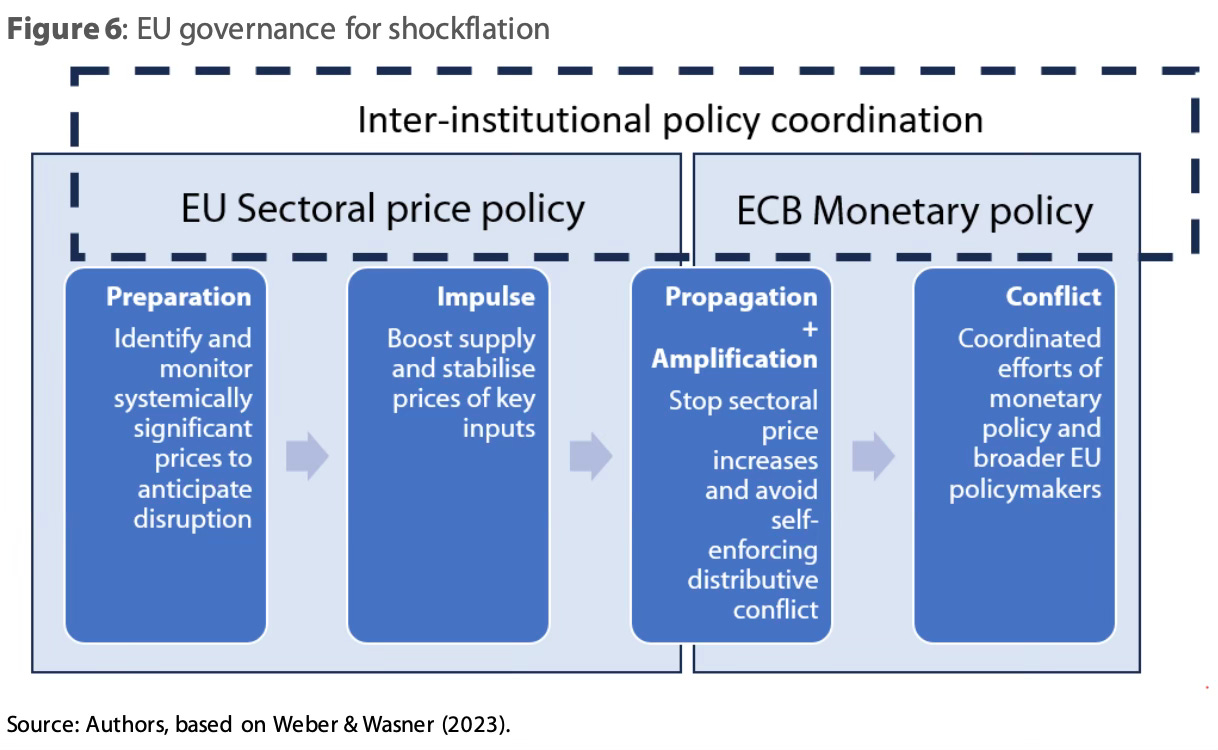
In a report to the European Parliament on how the EU should deal with shockflation (inflation unleashed by shocks to systemically significant prices such as energy and food), Jens van’t Klooster and Isabella Weber argue that the ECB’s monetary policy is inadequate and suffers from an “inflation governance gap”. They worry that the orthodox approach of tightening when faced with inflation from recurrent supply shocks will adversely impact the EU’s ability to meet its public and private investment requirements to combat climate change. They propose that EU “should develop a new inflation governance framework that targets shocks to systemically significant prices directly, before they are propagated through the economy”. Their summary is as follows:

Monetary policy has limited traction on firm price-setting, making it a costly and ineffective instrument to bring down consumer prices in a context of shockflation.

To stop firms from propagating and amplifying sectoral shocks, a new EU-level inflation governance framework should anticipate disruptions where possible and intervene as early as possible.

Eurostat and the ECB’s Datawarehouse should develop an enhanced price monitoring system. 

For essential sectors such as energy, food and critical raw materials, the Commission should coordinate Member State policies at the EU-level to avoid impulse shocks as well as boosting supply with physical buffer stocks, stabilising prices with virtual buffer stocks and capping prices when corrections of supply shortfalls and market overshooting are not sufficient. 

Competition policy to address price gouging and taxes on windfall profits to stop the proliferation and amplification of shocks should be implemented by the Commission and national competition authorities.

Coordination between the Council, the European Parliament and the ECB should serve to align inflation governance across the different sectors of the European economy.

Immediate monetary tightening to control inflation induced by supply shocks risks hurting investment, innovation, and productivity, thereby imperilling medium to long-term economic growth. Instead, there’s a need for close monitoring, using a heterodox toolkit of policy measures, supplementing with fiscal policy, and coordinating with the multiple stakeholders involved. All this should be wrapped up in a robust governance framework. 

The crux of the matter is the judgment of the trade-off between the medium-term inflation trajectory and economic growth prospects. Unlike the single-minded technocratic pursuit of a specific inflation target using only monetary policy levers, inflation management in the age of shockflations would involve the mobilisation of monetary, fiscal, and other instruments and would require the central banks to act in concert with governments. 

The political economy of inflation management centres on food, fuel, and housing prices. As climate change and geopolitical tensions rise, supply shocks on food and fuel are likely to become increasingly frequent and exogenous. When faced with inflation arising from supply shocks on those goods whose consumption is both inelastic and essential, apart from being blunt, monetary tightening can be counter-productive. In these circumstances, as much as experts will be displeased, it’ll be required to draw upon a much wider set of policy instruments - trade restrictions, buffer stocks, price controls, fiscal transfers etc. On the same lines, rent controls and minimum wages will have to be on the table to address housing affordability and wage stagnation. 

There are well-known dangers associated with the use of these instruments and it’ll be a challenge to pursue them without engendering distortions and excesses. But without them, we might not stand any chance of making a meaningful dent in the inflation problem. Worse still, the political economy of food and fuel inflation will anyways end up forcing the politicians into these instruments and that too with a damaging populist tilt. 

It might therefore be prudent to proactively engage with these instruments as a matter of policy. One way to limit the distortions and excesses with the use of these instruments is to lay down the principles on the triggers and boundaries for their use, how each should complement the other, and an institutional mechanism for their pursuit. Taking cue from van’t Klooster and Weber, it might be useful to have a governance framework for inflation management that clearly outlines the theories of change and channels of policy transmission, the triggers and scope of use of the different instruments, the roles of different stakeholders identified, and the institutional framework for its pursuit.

The effective coordination of all these instruments and stakeholders will be very difficult. But that should not detract from acknowledging these contributors to inflation and the need to address them. Doubling down on monetary policy levers without complementing them with the other instruments will only hurt the economy without controlling inflation. 

There's a need for a vigorous public debate on this issue. 

Finally, as an aside, Aswath Damodaran points out that a higher interest rate enables market discipline.

A market with a T-bond rate of 4 per cent is much healthier than a market with a T-bond rate of 1.5 per cent. People don’t feel the urge to do stupid things… the fact that the T-bond rate is 4 per cent is a good sign for the markets and for the economy. All this talk about “when will the Fed lower rates?” completely misses the point. This is where we ought to be.

I have blogged earlier questioning the wisdom of pursuing a 2% inflation target, one with limited objective and historical basis. Further, the 2% inflation target has distorted expectations by making monetary authorities implicitly pursue a lower interest rate and T-bond rate. But in the current circumstances, this pursuit of the 2% target (on inflation and interest rate) runs the risk of strangling economic growth and creating expectations that result in financial instability.

In fact, given the long struggle of central banks in developed countries to escape the zero-bound, the IMF and others have in recent times argued in favour of a higher inflation target or at least a wider inflation band. Further, the financial market distortions created by the long period of ultra-low interest rates are too well known to be reiterated. The current inflation scenario can therefore be viewed as a return to normalcy. 

Therefore, instead of targeting the lowering of the prevailing T-Bond rates, the time may have come for central banks to pause on its monetary tightening and lower rates but only to a level consistent with a new higher inflation target. Instead of explicitly outlining the higher target, central banks could allow the economy to adjust gradually to the new higher inflation level and thereby restore normalcy.