Substack

Monday, June 12, 2017

An SME development agenda

An excellent compilation of studies done by IPA researchers on interventions to support SMEs has several good ideas. But the vast majority of the studies focus on micro-enterprises, especially small traders, whose promotion while important, may actually be secondary to policies that focus on small and medium enterprises.

As I have blogged earlier, the problem with many developing countries like India is not lack of enterprises or entrepreneurship, but more likely an excess of them. There are too many small and unproductive, mostly run by family members, micro-enterprises, all of which exist in the informal sector. Worse still just a handful of them manage to grow beyond subsistence and create jobs. The vast majority of these people turn to such entrepreneurship only as a survival option in the absence of adequate wage employment opportunities.

Instead, as the "missing middle" research shows, one of the biggest economic growth challenges for developing countries is to get some proportion of their massive numbers of micro and small enterprises grow in size and create jobs. As the historical trajectory of growth shows, jobs are created when firms start small and formal and grow to become medium sized enterprises. So the focus of attention should be on the growth prospects of small enterprises to become medium sized ones.

The conventional wisdom on SMEs in developing countries is that they are constrained by difficulties in accessing credit and skilled labour, infrastructure bottlenecks, excessive bureaucracy and regulations, and high taxes. While these are undoubtedly important, their meaningful enough resolution is a longer game. Instead, a growing body of evidence points to how adoption of better management practices can help boost firm productivity by a quarter to a third.

Therefore, the biggest win in SME policy could be from supporting these firms with business development services. They would include adoption of accounting standards, better management practices (inventory and quality control, targets and incentives, monitoring frameworks etc) assistance in market access or linkage, help in preparation of technical documents for procurements, benchmarking quality and standards etc. 

It may be worthwhile to repurpose a share of the industrial policy allocations away from concessions and subsidies towards the provision of business development services as a public good. Governments can empanel consultants and service providers and offer to bear a share of the service fees. This would align the incentives of both the firms purchasing these services as well as those of the service providers. The support can be restricted to firms with certain number of employees and for a duration of 2-3 years for each firm.  

Such business development services have another crucial advantage over concessions and subsidies. The latter confer benefits which are completely privately appropriated and most often temporary. In contrast, business development services have significant spill-overs on the entire neighbourhood eco-system. Further, its benefits are not transient and more likely to be permanent and diffuse among the entrepreneurs, management, firm, and employees as well as generate spill-overs across the eco-system. 

Access to credit comes at or near the top of concerns for SMEs across the world. Government's have preferred to intervene heavily in enabling access by establishing SME financing institutions and providing concessional loans. But such policies may not have achieved their objectives given the near inevitability of political capture and cronyism. Consequently, they distort incentives and come in the way of the market test in accessing capital.

In the circumstances, the best that governments could do would be to create the enabling conditions for SME credit access. A critical contribution would be to facilitate the development of simpler mechanisms for credibly assessing the credit-worthiness of SMEs. Regulators should facilitate consolidation of data available with various institutions like banks and non-bank financiers, e-commerce platforms, mobile phone companies and so on to develop credit information companies. This should complement simplified credit application processes. At the macro level, mandating SME lending targets as a share of total bank credit supply may be necessary to ensure that SMEs don't get marginalised in the formal financial intermediation channels.

Other instruments, many of them validated by IPA research, include supporting the development of deeper networks among SMEs. They would include platforms to facilitate information sharing and co-ordination in areas of mutual interest among interested firms, as well as connecting firms to the eco-system of service providers.

Another potentially beneficial instrument would be to use public procurements to support SMEs. However, this would have to involve making changes to typical procurement policy (pre-qualification norms etc) that favours entrenched larger enterprises over new SMEs. 

Saturday, June 10, 2017

Weekend reading links

1. Excellent Times story on Andrew Left, an "activist" short-seller who makes his money identifying corporate frauds and publicising them, after shorting the company shares,
After he places a bet against the price of a stock, he then publishes research designed to torpedo the company’s value, often by airing accusations of fraud or abuse. This is entirely legal, as long as what he publishes is not itself fraudulent. Left takes short positions in companies across a whole range of industries — Tesla, Valeant, GoPro — and though he makes mistakes, he has an unusually high success rate... If you build enough of a reputation, all you need are some Twitter followers and a website. Left has emerged at the forefront of this new guard... Left invests his own, which exempts him from disclosing his holdings to the public. And now that his work has brought him national attention, he has found that others are willing to make it easier, by leaking documents to him and passing tips. In many cases, Left’s dossiers against his targets are not wholly his own but built using information from a confidential source. He is, in this sense, a bit like a journalist...


From 2006 to 2015, the number of activist short campaigns rose by 1,300 percent, to 1,289. In the past three years, the number of activist short-sellers working globally has nearly doubled, to 72 from 39. Very few have a positive track record. Left does. On average, the value of companies he writes about drop 10 percent in a year, and some drop as much as 95 percent... “I’m an investigative journalist who trades on his information”... Most of us do not care about a random pharmaceutical company meeting its debt covenants. We care about getting medicine at a price we can afford. We don’t care about organic versus inorganic growth, but we worry that our kids will have no coverage if the Trump administration repeals Obamacare. Left’s very timely gift is to connect our daily human concerns to the convoluted operations of the economy, wrapping financial analysis in a moral, populist language that is calibrated precisely to draw maximum attention in a media environment in which screaming is the only way to be heard.
2. Cesar Hidalgo pushes back at the dominance of economists in explaining economic development with what he calls post-neo-classical thought. He weaves together the pop works of Yuval Noah Harari (institutions, from religions to corporations, are shared imagining collectively constructed by humans), Joseph Henrich (human success is due to our ability to learn from others, and adapt and accumulate knowledge through generations), and himself (products matter because of their physical order or information obtained through the imagination of a collective group of humans) to develop a multi-disciplinary explanation for economic growth,
A better conceptualization of the role of imagination in the economy involves thinking of imagination in the context of, first, shared beliefs that help us coordinate our activities with others; and, second, the embodied information that allows products to distribute the practical uses of knowledge and know-how. Can we put these two ideas together? Since creating products is difficult, because making them requires more knowledge than what any single individual possesses, humans need to create networks to accumulate that knowledge and know-how. The creation of these networks is facilitated by the institutions and rituals described by Harari and Henrich but also by the products that we make, since many of these involve devices that augment our communication and transportation capacities. So by embodying imagination into the institutions that help us form cooperative networks, and by embodying imagination into the products that augment our capacity to interact, we expand the capacity of these networks and ignite economic growth. In fact, the diversity and sophistication of a country’s products accurately predict future economic growth—contrary to what neoclassical trade theory would predict, seeing products as epiphenomenal, rather than central to economic development.
3. Lawrence Mishel and Josh Bivens take on the robot scare-mongering, the Robot Apocalypse. They question the recent Acemoglu-Restrepo paper (which finds that six workers lose jobs for every robot per 1000 workers) claiming that the job displacements due to China trade-shock was four times the estimate of job loss through robots. Instead, they focus attention on the real problem at hand,
There clearly are serious problems in the labor market that have suppressed job and wage growth for far too long; but these problems have their roots in intentional policy decisions regarding globalization, collective bargaining, labor standards, and unemployment levels, not technology... We argue that the current excessive media attention to robots and automation destroying the jobs of the past and leaving us jobless in the future is a distraction from the main issues that need to be addressed: the poor wage growth and inequality caused by policies that have shifted economic power away from low- and moderate-wage workers. It is also the case that... our productivity growth is too low, not too high.
Their headline findings, 
Technological change and automation have not been the main forces driving the wage stagnation and inequality besieging working-class Americans. There is no historical correlation between increases in automation broadly defined and wage stagnation or increasing inequality. Automation—the implementation of new technologies as capital equipment or software replace human labor in the workplace—has been an ongoing feature of our economy for decades. It cannot explain why median wages stagnated in some periods and grew in others, or why wage inequality grew in some periods and shrank in others... There is no evidence that automation-driven occupational employment “polarization” has occurred in recent years, and thus no proof it has caused recent wage inequality or wage stagnation... wage inequality overwhelmingly occurs between workers within an occupation, not between workers in different occupations. So even if occupational employment polarization had occurred, it could not explain the growth of wage stagnation or inequality... There is no evidence of an upsurge in automation in the last 10 to 15 years that has affected overall joblessness. The evidence indicates automation has slowed. Trends in productivity, capital investment, information equipment investment, and software investment suggest that automation has decelerated in the last 10 or so years. Also, the rate of shifts in occupational employment patterns has been slower in the 2000s than in any period since 1940... The fact that robots have displaced some jobs in particular industries and occupations does not mean that automation has or will lead to increased overall joblessness.
And, their recommendation, 
Rather than debating possible problems that are more than a decade way, policymakers need to focus on addressing the decades-long crisis of wage stagnation by creating good jobs and supporting wage growth. And as it turns out, policies to expand good jobs and increase wages are the same measures needed to ensure that workers potentially displaced by automation have good jobs to transition to. For these workers, the education and training touted as solutions in the mainstream robot narrative will be inadequate, just as they were not adequate to help displaced manufacturing workers over the last few decades... The problems afflicting American workers include the failure to secure genuine full employment through macroeconomic policy and the intentional policy assault on the bargaining power of low- and middle-wage workers; these are the causes of wage stagnation and rising inequality. Solving these actually existing problems should take precedence over worrying about hypothetical future effects of automation.
I agree completely with the high-level point being made that robots and automation is becoming a fig leaf to gloss over taking action on fundamental structural features that have contributed to widening inequality and weak growth. The backlash we see in the form of Trump and Brexit, can be addressed only by taking these concerns head on. Unfortunately, the establishment sees the response in terms of band-aid solutions like Universal Basic Income (UBI). If we do not acknowledge and address the fundamental issues, do not be surprised if the house is burnt down. 

4. Finally, Kenneth Arrow's "cautious case for socialism" is hugely relevant for today. It resonates strongly with all my latent socialist instincts.
The idea, sometimes bruited about then, that unemployment was the fault of the unemployed—that they were lazy or incompetent or whatnot—struck me as laughable. I regret to say that this concept has been revived by some of my fellow economists... the insight Marxist theory gave into history and particularly as to political events was striking: the state as the executive committee of the bourgeoisie, the class interpretation of political and social conflicts, and the interpretation of war and imperialism as the conflict of competing national capitalist interests were illuminating and powerful. It appeared more profound than the alternative versions of the economic interpretation of history; they seemed to be mere muckraking, the behavior of venal individuals. Marxism put the system rather than the individual into the foreground... I did not accept ideas of historical inevitability. What the Marxist analysis did say to me, at least then, was that the system of production according to profit established vested interests in destructive activity, most especially war and imperialism, but also oppression of workers and destruction of freedom... the basic values that motivated my preference for socialism over capitalism were (1) efficiency in making sure that all resources were used, (2) the avoidance of war and other political corruptions of the pursuit of profits, (3) the achievement of freedom from control by a small elite, (4) equality of income and power, and (5) encouragement of cooperative as opposed to competitive motives in the operation of society.
This is strikingly reminiscent of today's capitalism,
Berle and Means’s The Modern Corporation and Private Property, which established not merely the concentration of the productive sector into large firms but also the concentration of control within those firms. Even the capitalist stockholders were deprived of power, if not wealth. The absorption of the economy by a small elite implied that the formal democracy and freedom was increasingly a sham; the major decisions on which human welfare depended were being made by a few, in their own interests.
On the concentration of income and political power in the capitalist,
A democratic polity is supposed to be based on egalitarian distribution of political power. In a system where virtually all resources are available for a price, economic power can be translated into political power by channels too obvious for mention. In a capitalist society, economic power is very unequally distributed, and hence democratic government is inevitably something of a sham. In a sense, the maintained ideal of democracy makes matters worse, for it adds the tensions of hypocrisy to the inequality of power... it is today a widespread doctrine, held by conservatives as well as socialists, that concentrated economic interests are more than proportionally powerful in the political process... The reasons offered are perfectly in accordance with ordinary economic principles; there are economies of scale in the political process, so that a small economic interest for each of a large number of individuals is less likely to get represented than a large interest by a small number. So long as the state power can be democratically run, much of this distortion of the democratic process should be minimized under socialism. Income inequalities should be greatly reduced. Economic power deriving from managerial control rather than income should be less easily translatable into political power than under a regime of legally and practically autonomous corporations. 
His doubts on the allocative efficiency of the market's price system is illuminating,
The central argument, which implies the efficiency of a competitive economic system, presupposes that all relevant goods are available at prices that are the same for all participants and that supplies and demands of all goods balance. Now virtually all economic decisions have implications for supplies and demands on future markets. The concept of capital, the very root of the term “capitalism,” refers to the setting-aside of resources for use in future production and sale. Hence, goods to be produced in the future are effectively economic commodities today. For efficient resource allocation, the prices of future goods should be known today. But they are not. Markets for current goods exist and enable a certain coherence between supply and demand there. But very few such markets exist for delivery of goods in the future. Hence, plans made by different agents may be based on inconsistent assumptions about the future. Investment plans may be excessive or inadequate to meet future demands or to employ the future labor force... In the ideal theory of the competitive economy, market-clearing prices serve as the communication links that bring into coherence the widely dispersed knowledge about the needs and production possibilities of the members of the economy. In the absence of suitable markets, other coordinating and communicating mechanisms are needed for efficiency. These come close to defining the socialist economy, although admittedly wide variations in the meaning of that expression are possible.
He makes the case for socialism based on the give values - efficiency, separating political decisions from selfish economic interests, freedom, equality of income and power, and the stress on cooperative as against individualistic motives. In particular, he argues that as long as state power can be democratic, the distortions of democratic process due to concentration of wealth and inequality, can be minimised under socialism. And the same with freedom and democracy. 

He acknowledges a representativeness bias with socialism - the empirical evidence of the negative contribution of Soviet style of socialism, with its authoritarian political system, is mistaken as the ideal representative of socialism itself. 

While he refrains from saying that socialism is superior to capitalism, he does point out that the co-existence of freedom and democracy, and equality of income and power is not only not the exclusive preserve of capitalism and is perfectly plausible under socialism, but also that capitalist dynamics that can come in the way of their co-existence.

His conclusion should serve as a reminder for ideologues from all sides, especially the free-marketeers,
The evidence, it seems to me, points to the view that the viability of freedom and democracy may be quite independent of the economic system. There can be no complete conviction on this score until we can observe a viable democratic socialist society. But we certainly need not fear that gradual moves toward increasing government intervention or other forms of social experimentation will lead to an irreversible slide to “serfdom.”

Friday, June 9, 2017

World economy fact of the day

Jesse Felder (HT : Ananth) points to this stunning graphic of relative valuations of equities and commodities, in the form of the ratio of GSCI benchmark commodities index and the US S&P 500. 
This should ring alarm bells among investors. Even discounting for the fact that past is no predictor of the future, the trend is striking. And there appears no compelling reason to argue that this time is any different. In fact, if we assume that the Trump Presidency and its foreign policy impacts on W Europe, Russia, China, and Middle East as foreign policy shocks engendering some of the largest uncertainty seen in decades, the volatility index has been remarkably stable during the current uptrend. 

It can be argued that by any reasonable sense of informed human judgement, equity markets today appear off-sync, both in its valuation and volatility. And among major economies, India has the second most expensive equity market after the US.

Thursday, June 8, 2017

PPPs in Railway Stations

The much awaited railway station modernisation and redevelopment on PPP is finally about to take off with the Habibganj station, near Bhopal. 

A few observations

1. This is a great opportunity to have Transit Oriented Development (ToD) by allowing much much higher FAR around the station than permissible under the local municipal laws which govern such developments. In fact, I would go ahead and propose FAR in double digits for these developments. Not only would this be sound urban planning, it would be even more attractive economics and politics. The positive impact of a huge number of residential and commercial units entering Bhopal's stock of such units can be very significant in making property affordable. 

2. The present contract promotes largely commercial development and prohibits residential usage. There are two major reasons for such structuring. One, these developments are most likely to end up as residential real estate projects. Two, commercial developments offer higher and stable long-term returns compared to residential units. 

But I think both these are disputable on several grounds and the concerns mitigated easily. For a start, apart from the poor infrastructure and its maintenance, the biggest problem with railway stations in India is safety and the public perception of areas surrounding such stations. Commercial use areas, active only during the day times, will only amplify these perceptions and likely turn these areas into uninhabited, crime-infested, soul-less zones. 

Instead, mixed use areas, with a significantly large share of built-up area allocated for different categories of housing, will only make these areas more liveable and attractive. Further, there should also be significant allocation for institutional facilities. In fact, mixed-use development will increase the commercial value of the commercial units themselves. 

More importantly, imagine a world of twenty years from now, when the greater Bhopal urban agglomeration would have developed with adequate rail transit connectivity, and traffic congestion would have peaked. The most efficient urban planning response to this most likely scenario would be to densify residential developments around important transit stations. This would enable people step out of their homes, board trains to commute to another location in Bhopal urban agglomeration, and walk to their offices within the railway station premises. 

In fact, it may be useful to limit parking space requirements for the residential developments so as to make vehicle ownership difficult. This has to be complemented with strict enforcement of parking restrictions around the railway station area, something which requires close co-operation with the local government. 

Finally, the concerns about the redevelopment getting converted into a higher end real estate development can be mitigated by having affordable housing mandates. A significant share, say a third, of all units should be reserved for affordable housing of 400-600 sqft. A costs-benefits analysis of a mixed use development would easily outstrip the net social benefits from a commercial-focused development. 

3. These developments should not have the first right of refusals or renewal rights on expiry of the lease. The case against such provisions is made here. While I have not read the documents, I would be surprised if both these options were not available. 

4. When we despair about government agencies working in silos, this is a classic example of Ministry of Railways driving a project which should have involved deep engagement with the Ministry of Urban Development. In an ideal world, the primary stakeholder in this should have been the Ministry of Urban Development. 

In fact, at the least, the Ministry of Railways should closely co-ordinate with the local government while establishing these facilities. The effective realisation of the objectives of such redevelopment plans is critically dependent on enforcement and other complementary measures, which are all with the municipal government.

5. Finally, each such railway station PPP projects are immense endeavours. Take the example of the numerous such projects in larger cities like London and smaller towns across European countries. They bring together all local stakeholders, have strong and empowered institutional arrangements to oversee the development, and strong and stable leadership. These developments are preceded by extensive stakeholder consultations and preparatory work. And the entire development itself takes more than a decade.

Instead, we have a national corporation to manage a large bundle of these projects, as centrally  managed projects, with limited local stakeholder participation, and with short implementation horizons.  

Update 1 (15.10.2020)

Article in Livemint about the ongoing tenders on the railway stations development on PPP basis.

Wednesday, June 7, 2017

How does executive visits to the White House affect firm prospects?

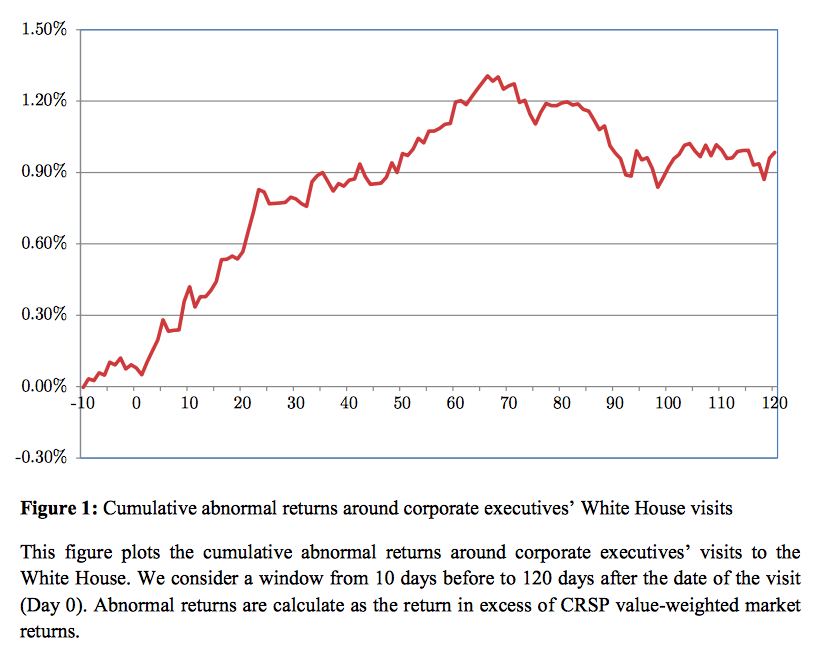
The Economist points to this fascinating study by Jeffrey Brown and Jiekun Huang which examined publicly available records of visits made by corporate executives to White House during the 2009-15 period and how it benefited the company. The benefit was measured in terms of the share prices of those firms, winning government contracts and regulatory relief in the aftermath of the visits. Their findings are unambiguous,
Consistent with money buying access, we find that political access is positively correlated with firms’ contributions to politicians’ election campaigns. We also find that corporate executives’ meetings with key policymakers are associated with positive abnormal stock returns. We further find evidence suggesting that following meetings with federal government officials, firms receive more government contracts and are more likely to receive regulatory relief (as measured by the tone of regulatory news). The investment of these firms also becomes less affected by political uncertainty after the meetings. Using the 2016 presidential election as a shock to firms’ political access, we find that firms with access to the Obama administration deliver significantly lower stock returns following the release of the election result than otherwise similar firms that do not have access.
The authors have taken great pains to isolate the selection bias confounders - the visitors were those with genuine problems and the visit led to the resolution of their problem, with attendant share price boost or bag the contract or get a favourable regulatory review.

They find that the shares of firms tend to outperform industry peers by 0.33% and 0.78% after 10 and 60 trading days of the meeting, with the outperformance being greater the more senior the White House host. Further, the average firm also generates $34 million in profit from incremental government contract volume due to the political access. In fact, they also find that about two-thirds of the increase in procurement contracts is due to non-performance based contracts and those which are awarded on a non-competitive basis, both more likely to be associated with higher rents, thereby suggesting that political access enhances firm value. Or cronyism is the contributor!

The roll call of frequent visitors included
The sheer scale of access to the highest office in the land is staggering. Even with the gravest existential problems, having such almost unfettered access to the White House is disturbing. At best, in very serious cases, the CEOs could have brought the matter to the notice of the President or his office and then engaged on substance with the respective Departments. Instead, here they have engaged directly with the highest office even on substantial processes and negotiations, bypassing the departments. 

Imagine the signals such frequent access communicate to everyone in the establishment. This is exactly what people mean when they talk about political capture and the attendant ability to make and game the rules themselves. The authors also point to some anecdotal evidence of how such influence pays, 
For example, a Wall Street Journal (2015) article claims that Google executives’ frequent visits to the White House were instrumental in Federal Trade Commission’s decision to drop its antitrust investigation of the company. As another example, commenting on the close ties between General Electric and the federal government, a Washington Examiner (2010) article notes that “Obama wants cap-and-trade, GE wants cap- and-trade. Obama subsidizes embryonic stem-cell research, GE launches an embryonic stem-cell business. Obama calls for rail subsidies, GE hires Linda Daschle as a rail lobbyist.”
Similarly, Goldman CEO Lloyd Blankfein had almost hotline access to the US Treasury Secretary and his predecessor, Mr Hank Paulson, during the peak of the sub-prime crisis. And this was at a time when Goldman was itself effectively bailed out. Or one ex-Goldman CEO using public money to bailout his successor!

If this were India, the knives would have been out and accusations of crony capitalism would have all over the place. Even when corruption is rampant, there is at least some pretension to prevent such unfettered official access. Just to highlight this reality, one of the important basis on which CBI field chargesheet against the former Coal Secretary, Mr P C Parakh is that Mr Kumarmangalam Birla, the Chairman of the Birla Group, and the accused in the case, met him in his office in the Ministry on an official meeting just before the decision on coal block allotment was made. 

For the record, Donald Trump has already declared that he will not be making White House visitor log public!

Monday, June 5, 2017

A cautionary note on India's infrastructure financing options

Indian Express reports that 18 months after its establishment in December 2015, the National Infrastructure Investment Fund (NIIF), which was to have sourced foreign capital for infrastructure projects, is still searching for both its first project and its first private, domestic or foreign, investor. 

The NIIF was registered with SEBI as an infrastructure fund, a Category II Alternate Investment Fund, to raise a corpus of Rs 40,000 Cr, with 51% coming from private sources, mainly pension, insurance, and sovereign wealth funds. It was the government's logical and technically correct response to the trend in infrastructure financing.  

But progress so far has been minimal. IE has a summary of the story so far, 
For the current financial year, the government has allocated Rs 1,000 crore as per Budget Estimates to NIIF. The government expects NIIF to raise Rs 8,000 crore from various sources to fund projects worth Rs 16,000 crore in the current financial year, according to the Output Outcome Framework for Schemes 2017-18. In the budget 2016-17, the government reduced the budgetary allocation for NIIF from Rs 4,000 crore as per Budget Estimates (BE) to Rs 1,000 crore in Revised Estimates (RE) for the same year. Of the Rs 1,000 crore allocation as per RE, the government transferred Rs 15 crore to the NIIF for the financial year 2016-17... for meeting the administrative/pre-operative expenses.
It is too early to pass any judgement on NIIF, especially given the difficulty of mobilising such resources, and even more so as a completely new institution. Why would domestic and international institutional investors and other limited partners prefer to give their money to NIIF over other more established infrastructure funds? Maybe it should leverage the advantages of its government capital and also differentiate itself by being able to better identify infrastructure investment opportunities in India. 

The most immediate opportunity in this regard for NIIF may be to raise resources to purchase some of the completed or close to completion stressed assets in steel and power sectors that are likely to be resolved and auctioned off in the months ahead. For example, NIIF could immediately explore options of floating two funds, India Steel and Power Funds, to raise capital for investing in these sectors. 

I also have three observations that relate to the broad issue of infrastructure financing for countries like India.

1. I have blogged here in detail laying down the evidence that inflows from such funds are unlikely to be significant. In fact, the annual dry powder available among all funds - infrastructure debt and equity funds, project finance bonds, and alternate investors like pension funds and insurers - for all developing countries (excluding China and the biggest Latin American countries), including India, are likely to be no more than a few billion dollars. 

Consider the numbers from the latest Preqin Report on global unlisted infrastructure fund raising for Q1 2017. In the year from Q1 2016, N America and Europe focused funds formed 84% of the total funds raised. All of Asia attracted just $8.7 bn, or 9.4%, the vast majority of which likely focused on China and E Asia. It is no different the coming year too. Of the 168 funds seeking to raise $102 bn funds, as on start of Q2 2017, an even smaller 7.4% are Asia focused funds. In fact, the investible dry powder available with all unlisted funds for all of Asia, as on March 2017, was just $16 bn. The vast majority of this would be sucked up by Japan and China, and few SE Asian projects, leaving just a couple of billion or so for countries like India. 
In general, unlisted funds are the predominant channel for institutional investors to invest in the infrastructure market. One can add a few hundreds of millions being deployed directly by some of the largest pension funds, especially those from Canada. I shall not at all be surprised if the largest share of such investment in India has gone into financing solar and renewables projects. 

In the circumstances, the ability of an entity like NIIF to use its expected public funding of $3 bn to leverage foreign capital may be limited. 

2. Such unlisted funds, especially in emerging markets, are very unlikely to finance greenfield infrastructure utility projects with all their significant and non-diversifiable construction risks. Their preference is more likely to be for commissioned assets, where construction risks are off-loaded, with attractions of stable returns. 

This may be a very good opportunity to securitise some of the functional infrastructure assets like tolled roads, power projects, steel plants and so on. 

3. Apart from infrastructure funds, the other major financing option that gets vigorously advocated in mainstream discussions is the bond market. Again as I have blogged earlier here, this too does not hold out much promise. Non-financial corporate bond issuances have been very small markets across the world, except the US. Capital markets are unlikely to be a major financier of India's infrastructure investment needs.

The bulk of such investments across countries, both developed and developing, come from plain bank loans. It is also for this reason that a quick resolution of the banking sector loans assume great significance. 

Sunday, June 4, 2017

Cash transfers in scale

Sceptics of cash transfers argue that the beneficiaries would fritter away the cash on temptation goods like alcohol and entertainment. But there is fairly strong evidence refuting this hypothesis. People, after all, behave as rational individuals and use the cash for their felt needs. 

But these are findings from small sample field experiments. In contrast, the findings of a real world scale cash transfer program is not encouraging. The Times points to a report by the Department of Agriculture which finds that the largest purchases by the beneficiaries of Supplemental Nutrition Assistance Program (SNAP), the $ 74 bn food stamp program that covers 43 million poorest Americans, are soft drinks, which accounted for about 10% of the dollars spent on food. The report concludes that a disproportionate amount of money was going to unhealthy foods,
Over all, the report found, SNAP households spent about 40 cents of every dollar at the grocery store on “basic items” like meat, fruits, vegetables, milk, eggs and bread. Another 40 cents of every dollar was spent on “cereal, prepared foods, dairy products, rice and beans.” Lastly, 20 cents of each dollar was spent on a broad category of junk foods that included “sweetened beverages, desserts, salty snacks, candy and sugar.” SNAP households spent 9.3 percent of their grocery budgets on soft drinks alone. That was slightly higher than the 7.1 percent figure for households that do not receive food stamps.
Now, it is possible that SNAP households would have, even without cash transfers, consumed more junk food. But that does not take away from the fact that SNAP households actually spend more on junk food than their non-SNAP counterparts. And it does pose worrying questions for those advocating the replacement of an in-kind food/nutrition security program with cash transfers. 

This is another reminder about the need for caution in interpreting the findings of field experiments.  It is likely that the scale dynamics associated with such transformations work in an unpredictable manner. In particular, the general equilibrium effects from a scale implementation can be very different from the partial equilibrium of a pilot.