It has always been a matter of debate that there may be a trade-off between building an enduring business and maximising short- to medium-term returns on those business investments. The private equity model of investment, it has often been argued, inclines to the latter.
I have written here about the incentive incompatibility problem when returns- maximising investors like private equity pursue infrastructure assets with their low but stable returns. More generally, when asset ownership and operation and maintenance are separated, and especially when the former is dispersed, the incentive distortions compound.
With headline returns capped by regulation, the PE investors must find alternative channels to squeeze more out of their investments. Leverage and asset stripping become the preferred strategies. The British water privatisation is only the most totemic illustration of these trends.
In this context, I have also blogged here and here, and here about the trend of rising PE investments in the locally operated regular consumer services — healthcare, education, residences, student housing, pet care, salons, mobile trailers, pubs, home repair services, etc. In all these cases, incentive distortions similar to infrastructure have now been widely documented.
The strategy in all these cases is to target service-based businesses with long-term demand (especially those requiring O&M, and the possibility of subscriptions and service contracts), aggregate or roll up small local providers, and centralise their operations to harvest economies and efficiencies of scale. On top is the purchasing (and bargaining) power with suppliers and customers. And on the bottom-line side, undertake aggressive cost-cutting and asset stripping.
On the financial side, the strategy is to harvest the scale arbitrage — acquire a large enough regional or sub-regional entity at 6–8x EBITDA, add 10-50 more smaller entities at 5–7x, centralise back-office and procurement, load up debt, and exit the consolidated entity at 10–12x before the consequences of cost optimisation show up on service quality. The primary driver of returns is less operational improvements, but the arbitrage of paying small-company multiples and selling at large-company multiples. This is financial engineering applied to a captive demand. The new buyer, in turn, would be motivated by another business model for the same business.
There is also the tension between building long-term sustainable business and the pursuit of short-term returns maximisation. In other words, long-horizon value creation trades off against short-horizon, leveraged returns maximisation. It is like the comparison between a business that earns a steady 8% over 30-40 years, and another that targets 15% over 7-8 years in addition to the 2:20 fees.
In short, the PE model’s problem appears to be that it seeks to maximise returns within a hold period that is too short to bear the consequences of its own cost optimisation. This causes a temporal mismatch — returns are harvested before the deferred maintenance, staff morale declines and attrition, community erosion, and quality degradation.
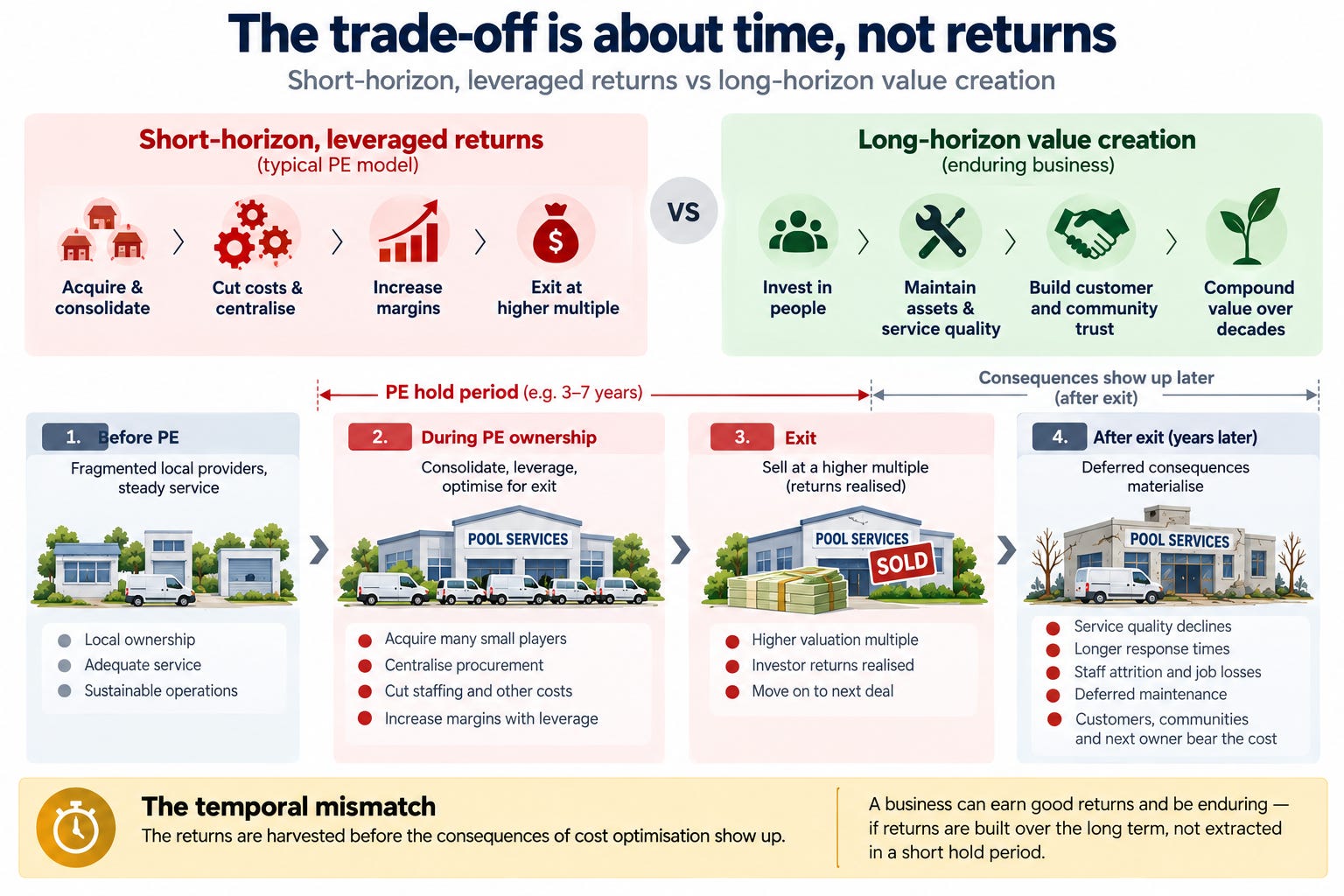
Apart from the adverse impact on the quality of service delivery, there are also the negative externalities ranging from a change in the ownership of local businesses (with disruptive impacts on local communities) and increased prices of services, to bankruptcies and closures with attendant job losses. So much so that private equity has become a lightning rod for rising housing prices in the US mid-term elections.
FT has an article that points to PE firms buying up swimming pools in the UK and offering maintenance services.
Private equity-backed swimming pool “platforms” have been buying up hundreds of local builders and repair services. The goal is to create national scale in an industry dominated by pint-sized companies. SPS Poolcare and Pool Troopers, two of the largest consolidators, between them bought more than 200 businesses before merging themselves earlier this year. Main Street Capital, a small listed private equity firm, has marked up the value of its equity holding in Cody Pools sevenfold since buying in at the height of the coronavirus pandemic.
The trend might sound surprising to anyone focused on public markets, where many investors ended up deep underwater after a wave of enthusiasm crested in 2021… while buying a pool is about as discretionary as it gets, upkeep on an existing pool is not. There are north of 10mn installed in the US, and they all need regular cleaning and repair. Servicing businesses can therefore offer the sort of subscription-like revenue that buyout firms love. And although construction is in a cyclical slump, there are reasons to expect longer-term growth as climate change makes outdoor pools attractive in more areas.
This mirrors PE investments elsewhere in retail. The FT article writes
Compare the heating, ventilation and air conditioning sector, where there have been more than 1,100 acquisitions since 2020, according to data from Capstone Partners. Mid-market specialists have had success rolling up small companies until they create a group big enough to appeal to bigger buyout specialists, as shown by Blackstone’s $2.5bn purchase of Champions Group earlier this year. Pools are just one riff on a wider home-enhancement theme. Other firms are trying the same playbook with trades like garage doors, pest control and plumbing.
The trajectory outlined above is largely a narrative formed by observations. What does the evidence say?
I have written extensively on infrastructure, consolidated here. See also this recently. The sector with the largest and most conclusive empirical evidence base, and at least less than positive impact of PE is healthcare. In a systematic review in The BMJ, covering 55 studies from 2000-23, Alexander Borsa and others found definitive evidence. Of the 27 studies assessing quality, 21 found harmful impacts; of the 12 studying costs to patients or payers, 9 found increased costs, and none found decreased costs; and of the 8 studying health outcomes, 3 found harmful, 2 beneficial, and 3 neutral impacts.
This mirrors findings across the segments in health care. Atul Gupta et al, found that PE ownership of nursing homes raised short-term mortality by about 10% or about 20,000 additional deaths over the sample (1,674 PE-owned nursing homes from 2000-17, and covering 4.2 million patients), increased spending by 11%, reduced nurse staffing, and decreased compliance with care standards.
On dental practices, Kamyar Nasseh et al, found that PE-acquired dental practices raised list prices by 3.3%, and shifted procedure mix from preventive toward higher-reimbursement restorative, specialty, and surgical procedures. Sailesh Konda and Joseph Francis showed that PE-owned dermatology practices saw 4.7–17% more patients per dermatologist, raised prices for routine visits by 3–5%, and employed four advanced practitioners per ten dermatologists (vs three in non-PE practices).
In the most dramatic evidence of revenue-maximising treatment intensity replacing clinical judgment, PE-managed neonatology practices were associated with 70% higher common NICU days and 54% higher physician spending. Finally, this study by MIT Sloan found that negotiated prices between hospitals and insurers rose 32% after PE investment. It also found that PE firms burden acquired health care organizations with unmanageable debt, stealthily decrease health care competition, often increase costs for patients and payers, can compromise patient care, and can harm health care workers and providers.
Its findings and recommendations are striking:
Private equity firms’ focus on short-term revenue generation and investor profit also can lead them to strip acquired facilities of their assets, force those entities to raise prices through anticompetitive practices, reduce staffing to dangerously low levels, avoid investment in critical infrastructure, and eliminate vital services—to the detriment of patients, workers, and entire communities… Policymakers must take steps to safeguard the health care system against harmful private equity practices by enhancing regulatory oversight over health care acquisitions, rolling back reporting exemptions on financial transactions in private markets, and changing the incentive structures to limit private equity firms’ interest in engaging in financially risky behaviors that run counter to the public interest.
The empirical evidence in other consumer services is thinner, perhaps only because of lack of studies. There is no peer-reviewed equivalent of the Borsa review for HVAC, pool services, pest control, pubs, pet grooming or salons. This will change in the years ahead as PE ownership in these businesses surge.
However, in all these cases, there are several anecdotal and journalistic examples of high-profile failures. They are most likely a good representative sample of the general direction of impacts from PE in those market segments. But in the absence of empirical evidence, supporters of PE will continue to argue in their favour.
This cannot detract from the emphatic finding that the distortionary impacts of PE ownership of businesses are documented wherever the research has been done.
As with all such debates, the reality is perhaps more nuanced. The evidence from competitive, non-essential service markets like manufacturing, technology, and business services is mixed. For example, Steven J Davis, John Haltiwanger, and others have found that PE-owned manufacturing plants had higher productivity growth.
I can think of some determinants of a business that increase the likelihood of incentive distortions. One, a service where quality is hard for the buyer to observe at the point of purchase creates perverse incentives. Two, the nature of these kinds of consumer services calls for stewardship and trust, which are most often overwhelmed by market incentives. Three, captive or sticky demand arising from switching costs, essential need, or geographic lock-in, is another factor that encourages market abuse. Four, there is a moral hazard arising from a regulatory backstop or a third-party payer that socialises costs. Finally, a short holding period allows the owner to exit before the consequences of underinvestment show up.
Healthcare and infrastructure are vulnerable to all these determinants, and others in varying combinations and degrees. The evidence is strongest in healthcare, and the same structural incentives apply wherever the determinants are met. However, the absence of evidence elsewhere reflects the absence of research, not the absence of harm.
All this comes in addition to questions on the financial side too, about the superiority of PE as an investment strategy. I have blogged earlier here and here about Ludovic Phalippou’s extensive research on PE returns (here and here). Across three large datasets for the period 2006-20, PE funds delivered net Multiple of Money (net-of-fee) of ~1.55–1.63x, or about 11% annually, matching public equity indices in the same period. During that time, roughly $230bn in carry accrued to a small number of managers, with the number of PE multibillionaires rising from 3 in 2005 to 22 by 2020. Much of the apparent outperformance, he shows, came from choice of benchmark rather than from the returns themselves.


No comments:
Post a Comment