Substack

Monday, April 21, 2025

More thoughts on corporate India

Over the years, I have blogged numerous times, highlighting corporate India’s singular failure to create world-class companies and products. This describes a scorecard of corporate India over the last three decades. 

This failure is now being ventilated by government officials and corporate leaders themselves. See thisthis, and this

Nothing manifests this failure more starkly than the IT industry. There’s a compelling argument that, despite all its acclaimed successes, India’s software industry will also be seen in economic history as a canonical example of stagnation and failure to move up the value chain. Thanks to a fortuitous confluence of factors, India gained a head-start in the software industry, an industry at the cutting edge of technology innovation. It even had large multinational companies with the finances and talent to become global leaders in the industry. Further, in the last two decades, the industry has spawned technologies with transformative potential - SaaS, IoT, cloud computing, automation and robotics, data analytics, and now a general-purpose technology, AI.

The industry could have become the springboard and platform for innovation and productivity growth, and for taking the economy to the next frontier. It could have become the anchor for the mass flowering of an ecosystem of technology startups that would be pursuing cutting-edge innovation. 

Unfortunately, India’s large software firms have foregone all these opportunities and preferred to stay attached to low-value, manpower-intensive services. They could have capitalised on their industry headstart to move up the value chain and become innovative product companies. They could have provided India with the invaluable anchor around which R&D and innovation could have flourished. Instead of breaking out and leading the way for the rest of corporate India, they have fallen prey to the country’s dominant corporate culture. 

Anuj Bhatia has a very good article on where India’s software firms lost their way and failed to capitalise on their head-start and contribute more meaningfully to national economic 

Take a look at India’s biggest tech companies. They are all ‘services’ companies, like Tata Consultancy Services, Infosys, and Wipro, and have nothing to do with the creation of IP. They essentially acquire clients and do coding for them at a cheaper cost, primarily handling maintenance work. They are not developing software or platforms that they sell to consumers or enterprises. Ask anyone who works for TCS, and they will tell you the difference between working for a services company and a product-facing company like Google. A lie has been sold for years that TCS and Infosys are software companies. However, in reality, US tech companies lead in software, including the likes of Microsoft, Oracle, Salesforce, Adobe, and Google. While India’s services companies may create jobs, they don’t drive innovation, and they certainly don’t position India as a tech powerhouse in the future.

And this is about the importance of IP

It all comes down to intellectual property, and India certainly isn’t an IP-based economy. Intellectual property is the most prized possession a tech company or startup could have… IP can protect you from competitors using your tech, giving you a competitive edge, securing funding, and even safeguarding you from being acquired by a large company. Take Apple’s iPhone, for example. The iPhone’s design, software, product name, concepts, patents, copyrights, trademarks, and trade secrets all fall under IP. Some may say the iPhone is a smartphone, but Apple never calls the iPhone a smartphone, and the reason is… well, the iPhone is a platform. That means Apple has exclusive rights to the platform and can expand it, create new products, develop solutions, tweak software algorithms, or make changes to the manufacturing processes whenever it feels. Hence, Apple protects its intellectual property, which is why the company’s top lawyer, Kate Adams, Apple’s General Counsel, earned a compensation of $27.2 million last year.

Similarly, Android is a trademark of Google, and that’s how the company controls the smartphone market being the owner of Android and Play Store. While Apple follows a closed model with iOS, the software powering the iPhone, Google gives Android for free to any company but charges a licensing fee to use the “Google Mobile Services” suite of apps, which includes the Google Play Store. Nintendo, too, is sensitive about its IP, which includes the characters, franchises, game titles, logos, and designs associated with its video games, such as Mario, Zelda, Pokémon, and Animal Crossing, among others… The point is, without intellectual property, patents (for example, Apple filed 5,000 patents for the technologies that contributed to the development of its Vision Pro headset), and a mechanism to protect your IP, it is hard to create a tech company with a foundation based on original ideas and creativity. And these are areas where India lacks in both aspects. This is why we have not seen an AI research lab like OpenAI in Bengaluru or a product like the iPhone emerge from India. All of this is because we never tried to develop the technology or take risks.

The article also makes a point about claims of India attracting tech companies.

We always talk about how big the market is and why tech companies are setting up shop in India. Of course, any major tech company would like to come to India: a) to access the large talent pool, and b) because there is little competition from local tech companies. However, the same tech companies face a lot of competition in China, where they are barred from doing business and have often failed to compete with local companies. But China itself has created its own unique tech ecosystem (take WeChat, TikTok, and how Huawei has finally ditched the Android mobile operating system for its own proprietary, HarmonyOS, for example), and that has helped it gain technological know-how to power its economy and challenge the geopolitical order…

Until we own platforms—be it on the hardware side, software, or cloud—and build the ecosystem, our tech companies and startups won’t be able to transform into tech giants. India Inc. may be keen on collaborating with US tech giants (and that has been the case for years), but that doesn’t change India’s position in the tech world. No tech company (or country, for that matter) would want to share its trade secrets with others—think of formulas, IPs, research and data, and algorithms.

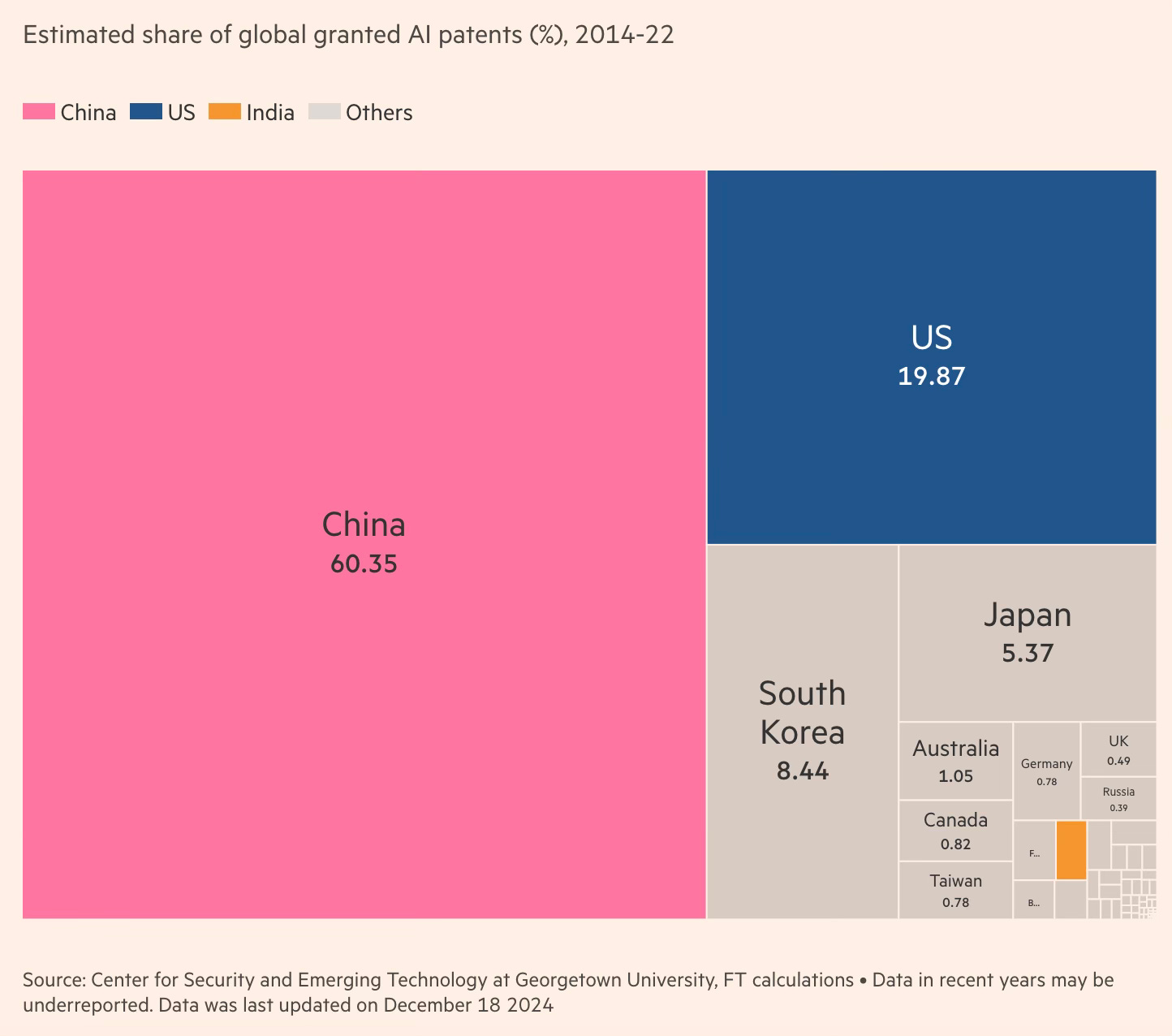
In this context, it’s not surprising that India’s share of global granted AI patents was an abysmally low 0.22%, far below even countries like Australia, South Korea, Cananda, and Taiwan. 
Of the $43 bn worth of AI investments globally in 2024, India got just $179.3 million. The Indian technology majors’ investments in AI pale into insignificance before the US Big Tech and Chinese firms. 

On similar lines, I have written earlier on our disappointing startup landscape. Forget cutting-edge innovation, they have struggled to meet any of the several development problems that a country like India faces. 

It remains to be seen how the much hyped Edtech unicorns will go beyond marginally improving the learning environment of a tiny sliver of students from middle-class families to helping improve the massive problem of poor learning levels that affect more than 90% of Indian students. Or whether Agtech firms will address any of India's several agriculture sector problems. Or the biotech and medtech companies will address the problem of access to affordable and good quality health care for more than 80% of Indians. Or whether the fintech companies will help address the problem of improving financing intermediation by increasing access to mass-market financial products and increasing India's financial savings, besides making formal finance mainstream for the 80% of the labour force working in the informal sector. Or ensuring access to finance simple for businesses in the informal sector. Or whether, like Alibaba's rural Taobao's, India's e-commerce sector has significantly improved market access and incomes in the aggregate to small manufacturers and traders.

It’s difficult to identify startups that have managed to break into the top echelons or have the promise to do so in areas like cloud computing, IoT, AI, data analytics, robotics, quantum computing, chip design, etc. 

Instead, India’s startups appear content to follow the footsteps of the IT firms and focus on the simple, low-hanging fruit of copying consumer-facing services like e-commerce and media. 
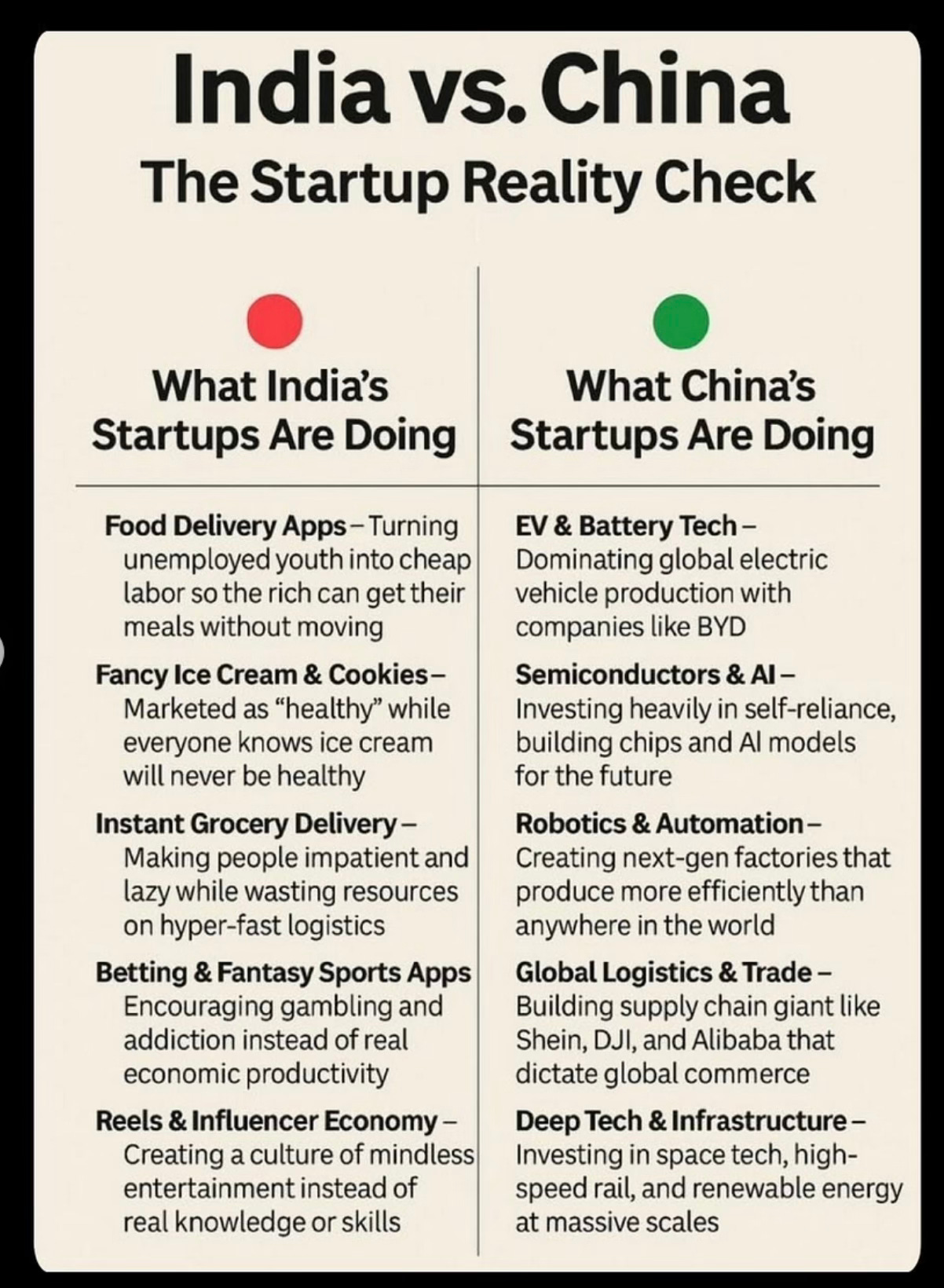
Just 5% of Indian startup funding went into DeepTech sectors, compared to China’s 35%. Semiconductor chip design, for example, has attracted just about Rs 200 Cr each in the last two years. 
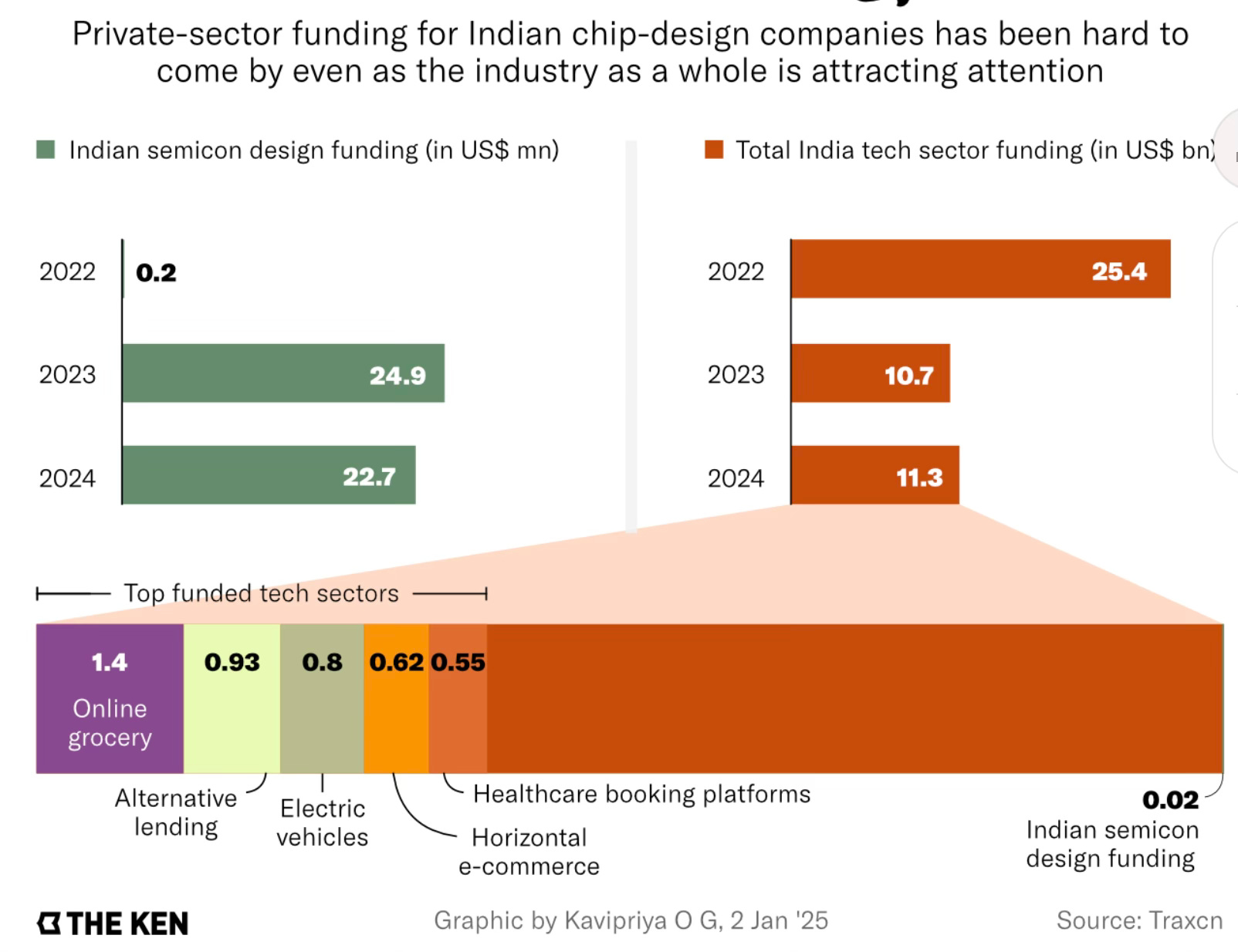
Of the $2-3 bn or so of VC capital raised from India-based investors (data is very difficult to get, and most likely is even lower), very little went into these risky and innovative areas. This low level of funding of riskier areas like deep-tech belies the optimism that the first generation founders and investors from the large and growing number of unicorns and decacorns would plough risk capital into these cutting-edge areas as in Silicon Valley. They have instead preferred primarily public markets and secondarily only the derisked and safer areas like consumer technology, healthcare, real estate and infrastructure

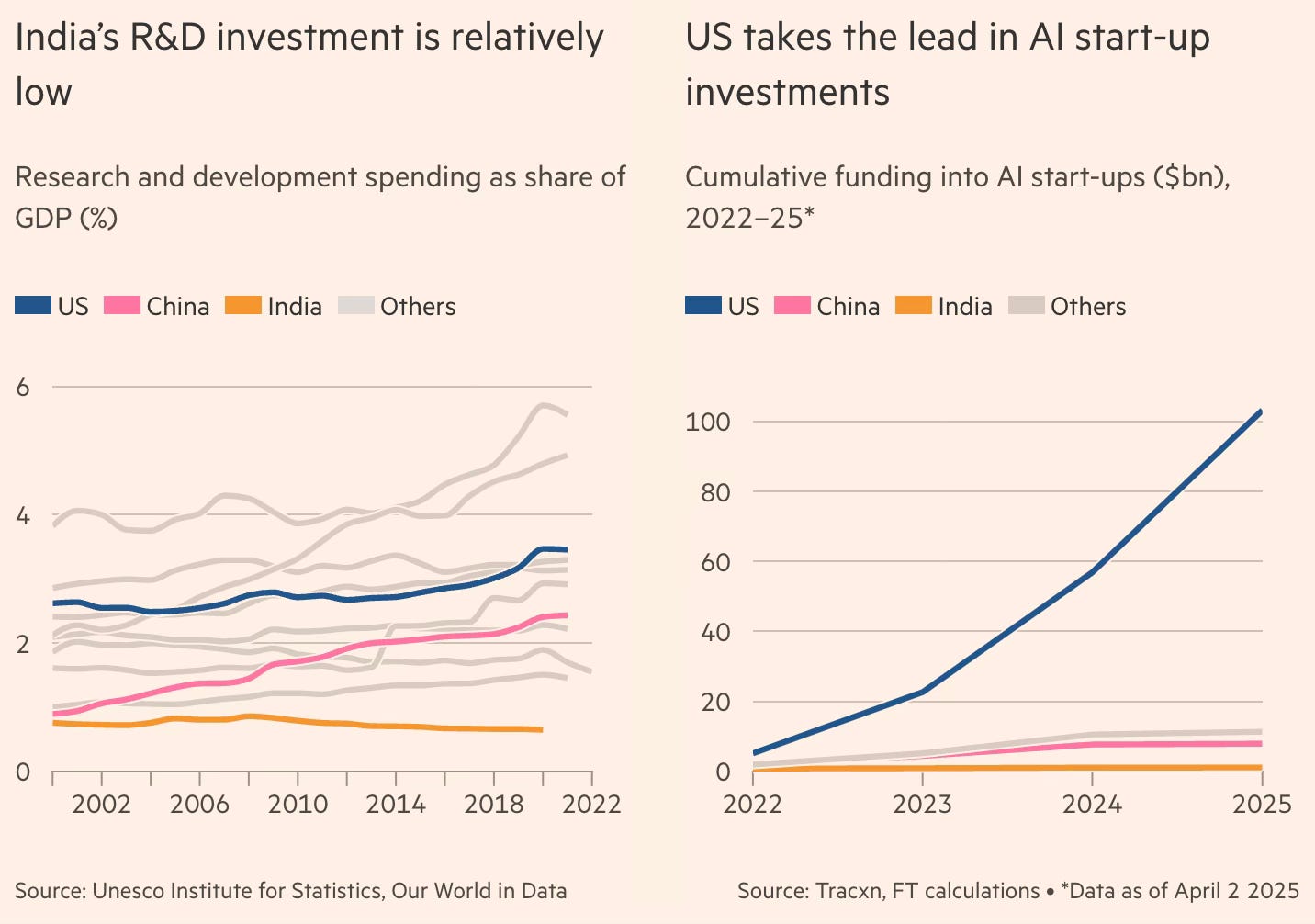
This is also reflected in the aggregate corporate expenditures on R&D, a topic on which I have blogged here recently. India’s gross expenditure on R&D is less than 1% of GDP, far behind the US (3.5%) and China (3.4%). Further, it has been falling continuously since peaking at 0.86% of GDP in 2008 and stood at a long-term low of 0.65% in 2020. The cumulative funding that went in AI startups in India in the 2022-25 period was just $1.09 bn, compared to $7.89 bn for China and $103.21 bn for the US. 
This disappointing reality is also reflected across sectors. Take the example of consumer durables manufacturing. 

The Ken has an article exploring the air conditioner manufacturing industry in India. With rising temperatures, ACs, once considered a luxury product, are now a necessity. Reflecting this, AC sales have been growing at around 20%, double that of other home appliances, and are estimated to be 12 to 12.5 million units. The Rs 27,500 Cr ($3.3 bn) industry is expected to double. 

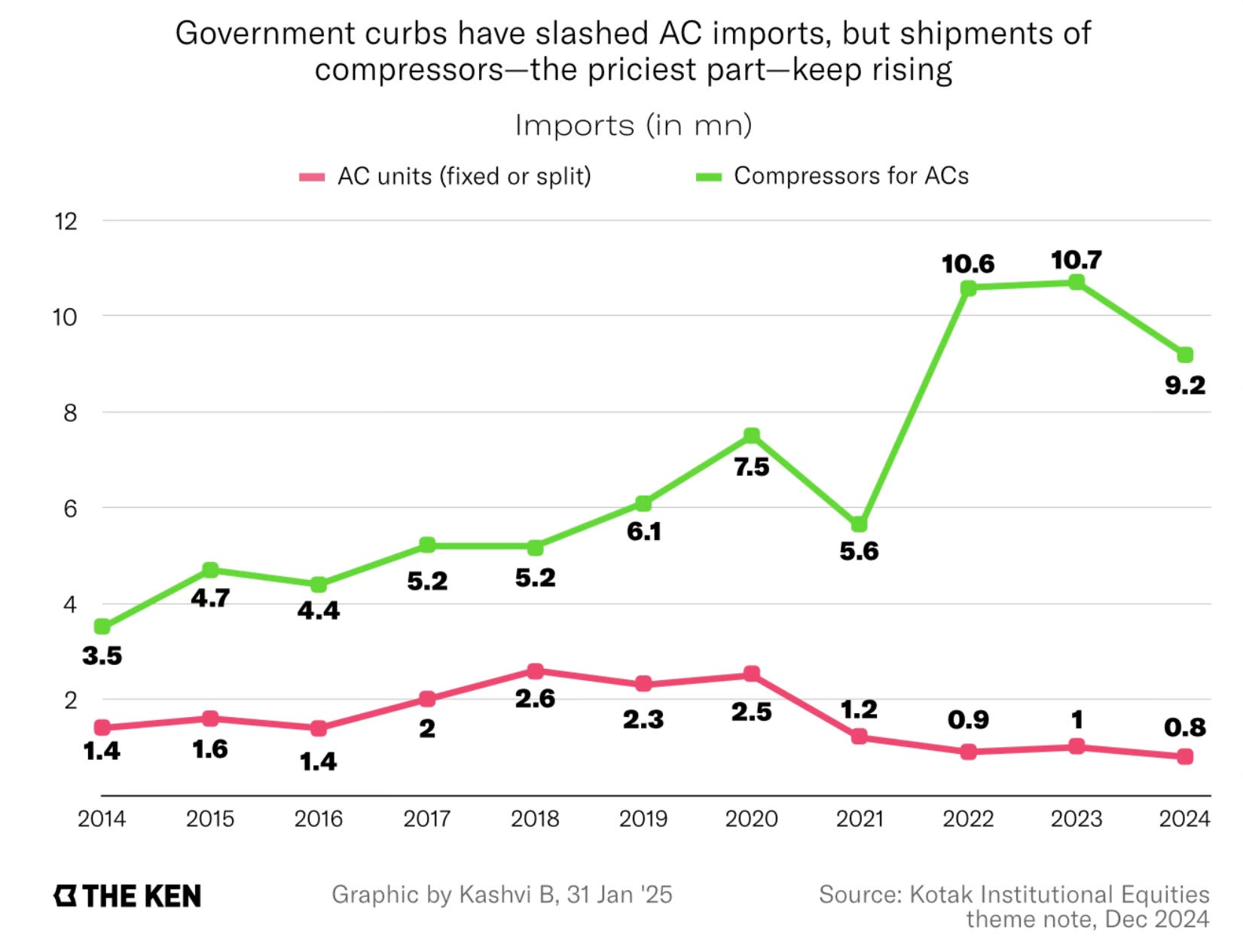
The market leader is Tata-owned Voltas, followed by others like Blue Star, Daikin, Lloyd, LG, Godrej etc. Despite the PLI scheme for white goods launched in 2021, more than 60% of the AC components are imported. In fact, 65% of the compressors, which makes up 30% of the product cost, are imported from China. 

The three main domestic contract manufacturers are Blue Star, Amber Enterprises, and PGEL. Compressors are manufactured by just four companies - Guangdong Meizhi Compressor Co. (GMCC, a Midea Group company), Highly India, Daikin, and LG Electronics. The first two are Chinese and the others are Japanese and South Korean. 
The uptake in PLI for compressor manufacturing was confined to just two companies - Daikin and LG. Voltas joined only in the third round with a Rs 256 Cr investment. Godrej and Havells, the other big domestic brands, skipped PLI completely. Others focused on the cheaper, lower-value components like heat exchangers and plastic moulding.

Like with most others, the unsatisfactory response to domestic manufacturing of compressors and components has to do with the Chinese competition. Even with higher import duties (it has gone up by 19% over the decade), importing them from China is still cheaper than making them in India. In particular, high-value components are not incentivised by small sales incentives. The article mentions that “localising production would be at least 25% more expensive than relying on Chinese imports.”

In this context, an oped in The Indian Express by Anand P Krishnan compares the private sectors of India and China and points to how they have taken the lead in the latter in national economic growth. 

According to China’s State Administration of Market Regulation, as of 2024, there are over 55 million private companies in the country. The private sector accounts for over 50 per cent of tax revenue, over 60 per cent of GDP, over 70 per cent of technological innovation, over 80 per cent of urban employment, and over 90 per cent of the total number of enterprises (in comparison, India’s private sector has a share of 36 per cent in tax revenue, 91 per cent of GDP, 36 per cent in technological innovation, 11 per cent in employment, and over 95 per cent of the total number of registered enterprises).

He writes about how the Chinese firms have leveraged their strategic advantages to strngthen their roles. 

Chinese private companies, with their sleek and sophisticated products, have been able to connect with global consumers and are pivotal entities in building an ‘industrial diplomacy’ – to borrow the phrase from sociologist Kyle Chan – to reshape global production networks and make them centred around Beijing. This is visible in a range of modern sectors and industries, that are qualitatively superior and critical in a technologically interconnected world, such as Electric Vehicles, consumer electronics and digital gadgets, lithium batteries, and solar panels. Chinese private companies form vital nodes in global supply chains in these industries, and their inextricability is used by Beijing for competitive advantage. Through these companies, China has remained attentive to building backward and forward industrial linkages – making components and specialised machinery, along with developing skilled personnel with the technical know-how – and holistically dominates the wider ecosystem while also guarding against the sharing of technology. The ability of Chinese smartphone companies to endure and build a loyal consumer base in a country like India (given the hostile geopolitical equation) is a testament to their adaptive capabilities.

All this necessitates deep introspection within corporate India about its role in economic growth.

Friday, April 18, 2025

Weekend reading links

The basis trade focuses on the price difference between Treasury bonds and futures contracts tied to those same bonds. Sometimes the price of a bond futures contract rises above the underlying bond price because of heavy futures purchasing by pension funds, insurance companies and other institutional investors. These asset managers often prefer to buy bond futures instead of the bonds themselves because futures require less cash upfront. To take advantage of the price discrepancy, a hedge fund will sell Treasury futures and simultaneously buy the corresponding lower-price bonds. By buying cheaper bonds in one market and selling expensive ones in the other, traders can profit from the small price differences, whether bond prices go up or down. 

The profit from these price differences is so tiny — as little as a small fraction of a penny — that traders typically borrow a lot of cash to multiply their bets. What makes this strategy risky is the combination of hedge funds’ heavy borrowing to execute the trades — as much as $50 borrowed for every $1 of their own capital that they’re investing — and a heavy reliance on short-term borrowing in particular. US Treasury bonds are normally considered low-risk investments because they are backed by the full faith and credit of the US government. But a sudden disruption to financial markets could cause short-term borrowing costs to skyrocket. When that happens, hedge funds are forced to repay the loans and dump Treasuries to unwind the basis trade. That could cause Treasury markets to seize up, and the resulting higher bond yields could ripple through the financial markets, raising the cost of everything from corporate borrowing to home mortgages.

2. Three graphics that capture the challenges that the US will face in rapid decoupling from China. This shows the US dependency on imports from China.

This shows the high level of dependency on China for electronics.
Abrupt decoupling will be painful.

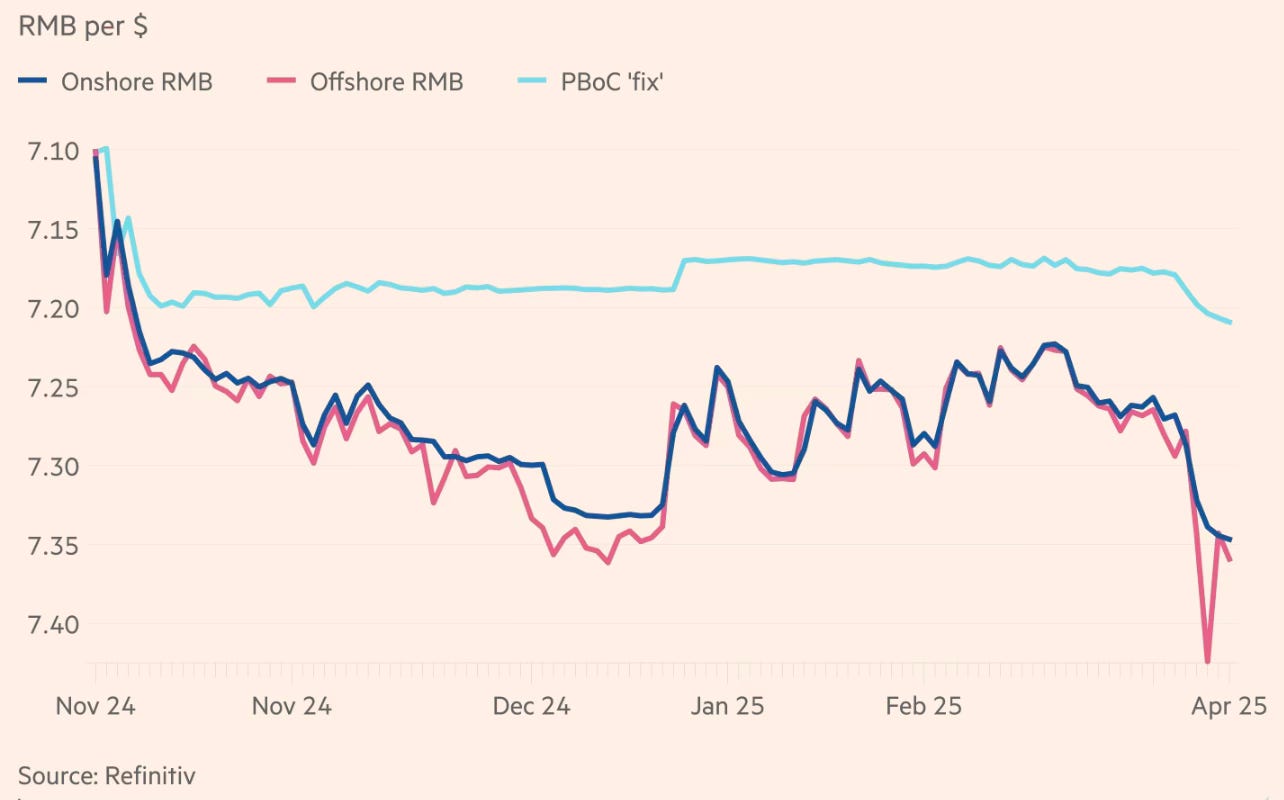
3. China has responded to the Trump tariffs with its tit-for-tat retaliatory tariffs. Apart from this, it has also opened the door on exchange rate response, allowing the renminbi to weaken against the dollar. The offshore renminbi has hit a 18-year low. The onshore renminbi is subjected to a band that restricts moves beyond 2% per day. 

4. Meanwhile, Stephen Miran has expanded on his proposal for an accord with trade partners where they agree to pay for the US security umbrella and access to the large US domestic market. He has outlined five options available with other countries for burden sharing. 

First, other countries can accept tariffs on their exports to the United States without retaliation, providing revenue to the U.S. Treasury to finance public goods provision. Critically, retaliation will exacerbate rather than improve the distribution of burdens and make it even more difficult for us to finance global public goods.

Second, they can stop unfair and harmful trading practices by opening their markets and buying more from America;

Third, they can boost defense spending and procurement from the U.S., buying more U.S.-made goods, and taking strain off our servicemembers and creating jobs here;

Fourth, they can invest in and install factories in America. They won’t face tariffs if they make their stuff in this country;

Fifth, they could simply write checks to Treasury that help us finance global public goods.

5. Michael Moritz makes some important points on the basis of China's manufacturing prowess.

Since the 1970s, China and countries in south-east Asia have perfected a formidable triple axle comprised of the command of raw materials, mastery of component manufacturing and packaging, and now — by dint of drive, creativity and a formidably well-educated cadre of scientists and engineers — an array of products that put the west to shame. Just look at the manufacturing knowhow of Foxconn and TSMC and the product line-up of companies such as Huawei, BYD and Xiaomi — the last of which is only 15 years old. They are enough to make Americans weep. And that’s before you calculate the size of their workforces or contemplate that about 450,000 cars were built in China in 1987 compared with 31mn in 2024.

6. Italian cheese facts of the day

The US imported €7.8bn worth of Italian cheese, olive oil, wines and other delicacies last year... parmesan cheese... is produced in regulated quantities in Italy’s Emilia-Romagna region. Producers there must adhere to 17-pages of strict rules that even dictate what cows can eat — and where their fodder is grown. The Parmigiano-Reggiano consortium allocates coveted cheese quotas to local dairies, polices the process and has to certify cheese as genuine and up to standard.

7. Important graphic on Indian middle class incomes.

8. India's manufacturing is a very big outlier in declining as the economy grows. 


9. Wall Street is also worried because the Trump trade wars may deal a fatal blow to the march of American financial institutions
For the past 15 years, the big US banks and money managers have been on the march... Goldman Sachs, JPMorgan, Morgan Stanley and Bank of America each captured at least 5 per cent of last year’s global investment banking fees. The top European bank, Barclays, pulled in just 3.3 per cent... In some quarters, BlackRock has recorded more inflows than the entire European asset management industry combined. Americans also dominate the custody market, holding four of the top five slots. All of them benefited from a vibrant US economy, deep capital markets, and the fundamental appeal of American equities and bonds to international buyers... 

But just when American finance was looking unstoppable, Trump pulled out the rug. His aggressive “liberation day” tariffs, followed by a partial 90-day pause, sent the markets into a tizzy. Other belligerent policies, including threats by his advisers to weaponise finance, are forcing overseas companies and governments to question their dependence on US financial institutions and their use of Treasuries as a standard risk-free asset. Foreign firms are reconsidering their US ties, looking for local service providers and making contingency plans to issue debt in home currencies rather than the now-less stable dollar. Governments are shedding their laissez-faire attitude to US dominance in technology and banking... The lack of European alternatives to Google, Microsoft and the like make it hard to reduce dependence on US technology, but financial services are a different story. European banks are not as big or as globally feared as the Wall Street beasts, but their top employees are experts at raising funds and closing mergers. Even before Trump set world markets on fire, Swiss lawmakers had raised concerns about the wisdom of using a US bank as custodian for SFr46bn in social security funds.

10. One more article on how the US is more dependent on China than the other way round, harping on the substitutability of US agricultural exports compared to the Chinese technology exports.

While the exposures may be so, there's so little discussion on the  job losses for the 10-20 million Chinese workers who are exposed to US-bound exports, whose re-routing will be extremely challenging in this hostile environment of protectionism globally. 

The one thing that the Chinese have a clear upper hand is in that the trade wars will most likely galvanise the country into becoming united despite the suffering to fight the US, a sentiment that's unlikely with the US.

11. The first quarter of 2025 economic data from China has some interesting insights. The headline growth of 5.4% has a good share of front-loaded exports to beat the Trump tariffs. This is reflected in the 12.4% rise in exports in Match. Disturbingly, industrial production and fixed investment rose sharply in March reflecting the continued expansion of manufacturing capacity, even as imports fell 4.3% for the the month. 

12. As we rail at China, it's an opportune moment for everyone to reflect on how they have been complicit in allowing China to become so dominant in manufacturing, none more so than the US.

China shook the world in 2010 when it imposed an embargo on exports of crucial rare earth metals to Japan... The embargo, prompted by a territorial dispute, lasted only seven weeks... When the embargo was over, China took forceful control of its mineral bounty... and consolidated the industry under state control... The mines were later nationalized and consolidated into a single state-run company, China Rare Earth Group... The world was put on notice, especially Japan and the United States, two of China’s biggest customers for rare earth metals used in everything from cars to smartphones to missiles. Governments from both countries drafted detailed plans for how to mitigate their dependence on China. Japan has largely followed through on its plans and today can source the minerals from Australia. Not the United States. Even after 15 years, the country is still almost entirely reliant on China for the processing of rare earth metals. As a result, American automakers, aerospace companies and defense contractors have been left vulnerable.

Angry about President Trump’s tariffs, China has suspended all exports of certain rare earths, as well as the even more valuable magnets made from them. These small yet powerful magnets — no bigger than a ring for a person’s finger, yet with 15 times the force of a conventional iron magnet — are an inexpensive and often overlooked component of electric motors. They are used in electric and gasoline-powered cars as well as robots, drones, offshore wind turbines, missiles, fighter jets and many other products... China now produces 90 percent of the world’s magnets. Further construction was underway at two of Ganzhou’s largest magnet factories last week...

China’s top leader, Xi Jinping, said in a speech in 2020 that it was important for China’s national security that the West’s supply chains remain dependent on his country. “We must build up our strengths and consolidate our international lead in industries where we have an advantage,” he said a few months after visiting Ganzhou’s most advanced magnet factory. He called for “intensifying the dependence of international industrial supply chains on China, forming a powerful capacity to counter and deter deliberate supply cutoffs by foreigners.”

More on rare earths and China's dominance

China dominates the mining and processing of rare earths, a collection of 17 elements that are essential to the auto, semiconductor, aerospace and defense industries. While abundant in the Earth’s crust, they are difficult to extract and separate, and the United States and other Western nations have largely left the work to China. For some critical “heavy” rare earths — named because they have higher atomic numbers on the periodic table — China is essentially the only country that can separate and process them. Rare earths have become so coveted because they help make the powerful magnets needed for new cars, missiles and drones. While “light” rare earths make up far more of those magnets, heavy rare earths are also needed to keep the magnets from weakening or being destroyed at high temperatures. Heavy rare earths have overwhelmingly come from mines in China and Myanmar, which has sold its output to its powerful neighbor, because those countries have natural clay deposits rich in the elements.

Japan has been alert to the dependence on China for critical minerals and has responded strategically. In response to export controls imposed by Beijing in 2010, Japanese companies and government agencies stockpiled these minerals and developed alternative sources, cutting their dependency on China from 90% to 58%. 

13. Talk of cutting the branch on which you are sitting, the case of Trump tariffs on Lesotho.

Lesotho is the largest African garments exporter to the US and a rare success story born out of Washington’s 25-year-old African Growth and Opportunity Act (Agoa), introduced under then-president Bill Clinton to offer tariff-free access to the world’s poorest continent. All that is now at stake... the US president has threatened to impose on Lesotho, one of the highest rates on any country. At $240mn of exports, Lesotho accounts for less than 0.02 per cent of the US’s trade deficit. Yet even without Trump’s higher “reciprocal” tariffs, which have now been paused for 90 days, executives and officials say the new blanket tariff rate of 10 per cent could still destroy an industry built on razor-thin margins and the US’s own decades-old trade policy. The duties “make a mockery of Agoa, which was intended to help developing economies grow”, said Nkopane Monyane, a businessman and former ambassador who for years ran a major garment factory... 

Faced with catastrophic economic consequences, Lesotho has been forced to join the queue of countries seeking to appease Trump with economic concessions... Lesotho this week granted Trump adviser Elon Musk’s Starlink a 10-year operating licence... foreign minister Lejone Mpotjoane also offered to greenlight the construction of a Marriott hotel and consider importing corn and wheat from the US. Lesotho is also considering accepting third country national deportees from the US and deploying soldiers to protect US companies in mineral-rich DR Congo...

In 2002, following Agoa’s implementation, more Asian investors saw an opportunity to use their knowhow and global garment connections to tap the pact’s benefits. Taiwanese multinational Nien Hsing, which also runs operations in Mexico and Vietnam, built its largest operation in Lesotho, where it makes some 600,000 units of clothing monthly for brands including Levi’s. A fifth of its exports go to neighbouring South Africa, while the rest is US-bound. The apparel sector is the southern African country’s biggest private sector employer, with 30,000 direct jobs and tens of thousands more people working indirectly, according to the country’s main business chamber. The reams of cotton being stretched, cut and sewn at Nien Hsing’s factory are a testament to the global nature of the business: cotton sourced from Egypt and West Africa is spun into denim, which then travels to South African ports before landing in the US.

14. Importance of the dollar, or the "burden of being the reserve currency" as per the Trump administration. 

Nowadays, the US only accounts for about a quarter of the global economy, but more than 57 per cent of the world’s official foreign currency reserves are in dollars, according to the IMF... There are many other pots of sovereign and quasi-sovereign money that are not captured by the IMF’s data on foreign exchange reserves, and whether you are a bank in Mongolia, a pension plan in Chile, a European insurance group or a Singaporean hedge fund, dollars are the ultimate reserve asset. The dollar is equally central in trade, with 54 per cent of all export invoices denominated in dollars, according to the Atlantic Council. In finance, its dominance is even more total. About 60 per cent of all international loans and deposits are denominated in dollars, and 70 per cent of international bond issuance. In foreign exchange, 88 per cent of all transactions involve the dollar. Even physical US bank notes are widely held abroad, thanks to the dollar’s broad acceptance. In fact, about half of the more than $2tn worth of US bank notes in issue are held by foreigners, according to the Federal Reserve. This enormous international demand for dollars translates into an embedded premium to US assets and means that the US borrows more cheaply than it would otherwise do — what France’s former president, Valéry Giscard d’Estaing, once famously referred to as America’s “exorbitant privilege”. It also gives the US the power to sabotage another country’s financial system through sanctions.

The effect of the Trump tariffs

Last week the DXY dollar index — which measures the strength of the currency against a basket of its biggest peers — fell 2.8 per cent. This was its seventh-worst week in the past three decades. It has kept dipping this week, extending its 2025 decline to 8.2 per cent... Most notably, the dollar has been particularly weak against other “haven” currencies that typically strengthen when markets are turbulent, such as the Swiss franc and the Japanese yen, and against gold. That the greenback is seemingly being excluded from this select club of currencies is a shocking development to many analysts and investors.

But there are no alternative to the dollar and it's still far from its lows. Despite the April declines, the DXY dollar index is 12% higher than it was its lows in 2020 and 40% over its lowest in early 2008. 

15. Alan Beatie points to the incentive distortions facing US car manufacturers. The US production of light-trucks, including poc

The EU import duty on standard cars such as hatchbacks and minivans is indeed 10 per cent versus the US’s 2.5 per cent. But the US production of light trucks, including pick-ups, has long sheltered behind a 25 per cent tariff wall. The duty is known as the “chicken tax” after Lyndon B Johnson imposed it in 1964 in retaliation for European levies on American poultry. Industry experts say the Big Three car companies in Detroit — Ford, General Motors and Chrysler (now part of the Stellantis group) — have accordingly increasingly focused their innovation on making pick-up trucks and used the same platforms and components to develop gas-guzzling large sport utility vehicles (SUVs). Felipe Munoz, senior analyst at the market intelligence company Jato Dynamics, told me that while pick-ups and heavy SUVs were only 17 per cent of US light vehicle sales, “it’s where the Big Three US manufacturers make most of their money in the American market”. The rest of the world, however, tends to have narrower roads and higher fuel taxes than the US. “The protection has made the US car manufacturers less competitive globally,” Munoz told me. Japanese companies make family cars popular around the world: Detroit does not... It’s not EU protectionism that hurts American carmakers abroad. The European Commission has long had an open offer to the US to cut all industrial goods tariffs including cars to nil, which the US has failed to take up.

16. OpenAI facts of the day

No other company has ever built a consumer internet empire so fast. It took Google 13 years to reach 1bn users, while Facebook reached the same milestone in eight. Thanks to the viral success of ChatGPT, OpenAI looks on track to get there in three... chief executive Sam Altman said last week that its audience had doubled in a matter of weeks and now comprises a tenth of the world’s population. This is mind-boggling — ChatGPT only passed 200mn weekly visitors last August. Rapid growth has left the company little time to address some of the most fundamental questions for any consumer internet company.

17. Semiconductor chip supply chain 

Those supply chains cross so many borders that “no one [country] is self sufficient — not even close,” Chris Miller, a Tufts professor, added, noting that while Japan dominates the wafer business (with a 56 per cent market share), the US has a 96 per cent share in electronic design automation software and Taiwan controls more than 95 per cent of advanced chipmaking. Meanwhile, China processes more than 90 per cent of many critical minerals and magnets needed to make digital goods.  

Wednesday, April 16, 2025

Making best use of the smart meter opportunity

I have blogged here about the installation of smart meters by electricity utilities across India. Now that smart meters are a reality, this post offers a few suggestions to make the best use of them.

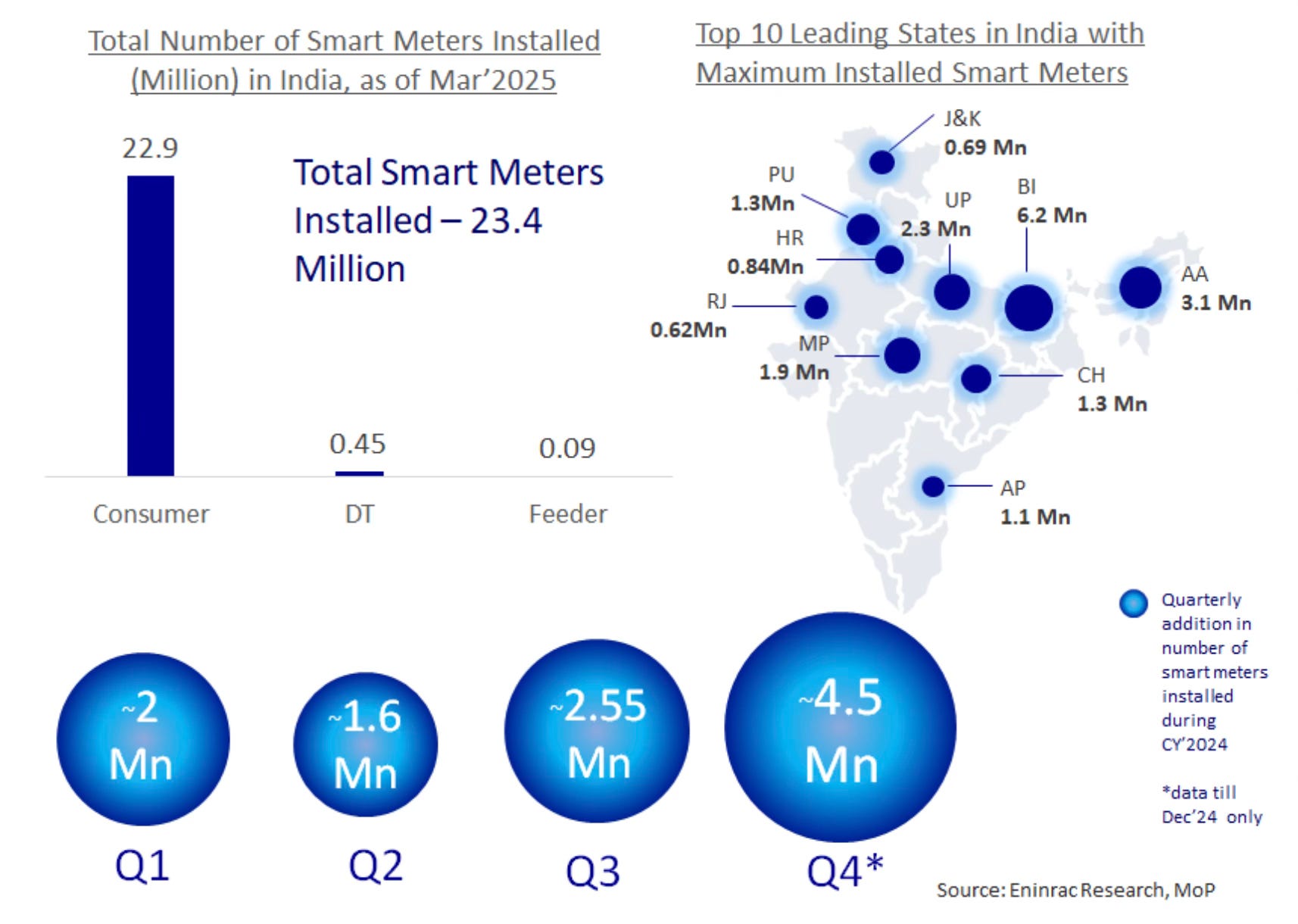
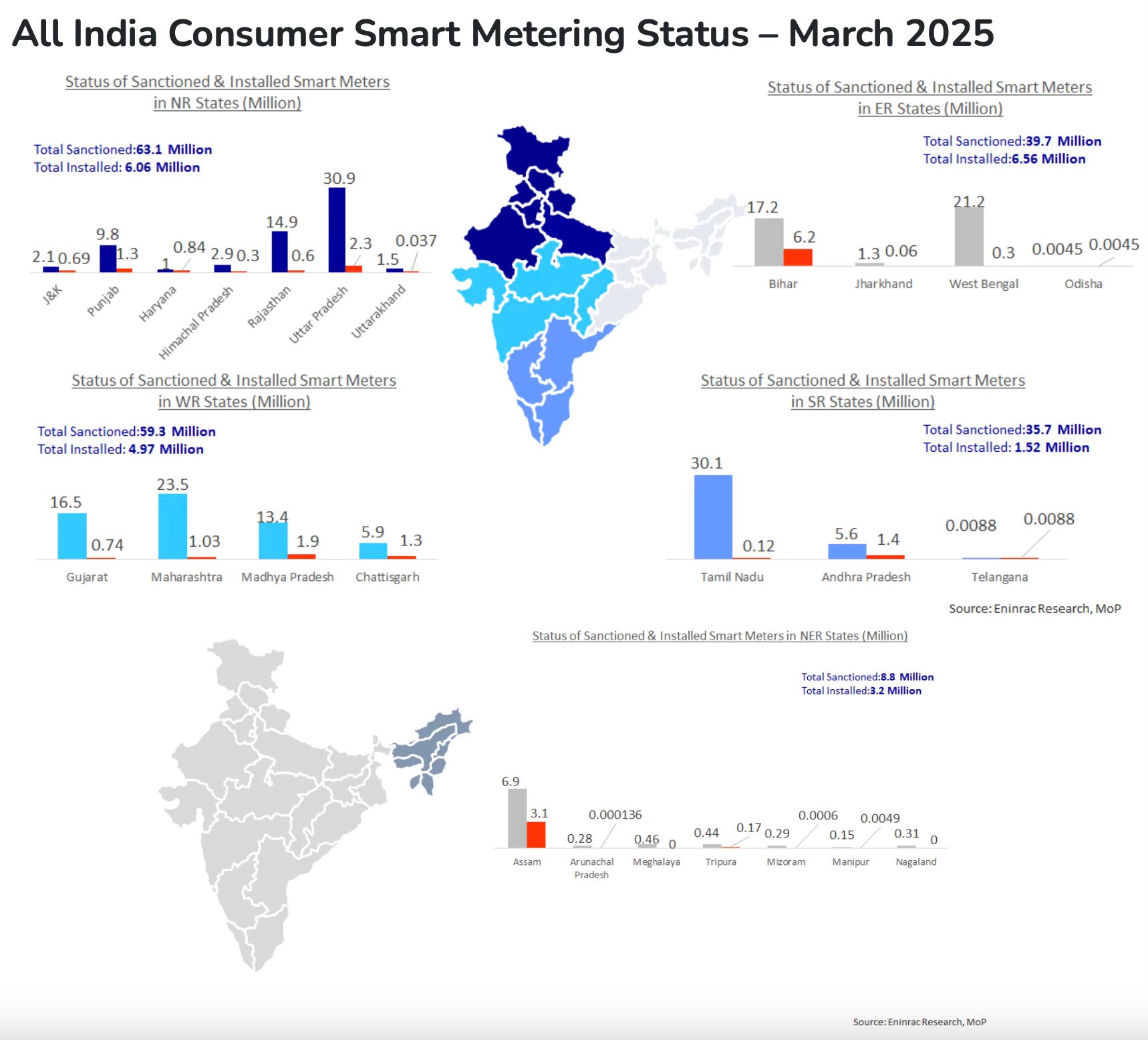
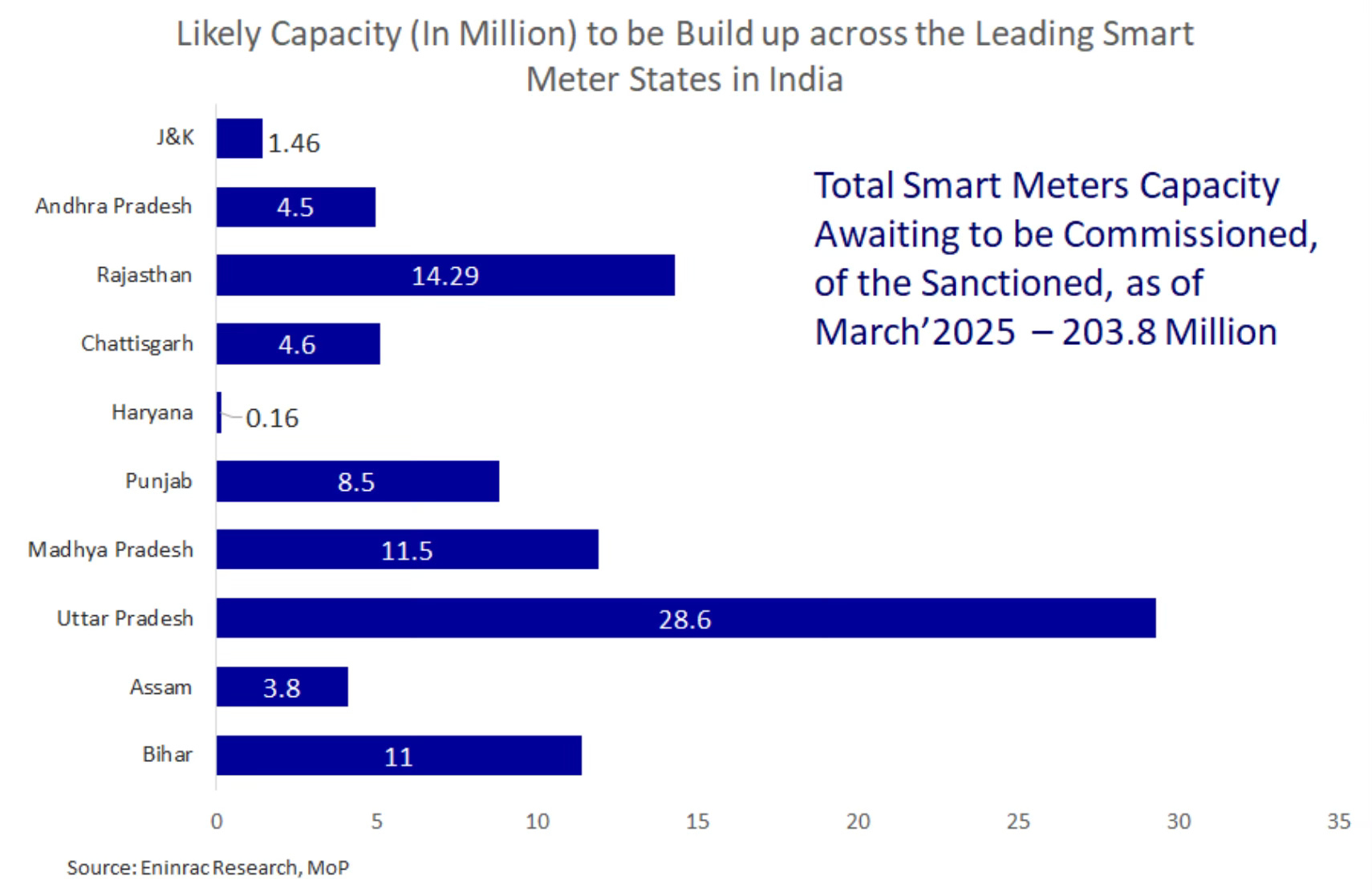
Before that some updates on the status of smart meter installations. Till March 2025, 222.3 million smart meters have been sanctioned, of which 138 million have been tendered and awarded, and nearly 22.9 million have been installed. 

The state-wise sanctions and installations show that the uptake has been surprisingly weakest among those states with the better discoms. 

The target is to install 250 million smart meters by 2027.

India has adopted the TOTEX (total cost of ownership) model in smart meters, whereby the private firm invests upfront in the entire smart meter infrastructure (meters, communication and telemetry system, software etc.) and the utility makes monthly payments, including for billing. In this model, infrastructure contractors like Adani, GMR, GPIL etc., contract with smart meter manufacturers like Schneider, Secure, HPL etc., and deliver metering as a service for the contract period (60-96 months). 

Now that smart meters are on us, some observations on ensuring their effective installation and utilisation.

1. The value of smart meters comes from comparing the energy input and billing for each feeder before and after their installation. It allows discoms to identify energy losses, feeder-wise, and take remedial action to lower them. Accordingly, smart meters can help reduce aggregate technical and commercial (AT&C) losses in distribution. 

In order to achieve this objective, it’s important to ensure that smart meters are installed feeder-wise in a manner that covers all services (including the distribution transformers) under an 11 kV feeder so that it becomes possible to conduct reliable end-to-end energy audits. Like with unmetered agricultural services, scattered smart metering of services within a feeder makes accurate energy audit difficult, if not impossible. 

Another level of prioritisation would be to cover the highest energy-consuming feeders. This will ensure that in the initial stages, the implementation bandwidth is focused on a few high-value supply centres instead of being spread out wide and thin. Besides, it will also ensure that the discoms start to realise meaningful financial benefits from the implementation.

2. I blogged about the assumptions behind the installation of smart meters to reduce energy losses and improve the quality of supply. 

One, the smart meter's telemetry is always synchronised to the grid and it reliably delivers information. Two, the smart meter itself is operational and does not suffer from technical problems and failures. Three, the smart meter is not tampered with or even bypassed at the consumer level. Four, even if the data is acquired and processed to make available actionable decision support, the discoms have the capabilities to undertake rigorous energy audits and monitor and enforce them. Five, the discoms are able to disconnect errant connections.

There is daunting state capability and political economy challenges to be overcome to meet these assumptions. Therefore, these assumptions should be salient and prioritised considerations during the installation of smart meters. They should be monitored closely and rigorously for compliance. 

If these assumptions are not complied with, there’s a strong risk that the smart meter will end up like using an expensive computer to do the functions of a typewriter. 

3. The nature of electricity distribution and energy audit makes it ideally suited for a technology intervention like smart metering. If, even after its implementation, the discoms are unable to substantially reduce losses, it would point to failures in either enforcement (not able to disconnect services despite knowing the sources of leakages or pilferages) or implementation (bad installation, poor telemetry, tampering with the smart meter etc.) failures. 

There’s a strong risk of such failures. The speed and scale of this roll-out must be calibrated with the capabilities of the systems on both the supply and discom sides. Careful thought and effort must go into testing and iterating the robustness of the smart meters themselves, their installation requirements (safeguards like earthing and other protections, network connections etc.), stabilising the telemetry, and billing and accounting systems of the smart meter network. 

The worst outcome would be for the vendors to erect the meters without the requisite safeguards and auxiliaries and claim their first bills. The poor quality of installation will invariably result in various kinds of meter failures. Given the difficult and widely dispersed contexts coupled with the speed of the roll-out, the vendors will have enough excuses to blame the government and get away. It’s a recipe for contractual failures. 

For these reasons, it may be useful for each discom to test and refine the installation in a few feeders for a few months before scaling them up. Such a stabilisation pilot approach should be made a mandatory requirement before full-scale roll-out. 

4. I’m not sure about how effective smart meters will be in serving as a service control device, i.e., in disconnecting services. Their primary value will be in communicating information about energy flows and consumption. This means making available the right kind of actionable information for different levels within the discom and government. 

Unfortunately, there are too many examples of technology experiments in development that have struggled at the last mile by failing to provide actionable information. Given this and the common institutional contexts and problems, it may be useful to standardise the reporting formats for energy audits across 3-4 levels to ensure that the system provides the basic first-order actionable information for each level. 

5. The 250 million smart meters offer a great opportunity to create an invaluable end-to-end domestic manufacturing ecosystem. Apart from the product itself, there’s a big opportunity to promote the emergence of an Indian System on Chip (SoC) that drives the smart meter. Given the biggest constraint to breaking into the tightly controlled chip design market is access to deployment use cases in large volumes, smart meters are an unmatched market-making opportunity. 

This requires very high-level coordination involving different Ministries of the Government of India, to integrate this strategy with public procurements, mandate product standards, expedite regulatory enablers and permissions, etc. For example, in the case of smart meters, the meter supply and O&M contractors (6-9 year TOTEX contracts) could be mandated to supply domestically designed and manufactured meters. This mandate could be phased in over time, with the initial supply being restricted to 10% of all installations and going up each year. The support provided by the Ministry of Power for smart meter installations under the Atmanirbhar Bharat Scheme could be leveraged to catalyse domestic chip and meter design. The government coordination could bring together the OEM/contract manufacturer, and chip and product design firms. 

At the least, this public policy mandate on smart meters must create a couple of globally competitive and competing domestic smart meter manufacturers. 

6. The smart meters also offer a great financial market opportunity. It presents a low-risk, long-term, assured revenue-generating regulated asset. Accordingly, in Europe, with its deregulated supply market, smart meters have been attractive investment destinations for private equity firms. In the existing TOTEX contracts, the financial risk is borne on the balance sheet of the discom in so far as it directly commits to repaying the meter costs (even if recovered through the monthly bills). In forthcoming tenders, as the market gets derisked, contracts could be structured to distinguish between the capex (meter) and opex (billing) risks, with only the latter being fully borne by the discom. 

Monday, April 14, 2025

Trump tariffs in perspective and some observations

The commentary in mainstream US media outlets is doing a good job of fuelling the narrative that lays all the blame for the crisis facing the global trading system on Donald Trump and his mindless tariff adventurism while almost completely overlooking its underlying cause of China’s beggar-thy-neighbour mercantilism. See this and this. This post tries to provide another perspective on the ongoing trade war. 

This narrative overlooks that it was the Trump 1.0 that took the festering China problem head-on and upended an entrenched equilibrium among vested interests. While the Biden administration continued and expanded on what Trump 1.0 began, it pursued an incremental strategy without meaningful diversification away from the excessive dependence on Chinese manufacturing. While it tightened restrictions on high-technology products, there were few plans to reduce the dependence on electronics, heavy equipment, critical minerals, renewable generation, etc. In fact, it presided over the steepest rise in China’s exports and trade surplus during the last four years. 

Trump 2.0 has rightly sought to focus attention on the underlying issue of China’s structural imbalances that manifest, among other things, in the large US trade deficits. It has recognised the need to go beyond incrementalism and move in and break things to be able to address the China problem. While it’s too early to definitively assess the magnitude of its impact, it cannot be denied that it has taken the disruptive actions of Trump 2.0 to force and expedite a decoupling from China

Having said this, its instruments and strategies to achieve this objective have been reckless and foolish. Specifically, its exclusive focus on tariffs, the abrupt and formulaic application of astronomical tariffs, the foolish tariff warfare on its allies, and finally, the undignified gangster-like threats to force allies and foes alike to the negotiating table. The conduct of trade policy on Truth Social and the countless flip-flops have destroyed the credibility of the US government. It has thoughtlessly conflated America’s structural economic problems with its trade deficits and free-riding (on the US security umbrella) by its allies. All this has been complemented with nationalistic and colonial rhetoric, bombast, and actions delivered in a demeaning and imperial manner. In short, it has opened up reckless wars on all fronts. 

While there are plenty of articles and papers in the mainstream Western media analysing and lamenting the disastrous impact that tariffs will have on the US economy, it’s difficult to find any that examines the impact it’ll have on the Chinese economy. On the contrary, some even claim audaciously, without any reasoning or evidence, that China is well-positioned to weather the trade war. There has been little by way of constructive commentary and proposals (like this and this) acknowledging the objectives sought to be achieved and the changes and additions required to Trump’s policies. 

All this is in line with the now common trend of a pathological ad-hominem fallacy about anything Donald Trump, which detracts attention from the critical underlying issue of a global trading system that had broken on the weight of China’s abusive practices that pre-dated Donald Trump.

Some observations in this context.

1. Donald Trump has landed a definitive blow to the current era of trade liberalisation and its global trading system underpinned by the WTO. While this trade war may appear to have been signed into effect by President Trump, it should not be forgotten that its underlying cause is Made in China. Besides, in recent years, China has not hidden its intent to weaponise its manufacturing dominance. It’s more accurate to describe Trump as only the trigger, a giant ill-directed bazooka at that, for the backlash that had been brewing. 

The world economy’s China problem, which had been allowed to grow unabated for over two decades, must count as the biggest collective action failure in modern economic history. Disturbingly, it’s now no longer a mere economic problem but a serious national security and strategic threat. Consumers, corporations, academics, commentators, and governments were complicit in allowing the concentration of manufacturing in China at the cost of manufacturing bases across sectors elsewhere and the destruction of good jobs globally. 

While it remains to be seen how the trade war plays out, it’s hard to disagree that the China problem had long become a giant negative externality on the world economy and it could not have been addressed through negotiations and incremental measures and without pain. While people may disagree with the scale and speed of the disruption, it cannot be denied that this kind of disruption is essential to get everyone meaningfully engaged in addressing the China problem. Incrementalism and negotiations can only get you so far. 

2. Now, with Trump putting on hold the reciprocal tariffs on all countries, if only for 90 days, while at the same time ratcheting up tariffs on China, this is emerging into a full-blown US-China trade war. The total tariffs on China now stand at a staggering 145%. Given that the trade war, though unleashed by President Trump, is Made in China, it was inevitable that China be treated separately and tariffed at a much higher rate. This is required to achieve the desired impetus to initiate a sustainable decoupling. 

The 90-day pause buys time to strike deals with trade partners. The separation of the 10% baseline tariff from the reciprocal tariffs and the decision to decouple tariffs on others from that on China may well turn out to be good decisions if followed up appropriately. 

The retention of the 10% baseline tariffs underlines the commitment to a new norm of higher tariffs. In this context, it’s important to bear in mind that the pendulum on trade liberalisation and tariff reduction has long swung to the other extreme. Too-low tariffs are just as distortionary as too-high tariffs. A balance is much required. 

However, there are two problems with the execution of the tariffs on China - it’s too abrupt and too high. While the high tariffs proposed are part of a negotiating strategy, its abrupt application is self-defeating given the level of dependence on ‘Factory China’. Even as a negotiating strategy, by doubling down repeatedly on the initial reciprocal tariffs, Trump may have shrunk the space available for negotiations. Instead, the high tariffs could have been announced in one go but come into effect over some time, thereby allowing firms to adapt and start to shift away from China. Oren Cass had proposed a two-year phase-in of the full tariffs. 

3. It’s reasonable to expect some iteration on the tariffs announced on China. The strategy of announcing tariffs to force partners to the negotiating table and then settling with them necessitates some iteration. While such iterations are inevitable, they ought to be part of well-thought-out plans. It would have been ideal to announce a phased tariff schedule instead of the abrupt and steep escalation. But now that the cards have been played and tariffs are on us, it’s required by the Trump administration to allow negotiations the opportunity to work. 

Unfortunately, that may not be the case given that there have already been five rounds of tariff announcements, and more are likely. Further, unlike the Rule of Law that we are used to historically from US governments, we now have a dispensation inclined to Rule by Law, or Trump’s Law. This is a recipe for confusion and deep uncertainty, a high-stakes Poker Game without any clear rules. 

Take the example of the announcement of the pausing of reciprocal tariffs on some electronics like smartphones, routers, chip-making equipment, and laptops. It gave the logic of the scale of dependence on China for consumer electronics but did not mention anything about other products with similar China import dependence - air conditioners, fans, tricycles, microwaves, dolls etc. Further, the initial announcement did not indicate any timeline for the pause, resulting in some market euphoria. However, within hours, there were repeated clarifications by senior officials that the exemption would be removed within “a month or so”, culminating in President Trump’s announcement (on Truth Social, where else) that the pause would be temporary. 

Similar confusion prevails elsewhere in the tariff policy. Some of the distortions like inputs being taxed seven times more than products (batteries and laptops with batteries) are plain stupid. Finally, the multiple tariff announcements have resulted in a complex patchwork of rates depending on what’s imported, materials used, its source, rates applied, exemptions etc. 

4. The combination of the 90-day pause on reciprocal tariffs and the steep tariffs on China have inevitably set in motion supply chain re-alignments. American importers and exporters are scrambling to find alternative sources and destinations while the process of relocating to the US gathers pace. The Chinese exporters will pursue a combination of strategies - look to route US exports through other countries (especially those with surpluses or lower deficits with the US), shift manufacturing to other countries and export from there, and diversify away from the US to especially developing countries. 

Pre-empting any Chinese plans to shift exports away from the US to other countries, European Commission President Ursula von der Leyen has already warned that the EU “will not tolerate” Chinese goods hit by US tariffs being redirected to Europe and that Brussels will “take safeguards” if a new monitoring mechanism detected an increase in Chinese imports.

It goes without saying that the Trump administration will keep a close track of the impacts of these emerging trends on the US trade deficits. There will be surveillance of the emerging trade trends with the ‘connector’ economies through which re-routing to the US is likely to happen. 

The test of the success of this policy would be a reduction in US imports, a lowering of the trade deficit, and an increase in US manufacturing, all without causing high inflation and a long and deep recession. Inflation and recession may be unavoidable costs to pay for the rebalancing, and the policy challenge would be to ensure that both are mild and short. A recession and 4% inflation for a year or so may not be a bad bargain if the objectives are achieved. 

5. The Trump baseline tariffs will also be formalising a trend that has been afoot for some time now. While being critical of Trump, we tend to overlook that Europeans and others have been raising tariffs on specific products to counter discounted Chinese imports. India, with its border problems with China, has been one of the first to recognise the harmful economic effects of cheap Chinese imports and raise tariffs. This trend is bound to intensify into a higher baseline of tariffs across major economies on many manufactured goods. 

The trends of automation and decline in job creation, coupled with the rise of populist parties, mean that protectionism is here to stay for the foreseeable future. The era of ultra-low tariffs are over and a higher tariff baseline is the new norm. 

6. The emerging plays on the trade war and supply-chain response are important for countries like India, which hope to benefit from the displacement of Chinese exports into major economies by taking some share of the Chinese exports. 

For a start, given the critical importance of exports in sustaining growth in the face of a weak domestic economy, China will “fight till the end” to retain its export share. Further, the corporations buying from China too will struggle with alternative sourcing and will resist diversification, even if subterfuge. Also, India will face stiff competition in manufacturing from its current set of competitors among emerging economies, who might be feeling that they are the biggest beneficiaries of the trade wars. Finally, protectionism and populism will feed each other and work towards the onshoring of manufacturing in the larger economies. 

With the US, the Trump administration’s single-minded fixation on US trade deficits with partners limits the room to substitute Chinese imports. So, for example, if Apple relocates more to India and supplies to the US, it’ll invariably increase the trade deficit with India. It’s unlikely that the Trump administration will take kindly to this scenario. Only to some extent can oil, natural gas, defence and other purchases from the US offset the increased exports to the US. So there are hard limits to how much more India can export to the US without provoking the Trump administration. Finally, having realised the follies of concentrating its manufacturing in China, Apple is certain to ensure that it diversifies its supply chain among a few countries while also onshoring increasing portions to the US itself. 

In the aggregate, there’s an opportunity for India, with its very low baseline of manufacturing exports, to take up a share of the displaced Chinese exports and significantly increase its exports. But to seize this opportunity, Indian firms must be able to overcome competition from countries in the South East Asia for the US and European markets However, here, too, we must be realistic given the current state of manufacturing supply chains, the intensity of competition from other countries, and the general rise of protectionism. 

Further, for the foreseeable future, as long as the current phase of protectionism endures, trade deficits will be a lightning rod. This will act as a restraint on large-scale export successes. There’s no room for the emergence of another China-like export success, even at a far-diminished scale. 

7. For now, the only restraint on Trump’s Rule by Law appears to be the markets. The unwinding of the basis trades and its impact on the Treasuries (which are the most liquid instruments) spooked him and appears to have driven the pull-back from the reciprocal tariffs. The Liberation Day tariffs triggered a combination of four events - a steep fall in equity markets, a surge in bond yields, a decline in dollar value, and a very rare capital flight from the US. The Fed had to step in. Adam Tooze has a very good explainer. 

New frontiers are being breached in terms of dollar and Treasury volatility and capital flight, and don’t be surprised if the capital markets react more violently next. Another potential restraint will be public opinion, especially among his staunch electoral base and how the economic suffering is impacting them. It’s already being strained

8. The Trump war on the global trade order is a throwback to traditional unilateralism. The Trump administration has invoked obscure domestic laws - International Emergency Economic Powers Act, the National Emergencies Act etc. - to impose reciprocal tariffs and other unilateral tariffs on specific products from targeted countries. 

It has threatened to retaliate with reciprocal measures against any levy imposed on ships for carbon emissions, and it did not attend a meeting of the UN’s International Maritime Organisation to consider its support for the measure and a first-ever global price for an industry’s carbon emissions. It has also proposed to charge fees of up to $1.5 million on every Chinese-built vessel calling at its ports

The world’s largest economy has now warned in its message that the agreed targets for shipping “would unwisely promote the use of hypothetical expensive and unproven fuels”, adding that it “rejects any and all efforts to impose economic measures against its ships based on GHG emissions”. The US said it opposed “any proposed measure that would fund any unrelated environmental or other projects outside the shipping sector”, as well as proposals that would give preferential treatment to less developed countries… “President Trump has made it clear that the US will not accept any international environmental agreement that unduly or unfairly burdens the US or the interest of the American people,” the US said in its message to IMO member states. “While we will not ignore threats to our natural environment, President Trump promised the American people a return to energy dominance.”

Such unilateralism has guidance for countries like India. Till the contours of the new global trading order emerge, India must adopt a qualified and nuanced position on WTO and international trade. For example, it should be open to pursuing industrial policy measures that incentivise exports, however without explicitly flaunting them and provoking retaliation. Sticking nationalism to industrial policy will certainly invite attention and should be avoided. Similarly, in areas like the EU’s Carbon Border Adjustment Mechanism (CBAM), instead of merely opposing it, India must also figure out mechanisms to respond in kind with measures that force negotiated deals.