Substack

Saturday, August 17, 2024

Weekend reading links

1. The Economist points to the troubles facing Chinese manufacturing companies. The percentage of loss-making industrial enterprises is now even beyond the level of 1998 when reforms to the SOEs started.
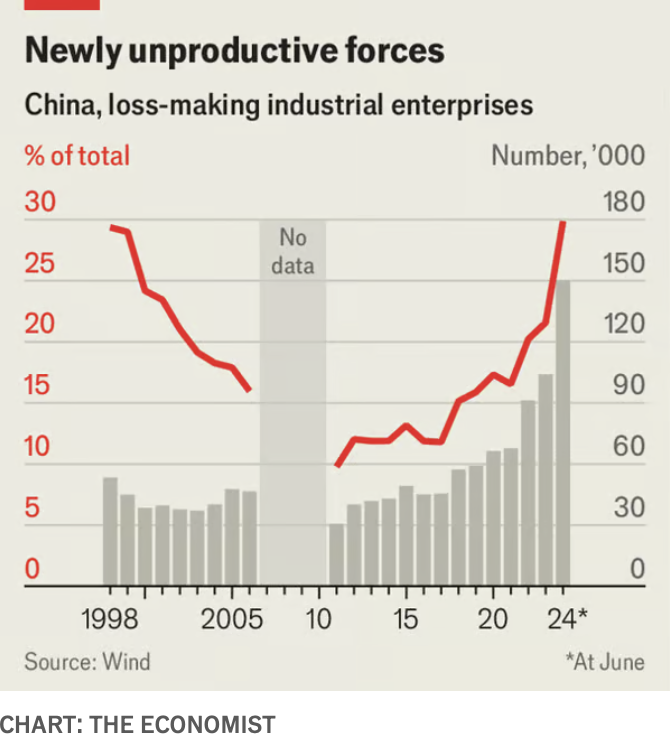
At least eight large makers of the cars have shut down or halted production since the start of 2023. The ripples are visible throughout the supply chain... Some 52,000 ev-related companies shut down in China last year, an increase of almost 90% on the year before, according to one estimate. China’s solar industry is also grappling with oversupply. This year the prices of most components of solar modules have fallen below their average production cost. Many companies in the industry are scaling back manufacturing. Others have scrapped plans to enter the market... A shakeout is occurring in the semiconductor industry, too. Local governments have focused their investments on low-end chip components in an effort to “easily win market share”, notes an industry insider. Those parts are now in great oversupply and many of the companies producing them are failing. In 2023 nearly 11,000 chip-related firms went out of business, roughly 30 a day, according to Qichacha, a company that collects corporate data.

2. Nice graphic that captures China's latest investment priorities - solar, EV, batteries, and semiconductor chips.

3. Unintended consequences of public policy actions - in Germany, carbon emissions from power generation rose sharply in 2022 as it shut down nuclear plants.
4. You can do such market micro-management actions only if you are China
China has adopted an unusual tactic to discourage banks from buying government bonds, as authorities try to halt an uncomfortable decline in yields and prevent a bubble forming: naming and shaming the buyers... While buying of their sovereign bonds may be welcomed by many countries, the People’s Bank of China has repeatedly warned that a bubble is forming in the sovereign bond market, with regulators saying that regional banks’ appetite for long-term government debt risks triggering a Silicon Valley Bank-style crisis if there is a sudden surge in yields. “The local PBoC branch called us and advised us not to buy bonds when state lenders are selling,” one bond trader at a local lender in Jiangsu province said this week. “They blamed a few rural banks in Suzhou for acquiring bonds sold by the state banks.” On Monday, large banks sold a net Rmb22bn of long-dated bonds, 10 times the daily average last week, according to BNP Paribas’ securities market data. The government is also trying to spur economic growth by pushing regional lenders away from parking their money in ultra-safe bonds and instead lending it out.

5. Some facts about the trends in low tech manufacturing and China.

Apparel, footwear and furniture accounted for 9 per cent of China’s exports in the first eight months of last year, according to a Bank of America Global Research report, down from 20 per cent in 2001. Car and machinery’s share of total exports increased to 33 per cent from 16 per cent over the same period. China’s share of global footwear and apparel sales has slipped in recent years, with its portion of overall supply for brands Nike and Adidas falling from 20-27 per cent in 2017 to 16-20 per cent in 2022, according to the BofA report. While it remains the world’s largest supplier, China’s share of global footwear exports has declined by more than 10 percentage points over the past decade, according to figures from the 2023 World Footwear Yearbook. Much of that capacity has shifted to south-east Asian countries, particularly Indonesia and Vietnam, the report added. Vietnam, now the world’s second-biggest exporter, has been the biggest beneficiary, with its share rising from 2 per cent to about 10 per cent.

6. About the UK's Teacher's Pension Scheme (TPS)

State schoolteachers (and some university academic staff) are automatically enrolled into the Teachers’ Pension Scheme. The TPS requires contributions of at least 7.4 per cent of gross salary but guarantees an inflation-protected retirement income linked to career-average salary. Like most public-sector schemes it is unfunded; current pensions are paid out of current contributions and if they are insufficient then taxpayers are on the hook. It is also expensive for employers, who currently make contributions of about 28 per cent of salary.

7. Nice Ed Conway X thread on the challenges with replacing existing materials and technologies.

Part of the problem here - one which crops up again and again throughout *Material World* - is that it turns out the suite of materials we tend to use these days are simply VERY good at doing what they do. Kerosene is really hard to beat as an aviation fuel. Methane is a brilliant source of the hydrogen for making, among other things, fertilisers. Concrete might not be the only strong building material, but it’s incredibly easy to lay and also phenomenally cheap... All these things create significant carbon emissions. But they are central to modern life. They are a large part of the explanation for how we've been able to urbanise and feed billions of people in recent decades. Finding low carbon replacements will be HARD.

8. Two good Ed Conway X threads, here and here, on how countries got locked into the single pipe system where the outflows from sewerage and storm water drainage flows through one pipe (instead of separate pipes).

9. Very good graphical article in NYT that shows how China has established nearly 50 new villages and expanded another 100 villages all along its south-western borders, some in areas claimed by India and Bhutan, in an effort to fortify its border claims. 

These villages are called "border guardians" and the villagers are paid to live there. 
Qionglin’s villagers are essentially sentries on the front line of China’s claim to Arunachal Pradesh, India’s easternmost state, which Beijing insists is part of Chinese-ruled Tibet. Many villages like Qionglin have sprung up. In China’s west, they give its sovereignty a new, undeniable permanence along boundaries contested by India, Bhutan and Nepal. In its north, the settlements bolster security and promote trade with Central Asia. In the south, they guard against the flow of drugs and crime from Southeast Asia. The buildup is the clearest sign that Mr. Xi is using civilian settlements to quietly solidify China’s control in far-flung frontiers, just as he has with fishing militias and islands in the disputed South China Sea... The mapping reveals that China has put at least one village near every accessible Himalayan pass that borders India, as well as on most of the passes bordering Bhutan and Nepal... The outposts are civilian in nature, but they also provide China’s military with roads, access to the internet and power, should it want to move troops quickly to the border. 

Villagers serve as eyes and ears in remote areas, discouraging intruders or runaways... in quietly building militarized villages in disputed borderlands, China is replicating on land an expansionist approach that it has used successfully in the South China Sea... To persuade residents to move there, Chinese Communist Party officials promised them their new homes would be cheap. They would receive annual subsidies and get paid extra if they took part in border patrols. Chinese propaganda outlets said the government would provide jobs and help promote local businesses and tourism. The villages would come with paved roads, internet connections, schools and clinics.

10. Livemint reports of declining fortunes of Kota, the coaching centre capital of India - the number of students declined from around 200,000 in 2022 to and estimated 70000-90000 this year.  

The primary reason for Kota’s decline today is coaching institutes opening centres in other cities in the last two years, which has had a cascading effect on local businesses. Allen Career Institute, for instance, now has centres in at least 60 cities across India, including Dibrugarh, Patna, Rohtak, Latur, Jodhpur and Durgapur. Unacademy’s website says it has 61 centres in 44 cities for offline preparation, including Ahmedabad, Bhopal, Bhubaneswar, Bengaluru, Dehradun and New Delhi. Physics Wallah has 124 centres in 105 cities, with its Kota centre opening in 2022. It has more than 200,000 students enrolled across these centres... The other reason for the drop in students in Kota is the image it has developed of being a “suicide and party" hub. According to a Hindustan Times report last month, at least 13 students preparing for NEET or the engineering Joint Entrance Examination (JEE) in Kota had taken their own lives as of July. Last year, 27 suicides were reported, which was the highest number since 2015, said officials.
11. Very interesting snippet in the context of Bharti Airtel's decision to invest £3.2bn and take a 24.5% stake in BT, India is the second largest FDI source for UK!
India is the country’s second-largest source of foreign direct investment: there are more than 950 companies with combined revenue of about $65bn operating in Britain — up from 900 in 2022, according to the UK India Business Council... Bharti Enterprises holds controlling stakes in satellite venture OneWeb and also owns prestigious hotel brands, including The Hoxton and the Gleneagles resort in Scotland, operated by a company founded by his son-in-law. Bharti’s Africa telecoms business is a member of the FTSE 100.

And the Empire strikes back again?

On a 1997 visit to Bengaluru, then-UK prime minister John Major hailed BT’s acquisition of a 21 per cent stake in a phone operator owned by Sunil Bharti Mittal as “an indication of the strength of our economy”. Now Indian politicians are cheering a dramatic reversal after Mittal’s Bharti Enterprises struck a deal to become the British former telecoms monopoly’s largest investor, agreeing to buy a 24.5 per cent, roughly $4bn stake from Franco-Israeli billionaire Patrick Drahi’s indebted Altice. Bharti Airtel, anchor of the 66-year-old Mittal’s conglomerate, has blossomed since its 1995 founding into one of the world’s biggest network providers and now dwarfs BT. With 550mn customers across 17 South Asian and African nations, the company commands a $100bn market value — more than five times that of the UK group, which has shed overseas assets in recent years.

12. Water desalination facts of the day

Christopher Gasson, publisher of Global Water Intelligence, which tracks the industry, figures that about 500 million people rely at least partly on purified salt or brackish water and that the number could rise sixfold to three billion by midcentury. Around the world, there are about 1,500 large plants — those that can produce about 2.6 million gallons a day — with roughly $14 billion being spent annually to operate the existing fleet and build new ones... Saudi Arabia is the largest market for these installations, followed by the United Arab Emirates... With nearly 100 big plants, Spain is the largest user of desalination in Europe and one of the world’s largest... the costs of operating the energy-intensive desalination technology — called reverse osmosis, which is standard at large plants including the one at Torrevieja — are being brought down by pairing water purification with cheap solar energy, encouraging the building of new plants.

13. It appears that Howard Schulz negotiated out several perks for himself from Starbucks that raise concerns about corporate governance and personal ethics.

In 2018, the man who built the Seattle coffee business into a global empire had negotiated an agreement to retain an chair emeritus role — for the rest of his life. The deal lets the 71-year-old attend and observe board meetings, according to Starbucks corporate filings... They range from Starbucks reimbursing Schultz when it uses his private jet for corporate purposes to him owning a stake in a business making extra virgin olive oil for one of the company’s coffee drinks... The deal — which can only be modified or waived if both parties agree... As Schultz was ending his third spell in charge, he was introduced while travelling in Sicily to the idea of eating a spoonful of olive oil every day. It inspired him to create Oleato, which Starbucks began rolling out to customers earlier this year. Corporate filings show that Schultz did not just originate the idea; he also owned 19 per cent of the family-controlled business from which Starbucks buys its oil. Starbucks paid the company, Partanna, about $26mn last year... Schultz’s air travel also remains intertwined with the coffee chain. He owns a jet used by Starbucks, according to filings, for which the company last year paid an entity he controlled about $1mn. He has also stored his plane in a Starbucks hangar, the filings show: in 2023, an entity controlled by Schultz paid Starbucks about $1.3mn to cover rent and other maintenance costs.

For those who scorn at public servants for their questionable integrity, imagine what would have been the case if the likes of much-worshipped Schulz were in the public sector!

14. US CPI inflation falls to 2.9%. Time to call an end to the war on inflation?

15. An emerging structural concern in the banking sector in India is the widening gap between the credit and deposit growth rates. 
In the last financial year, for instance, while credit expanded at about 20 per cent, deposit growth lagged at about 14 per cent. The gap was also highlighted in the RBI’s latest Financial Stability Report. This trend is reflected in the credit-deposit ratio, which has increased since September 2021. It peaked at 78.8 per cent in December 2023 before moderating to 76.8 per cent at the end of March 2024. The ratio is particularly high among private-sector banks.

Some thoughts here. One, the high ratio among private banks is reflective of the problems with efficiency maximisation pursuit of the private sector, and the need for regulation to bring in resilience to the banking system. Two, as the editorial alludes to, the sharp decline in household savings to a multi-decade low of 5.3% of GDP in 2022-23 may be a reason behind the lower deposit growth rate (apart from the emergence of alternative savings opportunities). Three, just as savers find alternative investment opportunities, the borrowers must also diversify away from banks to capital market avenues. 

16. Interesting snippets of Chinese trade data

While China’s share of US imports has slipped to 13.5 per cent today from 21.6 per cent in December 2017, its overall market share in global goods exports has risen from 12.8 to 14.4 per cent over the same period.
17. Tim Harford on luxury brands
The real trick that luxury brands have pulled off is that the two features of the brand — subtle excellence paired with conspicuous expense — reinforce each other. In its purest form, conspicuous consumption is crass and unattractive; it needs the cover story of excellence before it becomes appealing. Both excellence and expense are part of the brand promise, then, but the difference between them matters. If the brand is mostly about excellence, the purchaser of the fake is the obvious loser: they are getting shoddy goods masquerading as something much better. But if high-end brands are largely about expense for the sake of expense, then counterfeit brands are like counterfeit banknotes. Their ubiquity debauches the value of the once-exclusive brand and the suckers are not the people who buy the fakes, but the people who pay retail for the tarnished originals...
But is this inability to signal quality really a problem for luxury fashion brands? I doubt it. Those who walk into the Louis Vuitton shop down the street from Florence’s Duomo and pay €500 for a baseball cap will be confident that they are getting the real thing, and rightly so. Those who pay €12 in a Palermo street market are expecting a knock-off, and they are right too... The economist Karen Croxson, now at the Competition and Markets Authority, once published a theory of “promotional piracy”, in which companies would tolerate the copying of some products because it created demand for the real thing. Microsoft probably benefits if tens of millions of schoolkids familiarise themselves with pirated copies of PowerPoint and Excel. And while the possibility of counterfeit Gucci loafers seems unlikely to enhance the appeal of the real thing, maybe some brands might be happy to see influential young artists, musicians and trendsetters displaying their logos, fake or not. Or maybe the ubiquity of the imitations builds demand for the original? Over in the Uffizi, “The Birth of Venus” is so prized because it is so recognisable, and that is down to it having been duplicated, imitated and remixed so often. Perhaps this is as true for Versace as it is for Botticelli.

Thursday, August 15, 2024

The importance of the space for policy experimentation

There’s an important reason why despite professions of wanting to usher in reforms during electoral campaigns, democratic governments struggle to implement them. It’s as if the bureaucrats and politicians stumble while attempting to cross a valley that separates a reform idea from its implementation. 

There are perhaps two approaches to doing public policy reform. The first is to formulate a comprehensive and water-tight proposal and implementation plan, get the buy-in of all the stakeholders, and then implement the reform. The second approach is to come up with a basic program design, prepare its implementation plan, get the broad support of important stakeholders, implement it, and then iterate based on emerging insights. As per this approach, the important thing is not the idea or the design or the plan, but the quality of iteration. 

The second approach assumes significance, especially in the context of public policy issues. I have written here about the value of iterating with the Minimum Viable Product and scaling up promising public policy ideas. The uncertain elements of a new idea are too many to make any comprehensive en-ante design/plan impossible. We need to iterate to allow the uncertain features to play out, and then address them. 

Consider the practical challenges with the first approach. If we were to dot all the i’s and cross all the t’s of any reform’s design and implementation, we would start to encounter several problems. Any reform idea by nature is treading new ground. Any public policy intervention will have several design features, and being new, each design feature will have several uncertain aspects. And then there are imponderables of practical implementation for each design feature. Finally, there are the risks associated with the emerging political economy responses, which can manifest in the form of adverse news items and public protests. 

When faced with such extreme uncertainties, bureaucrats tend to batten their hatches and pull back from the reform. Perversely, this kind of risk aversion is especially likely with a bureaucrat who is prone to do his homework and diligently examine all the possible issues associated with the reform idea. 

It’s for this reason that I’ll argue that any reform requires some space for strategic ambiguity. 

There are some good frameworks to describe such ambiguity. Three come to mind. 

Albert Hirschman proposed a theory of hiding hand to describe the need for governments to have a cloak over complete information if they are to proceed with complex reforms. Accordingly, for example, if a government were to become fully aware of the several uncertainties and costs associated with building a hydropower project, it might in the first instance never set out to build one. 

Similarly, Bent Flyjvberg has described the idea of strategic misrepresentation as an essential requirement to get approval for large infrastructure projects. Given that such large projects invariably cost massive amounts, and are prone to cost and time over-runs, governments, especially the Finance Departments, are likely to resist approving them. Therefore, to win approvals for such projects, the sponsoring ministries and their agencies end up misrepresenting by low-balling estimates to win approvals, in the firm belief that they’ll be able to renegotiate the estimates upwards once the original project is approved and implementation starts. It’s difficult impossible for any government to pull back and leave the project incomplete. 

Deng Xiaoping famously institutionalised Capitalism with Chinese Characteristics, which was essentially about the strategy of “crossing the river by feeling the stones”. See this, this, and this. Local and provincial government officials were encouraged to undertake low-profile experiments of various kinds that went radically counter to the dominant principles of communism and the Chinese Communist Party. These experiments were then closely watched but outside the glare of any publicity, which allowed them to happen in a low-stakes environment. But once an experiment started to show promising results, it would get adopted by the Party and scaled up nationally (famously exemplified by Deng’s high-profile personal visits and announcement to scale up the initiative). 

Such strategic ambiguity requires work at the bureaucratic, political, and civil society levels. In fact, I would argue that the space for such ambiguity emerges from a virtuous cycle that intertwines the motives and actions of all three stakeholders. 

First, the bureaucrats must become more willing to break out of their risk aversion and bite the bullet based on their judgment of what are good ideas that are steps in the right direction and have a reasonable likelihood of success if done well and over some reasonable period. 

Second, the bureaucrats’ willingness to accept the risk emerges from their political masters’ willingness to accept and tolerate failures. This space is critical and must be communicated widely within the bureaucracy for the individual bureaucrats to summon the courage to trust their judgments and propose/approve reforms. In other words, there must be a politically created culture that encourages experimentation and reform, that’s underpinned by a tolerance for failures.

Third, this political appetite for failure, in turn, comes from the civil society’s acceptance of honest failures. This is formed by the institutional maturity of the press and the wider public commentariat. Instead of excoriating missteps and condemning officials and politicians who dared to pursue these reforms, the public commentary must restrain itself from sensationalism. Public intellectuals and scholars must rise above partisan politics and populist grandstanding to support genuine and well-intentioned reform endeavours.

The third requirement is extremely difficult in polarised political situations, that is now common across democracies. 

In the circumstances, it’s all the more important for at least some bureaucrats and politicians to show leadership and the courage of conviction to break free from the shackles of risk-aversion and pursue reforms that they are convinced about. Such individual initiatives therefore become the only outlets for reform. It’s important that those individuals, especially bureaucrats with the inclination to pursue reforms, are provided the space to do so. 

A very useful way to increase the likelihood of success with public policy reforms is to do it quietly and outside the glare of publicity. Unfortunately, this runs counter to the incentives within the bureaucracy and the political system, where the natural propensity is to claim credit for doing something new and where the tenures of officials and politicians are not enough for them to experiment and successfully scale up complex public policy interventions. Besides, this propensity also comes in the way of bureaucrats, in particular, cutting corners to make the reform look good in the short-term but with serious long-term consequences. Worst of all, it creates perverse incentives to pursue reforms that while creating some immediate good (or the form of “good”) end up leaving greater long-term damage. 

While it’s understandable for the politician to claim credit, it’s especially unacceptable for the supposedly impersonal bureaucrat to flaunt their reform and claim credit. It may therefore be useful to align incentives within the bureaucracy by backing genuine reform attempts and honest failures. For sure identification of such honest reform endeavours is difficult. But equally, they are not impossible and can be done with good judgment by experienced bureaucrats. 

A useful marker or validation for backing bureaucrat-led reform efforts could be signatures that the reform is not being pursued with the intention of publicity and for furthering the personal agenda of the bureaucrat (most often when pursued with these considerations, its negative signatures are clearly visible within the bureaucracy).

A more institutional approach may be to explicitly acknowledge an experiment as just that and with all the associated risks of failure. This would be akin to providing a virtual ring-fenced reform sandbox, thereby creating the conditions for experimentation and encouraging honest reform endeavours. This is harder to achieve but creates the public space for such reforms to be pursued without all the usual constraints and fetters. 

Monday, August 12, 2024

Industrial policy for services sector productivity

We live at a time when the labour intensity of manufacturing is decreasing and even the limited lower-tech manufacturing jobs are disproportionately concentrated in China. Besides, manufacturing itself appears to be on the path to becoming more services-intensive. 

All this coupled with the general dominance of the services sector in the economy (in India it contributes 55-60% of GDP, compared to 12-14% of GDP for manufacturing) means there’s a strong argument that the future will become even more services-dominated and services will drive productivity growth. Accordingly, in recent times, there have been several influential voices demanding a focus on services as the driver of economic productivity and growth. 

But this sits with the reality that high productivity and tradeable services jobs are mainly in the knowledge-based sectors, which comprise only a small proportion of the labour force (India’s $250 bn IT sector employs just 5.5 million people). The vast majority of services sector jobs, which form the dominant source of employment in developing countries, run into the problem of low productivity. 

So, what can industrial policy do to address this problem? 

Before we examine this issue, it’s useful to look at the challenge of productivity improvements in the services sector. 

Our concern is with widely varying services sector occupations like haircuts, retail shop floor services, construction and related services, drivers, janitors, housemaids, cooks and waiters, security guards, lawyers, accountants, data entry operators and so on that serve the mass market (not the high-income consumers or serve the large firms). They make up not only the vast majority of the services sector workers but also the aggregate new jobs creation. 

Consider the following:

1. The tradeability of manufactured goods, within and outside the country, is a critical source of its competitiveness and productivity. However, unlike manufacturing, given its general non-tradeability, there’s no possibility of globalised market competition in the vast majority of the services sector. In fact, the vast majority of mass-market services serve small localised markets. This means that the services sector must look for alternate channels to drive productivity improvements. There may even be a case for industrial policy to guide services sector productivity growth. 

2. Apart from their low tradeability, good quality services sector jobs are skills-biased. This means that there will be hard limits and constraints to both demand and supply of those jobs. It should be noted that the entire IT services sector employs less than 0.1% of India’s 565 million workforce. While there are no good estimates, I would imagine the higher-skilled services employ no more than 1-2% of the workforce. This low base cannot be the driver of technology and productivity spillovers and diffusion across the economy, nor become the driver of broad-based economic output expansion. In contrast, manufacturing occupies 11.4% of the workforce.

3. Further, unlike manufacturing, the productivity of the services sector is intimately linked to the country’s per capita GDP. Lower-income countries have the majority of their employment and a very high share of their output in the informal sector, where productivity is low. There’s an endogeneity to this - low incomes reduce purchasing power, thereby confining consumption affordability to the informal sector where prices are lower. 

If you consider the high share of the services sector in the economic output, the large informal sector employment arising from the low incomes and attendant consumption affordability, and the generally low productivity of the informal sector, there’s a real productivity (and thereby output growth) challenge that developing countries like India that are reliant on the services sector will face. A low-income country can grow rapidly by becoming a manufacturing powerhouse for textiles or toys or footwear and exporting them, but there are limits to growth through the production of the globally competitive services sector jobs we’re interested. 

4. The market dynamics cannot do much to increase the productivity of these informal markets. Many of these informal markets are perhaps more competitive and dynamic than their formal sector counterparts. But at low price levels, there is only so much capital investment and productivity improvement that is possible. The real binding constraint is affordability, and this constraint is relaxed only gradually and that too with economic growth. 

This brings us to the question of what governments can do to address productivity in the services sector. 

In the latest Union Budget, the Government of India announced a new skilling scheme that seeks to provide one-year internship opportunities to 10 million youth by 500 top companies over the next five years. The interns would be paid a one-time allowance of Rs 6000 by the government and a monthly stipend of Rs 5000, of which the Government would pay Rs 4500 and the companies could tap into their Corporate Social Responsibility (CSR) funds for the remaining Rs 500. The participation by companies is purely voluntary. The objective is to provide exposure to “real-life business environment and varied professions”, and there’s no obligation for the companies to hire them subsequently. 

In simple terms, this scheme tries to provide a learning-by-doing employability skills acquisition opportunity for new workforce entrants. It’s hoped that by being part of the industrial ecosystem, these interns would have acquired some skills that increase their employability. It’s a good idea but its success will depend on its uptake and quality of internship. There should be some patience with the implementation of such ideas - the design will have to undergo iteration and the uptake will be non-uniform. There’s likely to be plenty of abuse of this scheme. Since companies anyways must spend their CSR funds, their stake in this scheme will be a function of the value they see in the interns. It’s therefore important that at least some of the industry becomes invested in the scheme. It should be framed as the industry’s contribution as a partner in the economic growth of the country, and only those genuinely interested companies should be allowed to participate in the scheme. 

Another approach is through the provision of management extension services. This includes supporting small businesses to improve their management practices - managing and monitoring operations, managing finances, and managing human resources. Apart from their impact on the productivity of the firm itself, it also has strong spill-over effects. There’s a rich body of evidence that points to the value of such services. The positive externalities highlight the public goods nature of such investments. In my co-authored paper on job creation in India published by Carnegie Endowment, we have described the details of such management extension services. 

Governments could enlist consultants and service providers and offer to bear a share of the service fees. The extent of the subsidy could vary, depending on the nature of the service and be restricted to firms younger than five years (with a higher subsidy reserved for the youngest firms), thereby aligning the incentives of the firms and their service providers. This support could also be further restricted to younger firms alone and for two to three years only. It could even be designed to recover the subsidies (once the enterprises have succeeded), either directly or as part of a tax collection scheme.

Another idea could be to make available easily customisable, user-friendly, and highly versatile productivity improvement tools as public goods. Good examples on the digital side would include making freely available software (on smartphones, tablets, and desktops) for inventory management, financial accounting, work monitoring, and so on. These could be customised for the specific requirements of mom-and-pop establishments and small firms across a variety of broad sectors. On the individual learning side, there could be a public supply of self-learning Apps and modules for generalised (within the firms in a specific industry) and cross-cutting (across industries) learning and skills. 

Industrial policy could support industry associations (or groups of large private companies in an industry) to develop these tools. These solutions could also be provisioned by the market at reasonable prices and the government could heavily subsidise their access. The theory of change with the adoption and effectiveness of these solutions will be very non-uniform and complex. 

In this context, in a new working paper, Dani Rodrik argues that since manufacturing is unlikely to absorb the large new additions to the labour force and that urban jobs are predominantly informal, unproductive, and in services, there’s a need to raise the productivity in services to achieve long-term growth. He proposes four ideas - incentivise large, productive firms to expand their employment; enhance productive capabilities of smaller firms through the provision of public inputs (like management training, loans or grants, customised worker skills, specific infrastructure, or technology assistance); provide workers or firms technologies that explicitly complement low-skill labour; and vocational training with “wrap-around” services to enhance employability and career progression. 

However, all these ideas have severe limitations in their effectiveness for at least two reasons. One, given the ubiquitous state capability weaknesses, even with the best program design, they’ll struggle to be implemented with fidelity. Unless demand-driven (by the internship-seeking youth and the internship-offering firms), they are likely to flounder. And demand will come from demonstration of value, for both the interns and the employers. This, in turn, will take time and the emergence of demonstration successes. They cannot be forced into realisation through targets and timelines.

Second, there are two parts of the employability challenge - education and skills. While internships and training can help bridge the latter, such short engagements can do little to address large antecedent education lags. It’s impossible to compress the learnings of 10 or 12 years of schooling into a few months of internship or training. 

This brings us to the real challenge of productivity, especially relevant to the services sector. The foundations of economic productivity are laid in the quality of education available. This again underscores the importance of quality of schooling and the realisation of learning outcomes. It assumes greater significance in the context of an economy where the vast majority of jobs will be created in the services sector, and that too in the informal market. 

We need to bear in mind that even if all these efforts succeed spectacularly, for all the reasons discussed earlier, the services sector has its limitations in boosting incomes significantly and that too in the broad-based manner required to raise output. That might happen only with manufacturing and exports.

Saturday, August 10, 2024

Weekend reading links

1. Fascinating tweet thread by Ed Conway about the Bretton Woods System that pegged the exchange rates of 44 countries with the IMF entrusted the responsibility of managing it. This graphic illustrates the remarkable currency stability among these countries in the 29 years of its existence.

This currency stability combined with a few other things resulted in a period of remarkable economic prosperity. This is a striking graphic about productivity and compensation in the US.
2. Good article that evaluates the semiconductor chips making in India, specifically the partnership between Tata Electronics and PSMC, one of the smaller Taiwanese chip manufacturing companies.
This is unlike the venture the other big player, Taiwan SemiconductorManufacturing Company (TSMC), is undertaking abroad – the company’s new fab in the Japanese city of Kumamoto, two $40 billion facilities in Phoenix, Arizona, and a commitment to invest nearly $4 billion to build a fab in Dresden, Germany. In these new fabs, apart from significant equity investment, TSMC, the ninth-most valuable business in the world, is an equity partner, and has invested in the ecosystem; it has taken along its key vendor base of some 25-30 companies to each of these locations, and is also undertaking large-scale training of manpower on the nuances of chip fabrication, a high tech-intensive job. In the Tata-PSMC venture, much of the heavy lifting is done by the Tatas, who have no real experience in chip manufacturing so far... The fact is, for TSMC to be successful outside Taiwan, it takes more than just its expertise. It takes its suppliers along so that an ecosystem develops locally for the construction expertise, material supplies, and equipment deliveries. For instance, TSMC has moved around 40 Taiwanese companies to Japan (for the new plant in Kumamoto), and taken around 30 of them to Arizona for the new plants.

3. NYT has an interview with Robert Putnam.

We looked at long-run trends in connectedness, trends in loneliness, that sort of thing, over the last 125 years. And the short version is, it’s an upside-down U curve. We were socially isolated and distrustful in the early 1900s, but then there was a turning point, and then we had a long upswing from roughly 1900 or 1910 till roughly 1965, and that was the peak of our social capital. People were more trusting then, they were more connected then, they were more likely to be married then, they were more likely to join clubs then, etc. And then for the next 50 years, that trend turned around...

That trend in political depolarization follows the same pattern exactly that the trends in social connectedness follow: low in the beginning of the 20th century, high in the ’60s and then plunging to where we are now. So now we have a very politically polarized country, just as we did 125 years ago. The next dimension is inequality. America was very unequal in what was called the Gilded Age, in the 1890s and 1900s, but then that turned around, and the level of equality in America went up until the middle ’60s. In the middle ’60s, America was more equal economically than socialist Sweden! And then beginning in 1965, that turns around and we plunge and now we’re back down to where we were. We’re in a second Gilded Age. And the third variable that we look at is harder to discuss and measure, but it’s sort of culture. To what extent do we think that we’re all in this together, or it’s every man for himself, or every man or woman? And that has exactly the same trend.

He makes the distinction between bonding and bridging social capital.

Ties that link you to people like yourself are called bonding social capital. So, my ties to other elderly, male, white, Jewish professors — that’s my bonding social capital. And bridging social capital is your ties to people unlike yourself. So my ties to people of a different generation or a different gender or a different religion or a different politic or whatever, that’s my bridging social capital. I’m not saying “bridging good, bonding bad,” because if you get sick, the people who bring you chicken soup are likely to reflect your bonding social capital. But I am saying that in a diverse society like ours, we need a lot of bridging social capital. And some forms of bonding social capital are really awful. The K.K.K. is pure social capital — bonding social capital can be very useful, but it can also be extremely dangerous. So far, so good, except that bridging social capital is harder to build than bonding social capital. That’s the challenge, as I see it, of America today.

4. In an interesting reversal of fortunes, developing countries have become more fiscally prudent compared to their developed counterparts, and central banks across developing countries are exhibiting greater responsibility and independence. Sample this from Gavekal.

Across the emerging markets, political leaders with populist leanings are calling for looser fiscal policy. Many are also berating local central banks for failing to do more to support growth, and leaning on them to loosen monetary policy. For the most part, central bankers, jealous of their independence, are pushing back and keeping monetary conditions relatively tight to counter inflation. This raises the prospect of loose fiscal, tight monetary policy settings in a number of key emerging markets, argues Udith Sikand. It also throws the contrast between emerging and developed market central banks into sharp relief. Arguably, developed market central banks have caved in to fiscal dominance, keeping real rates for the most part low or negative over recent years to prevent public debt burdens from becoming unsustainable. By contrast, emerging market central banks are likely to maintain positive real rates in order to attract funding to cover growing fiscal deficits. The bottom line is that this sets up conditions for a potential triple merit scenario in emerging markets over the coming years, with local risk assets and currencies rising strongly.
5. India's long tail of corporate tax distribution

A total of 353 companies earning above Rs 500 crore accounted for 55.7 per cent of the Rs 14.7 trillion in gross total income recorded by all companies in 2018-19. A total of 842 companies made more than Rs 500 crore in 2023-24 and accounted for 62 per cent of the Rs 34.6 trillion in gross total income recorded by all companies.
India's textile industry, valued at USD 250 billion, provides jobs to 50 million people. The sector is divided into three broad categories - Textiles (fibre, yarn, and fabrics); Garments and; Made-ups (Bed sheets, curtains etc.). India is present across all parts of the value chain. In 2023, China exported USD 114 billion worth of garments, followed by the EU (USD 94.4 billion), Vietnam (USD 81.6 billion), Bangladesh (USD 43.8 billion), and India with just USD 14.5 billion. From 2013 to 2023, Bangladesh's garment exports grew by 69.6 per cent, Vietnam's by 81.6 per cent, and India's by only 4.6 per cent. "As a result, India's global market share in garment trade has declined from 2015 to 2022. The share of knitted apparel dropped from 3.85 per cent to 3.10 per cent, and the share of non-knitted apparel decreased from 4.6 per cent to 3.7 per cent," GTRI founder Ajay Srivastava said. He said that the garment imports too surged by 47.90 per cent, from USD 1.06 billion in 2018 to USD 1.56 billion in 2023. Textile imports also saw a notable increase of 20.86 per cent, from USD 5.77 billion to USD 6.97 billion. 

7.  A new NBER working paper points to more evidence of price markups in the US economy. It uses data on price data from more than 100 distinct product categories in the US in the 2008-19 period. 

We estimate demand with flexible consumer preferences and recover time-varying markups for individual products under the assumption of profit maximization. Our results indicate that markups increased by about 30 percent during our sample period. This reflects within-product changes and is primarily due to reductions in marginal costs, rather than increases in (real) prices. Changes in marginal costs, along with declining consumer price sensitivity, account for the vast majority of the time series variation in aggregate markup changes between 2006 and 2019. Our model indicates that consumer surplus has increased despite rising markups, though the increases are concentrated among higher-income consumers.
Between 2006 and 2023, Mr. Buffett had given more than $39 billion to the Gates Foundation. By comparison, Mr. Gates and Ms. French Gates gave $39 billion between 1994 and 2022, including $22 billion to get the foundation going in 2000. In some years, the former couple gave less than half a billion. In 2021, they pledged $15 billion to the foundation’s endowment, and the following year, they transferred that money, as well as another $5 billion Mr. Gates had contributed.

9. Important point made by Richard Rorty (HT: Rana Faroohar)

National pride is to countries what self-respect is to individuals: a necessary condition for self-improvement. Too much national pride can produce bellicosity and imperi­alism, just as excessive self-respect can produce arrogance. But just as too little self-respect makes it difficult for a person to display moral courage, so insufficient national pride makes energetic and effective debate about national policy unlikely.

10. An important trend to be kept in mind as we follow China, the sharply increasing Chinese emmigration.

The number of Chinese citizens living in Malaysia has almost doubled over the past three years, driven by a jump in students and new investors, according to government officials, academics, schools, and business and community associations... China’s slowing economic growth as well as a more heavy-handed approach to business have driven more of its citizens to seek new lives abroad. Wealthy Chinese citizens have flocked to destinations such as Singapore and Malta where they have acquired citizenship through investment, and they make up the largest source of golden visa applicants in Portugal and Greece. Chinese citizens also form one of the largest groups of illegal migrants attempting to enter the US from Latin America...

Malaysia... is home to a centuries-old Chinese diaspora that makes up about 23 per cent of its 34mn citizens. Most new Chinese arrivals are middle-class families who see south-east Asia as a more affordable destination, or students shying away from anti-China sentiment in the west, making Chinese people the largest group of foreign students and long-stay residents in Malaysia. Universities and international schools in Malaysia are reporting soaring demand. The nation’s higher education institutions had 44,043 Chinese students enrolled last year, up 35 per cent from 2021, according to the education ministry... the number of Chinese pupils in international schools more than doubled in the same timeframe from 2021 to 2023. More than 56,000 Chinese immigrants now hold Malaysia My Second Home long-stay visas, more than double last year’s number. Chinese investors are also contributing to the boom in expatriate numbers. There are about 45,000 owners, managers and workers of Chinese companies in Malaysia, up from an estimated 10,000 in 2021, according to a Chinese trade official... The rise in Chinese residents mirrors an earlier trend in Thailand. Sivarin Lertpusit at Thammasat University in Bangkok said the number of new Chinese immigrants in Thailand was “rapidly increasing”, reaching 110,000-130,000 living in the country in 2022, most of them entrepreneurs, employees, students and their family members as well as lifestyle migrants.

11. The week saw a US federal judge ruling on a DoJ suit that Google spent billions of dollars on exclusive deals to maintain an illegal monopoly on search, a sector where it handles more than 90% of online queries. The judge, Amit Mehta, of the US District Court for the District of Columbia, said, "Google is a monopolist, and it has acted as one to maintain its monopoly."

The DoJ argued the search giant paid tens of billions of dollars a year for anti-competitive deals with wireless carriers, browser developers and device manufacturers — and in particular Apple. These payments, which cemented Google as the default search engine, totalled more than $26bn in 2021, according to the decision... The proceedings will now enter a second phase in which the court will determine what remedies Google needs to take. The DoJ has not yet indicated what penalties it would seek, but it may focus on curbing Google’s ability to strike the deals at issue in the case. The decision is the biggest win against Big Tech by US antitrust enforcers in decades... the DoJ’s antitrust division, led by Kanter, has sued Apple and has a second case pending against Google, accusing it of allegedly exercising monopolistic control of the digital advertising market. The second Google trial is set to begin next month. The Federal Trade Commission, chaired by Big Tech critic Lina Khan, has also filed lawsuits against Amazon and Meta. 

Google’s years-long agreement with Apple to make it the default search engine on the iPhone’s Safari browser has long drawn scrutiny. Unsealed court documents showed that Google paid Apple $20bn in 2022 alone. This would amount to a substantial portion of Apple’s $85bn-a-year services business, which includes its App Store and Apple Pay... Also at issue in the case were contracts the tech giant reached over the years with browser developer Mozilla, Android smartphone makers Samsung, Motorola and Sony, and wireless carriers AT&T, Verizon and T-Mobile... The ruling strikes at the heart of Google’s most prominent business. The company made $175bn in revenue from its search-based advertising last year, more than half its $307bn of total revenue... Google’s “distribution agreements foreclose a substantial portion of the general search services market and impair rivals’ opportunities to compete”, Mehta said in the ruling. “Google has not offered valid pro-competitive justifications for those agreements.” The deals deny competitors “scale”, he said, which is “the essential raw material for building, improving, and sustaining” a general search engine. Google benefits from a “feedback loop” in which parties “routinely renew” exclusive distribution deals with the company, Mehta added. “That is the antithesis of a competitive market.”

Judge Mehta pointed to three ways in which Google distorted competition

The company’s grip over 90 per cent of the search market enabled it to make super-profits from advertisers. Its business model, based on surveillance advertising, compromised user privacy, which rival search engines might otherwise prioritise. And its massive payments to Apple, and other tech companies, for default distribution of Google search on their devices and services in effect buy off potential competitors, stifling innovation.

This about the extent of Google's dominance

According to Mehta’s decision, nearly 90 per cent of US search queries flowed through Google in 2020, and 95 per cent for mobile. It has no serious rivals — the next closest, Microsoft’s Bing, accounted for just 6 per cent. The advertising business Google has built around its search business generates enormous revenue: $175bn last year, more than half its $307bn total. It has spent lavishly to protect its cash cow: Google’s total payments to the likes of Apple and Mozilla to make it their default search engine reached more than $26bn in 2021 alone, Mehta said.

This is a summary of the cases against the other Big Tech companies. 

12. This blog has long held that India's objective should be to grow at 6% for the next 30 years, and use the occasional tailwinds to opportunistically engage for episodes of slightly higher rates. TT Rammohan points to the WDR 2024 and makes this important point.

The WDR 2024 report complements the findings of a study carried out by the World Bank in 2008 under the leadership of Nobel Laureate Michael Spence. That study showed that growth of over 7 per cent for over 25 years from any starting point, not just from a MIC starting point, is a tall order — only 13 economies had been able to do so. Of these, nearly half were small economies. The economies that had grown rapidly had had the benefit of a post-World War II world environment that was substantially open to free trade.

M Govinda Rao points to the accounting challenges with India's growth aspirations

According to the World Bank’s definition, a developed country in fiscal 2025 has a per capita gross national income (GNI) of $14,005. India’s GNI is estimated at $2,600, implying that to leapfrog into the developed country club, India must multiply its per capita GNI by 5.3 times. This translates into an average annual growth of about 7.5 per cent in per capita GNI or about 9 per cent per year in overall GNI for the next 23 years... Accelerating growth requires the economy to enhance both investments and productivity. At the present incremental capital-output ratio of 5, the investment rate must increase to 40 per cent of gross domestic product (GDP) from the prevailing 34 per cent. Any shortfall will have to be compensated by increasing productivity.

13. Some striking numbers about the role of state in today's capitalist society.

Sovereign Wealth Funds (SWFs) controlled more than $11.8 trillion in 2023, beating hedge funds and private equity firms combined, up from $1 trillion in 2000. State-owned enterprises (SOEs) had assets worth $45 trillion in 2020, the equivalent of half of global gross domestic product, up from $13 trillion in 2000. The Organization for Economic Cooperation and Development calculates that half of the world’s 10 biggest companies and 132 of its 500 biggest are SOEs...

For the most part, these SOEs are different from the state-owned bureaucracies of old. The state acts as a passive shareholder (sometimes with a majority but often with a minority share) rather than as a hands-on owner. The chief executives tend to have MBAs from fashionable schools and, in many cases, experience in the private sector. And the companies participate fully in global markets rather than, like old fashioned state-owned companies, hiding behind national walls... Big European SOEs have been buying up smaller private companies across Europe: France’s SNCF and Deutsche Bahn AG have purchased British railway companies, creating the oddity of foreign state companies running Britain’s privatized railways, while Spain’s Telefonica SA has expanded across Europe and the Americas. The Norwegian sovereign wealth fund is so big, controlling more than $1.7 trillion in assets, that it owns almost 1.5 per cent of the shares in all the world’s listed companies.

14. Some interesting snippets about China's priortisation of science education and applied research in areas close to the country's strategic priorities. 

A majority of undergraduates in China major in math, science, engineering or agriculture, according to the Education Ministry. And three-quarters of China’s doctoral students do so. By comparison, only a fifth of American undergraduates and half of doctoral students are in these categories, although American data defines these majors a little more narrowly... China’s lead is particularly wide in batteries. According to the Australian Strategic Policy Institute, 65.5 percent of widely cited technical papers on battery technology come from researchers in China, compared with 12 percent from the United States. Both of the world’s two largest makers of electric car batteries, CATL and BYD, are Chinese. China has close to 50 graduate programs that focus on either battery chemistry or the closely related subject of battery metallurgy. By contrast, only a handful of professors in the United States are working on batteries...

The roots of China’s battery successes are visible at Central South University in Changsha, a city in south-central China and a longtime hub of China’s chemicals industry. Central South University has nearly 60,000 undergraduate and graduate students on an extensive, modern campus. Its chemistry department, once in a small brick building, has moved to a six-story concrete building with labyrinths of labs and classrooms. In one lab, which is filled with glowing red lights, hundreds of batteries with new chemistries are tested at the same time. Electron microscopes and other advanced equipment occupy other rooms... Peng Wenjie, a professor, has set up a battery research company nearby that employs more than 100 recent doctoral and master’s program graduates and over 200 assistants. The assistants work in relays for each researcher so that the testing of new chemistries and designs continues 24 hours a day... Building and equipping an electric-car battery factory in the United States costs six times as much as in China, said Robin Zeng, the chairman and founder of CATL. The work is also slow — “three times longer,” he said in an interview.

It would be useful to go back and check on similar articles that compared the scientific research focus in the Soviet Union and its comparison with the US. The Communist Party recognised the importance of higher education and research, and the USSR was a leader in basic sciences education and in applied research, competing on level terms in many of the cutting-edge areas of technology. We now know that it didn't go much far. 

Not saying that the same fate awaits China. But it's useful to keep history in mind and judge such trends with some perspective, and not in any absolute terms. 

Thursday, August 8, 2024

The missing "account" of the ease of doing business

One of the most valuable frameworks for understanding public policy is the distinction that Lant Pritchett makes between two forms of accountability - accounting and account-based.

The former refers to the traditional top-down log-frame supervision and monitoring, where performance is defined in terms of certain metrics and official accountability is assessed by tracking those metrics. The latter refers to an organic internalisation and ownership of the collective mission and objectives of the organisation, an account, and a commitment borne thereon that drives their efforts. The former is about externally driven engagement, whereas the latter is about intrinsic motivation built around an account about organisational goals. 

Pritchett used this distinction in the context of school education, where the organisational structures and institutional incentives were aligned towards accounting based accountability. The teachers and school managers did not have, much less internalise, a common account about their shared purpose.

This is an excellent description of the comparison between India and Vietnam, which achieved enromous success with student learning,

After pushing our Vietnam team to say, “What was the answer? Why did Vietnam do so well?” in the end, one of our researchers, who I have a lot of respect for, he said, “Look, it’s just—they wanted to. They wanted to, and because they wanted to, they found a way to do it.” So you’re pressing for proximate determinant causes that aren’t the ultimate causal driver of this. If you want to know why Vietnam has really high learning performance among the students, it’s because they consistently, coherently wanted to. If you don’t want to, knowledge of the type of this program versus that program, it’s just not necessarily going to work as designed when you implement it. Because it’s not going to get implemented, or it’s not going to be implemented as well... 

Yes, you got to want to, and if you don’t want to—and I think what India got wrong is India, as a society, as a government, was never really (and still to this day isn’t truly) committed to the belief that every child can and should achieve a relatively high level of learning performance. They’ve never really committed to it, still aren’t. There’s still the belief that education is a process of choosing the elite few who are good at it and devil take the hindermost, even inside Indian classrooms today. I think India is in the process of coming around to the “you got to want to” stage where there is generating a lot more social concern over this. But until India gets there, as we saw with SSA [Sarva Shiksha Abiyaan] was this massive, massive investment. During that whole period, as best the evidence can tell, overall learning per year of schooling of children was on a stagnant at best, but probably declining trend during that whole period.

The missing ingredient was the ‘want’, captured in the form of a collectively internalised ‘account’!

The same framework can be applied to diagnose the Ease of Doing Business (EoDB) movement. The movement was part of the efforts to liberalise, simplify, and workflow automate the processes faced by businesses to access to statutory services and permissions from government authorities. The World Bank formulated a set of parameters covering the number of procedures, time and cost of registering business, getting statutory permissions and utility services, accessing credit, paying taxes, investment protection, enforcing contracts etc., and ranked countries based on a composite EoDB score. 

Given the need to quantify parameters and rank countries, the EoDB rankings naturally confined itself to measurable (read procedural) indicators and avoided any assessment of the quality of service delivery. For other issues with such procedure-focused perception surveys read this.

We need introspect whether nearly two decades of EoDB rankings has led to bureaucrats and institutions in countries like India imbibing the spirit of easing the business improvement. Have they internalised the “want” to make India a truly desired investment destination? For sure the forms of ease of doing business have improved, even dramatically in some areas, but I’m not sure we can say the same about the substance and spirit of ease of doing business.

Have there been significant changes in the manner the building inspector or tax agency official or municipal authority or police inspector or higher level regulatory or adjudicating official engages with businesses and citizens? Has there been a mindset change in the way the bureaucracy and the government views businesses? 

I’m afraid that a honest answer to both have to be in the negative. In the absence of a collective commitment and personal conviction in EoDB campaign, the bureaucracy reduced it to a purely notional box-ticking exercise.

Consider the example of something as simple as a utility service. Yes, we can do accounting of the time taken to issue the connection or pay the bill, and even workflow automate the process. But what about maintenance, services, and other routine continuing engagement for the business with the same utility officials? Can we do effective accounting of those?

Or, we can lower taxes, simplify tax registration, and ease payment processes, and have all of them monitored using an accounting framework. But how do we monitor the repeat game involving assessments, issuing demand, adjudication, appeals, and so on. No accounting-based accountability system can ensure these are all done well. The recurrent examples of outrageous tax demands by taxation officials are a reflection of their failure to imbibe the spirit of ease of doing business. As also are the constant inter-departmental/unit struggles at both central, state, and local government levels to improve the business environment. 

From hindsight, it can be argued that the EoDB enthusiasts made at least three cardinal mistakes. One, while focusing on the details of the ease of doing business activities, they overlooked the account. The did not realise that the the accounting of the EoDB had to arise from a shared account among the implementers of the EoDB movement. The system had to internalise the culture of ease of doing business. 

Two, they made the mistake of believing that it was possible to create oases of a simplified and easy transacting environment for businesses that co-exist with the struggles faced by common citizens in their engagement with the government. They overlooked that EoDB has to go with the ease of living (EoL) for citizens, with the former originating in the latter. Perhaps the campaign should have focused on EoL, with business being just one of the constituents. 

Three, related to the distinction between EoDB and EoL, I’m inclined to argue that the EoDB movement has been almost completely focused on large domestic and especially foreign investments. The more important requirement of creating the right business environment for the local small businesses that create most of the jobs, has been a marginal concern. This bias has been an important factor behind the EoDB movement’s failure to not only achieve the shared account but also create a domestic political constituency for itself. 

Having said all this, we should be careful not to underplay the significant achievements of the EoDB movement. It has doubtless elevated ease of doing business to an important public policy priority, galvanised the system to work on EoDB, and improved the business environment, albeit from a low baseline. It has helped a bad system move to the average. 

But to move further upwards, there must be a collective want. The account must be internalised.

Monday, August 5, 2024

The world economy's China problem

It’s not a hyperbole to argue that managing economic relations with China is the biggest problem facing the world economy. Its dominance of manufacturing sectors is so stifling that allowing any further deepening is undesirable while reducing the reliance is very hard. 

For a long time, China’s manufacturing prowess was the subject of global praise - its exports of textiles, footwear, consumer durables etc., expanded consumption and lowered inflation globally, and its cheap solar and other green technologies expedited the green transition. But as Econ 101 reminds us, there are no free lunches. In the absence of concomitant import demand from China, these gains for the world economy were accompanied by a creeping de-industrialisation across China’s trade partners. As I blogged here, China became the country with a comparative advantage in everything leaving nothing to others. China's industrial policy is the mother of all beggar-thy-neighbour policies. 

Its industrial policies that rely on massive subsidisation of critical industries have the effect of concentrating supply chains and control over critical industries, making local firms in developed and developing countries uncompetitive and forcing them out and generally de-industrialising economies. All this coupled with the country’s propensity to weaponise its dominance of these industries make it a severe national security hazard for developed and developing countries alike.

The narrative on Chinese manufacturing dominance has recently been dominated by its impact on the destruction of industrial bases in developed countries. There’s now evidence that its adverse impact on the manufacturing base is even greater for developing countries. 

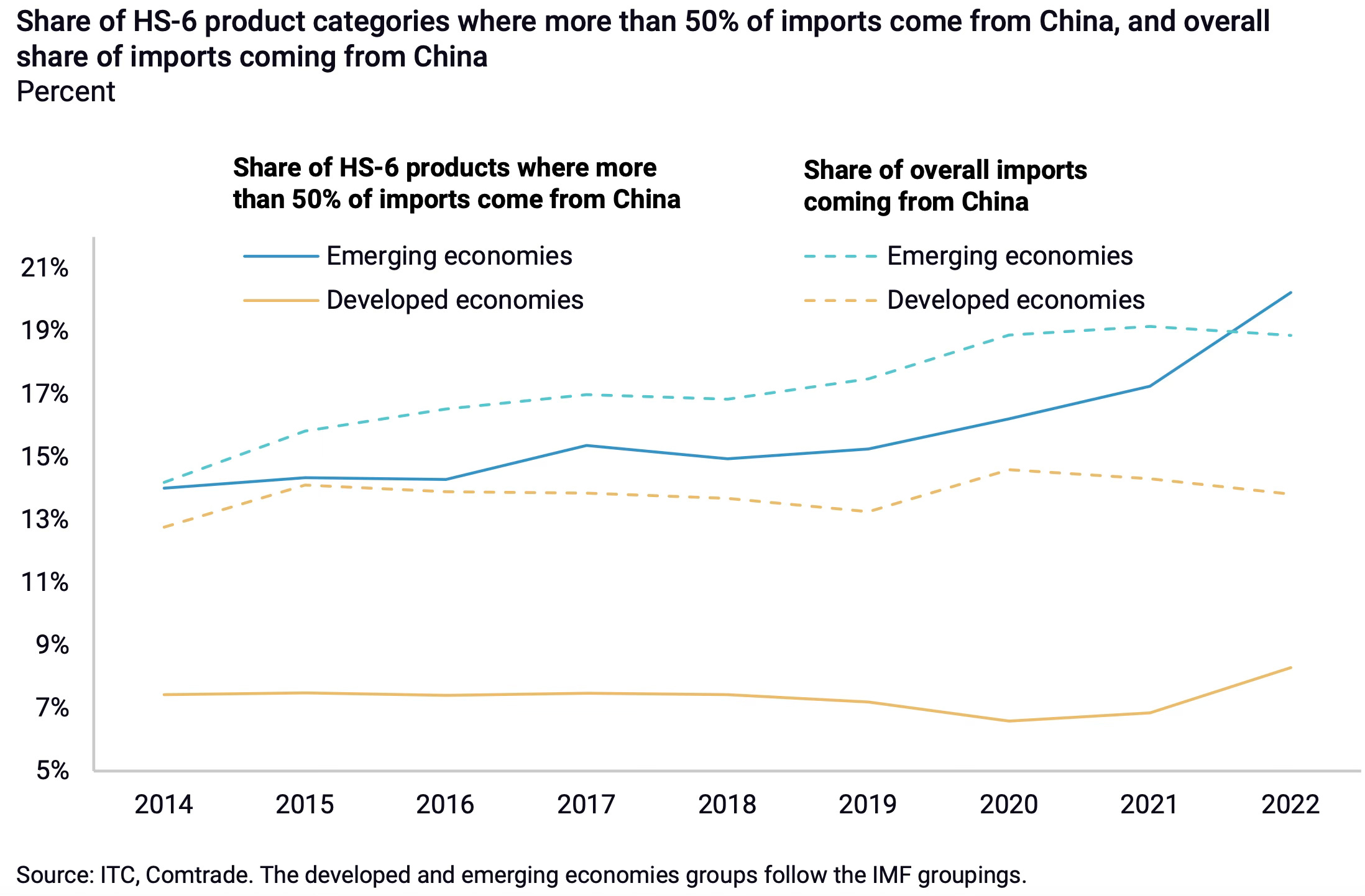
A recent report by the Rhodium Group discussed how China’s manufacturing overcapacity threatens to crowd out developing nations from manufacturing. It finds that emerging economies were reliant on China for more than half their imports in 20% of all HS-6 product categories in 2022, up from 15% in 2019. 

In contrast to the increasing dependence of developing countries on Chinese imports, the developed economies’ reliance on China is lower and has risen less sharply. It rose by just one percentage point in the same period to 8%. 

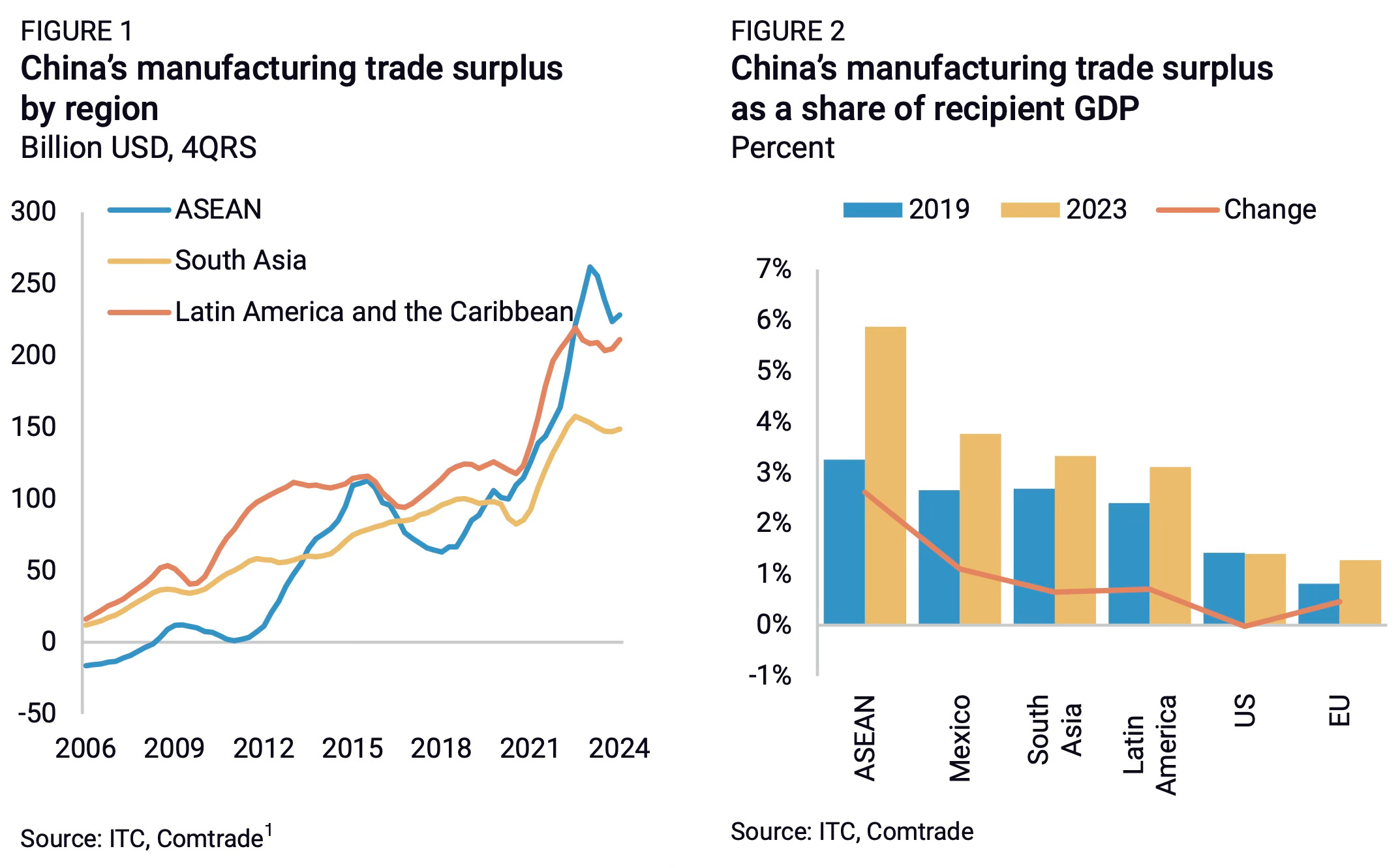
China’s manufacturing trade surplus with its favoured trade partners among developing countries is rising sharply, whereas those with the US and and EU are declining or stagnant. 

The report nicely captures the problems with China’s manufacturing dominance.

China’s share of global exports has variously been surpassed by at least one other major exporter (such as the US, Japan, or the EU) over the last few decades, but no other country has had the same level of global dominance across product categories since the early 1970s. Moreover, achieving that level of dominance is more significant now than in prior decades, when trade represented a much lower share of global goods production and consumption. For comparison, the global trade-to-GDP ratio in 1970 was around 25%. By 2022, that had risen to 63%. China’s dominance over so many product categories creates, first and foremost, a risk of economic coercion, where the government restrains access to crucial inputs for political leverage. Examples already exist, from rare earth exports to Japan in 2010 to more recent export controls on solar panels and other technologies and reported denied access to solar equipment in India…

But compared to other leading trading nations throughout history, the Chinese state is heavily interventionist, managing competition between its domestic firms and their external trade relations. State-owned enterprises accounted for half of China’s top 100 listed firm market capitalization in 2023 and 70% of listed companies declared that they hosted Communist Party cells within the firm as of 2022. This means that the Chinese government can encourage companies to partner together, merge and consolidate, coordinate to gain market shares, raise prices, restrict access to products where they already have substantial market power, or favor domestic firms in their suppliers and client networks. As a result, China’s dominant position across so many product categories considerably limits the space for new entrants to emerge as new manufacturing powers. 

Such a strong dominance in export markets also means that developing countries are vulnerable to changes within the domestic environment in China. Weakening domestic demand, combined with export-facilitating policies in products where China is the world’s dominant manufacturer, can cause prices to collapse globally and drive other national producers out of business. Consider the steel industry, where China accounts for more than half of global production. China’s property sector woes since 2021 caused vast overcapacity and led to a collapse in global prices, which now puts significant pressure on producers in India, Vietnam, Brazil, and other countries. China’s steel product exports are surging again—by 27% so far in 2024—after 35% growth last year…

Despite the country’s economic heft and manufacturing prowess, its dependence on the rest of the world (as reflected in its imports) has been remarkably minimal. Its economic growth trajectory has deviated from the standard flying geese model of moving up the value chain and vacating the lower-skill sectors for other emerging economies. 

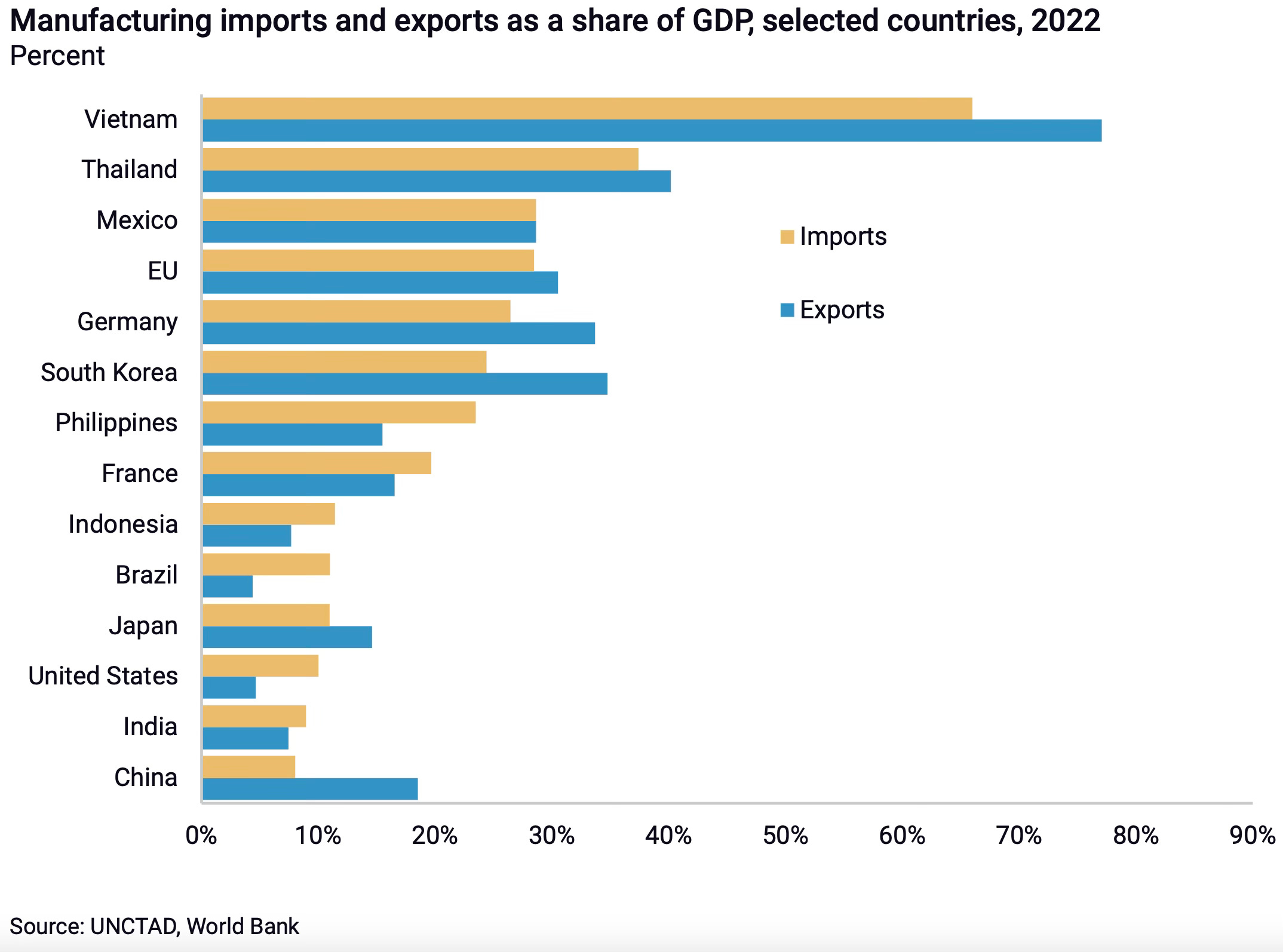
Over the past two decades, China’s move up the global value chain was expected to create massive demand for low value-added manufactured goods. This underpinned expectations of industrial development in emerging economies. That assumption is now undermined by China’s weak domestic demand and the growing gap between its manufacturing exports and imports. This gap is by far the largest in the world, and almost an order of magnitude larger than that of the worst years of trade imbalances in Germany, Japan, and South Korea. More than export competitiveness, weak Chinese imports explain this imbalance. Given the size of its economy, China is not exceptional in its large volume of manufacturing exports, but China has seen lower import volumes of manufactured goods than all other large economies in the world. Much of that imbalance can be explained by the small contribution of China’s household consumption to economic growth, which is the result of Beijing’s systematic policy support for producers and weak fiscal support for consumers. China’s domestic demand for imported manufacturing goods has been weak for years but was somewhat obscured by China’s reliance on imports related to the processing trade for re-export, and commodities imports. Both of the latter categories are now under pressure, particularly because of the slowdown in construction activity.

Since 2019, China’s manufacturing imports from emerging economies, already weak relative to the size of its economy, have plateaued in absolute terms for countries like Vietnam, or outright declined in the case of Malaysia and Thailand. Put differently, if China had increased its manufacturing imports as much as its exports since 2019, it would have created an additional $363 billion in import demand in 2022, or the equivalent of 11% of total manufacturing exports from developing countries. If it simply imported manufactured goods as much as it exported them in 2022, the additional demand would be equivalent to 54% of developing countries’ total manufacturing exports… While China still needs to import high-tech products from rich industrialized economies, it imports very few low-tech goods, where developing countries would have a comparative advantage. This is largely a result of deliberate policy interventions, which have intensified in recent years. While the central government has long emphasized developing high-tech industries, local governments sought to sustain low-end manufacturing companies through subsidies and other types of state support, because they are a vital source of local employment.

… since 2021, China’s high-level economic strategy has shifted emphasis toward retaining low-tech manufacturing jobs and production… As Xi Jinping remarked in 2023, China must “insist on promoting the transformation and upgrading of traditional industries and cannot regard them as ‘low-end industries’ to simply abandon.” Many provincial five-year plans followed suit, outlining quantified targets for the share of manufacturing in the local economy. As a result, deliberate policy interventions to retain low-end manufacturing have multiplied, with visible consequences on manufacturing jobs and production. The result is that China provides fewer opportunities as an export market for emerging countries while competing head-on with them in the low-tech and mid-tech space.

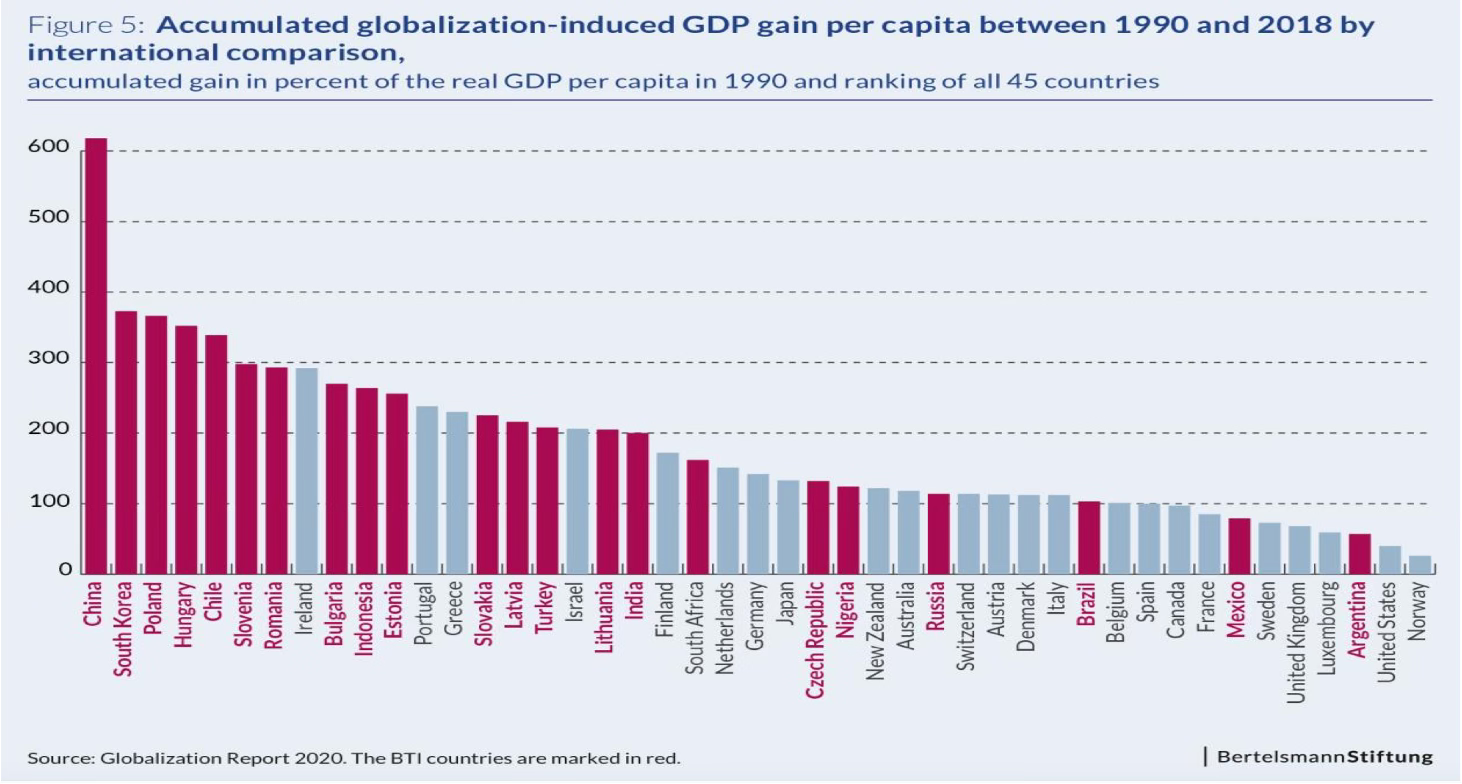
This graphic from a Bertelsmann Stiftung study shows that there has been only one mega beneficiary from globalisation and trade liberalisation, China! Others picked up the crumbs. 

The result of large hidden subsidies is a competitive advantage that no country can match.

US-made crystalline silicon panels generate energy at an average cost of 29.5 cents per watt, while First Solar’s panels hover above 30 cents per watt and were less efficient, according to BloombergNEF. A panel sourced in south-east Asia, meanwhile, can cost under 16 cents per watt, and in China, it is 10 cents per watt.

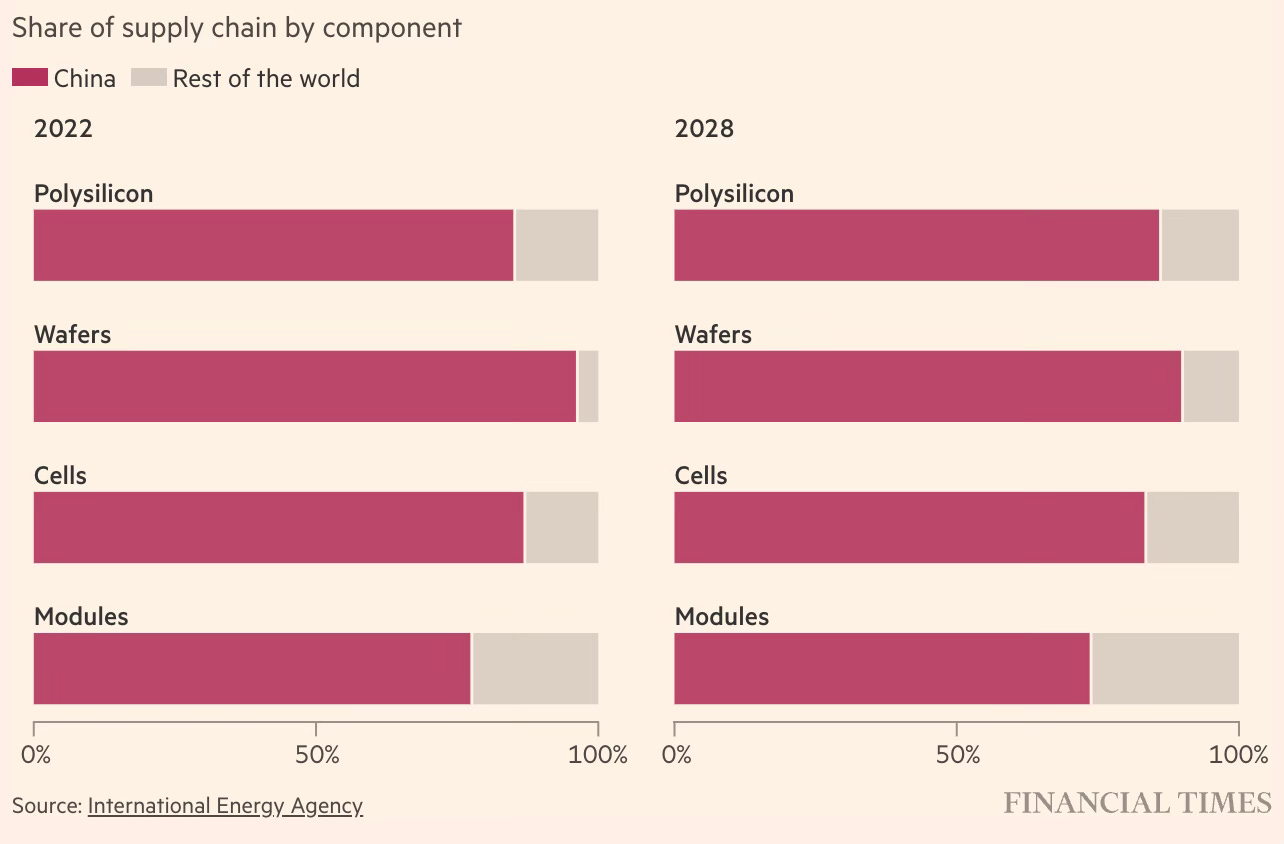
The result of this is a stranglehold on the solar industry supply chain that is nearly complete.

China's global dominance of the solar power generation market co-exists with companies making those wafers, cells, and panels, and their equipment losing money! Sample this from a story in NYT.

Nearly every solar panel on the planet is made by a Chinese company. Even the equipment to manufacture solar panels is made almost entirely in China... But China’s solar panel domestic industry is in upheaval. Wholesale prices plummeted by almost half last year and have fallen another 25 percent this year. Chinese manufacturers are competing for customers by cutting prices far below their costs, and still keep building more factories. The price slashing has taken a severe toll on China’s solar companies. Stock prices of its five biggest makers of panels and other equipment have halved in the past 12 months. Since late June, at least seven large Chinese manufacturers have warned that they will announce heavy losses for the first half of this year... Compounding the problems facing China’s solar energy companies is the rapid disappearance of local subsidies. Local governments are running out of money as a housing crisis makes it hard for them to sell long-term leases on state land to real estate developers — previously their biggest source of cash… 

The West is raising barriers to China’s solar panels. Europe has begun barring their use in government procurement projects unless Chinese companies disclose their subsidies, which they refuse to do. Partly because of worries about Chinese subsidies, President Biden last month allowed steep tariffs that had expired to go back into force on solar products imported from Southeast Asia that use lots of Chinese components…

Solar manufacturers across China have been laying off thousands of workers to cut costs — and those workers may be the lucky ones because they qualify for months of severance pay. Other big solar companies have resorted to tactics like giving yearlong unpaid vacations or 30 percent pay cuts for employees who keep their jobs.

The article highlights the example of one solar panel manufacturer

The rise and fall of Hunan Sunzone Optoelectronics in Changsha, the capital of Hunan Province in south-central China, is a case study of how China’s policies work. Started in 2008, the solar panel manufacturer benefited early on from practically every possible subsidy. It got 22 acres of prime land in the heart of the city almost for free. One of China’s biggest state-owned banks arranged a loan at a low interest rate. The Hunan provincial government then agreed to pay most of the interest. Despite the financial help, Sunzone’s factory now sits empty... Sunzone epitomizes how lavish lending from state-owned banks and generous local subsidies have produced manufacturing overcapacity. Solar companies cut costs and prices sharply to maintain market share. That led to a few low-cost survivors while many other competitors were driven out of business in China and around the world. China’s banks, acting at Beijing’s direction, have lent so much money to the sector for factory construction that the country’s solar factory capacity is roughly double the entire world’s demand. Sunzone’s 360-employee factory was big when it was built. Within a few years, rivals elsewhere in China were building much larger factories...

The storyline in solar is being repeated in the automotive sector.

Annual car sales in China are around 25 million, more than any other country but barely half the country’s ability to make vehicles. So automakers in China are now following the solar industry’s lead in cutting prices sharply and ramping up exports. China’s approach can lead to big financial losses for local governments, state investment funds and state-supported banks, all of which bankroll companies in favored industries.

Another NYT article describes how Chinese EV makers and their imports are making rapid ingress into Thailand and shaping the country’s EV industry in the manner that China wants. The Chinese EV makers see Thailand as a beachhead and are therefore focused on first capturing the local market and then establishing themselves for exports. And they are trying to do it rapidly enough before the global squeeze on Chinese manufacturers led by the US and EU starts to bind in countries like Thailand too. 

Chinese electric vehicle manufacturers like Aion are stampeding into overseas markets. Thailand is one of the first countries to experience the sudden influx of China’s automobile brands, and is confronting how their ambition and competitiveness are reshaping its car industry. The arrival of China E.V. Inc. is evident everywhere in Thailand. Billboards are blanketed with advertisements for Chinese cars. Land prices are soaring because so many Chinese firms are building car factories. The fast changes in the Thai auto market also show how Chinese companies are leaping ahead of their global rivals in Japan, which has shunned E.V.s, and the United States, where Tesla dominates the sector. Last year, sales of popular Japanese brands such as Nissan, Mazda and Mitsubishi plummeted as consumers bought new electric cars from Chinese manufacturers instead. Dealers that had worked with Japanese and American automakers for decades were now turning over showrooms to make way for Chinese vehicles. Amid an increasingly crowded field, Chinese brands are slashing prices on electric vehicles.

The overseas push is the next phase in Beijing’s long-term strategy to focus on new energy vehicles and upend the balance of power in the automobile industry. After years of government support for the sector, Chinese manufacturers are adept at mass-producing electric vehicles. They have established dependable supply chains, while working out the kinks to reduce prices. That international push has been met with tariffs in two major auto markets to prevent a glut of Chinese vehicles from crushing homegrown competitors. Last month, the European Union said it would impose tariffs of up to 38 percent on electric vehicles imported from China into the bloc. A month earlier, the United States quadrupled tariffs on E.V.s built in China. Thailand is small by comparison, but it is the biggest market in Southeast Asia. Known as the “Detroit of Asia,” it serves as a regional manufacturing hub. Its proximity and strong trade ties to China also allow Chinese cars to be imported quickly and inexpensively… In a market once considered a Japanese stronghold, a changing of the guard is already happening. Japanese automobile brands accounted for 86 percent of new car sales in 2022. That figure dropped to 75 percent last year, with China’s BYD, Great Wall Motor and SAIC Motor grabbing significant market share.

Realising the rapidly expanding squeeze on Chinese imports in developed countries, Chinese manufacturers across critical industries are adopting a two-pronged strategy to shed production from their massive excess capacity. 

On the one hand, they are expanding aggressively with low-priced imports to developing markets like Southeast Asia, the Middle East, Latin America, Eastern Europe, and Africa. Countries like Poland, Hungary, Brazil, Mexico, South Africa, Saudi Arabia, Indonesia, Thailand etc., are at the forefront of this rush to capture large and strategically important developing country markets. The local manufacturers stand little or no chance when faced with the heavily subsidised low-priced dumping of Chinese EVs. This capture of local markets is being complemented with efforts to form joint ventures and establish Chinese-controlled manufacturing facilities in these countries to use them as a base for exports to advanced countries. 

A combination of these two would make it more difficult for US and European efforts to keep out Chinese manufacturers, besides also deepening the country’s hold on the global supply chains and the industry itself. And the Chinese manufacturers are pursuing this strategy at great speed to capture as much market leverage as possible before the US and EU-led squeeze tightens further. 

“The window of opportunity for Chinese new energy vehicles going overseas will be relatively short,” said Ma Haiyang, general manager at Aion for Southeast Asia. “This is why we wanted to hurry up.”... Six Chinese electric vehicle companies are already selling cars in Thailand, and three more entrants are coming this year. BYD, Aion, Great Wall, Hozon Auto’s Neta and Chery are among those that have opened or are building factories in Thailand… Aion, in its first year in Thailand, has opened 41 showrooms and started production at a new factory this month. It has announced plans to open a plant in Indonesia and start selling its cars in nine countries across Southeast Asia.

The Chinese have been adept at dangling carrots and striking alliances with strategically important partners. 

Japan’s dominance over Thailand’s automotive industry dates to the 1960s when Nissan Motor and its local partner, Siam Motors, opened the country’s first car factory. Japan’s support helped establish the Phornprapha family, which owns the privately held Siam Motors, as the first family of Thailand’s car industry. But even within the Phornprapha family, alliances are shifting. Pratarnwong Phornprapha and Pratarnporn Phornprapha, the grandchildren of Siam Motors’ founder, control Rever Automotive, which is the exclusive distributor for BYD cars in Thailand. BYD, China’s leading E.V. company, competes directly with Siam Motors’ longtime partner, Nissan. BYD sold more cars in Thailand than Nissan did last year, even though the Chinese automaker had only three models available… This month, BYD said it had acquired a 20 percent stake in Rever for an undisclosed sum. In less than two years, Rever has opened 110 showrooms across the country, with the goal of another 50 by the end of 2024. Pratarnwong Phornprapha, the Rever chief executive, said there had been no tension within the family, because Rever was focused on electric vehicles and Siam Motors made traditional cars.

An example of this creeping capture of a country’s manufacturing base is Indonesia’s nickel industry, which has come to be dominated by Chinese companies. 

About 80 to 82 per cent of its battery-grade nickel output is expected to come from majority Chinese-owned producers this year, according to Benchmark Mineral Intelligence. This stems from Jakarta banning nickel ore exports in 2020 to force processors and battery makers to invest in the country. Chinese companies came forward quickly with billions of dollars. The investments have transformed the economy and made the nation a critical player in the global EV transition. Indonesia accounts for 57 per cent of global refined nickel production, and its share is forecast to rise to 69 per cent by the end of the decade, according to BMI. Only a handful of foreign companies that are not Chinese operate in the Indonesian nickel industry.

The Indonesian government is now trying to reduce Chinese influence and is finding it a big challenge.

Indonesia is trying to reduce Chinese investment in new nickel mining and processing projects to help its industry qualify for tax breaks in the US… Generous tax breaks are available from 2025 under President Joe Biden’s Inflation Reduction Act, but they will not apply to EVs containing batteries and critical minerals such as nickel sourced from “foreign entities of concern”, including some companies with more than 25 per cent Chinese ownership. That would hurt Indonesia’s industry, which has become the world’s biggest supplier of nickel on the back of a huge influx of Chinese capital over the past four years into mining and smelting projects. Indonesia’s government and industry are now working to structure new nickel investment deals with Chinese companies as minority shareholders… Last year, Indonesian government officials asked some Chinese companies if they would be open to taking a minority stake of about 15 per cent in nickel projects, according to an executive at a nickel producer. 

Another example is Kazakhstan that has critical minerals like Nickel and where the Chinese are investing heavily to strengthen their control over the supply chain. 

In this context, the Indian authorities should be watchful of the Chinese strategy in areas like solar panels and EVs. Like in Thailand, the Chinese have been quick to strike alliances with India’s big business groups. There are emerging partnerships between Chinese companies and the Ambani and Adani Groups, and other influential Indian corporate groups in the green technologies space. Indian groups are vulnerable to being allured into financially beneficial deals as virtual sleeping partners. It’s important that they be nudged or mandated to wrest significant technology transfers and local value addition in these partnerships.

In this context, India should be closely scrutinising the entry of Shein on the platform of Reliance Retail and JioMart. The cheap imports of Shein can become one more nail in the coffin of an already flagging local textile manufacturing base. It’s essential to have significant domestic content requirements that prevent wholesale import or cosmetic value addition in India. Shein can become the backdoor for the Chinese capture of what’s left of India’s textile and garment industry. 

I’m also not sure about how far developing countries can go with attracting Chinese investments as FDI, for some reasons. One, China has preferred debt to FDI as the dominant means of exporting capital. This is clearly borne out by the BRI, which focused on debt-financed infrastructure creation and largely stayed away from manufacturing investments. Similarly, its several natural resource deals in Africa and elsewhere have focused on extraction and exports, and avoided mineral processing investments in the host countries. 

Two, as the US and other advanced countries tighten their squeeze on China, it’ll no longer be easy for Chinese companies to access Western markets through the backdoor from other markets. This makes such joint ventures largely blunt as an export-promotion industrialisation strategy. Three, the Chinese companies don’t have a problem of large equity capital waiting to be channelled into investments in other countries. The country’s problem is not excess capital, but excess capacity that can be addressed only through exports. Given the well-documented profitability problems being faced by them, I’m not even sure they have the sort of risk capital to invest and expand in other markets on purely commercial considerations. 

Finally, given that all major economic strategies are dictated by the Party based on national interests, I don’t see how investing in building manufacturing capabilities in countries like India can further Chinese interests. Even if such capital comes to India as FDI, it’s most likely tied with enough levers to limit technology flows and with limited value addition, besides posing unseen strategic risks.