Substack

Saturday, December 23, 2023

Weekend reading links

1. NYT has an article on how the Russian government facilitated a massive wealth transfer in the process of facilitating the sale of western multinational corporation's businesses in Russia in the aftermath of the Ukraine invasion. 

Mr. Putin has turned the exits of major Western companies into a windfall for Russia’s loyal elite and the state itself. He has forced companies wishing to sell to do so at fire-sale prices. He has limited sales to buyers anointed by Moscow. Sometimes he has seized firms outright. A New York Times investigation traced how Mr. Putin has turned an expected misfortune into an enrichment scheme. Western companies that have announced departures have declared more than $103 billion in losses since the start of the war, according to a Times analysis of financial reports. Mr. Putin has squeezed companies for as much of that wealth as possible by dictating the terms of their departure. He has also subjected those exits to ever-increasing taxes, generating at least $1.25 billion in the past year for Russia’s war chest.

2. Business Standard reports that the R&D expenditures of Indian companies has been declining as a share of their net sales. It examined 445 S&P BSE 500 companies who spent Rs 651.3 trillion in the last decade of which less than one percent went into R&D. 

Even this limited R&D expenditure has been skewed towards recurring costs (salaries, wages and maintenance).
The decline in share of R&D expenditure has been seen even in technology intensive sectors like automobiles and IT. 
This is the comparison with other countries,
Companies in the United States spent the most on R&D (investing 8.1 per cent as a proportion of their net sales) in 2022. Chinese companies were the second biggest spenders (3.8 per cent) and the Japanese (3.8 per cent) came third. It was 1.7 per cent for Indian companies, according to data from the Economics of Industrial Research and Innovation.

3. TN Hari in Livemint has a long read where he questions the incremental value of big data in most contexts. He illustrates the example of BigBasket.

On an e-commerce platform like BigBasket, when you scroll down the list of ‘frequently purchased items’ to place your order, there would be a couple of items that are ‘recommended’ for you. Typically, the number of recommendations is around 5% of the items in the frequently purchased list of items. And the success rate—defined as the per cent of recommended items actually purchased by the customer—is around 2%. In other words, the increase in the order value because of recommendations is nearly a tenth of a per cent (2% of 5%).

Therefore, if your basket size is a thousand rupees, all that this data crunching and insights engine is achieving is to increase it by a rupee. Doing anything that increases the basket value of a customer is perfectly understandable as long as the cost of doing it is insignificant. Hence, it is not a bad idea to make a small one-time investment to build a recommendation engine, but making a big noise about how crunching big-data can transform your business, at least in this context, is a bit far-fetched.

He questions the value of data analytics in the well-known settings.

The ad-income model has created some wildly successful companies such as Facebook and Google. Amazon has also monetized its customer base to generate a decent income. The truth though is that companies like Google and Facebook are somewhat of an exception and a rarity. Building a business with the hope of monetizing, à la Google or Facebook, is extremely risky and naive. All other platforms with a customer base (or reader base) have struggled to earn ad-income. Most readers tend to skip ads, and the effectiveness of algorithms that drive the real-time placement of ads is highly questionable. There is also a growing realization that the only beneficiaries of Facebook and Google ads are Facebook and Google.

The ability to personalize ads is questionable. This writer has come across many friends and colleagues who continue to be highly amused by the jobs that LinkedIn keeps recommending for them based on its interpretation of their profiles and online activity. The recommendations don’t come anywhere near what they would be interested in... The business model of most fintech companies hinges on being able to evaluate the creditworthiness of borrowers accurately and quickly. The belief is that it would lower defaults. Successful lending has always been a trade-off between not lending to good borrowers (because of some wrong red flag) and lending to bad borrowers (because no red flag came up).

His summary is brilliant,

Crunching big data is somewhat akin to creating better image resolution... Unless the enhanced resolution results in recognition of new patterns that were not discernible at lower resolution with lesser data, there is no advantage of crunching this humongous data. And even if you assume that some additional patterns do show up, there is the non-trivial problem of monetizing them. This is where the universal Pareto principle kicks in, which is, 80% of patterns are evident with 20% of the data. Beyond this is the valley of severely diminishing returns. When you have a hammer in your hand, everything looks like a nail. In this case, the hammer is computing power.

Nothing can substitute for a deep understanding of your target group of customers and good execution. Someone wise had once said that when there is a gold rush the ones who make money are not the gold diggers but the ones selling shovels. And ironically, it is the gold diggers who always make the most noise about how the power of the new shovels would make them all very rich. When there is a rush to create and monetize customer data, the ones who make money are not the companies that wish to monetize their customer data but the ones selling computing capacity.

The science of thermodynamics is based on the premise that everything that matters about a gas can be understood without having to crunch data on the positions and velocities of the individual molecules.

4. Brilliant set of graphics on the power of compounding and other financial savings insights. This graphic on the percentage of gains required to recover from a loss.

5. Ruchir Sharma thinks Africa as the biggest problem for the world economy,
My research shows that a rate of growth in the working-age population of at least 2 per cent is a necessary condition for “miracle” economic growth, implying a sustained pace of at least 6 per cent. As of 2000, 110 countries had a working-age population growth that fast, nearly half in Africa. Now there are just 58, with 41 or more than two-thirds in Africa... Over the past five years, only three of the 54 African economies have grown at an annual rate of more than 6 per cent: Ethiopia, Benin and Rwanda. That is down from 12 in the 2010s. Not a single African economy has seen a transformative gain in average per capita income, and half have seen a decline, including three of the continent’s five largest countries — Nigeria, South Africa and Algeria. Africa is adding workers but not increasing output per worker.

6. Interesting snippet about donor funding of US universities

The US Council for Advancement and Support of Education calculates donations to US universities in 2022 were $60bn, including 14 per cent from those who gave at least $25mn each... the funding of American higher education, with once state-funded public institutions increasingly reliant on powerful donors like their elite, private, non-profit peers in the Ivy League... a longer-running discussion about the operation of university boards, including who is selected, how long they should serve, what their responsibilities should be, and how their relationships should be managed with a larger circle of donors...
Many universities have established sprawling boards with dozens of members, partly to cultivate and engage donations. MIT has 74 board members, while Cornell has 64. Harvard has a 12-strong corporation and a broader board of 32 overseers. Board members sometimes come from a narrow range of fields and many do not have academic backgrounds... Penn’s board has 48 voting participants, and a further 36 longstanding emeritus members who have reached the retirement age of 70 but are still allowed to attend and speak at meetings. Most are drawn from finance, including many who made large fortunes on Wall Street... “they are people especially from private equity and the hedge fund world who are used to getting their way in life”, and are “clubbable types” who frequently interact with each other and other donors, making them vulnerable to pressures beyond the Penn boardroom. “Trustees do have a bit of a conflict between their business, social and personal lives.”

Given how needlessly beholden the universities have become to Wall Street interests and the questionable governance structures, no wonder that US universities are now being blackmailed by vain and loud donors like Bill Ackman and Marc Rowan. 

This is a good long read on the issue.

7. Is TSMC contributing to Dutch Disease in Taiwan?

As of December 8, TSMC accounted for 26.8 per cent of the Taiwan Stock Exchange’s market capitalisation... Ko Wen-je, the former Taipei mayor who is challenging Taiwan’s largest two established parties, the DPP and the opposition Kuomintang, in the presidential race, also claimed that Taiwan was suffering from the “Dutch disease”. He pointed to a growing gap in investment and incomes between its tech sector and the rest of the economy... Economists agree that Taiwan’s economy is growing too lopsided. In the past two years, semiconductors accounted for almost 42 per cent of exports, up from about 33 per cent in 2016 when president Tsai Ing-wen and her Democratic Progressive party came to power...
The services sector which provides the majority of jobs — it employs 4.8mn people compared with just 663,000 in the chip industry — is languishing because sluggish consumption during the pandemic has weakened its mostly small companies... According to TSMC’s 2022 ESG report, the company, including a handful of overseas plants, consumed 21,056GWh of electricity, equivalent to 7.5 per cent of Taiwan’s entire power consumption last year.

8. Pharmaceutical drug of the year should undoubtedly be Novo Nordisk's Wegovy and Ozempic. This is a very good profile of Lars Fruergaard Jørgensen, the understated CEO of the company. The company's blockbuster diabetes treatment drugs have become game changers in obesity treatment and have the promise to prevent heart attacks and also treat Alzheimer's disease by reducing inflammation in the brain. 

Fatima Cody Stanford, an expert in obesity medicine at Harvard Medical School, says the drugs will be “highly influential” and may lead to a decline in the need for treatment for conditions such as hypertension, kidney disease, fatty liver disease, diabetes and sleep apnoea. Novo Nordisk is running a late-stage trial to see if semaglutide could treat the widespread neurodegenerative disease Alzheimer’s, and external researchers are also intrigued about the potential for the drugs to be used to treat alcohol addiction.

The article points to the long-gestation of the development of these drugs,

The drugs began life at Novo Nordisk 32 years ago — by coincidence, when Jørgensen joined the company. Wegovy and Ozempic are both made from semaglutide, a version of an appetite-reducing hormone called GLP-1. But in the body, the hormone only lasts for minutes, so Novo’s scientists spent years making it stable enough to use as a medicine. Jørgensen’s time at the company has coincided with a long-term bet on the potential of this new science. The first real breakthrough came 14 years ago, when the drugmaker got its first approval for a GLP-1 drug for diabetes in 2009. Another version followed in 2015, targeting weight loss. But it only helped patients lose about 5 per cent of their body weight. It would take six more years until Wegovy was approved, after a trial showed an average of 15 per cent weight loss.

And how the company ownership structure allowed it to take the long-term view.

Novo Nordisk could invest for the very long term partly because of its unusual ownership structure. Initially called Nordisk Insulinlaboratorium, the company was founded in 1923 by the Danish Nobel laureate August Krogh, pharmacist August Kongsted and scientist Hans Christian Hagedorn. The Canadian scientists who discovered insulin granted the pair permission to produce it in Scandinavia, with a caveat: the proceeds from its sale should be reinvested in research. So they set up the Novo Nordisk Foundation, which thanks to the company’s growth is now the world’s largest philanthropic foundation by assets. Novo Holdings, which manages the foundation’s wealth, has 77 per cent of the voting rights of Novo Nordisk. Martin Jes Iversen, an associate professor of strategy and innovation at Copenhagen Business School, says the structure kept the company committed to its broader purpose beyond profitability. It also ensured Novo Nordisk was not for sale.

This is a list of other medical conditions that such semaglutides like Ozempic might be able to treat. They include alcohol abuse disorder, polycystic ovary syndrome, liver disease, cardiovascular issues, sleep apnea, and kidney disease.  

9.  If the proposal by Nippon Steel to buy the ailing US Steel for $14.9 bn is rejected on political grounds, as is being demanded by leading US politicians on national security grounds, then it should count as protectionism becoming mainstream in the US politics. As an FT columnist wrote,

The now bipartisan American backlash against Nippon Steel’s $14.9bn purchase of US Steel — a deal driven by robustly commercial motives and for which the Japanese buyer is shelling out roughly twice what a US bidder was prepared to pay — appears to be shaped by the idea that even close friends merit suspicion... If Nippon Steel’s deal is approved, it will draw a mid-ranked American company under the umbrella of one of the world’s top three steelmakers, none of which is American. Specifically, it will make that company more competitive with Chinese rivals (that are genuinely state-owned) in an era where that battle is the greater threat. The tougher question, though, is that of trust. If Japan does not count as a legitimate buyer of assets in the US, who does?

10. Finally, Martin Wolf has a set of sobering graphics about the indebtedness among the 75 low income countries eligible for assistance from the World Bank's soft-loan arm, IDA. The risk of debt distress has soared among these countries, with 28 countries eligible to borrow from IDA now at high risk of debt distress and another 11 in distress. 

Contrary to expectations of private sector stepping in as important contributors to financing infrastructure and other capital requirements in developing countries, their share in external financing to low income countries has been falling.

And Chinese lending to these countries has been on a declining trend for some years.

Wednesday, December 20, 2023

Limits to technology - body cameras edition

NYT has an excellent long read that evaluates the use of body cameras by police departments. It’s a sobering reminder on the limits to the use of technology in governance. 

Body cameras were once considered the holy grail to get police officers exercise restraint and thereby address the chronic problem of abuse and excess.

When body-worn cameras were introduced a decade ago, they seemed to hold the promise of a revolution. Once police officers knew they were being filmed, surely they would think twice about engaging in misconduct. And if they crossed the line, they would be held accountable: The public, no longer having to rely on official accounts, would know about wrongdoing. Police and civilian oversight agencies would be able to use footage to punish officers and improve training…

In 2013, Judge Shira Scheindlin was hearing testimony in a federal lawsuit in which multiple advocacy groups claimed that the Police Department’s aggressive “stop and frisk” policy was racially biased and unconstitutional… Two months later, Scheindlin issued a historic ruling that New York’s stop-and-frisk practices were unconstitutional. She ordered the Police Department to begin piloting body-worn cameras, writing that they were “uniquely suited to addressing the constitutional harms at issue in this case.” Scheindlin laid out three different ways the cameras would help: “First, they will provide a contemporaneous, objective record of stops and frisks.” She continued: “Second, the knowledge that an exchange is being recorded will encourage lawful and respectful interactions on the part of both parties. Third, the recordings will diminish the sense on the part of those who file complaints that it is their word against the police.”

… the technology represented the largest new investment in policing in a generation... Body-worn cameras were adopted by police departments across the country in the wake of widespread Black Lives Matter protests in 2014, sparked when Michael Brown was killed by the police in Ferguson, Mo... President Barack Obama put the cameras at the center of his plans to restore trust in policing. Cities quickly began spending millions on the devices, expenditures that continue today for storage and software. Los Angeles has spent nearly $60 million since getting cameras in 2016... New York City has spent more than $50 million...

But its outcomes have turned out very different from expectations.

As policymakers rushed to equip the police with cameras, they often failed to grapple with a fundamental question: Who would control the footage? Instead, they defaulted to leaving police departments, including New York’s, with the power to decide what is recorded, who can see it and when. In turn, departments across the country have routinely delayed releasing footage, released only partial or redacted video or refused to release it at all. They have frequently failed to discipline or fire officers when body cameras document abuse and have kept footage from the agencies charged with investigating police misconduct... But whether citizens benefit from the cameras they’re paying for is often up to the police, who have often been able to keep footage hidden from the public in even the most extreme cases... The reporting reveals that without further intervention from city, state and federal officials and lawmakers, body cameras may do more to serve police interests than those of the public they are sworn to protect.

To Seth Stoughton, a former police officer who is now a professor at the Joseph F. Rice School of Law at the University of South Carolina, body cameras represent the latest chapter in America’s quest for a technological fix to the deeply rooted problem of unchecked state power. “Dash cams were supposed to solve racial profiling,” he says. “Tasers and pepper spray were supposed to solve undue force. We have this real, almost pathological draw to ‘silver bullet’ syndrome. And I say that as a supporter of body-worn cameras.” 

Technology does not address the problems of poor governance, political economy, deeply rooted cultural attributes etc. If the stakes associated with some issue is very high, not even the most sophisticated the technology can address it. 

The secrecy undercuts the deterrent effect on officer behavior that many had presumed body cameras would produce. Three years before the Minneapolis police officer Derek Chauvin murdered George Floyd by kneeling on his neck, body-camera video caught him kneeling on the necks of others. In 2017, Chauvin dragged a handcuffed Black woman out of her house, slammed her to the ground and then pressed his knee into her neck for nearly five minutes. Three months later, Chauvin hit a 14-year-old Black boy at least twice in the head with a heavy flashlight, choked him and pushed him against a wall. The boy cried out in pain and passed out. Chauvin pushed a knee into his neck for 15 minutes as the boy’s mother, reaching to help him, begged, “Please, please do not kill my son!”

The footage was left in the control of a department where impunity reigned. Supervisors had access to the recordings yet cleared Chauvin’s conduct in both cases… “Chauvin should have been fired in 2017,” says Robert Bennett, a lawyer who represented both of the victims… A Department of Justice report from this summer found that the secrecy and impunity was all part of a larger pattern in the Minneapolis Police Department. Shootings, beatings and other abuse had routinely been captured on video. But the department didn’t make the footage public or mete out punishment… There was a similar dynamic in Memphis, where officers in a street-crimes unit regularly abused residents. They wore body cameras but faced no consequences until the case of Tyre Nichols, who was beaten to death this January by officers in the unit, attracted national attention.

There’s the issue of policy intent, as illustrated by the NYPD’s body cameras policy of 2017,

No video would automatically become public. Anyone that requested it would have to go through an opaque, often slow-moving Freedom of Information process — in which the department itself would be the arbiter of what would be released (though the courts could review that decision). The policy blunted the technology’s potential for accountability in other ways. Officers could decide when to start filming, instead of at the beginning of all interactions as the public wanted. And while the public had little access to footage, the police had privileged access: Officers who were the subjects of complaints would be allowed to watch the footage before having to give any statements — something that could allow them to tailor their accounts to the video. The policy was “so flawed that the pilot program may do little to protect New Yorkers’ civil rights,” Ian Head and Darius Charney of the Center for Constitutional Rights wrote in a guest essay in The New York Times. “Instead, it might shield police officers from accountability when they engage in misconduct.”

The lack of policy intent is demonstrated by the obfuscation and excuses given by the Departments in response to requests to release video footage of incidents under the Freedom of Information Act. 

After it rejected her initial request, she appealed the decision. The department sent her some redacted footage but again rejected her request for all of it. Disclosing the full footage would be an “unwarranted invasion of personal privacy,” the department wrote. Whose privacy — the dead man’s or the officers’ — was not explained. Releasing the full footage, the department insisted, could “endanger the life or safety of any person.”

Even oversight institutions within the government struggle to access the video footage,

The city’s Civilian Complaint Review Board had been vested with the responsibility to investigate New Yorkers’ allegations against the police… Nicole Napolitano… joined the review board as its new director of policy and advocacy in September 2017… As with most civilian boards across the country, the agency did not have its own access to footage. Like the public, it, too, had to rely on the cooperation of the department. To try to obtain footage, the board had to navigate a baroque multistep process. Written requests were submitted to a department “liaison” unit, which in turn forwarded them to the legal unit for review. Then the department had to locate the footage, which was a significant undertaking because it wasn’t cataloging the footage in any systematic way. Unlike in many other cities, the department’s cameras had no GPS location data. If a civilian making a complaint didn’t know an officer’s name or badge number, investigators and even the department could have a hard time finding footage. Perhaps most problematic for Napolitano, though, was the fact that the review board’s investigators had to agree to a strict set of conditions before watching videos of incidents. If they spotted other, unrelated misconduct, they were not allowed to investigate it… Napolitano and her colleagues noticed an even more troubling trend: The department would often tell the review board that the footage it requested didn’t exist — only for the civilian agency to later discover that wasn’t true. According to an analysis the agency put out in early 2020, this happened in nearly one of every five cases.

Internal controls just breakdown completely and egregiously when there’s no institutional resolve to address the problem.

This year, a federal court monitor wrote a scathing report about persistent problems with stop-and-frisk, the unconstitutional policing tactic that prompted Judge Scheindlin to order the department to adopt body cameras a decade ago. The monitor found that contrary to Scheindlin’s expectations, police supervisors weren’t using footage to flag misconduct. In a sample of cases the monitor looked at, supervisors reviewing footage of stop-and-frisk encounters concluded that 100 percent of the cases they looked at were proper stops. The court monitor reviewed the same footage and found that 37 percent of the stops were unconstitutional.

This conclusion about the reluctance of the Police Departments to use footage to enforce accountability is apt.

“Body cams are essential, if done right,” says a high-ranking commander who just retired and who spoke on the condition of anonymity because he still works in law enforcement. “They are a game changer.” He added: “If there’s a problem, you flag — and potentially there’s discipline. But that’s not happening in most cases.”… “Body-worn cameras have not been exploited the way they should be,” says Jeff Schlanger, the former deputy commissioner. “The way to true reform is through using body cams as an early-warning system, as a way to correct small mistakes before they become big mistakes. But there weren’t a lot of discussions about it. The N.Y.P.D. needs to do a lot better.”

This is the kind of commitment required to make such technologies succeed. 

One of the most comprehensive studies of the use of body cameras, a 2019 meta-analysis led by researchers at George Mason University, recommended that police departments consider using footage the way sports teams use game tape, to regularly review and improve performance.

Some observations:

  1. There’s no denying that body camera is a very effective device to capture police actions and incidents. But body cameras are not very effective in reducing the problem of abusive actions and use of excess force by police officers. The difference between the two lies in the challenges arising from the use of body cameras to monitor and administer the actions of officers in police departments. 

  2. This is the challenge with new many new ideas. Translating an idea or innovation to implementation at scale is a near universal problem, and involves the issue of how the new idea interacts with the system’s environment. 

  3. Impact evaluations done in sanitised environments and supervised by energetic and committed research assistants merely assess the technical efficacy of body cameras in detecting abuses and excesses. They do not evaluate the efficacy of these cameras in reducing the systemic problem of abuses and excesses by police officers. In fact, they cannot ever evaluate such efficacy since there are too many confounders and systems vary widely in their characteristics. 

  4. The technology innovation, body cameras here, have to be complemented with its effective deployment (positioned to capture actions, should not be possible for the police officer to tinker with it etc) and its effective adoption by the primary stakeholder (the police department in monitoring errant actions and administering disciplinary action). The last, in particular, is dependent on state capability, systemic culture, and governance. And none of these are addressed by the technology innovation. 

  5. Technology solutions are rarely the solution to intractable systemic problems on social/public issues. At best they can improve things at the margins. In any case, without addressing the institutional structures or incentives or cultures that create these problems, technology solutions are unlikely to be of much use.

  6. The most important requirement for successful adoption of such new technologies is institutional commitment. Without such commitment, the innovation is a non-starter. The system will easily stifle the innovation and leave it a failure or even worse than before. 

Monday, December 18, 2023

Problems with international development IV

I blogged here highlighting the obsession in international development circles with new ideas and innovations and neglect of regular development interventions, and examined the reasons, here questioning the belief that there are new ideas and innovations waiting to make a transformative impact, and here that policies in most of development matter very little and it's mostly about implementation. 

I have blogged earlier that evaluation in the context of international development refers mainly to new programs, of headline impact, and is post-facto. This is at variance from the real world value of evaluations. A presentation on this topic is here

This post will question the conventional wisdom on impact evaluations and instead argue that evaluations should focus on the use of administrative data (and surveys) coupled with qualitative information to help improve the effectiveness of implementation.

International development actors are focused on new ideas (and not new programs - and they are different and I’ll blog next on this). This partially explains the focus on headline evaluations. But as I blogged here, there are too few altogether new ideas and interventions. Instead there are badly implemented programs with well-known sets of program features. 

This makes evaluations aimed at improving the implementation of ongoing programs and interventions very relevant. Instead of evaluations of headline outcome or impact, the requirement is for an understanding of whether the implementation is being done with fidelity and whether the premised theory of change is holding up. Ideally, instead of providing static post-mortems, evaluations should provide actionable concurrent decision support. 

Consider the examples of a few development interventions. A cash transfer program, a health insurance program, an agriculture extension program, a skill development program, a school ICT program (smart classroom and tablets), a price stabilisation scheme for certain agriculture crops, a mobile health clinic program, a maternal and child health intervention, an agricultural free power metering initiative, a community mobilisation campaign etc. 

In all these cases, there are certain issues that are of first order interest to policy makers and program implementors. Consider the following questions:

1. Are all the important implementation elements being captured and periodically reviewed? How can monitoring and review be improved?

2. Is the program being implemented with fidelity as intended? If not, where are things not going right and what can be done to address them?

3. Is the theory of change holding? What are the signatures that point to it failing or succeeding?

4. What are the proximate determinants (or proxies) of impact? Is the program generating the expected impact? If not, what's going wrong and what can be done to address them?

5. In light of all the above, what can be done to improve outcomes? Any program design changes, complementary interventions, any technology application?

The mainstream quantitative and experimental evaluation strategies and techniques are not suited to investigate these questions that involve details of the program's operational dynamics. This is also because, unlike in developed countries, there are some important challenges associated with program evaluations in developing countries.

For a start, given weak state capabilities, the implementation fidelity is generally poor. This means that any evaluation ends up assessing a poorly implemented version of the program. This becomes an evaluation of the implementation and less of the program itself. 

From the perspective of evaluation, a major deficiency with government programs in developing countries is the lack of a clear delineation of the theory of change and articulation of objectives in terms of desired outcome/output parameters. They are essential to examine intermediate and proximate indicators and thereby assess the broad directionality and extent of change taking place from the intervention. 

In development interventions, most often there are so many other confounding factors that establishing causal relationship is almost impossible. Finally, several contextual factors (social, cultural, and local political) act as binding constraints that weaken the implementation fidelity and outcomes realisation. All these factors are more pronounced in developing country contexts. 

In the circumstances, meaningful program evaluations require a combination of quantitative and qualitative assessments. The former would include analysis of administrative data and carefully designed surveys. It should be layered on top of observational studies of the program implementation. 

Further, these evaluations should prioritise the realisation of execution fidelity. This would entail looking at inputs, processes, and intermediate outputs. It would entail examining and answering the questions posed above. The answers should provide decision-support to tweak and improve implementation.

There’s also a genuine demand side failure that has contributed to the absence of such evaluations. Politicians assume that their programs must and will succeed. Bureaucrats, for a variety of reasons (cognitive biases, over-confidence, poor state capability, absence of supply-side, procurement challenges, uncertainties and increased work, limited posting durations etc), do not demand evaluations of the kind that would generate actionable implementation decision-support. Instead impact evaluations commissioned by governments are almost always with the unsaid intention of validation and publicity. 

In conclusion, headline impact evaluations of ongoing programs are likely to be neither accurate and relevant, nor resonate with policy makers. The presence of numerous counterfactuals means that there are likely several omitted variable biases, thereby weakening the findings of the impact evaluation. They also provide convenient excuses for the policy makers and politicians to reject such findings. In any case, junking or significant changes to an ongoing program runs into political economy and other problems. 

Saturday, December 16, 2023

Weekend reading links

1. Latest PISA results points to significant learning losses from Covid 19 pandemic across the world. 

One interesting finding is the relative decline of Finland's standards

Some of the largest declines in both equity and overall attainment occurred in Finland, once regarded as one of the more successful European education systems. Learning loss since 2018 was almost three times the OECD average in reading and four times higher in science, but educational outcomes in the Nordic country were deteriorating even before the pandemic. Andreas Schleicher, director for education and skills at the OECD, says this was because Finland relaxed its academic expectations for students... There have been significant changes to the Finnish education system in recent years, with traditional subjects scrapped in favour of an approach called “phenomenon-based learning” that requires students to draw on multiple subjects to solve problems. It is also unusual in having no standardised national tests, aside from the matriculation exam at the end of secondary school for students applying to university.

Estonia has emerged as the new model, though its approach may be hard to replicate in larger countries.

Estonia’s education minister, Kristina Kallas, says its community-based system that hands schools considerable autonomy over resources and curriculum is hard to replicate in other European countries. But there are successful practices in Estonia that can be replicated elsewhere. “The common aspects of [successful systems] are teacher competence and autonomy, and the student mindset . . . to aim high and work hard,” she says. Although children start school aged seven, later than in most other developed economies, most benefit from Estonia’s high-quality pre-school system where teachers are required to have a bachelor’s degree. Almost 90 per cent of children are enrolled in pre-school for at least three years, compared with the OECD average of 57 per cent. “[Children] have very affordable and accessible pre-school. It’s still mostly play and developing social skills, but it is a pedagogical approach and we have high quality requirements,” says Kallas.

2. China's consumer price inflation falls by 0.5 percent year on year in November, following 0.2 per cent decline in October. Producer prices have been on the negative territory for the past year. 

This comes on the back of a decision by rating agency Moody's to cut the country's sovereign credit rating to negative citing growing risks of persistently lower midterm economic growth and overhang from property sector crisis. 

More than 1.5 million people now work at dozens of electric vehicle companies in China and their suppliers. The largest of them, BYD, has 570,000 workers, compared with 610,000 worldwide for Detroit’s Big Three combined.

4. Argentine President Javier Milei will struggle to implement dollarisation in an economy struggling to survive and with no foreign exchange reserves. 

Argentina’s economy is in its most fragile state for two decades, with annual inflation running above 140 per cent. The central bank has exhausted its foreign exchange reserves, leaving businesses unable to buy the dollars to settle some $60bn worth of debt with foreign suppliers, and the government is at risk of going into arrears on its $43bn programme with the IMF, which Milei will need to renegotiate. Interest payments are spiralling on a pile of more than $20bn in short-term liabilities issued by the central bank to local financial institutions to mop up an excess of pesos in circulation.

In the meantime Milei's government has made his first major economic policy announcement to devalue the Peso by half, slash public spending, and reduce energy and transport subsidies.

The new government would move the official exchange rate to 800 to the dollar from levels just below 400 last week. Banks had already anticipated a sharp devaluation, but the new official level for the dollar was still some way below the black market rate of 1,045 on Tuesday. Federal budget transfers to the provinces would be cut to a minimum and all new public works projects halted, the minister said... Caputo also announced a temporary rise in taxes on imports but promised to scrap the existing system of government permits for imports. Export taxes, which are hated by Argentina’s powerful farming lobby, will be removed once the economic emergency is over. To offset the impact of the cuts on the more than 40 per cent of Argentines living in poverty, Caputo said the value of the government-provided food card would rise by 50 per cent and child benefits would double. The budget for one of Argentina’s largest welfare programmes, Potenciar Trabajo, would be frozen at 2023 levels.

5. Staying on in South America, in case you missed it in an extraordinary referendum, Venezeulans have voted overwhelmingly to claim rights over Guyanan territory. More than 10 million people voted with atleast 95% support in the referendum that the oil rich Guyana Esequiba region, which makes up 60% of Guyana, should become a Venezuelan state. And days after the vote, Venezuelan President Nicholas Madura ordered the state-owned companies to grant licenses for oil exploration in Essequibo.

6. Remarkable that profit margins of corporates in the US have spurted during the post-pandemic period. In fact, interesting that net profit margins of US S&P 500 companies have been rising steadily since 2010, even as labor wages have been relatively stagnant. 

Big companies that had previously pushed through one standard price increase per year are now raising prices more frequently. Retailers increasingly use digital price displays, which they can change with the touch of a button. Across the economy, executives trying to maximize profits are effectively running tests to see what prices consumers will bear before they stop buying... For big companies in the S&P 500 index, the average profit margin — the percentage of profit relative to revenue — soared in late 2020 and into 2021, as government stimulus and the Federal Reserve’s emergency interventions stoked consumer demand. At the same time, companies raised their prices so much that they more than covered higher costs for energy, transportation, labor and other inputs, which have recently started to come down.
Corporations as varied as Apple and Williams-Sonoma recently reported their highest-ever margins for the third quarter, while Delta Air Lines said its international routes generated record profitability over the summer... Average margins in nearly every sector in the S&P 500 are running near or above 10-year highs, according to Goldman Sachs.

It's also interesting that this accompanies a subtle shift in strategy by companies from chasing growth (which often entailed competing aggressively to lure customers) to focusing on margins.  

7. Andy Mukherjee points to the emerging Reliance-Sony duopoly in India's television and streaming market.

8. Fascinating long read in FT on Japanese savers who have over a three-decade span of near zero interest rates and having been scarred by the stock market crash of the late eighties preferred to save in currency and cash deposits over equities or real estate, but are now facing the prospect of higher interest rates on the back of inflation which has now spend more than 18 months above the BoJ's 2% target rate. 

Even after 30 lean, post-bubble years, Japanese households hold ¥2.1 quadrillion ($14.7tn) of financial assets, of which more than half ($7.7tn) is held in cash and deposits. By contrast, households in the US and UK respectively hold 13 and 31 per cent in deposits. In national terms, Japan’s cash savings alone are equivalent to the combined annual gross domestic product of Germany and India. In corporate terms, Mrs Watanabe could buy Apple, Microsoft and Saudi Aramco with what she has sitting (earning almost zero interest) in the bank. When prices in Japan were stagnant or falling, as they were for most of the past 25 years, Mrs Watanabe’s preference for holding the majority of savings in cash was reasonable, especially so after the government guaranteed bank deposits in 1995. The central bank’s long experiment with ultra-low interest rates, which began in the late 1990s, meant she was not making any returns, but nor was her wealth being significantly eroded as long as Japanese companies held back from raising prices. But as more and more Japanese companies have broken ranks and raised prices in the past couple of years, Mrs Watanabe has arrived at a pivotal moment...
After years of failed efforts to coax that exact switch into investment, the Japanese government has created an unprecedented inducement. From January 2024, a dramatically expanded version of the Nippon Investment Savings Account, or Nisa, will offer a remarkable lifetime tax exemption for individuals’ equity investments. They have also raised the limit on both annual contributions from ¥1.2mn to ¥3.6mn and the cumulative limit from ¥6mn to ¥18mn. If the ploy works, it will begin to offset an aversion to stocks that has bedded-in since the collapse of the 1980s stock bubble. Japanese households hold just 24 per cent (17 per cent direct and 7 per cent through their pensions) of their assets in equities — far lower than the 54 per cent in the UK and 75 per cent in the US. That sets up, over the coming weeks and months, one of the biggest questions ever asked of the Tokyo stock market, its constituent companies and of Mrs Watanabe. Are savers about to become serious, price-moving retail investors in a domestic Japanese stock market that they have long shunned like a casino? Even a relatively moderate positive answer and a mere 2 per cent reallocation of assets, say analysts at AllianceBernstein, could produce $150bn of inflows into equities. If that happened, it would be market moving, say brokers. Inflows of less than half of that from foreign investors triggered a rally of more than 25 per cent in the Topix this year...
In the 1970s, Japanese individuals owned 40 per cent of the Japanese stock market. After stocks peaked and then crashed in the late 1980s and early 1990s, that ratio began to sink towards its current level of just 17.6 per cent.

It's interesting that many companies are bundling "shareholder benefit schemes" - offers of food products, cash equivalent prepaid cards and other perks - along with share ownership. Supermarket chain Aeon, who shares are very popular, distributes benefit cards with store discounts, and Oriental Land offers a one-day passport to Tokyo Disneyland! 

9. Bloomberg article on Salesforce's marketing and sales focus 

Salesforce built an army of cheerful young people who spent a lot of their time checking in and hanging out with customers such as Amazon, PayPal, Spotify and Uber. The company’s “customer success” teams functioned as in-house consultants for clients, helping them set up applications and use new features—a service that consulting companies could have charged many thousands of dollars more for. “We recognized the more successful the customers are with your technology, the higher likelihood they’re going to spend more money with you going forward,” says Brian Millham, who joined Salesforce more than two decades ago as one of its first salespeople and now serves as chief operating officer.

The bet worked. Salesforce was bringing in $1 billion a year in revenue by 2009 and $26 billion by 2022. Some of that came from increased demand for its CRM software, but most of it came from selling leases for new tools, often ones Salesforce acquired. The 2013 purchase of ExactTarget gave the company a marketing product so Salesforce clients could email everybody who might have browsed, say, a pair of shoes on their site; Demandware, purchased in 2016, brought a tool for building those e-commerce sites. Salesforce has bought nearly 70 companies since its founding in 1999. One of its largest acquisitions, MuleSoft, gave Salesforce the means to stitch all these different software platforms together.

10. Two nice long reads in The Economist on UAE and London. Both have, in different ways and over differing time periods, proved how countries and cities can adapt to changes. UAE, with just 1 million citizens out of a total population of 10 million, has sought to diversify its economy away from oil and has done so successfully. It competes with Hong Kong and Singapore in attracting businesses and high networth individuals.  

Dubai, which has little oil of its own, led the way, creating lightly regulated, low-tax economic zones designed to attract multinationals... its basic economic formula, of turning itself into a trading entrepot, transport hub and financial centre, remains successful. At the same time, the UAE has invested its oil wealth in strategically important industries and strategically important parts of the world... Start with the Emirates’ role as an entrepot. The fact that it is within easy flying and shipping distance of most of Africa, Europe and Asia makes it a natural hub. DPWorld, a firm owned by the government of Dubai, runs Jebel Ali, one of the world’s biggest container ports. Dubai airport is the busiest in the world for international travel. Logistics have grown to account for nearly 8% of the country’s GDP.

But the business climate is as important as geography. In an index of economic freedom compiled by the Heritage Foundation, an American think-tank, the uae ranks 24th out of 176 countries—one notch above America. Foreigners laud the ease with which offices can be set up, flats rented, visas approved... In recent years, businesses have set up in Dubai at a frenetic pace: the number of new businesses joining the city’s chamber of commerce rose by more than 40% in the first half of the year, compared with 2022. A fifth went to Indian firms; the numbers of companies from China and elsewhere in the Middle East also grew rapidly... For Chinese ones, it has become an offshore trading hub. One example is Dragon Mart, a wholesale and retail complex in Dubai that bills itself as the biggest trading hub for Chinese goods outside China. Last year DP World helped set up Yiwu Market, which hopes to eclipse it. For Indian firms, the uae offers what Hong Kong and Singapore do for China and South-East Asia: an easier place to do business internationally, with more efficient courts, better infrastructure and access to capital and talent. It is also becoming a second home of sorts... Indifference towards Western sanctions has made the UAE a haven for businesses from shunned places. Iranian oil is often exchanged at sea off the emirate of Fujairah, blended with other crude and sold on. After traders in Geneva began shunning Russian crude, Dubai became the place to finance and trade shipments... Hong Kong’s seemingly never-ending lockdowns during the pandemic, meanwhile, sent some of its professionals fleeing to Dubai, where covid restrictions lasted only three months. Last year more millionaires moved to the UAE than anywhere else in the world, in net terms...

Its various sovereign-wealth funds have assets of more than $1.5trn in all manner of businesses. The varied holdings of Mubadala, one of them, include stakes in Chime, an American fintech firm, XPeng, a Chinese electric-vehicle maker, and Jio, Mr Ambani’s telecom network, among other things. Many of the investments are in logistics. DP World runs ports everywhere from London to Sydney. All told, no less than a tenth of the world’s container-shipping passes through the firm’s hands... In 2006 the UAE made a prescient bet, setting up a firm called Masdar to diversify its energy supply and build on its energy expertise by investing in renewables. Masdar is now one of the world’s biggest developers of wind farms and solar power.

And this about London

London is thriving—a hardiness that holds lessons for cities everywhere. Its globalised economy has weathered Britain’s exit from the European Union far better than doomsayers had predicted. For all the political bluster on immigration, it remains a magnet for ambitious newcomers. And it is better-placed than many cities to absorb the disruptions of covid-19. Traverse London from south to north and west to east, and you find that its biggest challenges are the results of its dynamism rather than decline... London has produced more tech unicorns than its three nearest European rivals—Berlin, Paris and Stockholm—combined...
London, after all, has absorbed all manner of shocks in its 2,000-year history. Its most precarious period, considers Tony Travers of the LSE, came after the Romans left in the fifth century AD. The Black Death killed much of its population in the 1340s; the Great Fire of 1666 razed swathes of it. A port city that adapted to the decline of its port, it was also an imperial capital that acclimatised to the loss of empire. It defied the Blitz of 1940-41—when, rather than sheltering in the Tube as urban myth has it, most Londoners simply slept at home... 
At the last count, disposable household income per person was 43% higher in London than in the country as a whole. Londoners are younger, more left-wing and far more diverse: ethnic minorities account for 46% of residents, over double the proportion in England and Wales. Two-fifths of Londoners were born abroad. Contrary to its reputation in the shires as a latter-day Gomorrah, on average London is slightly more socially conservative and less boozy than other regions. For that, thank its immigrants, many of whom are devout. They have also helped raise standards in London’s schools, which this century have been transformed from the worst-performing of any English region to the best.

London has managed to avoid the race to the bottom with subsidies to promote manufacturing by focusing on services.

London’s emphasis on services rather than manufacturing helped it to sidestep the worst fall-out from Brexit. Between 2016 and 2021 London’s exports of services grew by 47%. London’s status as a global financial centre remains intact even as its dominance within Europe has been eroded; it is a vibrant centre for tech startups. Politicians in America, Europe and Britain itself are shovelling subsidies towards manufacturing, but London is a reminder that high-value services—from law to coding, consulting to higher education—can be a better source of growth, jobs and innovation... Between 2016 and 2021 London’s exports of services grew by 47%, notes Emily Fry of the Resolution Foundation, another think-tank; for the rest of Britain the rise was just 4%. Places that import parts and export goods have suffered more Brexit-related costs and bureaucracy.

A remarkable feature of London has been the dispersed nature of its migrant populations.

Nigerians, South Asians and Latin Americans have taken the place of eu immigrants. Two-fifths of Londoners were born abroad. Most great Asian metropolises are far less heterogeneous: under 5% of Tokyoites are foreign-born, for example. London and New York are roughly as diverse but the British capital is not as ethnically segregated, in part because of the dispersal of social housing across every borough. Immigrants have helped raise standards in London’s schools, which have gone from the worst-performing of any English region to the best.

The long read on London has this interesting irony about Suella Braverman

Suella Braverman, twice forced out as home secretary in Conservative governments, recently claimed multiculturalism has “failed”. She is walking proof of the opposite: a Buddhist brought up in London by parents from Mauritius and Kenya, she found a Jewish husband and rose to one of the highest offices in the land. The London dream, you might call it.

Wednesday, December 13, 2023

The dissonance between narrative and reality

This blog has long highlighted the importance of narratives in shaping beliefs, cultures and policies. And such narratives often stand in stark contrast to the realities of the problem they seek to address. This post highlights the reasons why narratives hegemonize our minds, this points to twenty-five orthodoxies that persist despite evidence to the contrary, and this argues why the pursuit of development remains a narratives-based faith driven activity. 

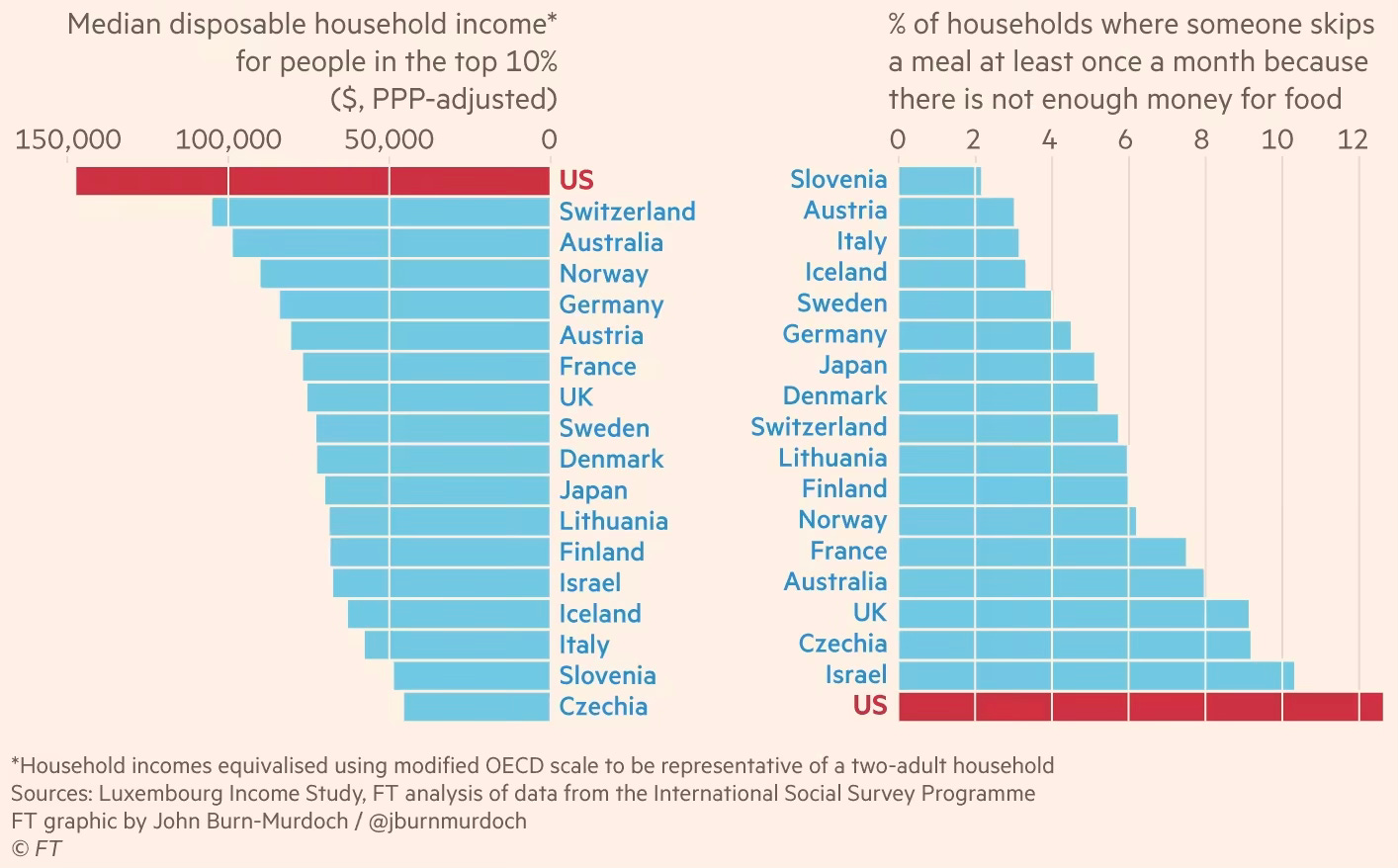
The FT’s chief data reporter John Burn-Murdoch is a terrific teller of stories using data visualisation. His weekly storiesare brilliant. His latest on the sharp dissonance between the realities of American life and what Americans think about themselves is a good example. This graphic in particular captures the stark reality of American economy and life. The richest country also has the poorest people.

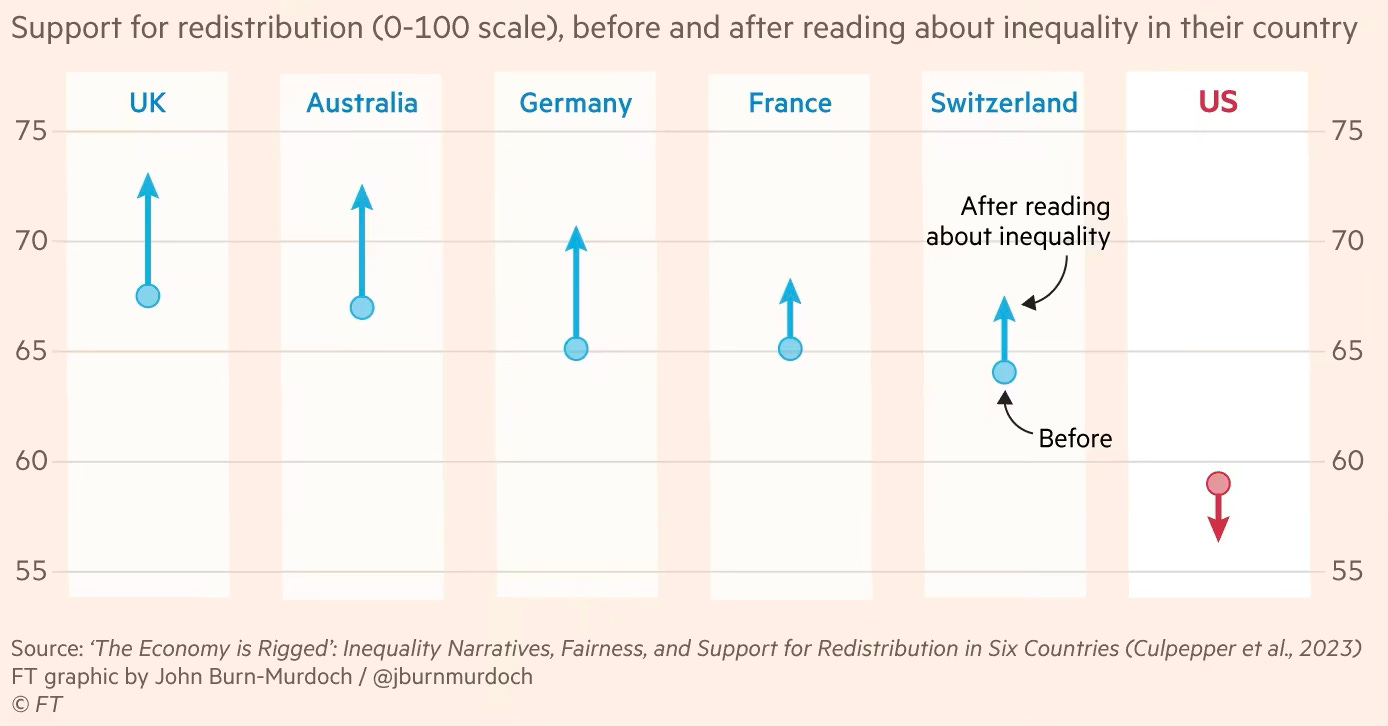
Despite this stark reality, Americans are less supportive of redistribution than people in other western countries. In fact, a new study that primed people to respond to questions after being asked to read stories about the wide national level inequalities appeared to make the even less keen to support redistribution. 

The study writes

Drawing on the media effects and political economy literatures, we expect articles employing narratives that portray inequality as the consequence of systemic unfairness to increase demands for redistribution. We test this proposition via an online survey experiment with 7,426 respondents in Australia, France, Germany, Switzerland, the United Kingdom, and the United States. Our narrative treatment significantly increases attitudes favoring redistribution in five of the countries. In the US the treatment has no effect.

Burn-Murdoch supplements

While Americans may recognise their country’s problem with inequality, they have less desire for something to be done about it than their counterparts elsewhere in the west. More striking still, being shown how wide national inequalities are has no impact on US desire for the gaps to be narrowed — in fact, if anything it reduces appetite for redistribution. In other western countries that same prompting results in more calls for redistribution… In these countries, people were given a news article that used inequality data to argue that the economic system in their country was rigged. Outside the US, reading the article reliably increased beliefs that society is divided into haves and have-nots, which in turn boosted support for redistribution. In the US, it did neither.

He points to two narratives-shaped cultural reasons for the persistence of these beliefs

The first is what I call the two sides of the American dream. Data show that Americans see themselves as more upwardly mobile than people from other western countries (in reality the inverse is true), and are more likely to say hard work is essential for getting ahead in life. These are aspirational, meritocratic beliefs, but the flip side is that Americans are also the most likely to say low-income people need to pull themselves up by their bootstraps. If Americans view extreme incomes with more aspiration than anger relative to their counterparts in other countries, this could explain reactions to the inequality article. If seeing inequality can equate to seeing opportunity, the American dream makes US society more tolerant of large disparities. 

The second dynamic, highlighted by Culpepper and his co-authors, is Americans’ distrust of government, and in particular their belief that government is inefficient. It’s more than 42 years since Ronald Reagan told Americans in his 1981 inauguration speech that “government is not the solution to our problem; government is our problem” — and it appears the nation took his words to heart. While Americans are the most likely to say income inequality in their country is unfair, fewer than half see this as the government’s responsibility to address. This compares with two-thirds or more in the UK, France and Germany. Where other societies see inequality as something that is done to people and must be tackled by helping them, Americans see it as something that people are responsible for themselves.

Narratives shapes culture and political economy, which in turn drives policies. And the narratives often run contrary to evidence. To rephrase a famous saying, narratives eat logic, theory, and evidence for breakfast. These findings on the limits of information awareness and evidence should be reminder to proponents of evidence-based policy making in development.

Monday, December 11, 2023

Thoughts on international development - III

I blogged here highlighting the obsession in international development circles with new ideas and innovations and neglect of regular development interventions, and examined the reasons. I blogged here questioning the belief that there are new ideas and innovations waiting to make a transformative impact. 

This post will highlight another counter-intuitive point that policies in most of development matter very little and it's mostly about implementation. 

It's common place to have opinion makers blame bad policies in low income and developing countries. In reality there are very few "bad" policies. But for any policy there are "bad" implementations. Conventional wisdom overestimates the "bad" nature of policies prevailing in developing countries, the design space of policies, and the agency of policies in general to generate good development outcomes.  

As an important qualifier, I'm confining myself to the human development (or social) sectors - education, skilling, health, nutrition, sanitation, social security, livelihoods, agriculture, animal husbandry etc. I concede that policies matter critically in areas like macroeconomic management, industrial promotion, and infrastructure development. 

The landscape of policies in social sectors have rarely changed over history. For example, education requires physical inputs like schools, teachers, and textbooks, and process inputs like recruitments, trainings, pedagogy, examinations, administration, and accountability. Similarly, health care requires clinics and hospitals, equipment, medicines, health personnel and doctors, coupled with recruitments, trainings, diagnostic and treatment protocols, administration, and accountability. Agricultural extension requires list of extension officers, agricultural research, list of good practices, delivery of extension as a service. 

They have been the same across history and remain so even today across countries. Even in most developed countries today, school education and primary health care is provided by the government and the ingredients remain the same. The physical infrastructure of schools and hospitals and other inputs remain the same. The design space of the processes like recruitment modes, trainings, examinations and administration too are well known and remain the same. Where there have been experimentation with alternatives like with pedagogy, the underlying core of the alternatives (while packaged differently) too have broadly been the same over history. 

Technology is often posited as a disruptor. But, as experience and practical challenges show, in most of these sectors technology is useful only at the margins and not to leapfrog or even significantly as a substitute for any core activity. Even where technology is powerful in theory, like with education content and delivery modes, the problems of teacher intermediation and digital access divide are daunting and difficult to surmount in any meaningful manner in a short time. Or where a smartphone App delivers all the good agricultural practices and market information, human cognitive inertias and other contextual factors hinder their adoption. 

There are important and unavoidable political economy issues that in theory could be modified. For example, it would have been good if there were greater focus on outputs and outcomes instead of inputs. Or if an alternative (but already well known) recruitment mode were chosen. But there are insurmountable political economy considerations or state capability constraints behind such prioritisations and choices. Theory is no good if it cannot be adopted in practice. Then there are path dependency issues also - basic infrastructure and personnel are essential requirements to even start thinking about outcomes, even with technology teachers will have to get familiar with it before they are able to make more effective use.

Fundamentally the processes and service delivery associated with social sectors are about human engagement and behaviour change, where quality is of essence. As a sample, consider the following - ensuring classroom instruction delivers learning outcomes, people maintain sanitation at home and in public spaces, primary care is delivered effectively, protocols are followed in diagnosis and treatment, extension services lead to adoption of good practices and improves farm productivity, students are equipped with employability skills while leaving school, parents provide nutritious food for their children etc. Neither top-down diktats nor technology can be significant contributors to improving quality of service delivery, especially at scale. None of these failings are a failure of policy. 

The following are the conclusions:

1. Policies are choices dictated by stage of development, resource availability, state capabilities, and most importantly, political economy. Egregiously bad policies are very rare, and when in place are conscious but unavoidable political choices. Evidence cannot change them. 

2. The design space for policies have remained largely the same over time. Technology and other innovations remain mostly marginal factors. 

3. The most important point is that policy matters far less in practice than we imagine. The challenge is to implement the policy, irrespective of the nature of the policy. It's about the implementation. Doing stuff, irrespective of its nature, is what's important in development. It's here that development falters almost universally. And it’s the realm of implementation that should become the focus of international development debates. 

Saturday, December 9, 2023

Weekend reading links

1. MS Sahoo has a very good explainer of the recent Supreme Court order in Dilip B Jiwrajka Vs UoI and others) where it disposed a batch of 384 petitions affirming the constitutionality of provisions of the Insolvency and Bankruptcy Code that includes the personal guarantors to corporate debtors (PGCD) in the resolution process. In one stroke, it expedites the disposal of over 2000 applications pending for initiation of insolvency resolution of PGCDs with an underlying debt of Rs 1.64 trillion.  

Desperate and unscrupulous debtors have litigated every major provision of the IBC like related party transactions and personal guarantees to retain their control over their firms. 

The insolvency resolution process for PGCDs facilitates negotiation of a repayment plan, under the supervision of a resolution professional. Upon the failure of the plan, the parties are entitled to initiate a bankruptcy process. This process entails the sale of the assets of the PGCD, leaving a single dwelling unit of value up to Rs 10 lakh in rural areas/ Rs 20 lakh in urban areas, and some other essential assets. Until the process is complete, the PGCD suffers from certain disqualifications, such as acting as a public servant or being elected to a public office. These provisions are, however, benign compared to those in the erstwhile individual insolvency enactments.
The IBC process requires retrieving the value lost by the CD as well as the PGCDs through irregular transactions. This occasionally invites legal action against the promoters/ PGCDs. Some promoters-cum-PGCDs, who have defaulted, or wish to default, have been repeatedly challenging different IBC provisions, on some excuse or another, to evade the IBC process and its consequences... a CD may seek credit to commence a business. A creditor, however, may not extend credit to such a CD, as it is yet to have a business. It may be willing to extend credit if promoters guarantee to repay it if the CD gets into stress. If recourse to the guarantors is not available, the guarantee loses meaning and significance. No creditor would lend on a guarantee; consequently, both business and credit markets would suffer.

2.  India and China's energy consumption in perspective.

This (and also the country graphics in the article) also underlines the important point that any meaningful decarbonisation will require large reductions by the developed countries. This in turn is impossible without meaningful changes in lifestyles and redefining the paradigm of economic growth itself. 

From the same article, a graphic which shows where fossil fuel use is still growing.
3. Times points to some graphics about CO2 emission trends from an estimate by the Rhodium Group. Those sectors where it's expected to fall, including electricity which contributes a quarter of all emissions. 
And those where emissions are expected to rise.
Industry — which includes production of iron, steel, cement, chemicals, oil and gas — remains one of the hardest sectors to clean up. It also often gets overlooked in climate discussions. But industrial emissions are currently expected to soar in the decades ahead... cement manufacturing alone is expected to produce twice as many emissions for the rest of the century as all of the world’s cars combined.

4. Good story on the challenges Foxconn faces in manufacturing iPhones in India at its facility in Sunguvarchatram in Tamil Nadu.

In China, Foxconn demands long days, high targets, and minimal delays and mistakes — all of which proved difficult, if not impossible, to replicate in India. The stress clearly took a toll on the company’s local workforce... China’s one-party system goes to great lengths on Foxconn’s behalf, investing billions of dollars to help set up factories, subsidize energy and shipping, and recruit and bus in workers during labor shortages. Independent unions are banned in China. In India, Apple’s suppliers have to contend with local policymakers, landowners, and labor groups. The country lacks China’s vast network of material and equipment makers, who compete for Apple orders by cutting their own margins. “Apple has been spoiled in China,” a senior manager at an Apple supplier, who was recently deployed from China to India, told Rest of World. “Here, except labor, everything else is expensive.”...
Indian Foxconn workers told Rest of World that eight hours under intense pressure is already hard to bear... For the expatriate workers, the slower pace of the factory floors in India is its own shock to the system. A Taiwanese manager at a different iPhone supplier in the Chennai area told Rest of World that India’s 8-hour shifts and industry-standard tea breaks were a drag on production... In China, Foxconn relies on lax enforcement of the country’s labor law — which limits workdays to eight hours and caps overtime — as well as lucrative bonuses to get employees to work 11 hours a day during production peaks... Foxconn used bonuses and promotional opportunities to encourage engineers and managers in India, too. 

But five Chinese and Taiwanese workers said they were surprised to discover that their Indian colleagues refused to work overtime. Some attributed it to a weak sense of responsibility; others to what they perceived as Indian people’s low material desire... the foreign staff are still frustrated by local workers’ performance. “They know how to do it, but they are slow,” the employee said. “They even walk slowly.” A foreign manager complained that Indian workers requested leave too frequently — to care for sick family members, for instance — or for reasons they considered insufficient, such as a “blood moon” lunar eclipse, deemed particularly inauspicious for women. They and another foreign manager said Indian workers were also frequently late to meetings... At Foxconn’s factories in China, people strive to exceed their targets, sacrifice leave days, and stay late to impress the bosses.

Interesting gender dynamic in Foxconn factories,

When electronics manufacturing took off in China in the 1980s, rural women who had just begun moving to the cities made up the majority of the factory workforce... Over the past 30 years, that’s changed. Today, most of China’s iPhone workers are men; women have moved into less arduous service sector jobs. But in India, Foxconn and other electronics manufacturers are once again recruiting from a female workforce beginning to migrate for better jobs. Hiring a young, female workforce in India comes with its own requirements — which include reassuring doting parents about the safety of their daughters. The company offers workers free food, lodging, and buses to ensure a safe commute at all hours of the day. On days off, women who live in Foxconn hostels have a 6 p.m. curfew; permission is required to spend the night elsewhere.

5. Inflation in the US in the last three years, January 2020 to October 2023 - nice illustration!

American oil fields are gushing again, helping to drive down fuel prices but also threatening to undercut efforts to reduce greenhouse gas emissions. Only three years after U.S. oil production collapsed during the pandemic, energy companies are cranking out a record 13.2 million barrels a day, more than Russia or Saudi Arabia. The flow of oil has grown by roughly 800,000 barrels a day since early 2022, and analysts expect the industry to add another 500,000 barrels a day next year. The main driver of the production surge is a delayed response to the Russian invasion of Ukraine in February 2022, which sent the price of oil to well over $100 a barrel for the first time in nearly a decade. The wells that were drilled last year are now in full swing...

The United States now exports roughly four million barrels a day, more than any member of the Organization of the Petroleum Exporting Countries except Saudi Arabia. On balance, the United States still imports more than it exports because domestic demand exceeds supply and many American refineries can more easily refine the heavier oil produced in Canada and Latin America than the lighter crude that oozes out of the shale fields of New Mexico, North Dakota and Texas... Most of the new U.S. oil production is coming from the Permian Basin, which straddles Texas and New Mexico. There are also some new projects and expansions in Alaska and offshore in the Gulf of Mexico.
When faced with commercial incentives (oil prices above $100, makes drilling attractive no matter what) and political economy (high oil prices makes governments encourage more drilling), climate change targets and considerations are the first to fall apart. 

7. In order to break the Chinese stranglehold on EV supply chain, the US has announced that from this month no US-made EVs with Chinese made battery components nor TVs made by companies with significant ties to the Chinese government or produced with a licensing agreement with a China-based or Beijing-controlled operator will be eligible for the subsidies under the Inflation Reduction Act.

Beijing has a vice-like grip on the processing of critical minerals for green energy technologies. 
And a BloombergNEF study estimates that it'll retain its grip over EV supply chain well into 2030. 
8. FT and Bloomberg have articles on how Huawei made the 7nm Kirin 9000S chips to run the Mate 60 series smartphones. Unlike the TSMC 7nm chips which uses extreme ultraviolet (EUV) lithography to print the chips, Huawei's contractor SMIC makes the chips using the less efficient deep ultraviolet (DUV) lithography process. While ASML, the sole manufacturer of these machines globally has never exported EUV machines to Chine, its DUV machine exports have now been stopped. FT writes,
According to ASML, the Dutch lithography machine manufacturer, it takes 34 lithography steps to achieve 7 nm on DUV machinery, compared to just nine steps with EUV. The additional production steps result in higher production costs and lower yields. With each additional step, more chips would be thrown away, and equipment costs go up... More components and materials are also consumed... The advanced lithography machine is subject to the Wassenaar Arrangement, a multilateral export control agreement formed by more than 40 nations to restrict the sale of products that could have a dual military purpose.

The Chinese government has heavily subsidised SMIC, Huawei and other semiconductor chips related firms in its efforts to overcome the handicap from the 2019 US sanctions on Huawei and to help the country catch up with the US.

Starting with the establishment of the China Integrated Circuit Industry Investment Fund in 2014, Beijing has nurtured its microchip industry with state funding. The investment fund has amassed a whopping $47bn over the past decade and is projected to raise an additional $41bn, further bolstering China’s quest for technological self-sufficiency. A report by research firm JW Insights, which analysed governmental investment by 25 provinces and regions, revealed that the government had poured $290.8bn into semiconductor-related sectors in 2021 and 2022, with one-third going to semiconductor equipment and materials.
Bloomberg reports of how Huawei has emerged as central to the Chinese efforts at achieving self-sufficiency in advanced chips design and manufacturing. A Shenzhen city government investment fund has become the lead financier to create an ecosystem of chip suppliers revolving around Huawei. 
The Shenzhen Major Industry Investment Group Co. was created in 2019 with state capital and given direct orders to support China’s chip efforts and Huawei specifically, according to people familiar with the matter. It has invested in about a dozen companies in the supply chain, including three Huawei-linked chip fabrication facilities, according to data from Tianyancha, an online platform that provides company registration information. But perhaps its most significant operation is a chipmaking tool company called SiCarrier Technology Ltd., founded in 2021. SiCarrier has formed a close, symbiotic relationship with Huawei, where it mainly interfaces with the electronic giant’s internal research arm, known as the 2012 Lab... 

The exchange of talent goes both ways. SiCarrier is vigorously hiring elite engineers to work directly on Huawei’s projects in Shenzhen and Dongguan, according to a person familiar with the matter. (The recruits are told not to reveal who they actually work for.) Huawei has also transferred about a dozen patents to SiCarrier, including sound-proof technologies for electronic machines and data center designs, according to patent transfer information published by the China National Intellectual Property Administration...

Its importance to Huawei is as far more than just a manufacturer, said people familiar with the relationship: SiCarrier is also a nexus between Huawei and the rest of the supply chain. For example, it’s the largest shareholder in optical machine maker Zetop Technologies Co., according to Tianyancha. Such technology is central to the production of microchips, which are built of layer upon layer of transistors bound to a silicon wafer. The key to this is a process known as lithography where light is projected through a blueprint of the pattern that will be printed.

Unlike critical minerals, renewables generation, and EVs, in the case of semiconductor chips manufacturing, the US and its allies maintain dominance across the supply chain. 

9. The Ken has an excellent article that examines the labour market for nurses. The market for nurses is characterised by both shortages and constraints against expansion in supply. There's a shortage of atleast 1.37 million nursing professionals to meet the WHO norms. There are perhaps two big constraints to the expansion of the supply of good quality nursing professionals. While establishing nursing colleges is easier and there has been significant progress, the challenge has been that of recruiting qualified and good quality faculty to work in newly established nursing colleges.

Nursing colleges offering a B.Sc. degree in the country grew from 30 in 2000 to over 2,200 in 2022. Still, the nursing sector—boasting the biggest workforce in the healthcare industry—continues to struggle. The problem is even more pronounced for those working in private hospitals, which cater to ~74% of healthcare needs in India... the Union cabinet approved the plan to set up 157 new nursing colleges on 26 April. The colleges will be established alongside the existing 5,000 medical colleges to increase the availability of qualified nurses... Even as new colleges are being planned for, the existing ones are scrambling to find teachers... Sometimes colleges are forced to hire faculty on a part-time basis or to call clinical practitioners as tutors because of the lack of full-time faculty... 
The Indian Nursing Council (INC)—the regulatory body for nurses and nursing education—mandates having a teacher-to-student ratio of 1:10. But private nursing schools often only recruit four or five nursing faculty and bring more people in to match the INC-prescribed ratio during inspections... numerous private nursing colleges have ghost faculty that appear only during inspections. This, in turn, leads to extreme anomalies, where one person becomes the principal of nine colleges at a time, or 33 teachers work across 80 colleges. The supply shortage is forcing universities to hire freshers as faculty... This is against the INC’s mandate. Every nursing college needs to have experienced faculty with 3–10 years of experience. Even the clinical instructors who educate nursing students on the responsibilities and practical knowledge should have a minimum of one-year experience. Even then, the colleges are not able to attract talent.

This challenge is amplified by the greater preference among nursing professionals for clinical practice as against teaching. 

What the profession really suffers from—lack of faculty, standardised nursing courses, rewarding career progression, individual welfare, and income parity—is yet to be cured... After 31 years, Mani earns only Rs 31,000 (US$ 379.09)per month as a senior staff nurse in a private nursing home. And as an assistant nursing professor with a Bachelor of Science (B.Sc.) in Nursing, she would make only Rs 15,000–20,000 (US$183.43–244.58) with her experience.
Then there's the challenge of retaining new nursing professionals in the country in the face of superior alternatives abroad.
The demand for freshers is rising not just for teaching within the country but also for nursing abroad... Earlier, if foreign countries hired experienced nurses with 2–3 years’ experience in clinical practice, they are now hiring nurses right after they graduate... “From our college, 75% of nursing graduates migrate immediately to Canada, UK, US, New Zealand, Australia, and gulf countries; they don’t stay back to work in our own hospitals,” said Dr Judith Noronha, dean at the department of obstetrical and gynaecological nursing, Manipal College of Nursing... With readily available, exciting opportunities abroad, freshers find no incentive in pursuing specialised courses such as M.Sc., further aggravating faculty scarcity... the salary of a fresh graduate nurse at private hospitals such as Fortis and Manipal is about Rs 20,000–25,000 (US$244–306). In contrast, the US, the UK, Canada, and the Gulf countries offer 4–5X of that in starting salary.
Further, the Indian medical system is excessively hierarchical and doctor-driven, and nurses are subordinated as blue-collar workers. The lobby of doctors wield disproportionate influence and doctors have more influence in making policy decisions concerning nurses. Doctors also occupy administrative positions meant for nursing and nurses. Finally, unlike outside, career progression opportunities in India's nursing market are limited. 

10. John Burn-Murdoch has some fascinating data about animal spirits in the US economy. Unlike Europeans, Americans have had a very dismal view about their economy since the pandemic. The majority of Americans have dismal views that stand contrary to actuals. 
Interestingly, there's a clear divergence between the views of Democrats and Republicans.
11. The size of the crude oil market dwarfs all other minerals.
12. Andy Mukherjee has an excellent article cautioning the perils of financialisation through the market for private credit, especially to stressed creditors of Indian non-banking financial institutions structured and delivered by Wall Street hedge funds and private capital institutions. 
When it looked like their big-ticket borrowers, especially real-estate projects, were going to default, some financiers took recourse to new funds tailormade for them by Wall Street firms. Investors who pooled money were issued senior securities, earning them interest. The finance company also contributed, but in a smaller junior tranche that ranks lower down in the repayment pecking order and is the first to absorb any losses. The private funds then lent money to the same stressed borrowers who, in turn, repaid their original loans and avoided bankruptcy proceedings. Finance companies were happy, too, since any mark-to-market losses on the securities they now held would be far lower than the provisioning burden they would have had to bear in case of soured credit.
This is how at least some shadow lenders in India have “evergreened” their loan books to avoid being on the radar of the Reserve Bank of India, their regulator. But the Securities and Exchange Board of India, the stock-market watchdog, has cottoned on to the sleight of hand. According to a Reuters report in October, the SEBI has detected at least a dozen cases involving $1.8 billion to $2.4 billion where alternative investment funds have been misused to sidestep other financial regulators including the RBI. The amounts involved may be small, but the problem with such shady practices is that they invariably lead to stiff regulation. And that could slow down the blistering growth of alternative funds, a broad category that includes venture capital, private equity, real estate funds, and private credit. A prominent Mumbai-based PE investor pointed out to me that it’s mostly the Wall Street firms that sponsored the cute structures. The same marquee buyout specialists will be the first to complain when, as a direct consequence, regulation in India takes a sterner turn. The lawyers who advised on these deals would wash their hands off...
The alternative-asset industry in India has venture capital and hedge funds as its two bookends. The main body, however, consists of private equity and private credit. Whereas just a decade ago these two asset classes were a $200 million sideshow, now they command $83 billion, or more than four-fifths of the $100 billion committed by investors to private funds.

It's good that the boring Indian financial market regulators are stepping in to regulate these practices at a time when the US SEC appears to be struggling to do the same.