Substack

Friday, August 5, 2022

Some thoughts on the public sector consulting work of big consulting firms

I've blogged about the dangers with the creeping influence capture of important public policy decision-making processes by management consulting organisations. This is a universal trend across countries and across consulting firms, varying only in the degree and brazenness of their actions across contexts. 

South Africa during the regime of Jacob Zuma has witnessed some of the most egregious examples of corrupt practices by these organisations, with established cases of misconduct. 

Early this year, Bain and Co was found guilty by a South African judicial commission of being an enabler of graft. Specifically, it helped the Zuma regime systematically weaken the South African Revenue Service (SARS) by crippling its ability to carry out investigations of tax evaders and allowing "state capture" by vested interests. The Judge wrote in the report that Bain's work on weakening of SARS was "a clear example of how the private sector colluded" on state capture. 
Over the past decade, Bain has worked closely with state companies and the private sector in South Africa. Vittorio Massone, the firm’s former South African managing partner, forged a close relationship with Zuma, meeting him on average every six weeks between 2012 and 2014, according to the report. An event management company owned by a soap-opera producer close to Zuma became Bain’s second-highest paid local adviser around the world, the report said... Between 2012 and 2015, Bain laid plans “to restructure entire sectors of the South African economy” and centralise state procurement, the report said. “Central procurement agency: he loves it, wants an implementation plan,” Massone said in one email that the inquiry said referred to Zuma... Bain’s quest for influence even extended to Massone attending meetings to discuss the manifesto of the ruling African National Congress, according to the report.

Now the British government has come down hard on Bain, banning it from tendering for government contracts for three years for its "grave professional misconduct". The government felt that Bain's role in the scandal had rendered its integrity "questionable". This is one of the first major actions by a western government against corrupt practices by western consulting organisations.  

In fact, Bain is only the latest in the series of misconduct by western firms in Jacob Zuma's South Africa
McKinsey agreed in 2020 to repay about R650mn ($39mn) over irregularities in contracts it had entered into with a local partner at government-owned companies. Auditor KPMG apologised in 2017 for “mistakes” in work for businesses linked to the Gupta family, accused of serious corruption through ties to Zuma. UK public relations company Bell Pottinger was brought down by its work for the Guptas, which led to accusations that it had stoked racial tensions in South Africa.
The UK government's barring of Bain from its public procurement process raises the question about why McKinsey and others with similar, if not worse, charges should not be similarly punished. 

Consider the infamous case of McKinsey's work with Purdue Pharma, where they advised both drug makers and the government regulators is an egregious example of practices which are becoming all too common in many developing countries too. See also this about McKinsey's work in South Africa and elsewhere. I've blogged here about questionable practices by McKinsey.

Consultants play an important role in shaping and reinforcing narratives on issues involving the intersection of public and private sectors. Most often, like with all profit driven incentives, their interests coincide with those of their private sector interlocutors. 

The problem with the work of consulting organisations advising governments is that it's largely opaque and secretive, commands disproportionately large influence, involves high stakes, and the incentives are clearly distorted

This has serious consequences in public procurements and institutional reforms. Weak checks and balances and institutional maturity within public systems encourages the Chinese walls within consulting organisations to become porous and allow commercial considerations to over-ride client interests and public interest at large. 

Appropriate safeguards by way of disclosures therefore become extremely important. For example, in case of consultancies advising governments on activities that involve private sector engagement, it's important that all the sector-related commercial engagements of the consultant be disclosed in the procurement documents. Consultants who advise on the sell-side of a private service/product should be barred from advising the buy-side government agencies. 

Similarly, public officials engaged with consulting organisations should be mandated to make public their or family connections with consultants. This should be done both before and for at least two years after the officials leave the post or the engagement has ended.  

It's also time that philanthropic foundations and civil society organisations, as well as multilateral organisations, support work that looks closely at the activities of consulting organisations working with governments. I have not come across even one comprehensive study scrutinising the business practices of consulting organisations advising governments. A part of the reason is that these organisations themselves are advised by the same consultants. 

Finally, taking a cue from the UK government's action on Bain & Co, western governments should redefine the scope of bribery and corruption to clearly include such practices. Firms engaging in such activities and held guilty in the host countries should be banned from public procurements in western countries too. 

Update 1 (01.10.2022)

McKinsey has been charged in a corruption scandal involving work it did advising South Africa's state-owned freight rail and port operator, Transnet, in a massive locomotive purchase contract.
To secure a consulting contract with Transnet, McKinsey was required by South African law to work with a Black-owned subcontractor. But instead of thoroughly vetting that subcontractor, McKinsey relied on a recommendation from Transnet that it hire a company called Regiments Capital to help oversee the purchase of a fleet of 1,064 rail locomotives. The locomotives were initially estimated to cost $2.6 billion, but their price inexplicably rose, almost overnight, by about $1 billion. Matthew Chaskalson, a member of a judicial commission investigating suspicious contracts with state-owned agencies, said in a 2020 hearing that after hiring Regiments, McKinsey received “an extraordinary succession of sole-source contracts” during which its fees increased “exponentially.” Subsequent investigations by the media and the commission discovered that Regiments had links to the politically powerful Gupta family — three brothers who for years hid their ties to companies that were improperly securing lucrative state contracts. By the end of 2020, the judicial commission had uncovered three tainted McKinsey contracts, including ones with the state-owned airline and the nation’s power company, Eskom.

See also this review of a book by two NYT reporters that exposes McKinsey's business practices,

In 2002, Martin Elling, along with three colleagues at the global consulting firm McKinsey & Company, published an article in the firm’s quarterly journal intended to gin up more business from the pharmaceutical industry. Elling’s article argued that drug companies were missing an opportunity by not tracking how often individual physicians were prescribing certain drugs. By aggregating such data, pharmaceutical salespeople could target their marketing pitches to the doctors most likely to become heavy prescribers, and the sales reps themselves could also be better evaluated by their companies. Soon enough, a relatively unknown drug company called Purdue Pharma came calling, retaining McKinsey in 2004 to help increase sales of its opioid pain killer OxyContin — which had already topped $1 billion annually. In the face of a worsening national opioid addiction crisis and multiple state and federal investigations, prescriptions of higher-strength OxyContin pills had begun to level off. Among other recommendations, McKinsey, led by Elling and his team, suggested “turbocharging” sales through more innovative and aggressive marketing tactics. Between 2004 and 2019, Purdue paid McKinsey $83.7 million in fees.

This is an abstract from the book. 

Thursday, August 4, 2022

A thought on the political economy of monetary policy

The Fed has raised interest rates by 75 basis points for the second month in a row, taking the target range to 2.25-2.5%. Faced with the highest inflation in more than four decades, this is the Fed's most aggressive monetary tightening since 1981, with the first 75 basis points rise being the first since 1994. 

In his remarks, the Fed Chairman Jerome Powell hinted at the need for a period of slower growth and weaker jobs market to bring down high inflation. 

This belief draws its theoretical basis mainly from one of the most important and contentious concepts in Economics, the Philips Curve which emerged in the 1950s. It describes the inverse relationship between inflation and labour market strength. As unemployment rises, demand declines, driving down inflation. So, the theory goes, to kill inflation, unemployment has to rise. It's a different matter that this relationship has not held in recent decades.

Apart from this, there is another important conceptual framework which sees rising inflation as a process of reshaping of expectations towards a period of higher inflation which makes workers demand higher wages. A wage-price spiral emerges, with the trigger being wage demands. With average labour wages having risen 15% since the onset of the pandemic, this wage-price spiral framework resonates loudly in inflation debates. 

Taken together, it's assumed that killing inflation requires cooling down the labour market, both at the intensive (limiting wage increase demands among existing workers) and extensive (limiting further tightening of the labour market) margins. The underlying theoretical framework is of aggregate demand increase driving up inflation.

This demand-driven-inflation assumption has been questioned in view of the obvious impact of supply shocks on the current episode of inflation. The disruptions to the global supply chains and manufacturing facilities due to the Covid pandemic was just starting to normalise when the Russians invaded Ukraine and Covid made a comeback to China. As Claudia Sahm writes,

There is no increase in the unemployment rate that would produce microchips for new cars, end China’s lockdowns, defeat Vladimir Putin, drill oil and build apartments. The Fed raises interest rates and lowers demand, cooling off the labour market. Whether it inadvertently causes a recession or not, higher interest rates would not fix the supply problems and would probably make some worse by discouraging investments.

In other words, fighting the current episode of supply-shock based inflation by raising interest rates may be barking up the wrong tree. This cure may turn out to be worse than the problem. 

On an emprical note, the report points to a study by Adam Shapiro which decomposes inflation contributors and shows that less than a third of monthly core inflation is due to demand.

In addition, I see a political economy dimension to the Fed's response. In the collective consciousness of important opinion makers and decision makers, the old theoretical framework of wage-price spiral exerts an overpowering influence. This theory also fits neatly with the ideological narrative which posits capital and labour as the all-time antagonists. The establishment at all levels therefore have a strong collective resolve in keeping the bargaining power of labour constrained. 

So, even at the cost of increasing their borrowing cost and also triggering a recession, I'm inclined to argue that the establishment (Wall Street, opinion shapers, and decision makers) would prefer to nip in the bud any revival of labour's bargaining power and the attendant possible wage-price spiral. Even if there is no overt conspiracy to do the same, this motive is baked into the collective consciousness of the establishment as to be a reflex response. 

Sunday, July 31, 2022

Weekend reading links

1. Scott Galloway has a stunning stat

Amazon generated more ad revenue in 2021 ($31 bn) than the entire newspaper industry did globally ($30 bn)!

2. Martin Sandbu points to an interesting set of facts about investment in infrastructure in G-7 countries - it declined throughout the last two decades, despite the ultra-low interest rates. 

Between 1970 and 1989, the share of gross domestic product devoted to investment by six of the world’s seven biggest economies averaged from 22.6 per cent for the US to 24.8 per cent for Germany. The seventh, Japan, was an outlier with 35 per cent... France and the US have invested nearly two percentage points of GDP less this century than they did in the 1970s and 1980s; Germany and Italy about 4.5 points less; the UK and Japan 6 and 10 percentage points less respectively. These are enormous numbers. The G7 account for about $45tn in annual GDP. Restoring their investment ratios could fill nearly half the global shortfall to the $4tn the International Energy Agency calls for in annual clean technology investment if we are to meet net zero by 2050... In the US, net government investment (after accounting for depreciation of the existing public capital stock) fell by almost two-thirds in the decade to 2014, when it dropped to 0.5 per cent of GDP.
Public investment as a share of GDP fell to slightly more than 0.5% of GDP in US and less than 0.5% of GDP in Europe. 

3. This is not as clear as it appears, but AK Bhattacharya writes that India's corporate tax cuts have achieved the purpose of higher tax revenues realisation. This is a good summary of the trajectory of corporate tax reforms in India,

In 1991, the corporation tax rate was raised from 40 per cent to 45 per cent in Manmohan Singh’s first Budget because of revenue concerns; and in 1994, it was brought back to 40 per cent. The first big reduction came in 1997, when finance minister P Chidambaram brought it down to 35 per cent after abolishing the surcharge as well. But from 2000 onwards, surcharges were back, raising the total tax rate once again to almost 36-38 per cent for the next five years. It was Mr Chidambaram again, who reduced the corporation tax rate to 30 per cent in 2005, although along with the surcharge the actual rate was about 33 per cent... Arun Jaitley’s Budget in 2015-16 promised that the corporation tax rate would be reduced to 25 per cent in a period of four years along with a phase-out of exemptions. The following year, the rate was reduced to 29 per cent (excluding surcharge and cess) for companies with a turnover of less than Rs 5 crore. New manufacturing companies were allowed to pay a tax of only 25 per cent, provided they did not avail themselves of any exemptions.

A year later, Jaitley reduced the tax rate to 25 per cent (excluding surcharge and cess) for all companies with an annual turnover of up to Rs 50 crore, thereby covering almost 96 per cent of Indian companies. In February 2018, Jaitley went a step further by extending the benefit to all companies with an annual turnover of up to Rs 250 crore, covering 99 per cent of all Indian companies. Ms Sitharaman in her first Budget in July 2019 took the next step by extending the 25 per cent tax rate to cover all companies with an annual turnover of up to Rs 400 crore. With that step, almost 99.3 per cent of Indian companies were covered under the lower tax rate. And then followed the tax cut to 22 per cent (plus surcharge and cess) in September 2019.

Its outcomes 

Total corporation tax collections in 2019-20 did decline by about 16 per cent to Rs 5.57 trillion, compared to Rs 6.63 trillion in 2018-19. But the decline was just about Rs 1 trillion and not Rs 1.45 trillion. The tax collection figures for 2020-21 are not relevant because of the Covid impact. The latest provisional unaudited numbers with the Controller General of Accounts show that in 2021-22, corporation tax collections rose to Rs 7.12 trillion, surpassing by a good margin the collections made in 2018-19. In terms of their share in GDP, corporation tax collections in 2021-22 were still at 3 per cent, marginally lower than the 3.5 per cent seen in 2018-19. But it would not be unreasonable to expect corporation tax revenues to breach that ratio soon. The advance tax collections in the first quarter of 2021-22 have continued to show healthy growth. And the dispersion of tax liability spread over a larger number of companies in different income levels, seen in 2019-20, should continue to help overall collections buoyancy.
4. More on the elite capture of the economy. FT reports that BCG ran a summer internship program for the children of its senior executives.
Staff in Boston Consulting Group’s London office have complained about “nepotism” after the children of dozens of top partners flew in from across the world for an exclusive week-long work experience programme. The US-based consultancy ran the programme, consisting of days of workshops, this month for about 30 children of the firm’s managing directors and partners... “They received office tours, dinners and stuff that wouldn’t normally be given to [job] candidates. They basically made it a bit of a holiday for the partners’ kids who came over,” one current BCG employee told the Financial Times. The children were participating in BCG’s “Bruce Henderson Summer Programme”, named after the firm’s founder... Three BCG staff members worked for two months to prepare the programme, work that would cost external clients well more than £1mn, according to the BCG employee.

5. Fascinating book extract highlighting how motor vehicles had to fight with pedestrians to win the battle to have a greater right over road pavements. This was the case till 1920s,

City people saw the car not just as a menace to life and limb, but also as an aggressor upon their time-honored rights to city streets. “The pedestrian,” explained a Brooklyn man, “as an American citizen, naturally resents any intrusion upon his prior constitutional rights.”  ... Readers’ letters to the St. Louis Star express pedestrians’ indignation at motorists’ intrusion upon their rights. One letter, signed “Pedestrian,” complained that “the pedestrian is forced to submit to the tyranny of the automobilist.”  Other letter writers urged pedestrians to organize to defend their claim to the streets. “It might be necessary to organize an antiautomobile league,” wrote one. “The time is ripe for the common people and the pedestrian to organize,” wrote another. “We must all pull together,” wrote a third, and “insist on our rights to use the streets” until the “auto-hogs . . . wake up to the fact that they cannot do as they please and monopolize the streets.” 

Local police tended to blame motorists for pedestrian traffic casualties... Police and judicial authorities recognized pedestrians’ traditional rights to the streets. “The streets of Chicago belong to the city,” one judge explained, “not to the automobilists.”  Some even defended children’s right to the roadway. Instead of urging parents to keep their children out of the streets, a Philadelphia judge attacked motorists for usurping children’s rights to them. He lectured drivers in his courtroom... Juries tended to favor pedestrians as well... The leading city paper in Syracuse, New York, argued that the burden of safety lay properly with motorists... The New York Times claimed in 1920 that pedestrians’ rights to the streets were so extensive that “as a matter of both law and morals they are under no obligation” to exercise “all possible care.” The greater share of responsibility (moral and legal) lay with the motorist: “drivers justly are held to a greater care than pedestrians,” the paper contended.

It was only by 1930, through public debates, technology changes, and legal mandates that the superior right of the motor vehicle over the roads came to be recognised.  

Wednesday, July 27, 2022

Urban planning thoughts

If one has to identify the biggest policy failings of India's urbanisation, it'll have to arguably be urban planning. The level of awareness, leave aside internalisation, within urban managers and decision makers in urban local governments about the potential of the instruments of urban planning in shaping the urban form, mobilisation of financial resources, and promoting economic growth is shockingly poor. 

For all practical purposes urban planning in India is about purely transactional activities like building plan approvals and city master plan implementation. Very few, if any, chief city planners and municipal commissioners have a comprehensive understanding of the potential of the various instruments of urban planning. Public awareness about urban planning revolves around tales of harassment and corruption.

In this context, one of the most disappointing facts is the lack of imagination about the integration of the instruments of urban planning into the development or redevelopment of transit stations and networks.

The NYT has a report on the redevelopment of Midtown Manhattan in New York that revolves around the iconic Penn Station,
New York State officials on Thursday approved a sweeping redevelopment of Midtown Manhattan that would transform Pennsylvania Station, the busiest transportation hub in North America, from a run-down transit center into a city centerpiece. The eight-member board of Empire State Development, the state’s economic development agency and the group steering the project, unanimously voted in favor. The plan calls for constructing 10 towers around Penn Station and providing an estimated $1.2 billion in tax breaks to developers. The redevelopment would be among the largest real estate projects in United States history: roughly 18 million square feet of mostly office space, up to 1,800 residential units, retail space and a hotel. At the center would be a renovated Penn Station, which sits below Madison Square Garden and served 650,000 riders each weekday before the pandemic. The board’s approval clears the way for an application for federal funding to help pay for upgrading the station, which is expected to cost about $7 billion. New York expects about half of that sum to come from Washington...
The new towers would be among the tallest in New York City, exceeding 1,000 feet in height, though the final dimensions would be decided later. The project requires the demolition of many existing buildings, potentially including a 150-year-old Roman Catholic church, and would reshape the skyline of Manhattan between the Hudson Yards neighborhood to the west and the Empire State Building to the east... The M.T.A. is leading the $7 billion renovation project at the station but New York expects the federal government, Amtrak and New Jersey to contribute most of the money. An agreement the state reached with New York City allows for payments from developers of the 10 towers to cover part of station renovation costs, all of the costs of the pedestrian and street improvements and half of the costs of the new subway entrances and underground concourses. The payments from the developers would derive from office leases, retail sales, apartment rentals and the hotel. That arrangement is part of a complex financial scheme known as payments in lieu of taxes, or PILOTs, that would suspend additional property taxes on the buildings for decades after they are constructed.

See also this, this, this, and this.
I had also blogged here about the King's Cross railway station area redevelopment project and here about the transformative change brought about by the Crossrail project.

The ambition and scale of the redevelopment is staggering. Compare it with the New Delhi or Mumbai railway station redevelopment plans. 

I had blogged here that the biggest problem with the railway stations redevelopment projects in India is that they are conceived and planned as predominantly railway station redevelopment projects instead of being seen as urban renewal projects. The fact that these projects are led by Railway Department and its officials with limited understanding of urban planning, and have limited engagement with and stakes of the local city administrations (beyond the perfunctory memberships in some committees) speaks volumes about its flawed design. 

If these projects are to realise their true potential, the entire redevelopment should be undertaken under the leadership of the local government as a generational project with the objective of transforming the economic prospects of the area around the station. It will have to be preceded by extensive local consultations and public debates, economic growth planning and infrastructure and real estate needs assessment, all of which have to be led by the local government. In fact, the least important stakeholder in the redevelopment would be the Railways Department. 

This is also a teachable example of the problems with experts-driven policy making in complex public issues like urban renewal. An expert like E Sreedharan can be great at a driving pure infrastructure development project but is unlikely to be successful with a civic project. 

On similar lines, as I have blogged here, India's urban metro railways projects are generational opportunities to shape the destiny of cities which too have been lost or frittered away for lack of integration with urban planning. Like the railway stations redevelopment, these too have been seen as primarily infrastructure development projects. Even within the Ministry of Housing and Urban Affairs, these projects are driven by Railways Department officials. These have to change. 

Monday, July 25, 2022

The four (and counting) problems with the Xi Jinping Turn

I have blogged several times arguing that President XI Jinping may be the latest version of China's Bad Emperor problem

I can think of at least four critical wrong policy turns driven by him, and will almost indelibly become his legacy. The first three are the roll-back of economic liberalisation and capitalism with Chinese characteristics, peaceful co-existence in its near-abroad giving way to needless aggression by the PLA and its wolf-warrior diplomats, and replacement of the supremacy of the Communist Party with that of the President. I have blogged about it here, here, here, here and here.

This post flags the fourth major wrong-turn, the nature and scale of the Belt and Road Initiative (BRI). The FT has a long read that summarises the challenge,

Since the programme was first proposed in 2013 the value of China-led infrastructure projects and other transactions classified as “Belt and Road” in scores of developing countries had reached $838bn by the end of 2021, according to data collected by the American Enterprise Institute, a Washington-based think-tank. But the loans that finance those projects are now turning bad in record numbers. According to data collected by Rhodium Group, a New York-based research group, the total value of loans from Chinese institutions that had to be renegotiated in 2020 and 2021 surged to $52bn. This was more than three times the $16bn of the previous two years. This sharp deterioration brings the total of Chinese overseas loans to have come under renegotiation since 2001 to $118bn — or about 16 per cent of the total extended, Rhodium estimates. China has had to manage a number of defaults on sensitive overseas loans in recent years but the cumulative impact of the multiple renegotiations that Beijing currently faces amount to the country’s first overseas debt crisis... Many of these loan renegotiations involve write offs, deferred payment schedules or a reduction of interest rates. But as increasing numbers of Belt and Road loans blow up, China has also found itself sucked in to providing “rescue” loans to some governments to prevent their debt distress from morphing into full-blown balance of payments crises.


It's rapidly becoming evident that many of these loans face an insolvency problem.

Bradley Parks, executive director of AidData at the College of William and Mary in the US, says that while the drip feed of rescue loans helps to avert defaults, it does little to resolve underlying financial problems. “I think Beijing is now learning that in some cases the fundamental problem is not liquidity but solvency,” says Parks. Parks says that for almost five years, China’s state financial institutions tried to keep the government of Sri Lanka liquid enough to service its old project debts and to avoid sovereign credit rating downgrades. However, he adds: “Their effort was a spectacular failure. So, the big question that Beijing needs to answer is whether it wants to be in the rescue lending business in the long run.” The transition that Parks alludes to is a critical one. As China has financed roads, railways, ports, airports and a gamut of other infrastructure over the past decade, it has found itself in competition with international development lenders — most notably the World Bank. Now, as its lending shifts to focus more on preventing defaults, it is starting to mirror the role usually fulfilled by the IMF — which provides emergency loans to get countries through economic crises.

The result is also declining interest and falling BRI loans.

The sheer scale of insolvency likely and associated restructuring with haircuts means that China would not only lose financially but also politically. As the example of Sri Lanka shows, the restructuring negotiations process can easily get out of hand. The opaque and bespoke nature of the BRI loans means that any restructuring negotiations will be controversial and acrimonious. Given that countries forced into restructuring will most likely also be facing political instability (as in Sri Lanka), Beijing will dissipate the political capital accumulated in the first place from these loans. Going forward, it's hard to see anything other than downside.

The history of China over the last forty years highlights two central principles - experimentation with economic policies and peaceful co-existence with the rest of the world. They are respectively encapsulated in Deng's maxims of "crossing the river by feeling the stones" and "hide your strength, bide your time" (tao guang yang hui).

In case of the former, President Xi has sought to concentrate powers and centralise the economy by feeling the stones, whereas with the latter he has decided that biding is over and it's now time to demonstrate China's strength. Both have come at prohibitive costs to China, and these costs will only increase. 

Sunday, July 24, 2022

Weekend reading links

1. Long read in FT on the issue of weight-loss drugs, especially Wegovy the new drug by Novo Nordisk. The self-administered weekly injection is part of the increasing belief that obesity is a disease rather than resulting from unhealthy habits and for the seriously overweight medical treatment may be necessary.

The article points to the long history of failures with weight loss drugs,

Despite the vast need, many major pharmaceutical companies have held back from developing weight-loss drugs, in part because the category is marred by a long history of quackery and safety scares. From the 1930s to the 1960s, the industry poured money into diet pills based on amphetamines. These eventually fell out of favour because they were highly addictive and had harmful side effects. In the 1990s, fen-phen — a combination of fenfluramine and phentermine — became so popular that weight-loss clinics sprung up across the US just to prescribe it, even though some patients on the drug experienced manic episodes. It was later taken off the market after a study showed up to a third of patients could suffer from heart valve defects. As recently as 2020, US regulators forced the withdrawal of weight-loss drug Belviq because of concerns it increased the risk of cancer. For the most desperate, surgery has become popular, though it is expensive and comes with its own risks and restrictions.

2. George Bass, a security guard in a university, has a brilliant essay chronicling life in times of rising inflation.

In my job keeping people and property safe on a university campus, I earn £10.71 per hour. Working 16 12-hour shifts a month bags me an average £1,400, after tax. I’ve always been comfortable earning a modest wage. Since I began working at the age of 15, I’ve picked jobs based on two guiding principles: I don’t want to have to tell lies all day, and I don’t want to get work calls beyond the car park. In my various roles over the past 25 years, working on a gun range, in a lead factory, as a labourer and shifting boxes, those two rules have never been broken. Getting a job in security taught me a third: once the uniform’s on, you need to help people. This year, the drumbeat of news about inflation has made me increasingly anxious.

The essay is a great example of how exceptional talent can remain hidden in all of us. Some, and only some, realise it and become rich and famous (in varying degrees), whereas it remains latent in the lives of most others. And the reason for the talent getting expressed in most cases is either the ovarian lottery of birth circumstances or plain good luck. 

3. The tumult in financial markets have hit emerging market bonds very hard. It's estimated than $52 billion has already been pulled out from EM bonds this year, with devastating consequences on EM bond yields.

EM bonds are having their worst year on record.

4. As it pulls ahead in mass manufacturing of 5 nm chips, TSMC's lead in the semiconductor chip business increases.

5. The age of ultra-loose monetary policy is being followed by a period of frenetic tightening,

In the three months to June, 62 policy rate increases of at least 50 basis points were made by the 55 central banks tracked by the Financial Times. Another 17 big increases of 50 basis points or more have been made in July so far, marking the biggest number of large rate moves at any time since the turn of the millennium and eclipsing the most recent global monetary tightening cycle, which was in the run-up to the global financial crisis. “We’ve seen this pivot point in the market where 50 is the new 25,” said Jane Foley, head of foreign exchange strategy at Rabobank.


This demonstrated collective resolve is an important point that can help anchor inflation expectations. 

6. Pratik Datta writes about the latest example of judicial activism which threatens the future of the Insolvency and Bankruptcy Code.

The Supreme Court recently passed an important judgment in Vidarbha Industries Power Ltd. v. Axis Bank. It held that the National Company Law Tribunal (NCLT) cannot admit an insolvency application filed by a financial creditor merely because a financial debt exists and the corporate debtor has defaulted in its repayment. Instead, the NCLT must consider any additional grounds that the corporate debtor may raise against such admission... The balance-sheet test is one method for determining insolvency at the point of trigger. This test, however, is vulnerable to the quality of accounting standards. That’s why the Bankruptcy Law Reforms Committee did not favour this test in the Indian context. Instead, it recommended that a filing creditor must only provide a record of the liability (debt), and evidence of default on payments by the corporate debtor. This twin-test was expected to provide a clear and objective trigger for insolvency resolution. The hope was this would minimise litigation at admission stage, enabling quicker resolution of distressed businesses. The Supreme Court’s latest ruling is likely to radically alter these expectations. Even if the NCLT is satisfied that a financial debt exists and that the corporate debtor has defaulted, it may not admit the case for resolution if the corporate debtor resists admission on any other grounds. Corporate debtors are likely to use this precedent to the fullest to resist admission into IBC. The likely outcome would be more litigation and delay at the admission stage, enhancing the risks of value destruction in the underlying distressed business. Unless the NCLT consciously constrains the use of its own discretion at the admission stage, the IBC may well end up like the SICA. 

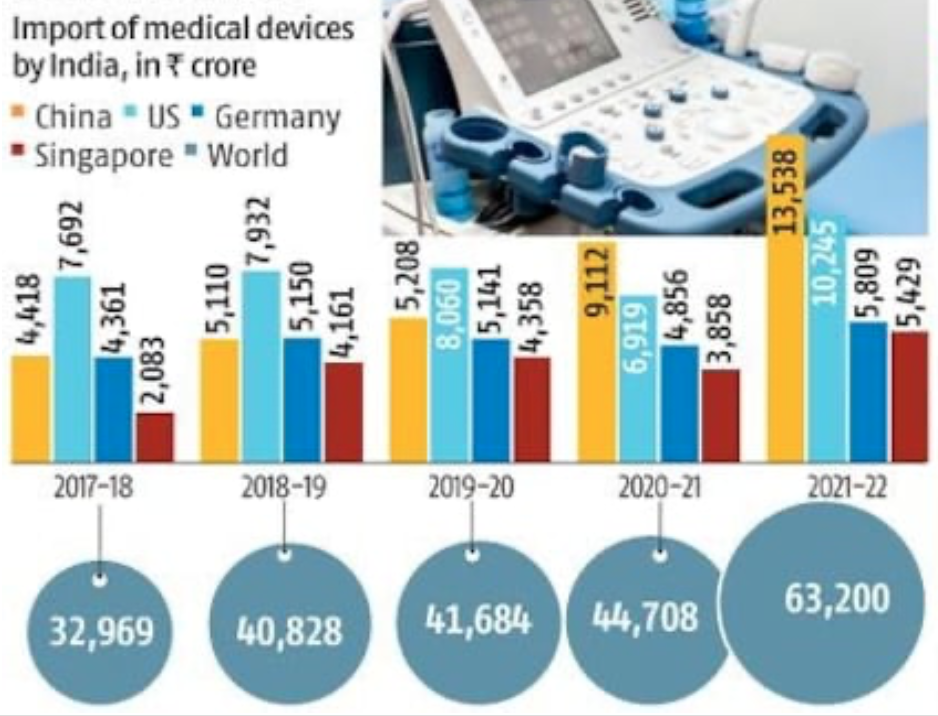
7. The rising dependence on imported medical devices, in particular from China.

The problem is the competitiveness with Chinese manufacturers. The pandemic boost has since subsided and makers are struggling to compete with the Chinese in a normal competitive market.

8. FT has a long read on the enduring high risk appetite among young investors in the US. It has a graphic which points out that only half Americans born in 1984 were likely to out-earn their parents at 30.

And this sums it all on high risk investing
Gary Stevenson, a 35-year-old former trader and financial education campaigner from east London, is one: “My dad never went to university. He worked at the post office for 35 years and could raise three kids and pay off [a mortgage] . . . he has a comfortable retirement,” he says. “That is off the table for most young people now. It’s created a bit of a panic.” “If you can’t do what your dad or grandad did . . . you have to come up with a better plan,” he adds. At some point, risky bets starts to look like the rational choice: “One way, you see a zero per cent chance of success. But if you take on insane risk . . . at least you have a chance.”... “If you said, ‘My dad spends all day gambling,’ [I’d] say, ‘Oh man I’m so sorry for your family’,” he says. But “if someone says, ‘My dad spends all day FX trading’, you think he’s the Wolf of Wall Street . . . It’s not gambling, it’s investing — and investing is how you get rich.”

9. Esther Bintliff has a long read in FT assessing the value of feedback in improving performance. She examines the research and literature on the topic and leaves you wondering whether there is any scientific basis to the claim that negative feedback when given appropriately can lead people to change habits and behaviours and improve their performance.

The article points to a 1996 meta-study of feedback literature by two academic researchers Avraham Kluger and Angelo De Nisi,

The two reviewed hundreds of feedback experiments going back to 1905. What they found was explosive. In 38 per cent of cases, feedback not only did not improve performance, it actively made it worse. Even positive feedback could backfire... Kluger came to believe that as a performance management tool, it is so flawed, so risky and so unpredictable, that it is only worth using in limited circumstances, such as when safety rules must be enforced. If a construction worker keeps walking around a site without a helmet, negative feedback is vital, Kluger acknowledges. The most effective way to give it is with great clarity about potential consequences. The worker should be told that the next time they go without a helmet, he or she will be fired. But in many other types of work, the formula for good feedback includes too many variables: the personality of the recipient, their motivations, whether they believe they are capable of implementing change, the abilities of the manager...
Instead of managers giving top-down feedback, he argues they should spend more time listening to their direct reports. In the process of talking in depth about their work, the subordinate will often recognise issues and decide to correct them on their own. Based on this theory, Kluger developed something he calls the “feed-forward interview” as an alternative, or prologue, to a performance review. He offers to give me a demo... Much of how we respond to feedback is driven by the nature of our relationship with the person giving it. This is why Kluger believes it’s useless to focus on the recipient of feedback alone. The outcome will always depend on the “dyad” — the sociological term for two people in a particular relationship — and what transpires between them.

The time, effort, and skill required to do a good feed-forward interview is too rare as to make the likelihood of a feedback being effective very rare.

10. Even as the Sri Lankan crisis occupies attention, the situation in Pakistan deserves greater attention as things worsened this week,

The Pakistani rupee’s 7.6 per cent tumble to Rs228 to the dollar marked the latest setback for the currency, which has fallen sharply this year. It marked the rupee’s sharpest weekly drop since October 1998. The latest slide reflected mounting concerns that a $1.2bn loan disbursement from the IMF agreed last week might not be enough to avert a balance of payments crisis. Pakistan’s bonds have been among the worst performers in emerging markets this year... Fitch Ratings this week downgraded its country outlook to negative from stable, noting what it called a “significant deterioration in Pakistan’s external liquidity position and financing conditions” this year. The rating agency said the central bank’s forex reserves had declined to about $10bn by June 2022, down from $16bn a year previously and equivalent to just over one month’s worth of current external payments. Pakistan’s central bank raised its main policy interest rate 125 basis points to 15 per cent on July 7 in an effort to stem demand for foreign currencies and reduce inflation.

Thursday, July 21, 2022

Some thoughts on the energy and other transitions

There are several shifts underway across the economy. The most salient are the shifts from thermal to renewable energies and from internal combustion engines to electric vehicles. Then there are others like physical to digital in specific realms from currencies to meetings, and from informal to formal across the economy. These are momentous shifts, with transformative consequences. Managing them carefully is important.

The emerging conventional wisdom is that these shifts are more likely sudden disruptions than gradual transitions. This world view is in keeping with the dominant theory of change in the scientific-technological age - innovation >> disruption >> transformation. It's become internalised that change is disruptive. 

Accordingly, there is a need to immediately and urgently prioritise all investments and focus towards these emerging technologies and away from those being replaced. The market, it's believed, will weave its magic and show the path towards the shift which minimises the pain and suffering associated with the shift. 

There are at least three issues with these views. 

One, there is no compelling reason at all to suggest that the shift would be abrupt and not a long transition. History of such transitions, from industrial revolution to automobiles and computers, show that they take time, and very long times. These are very slow and gradual transitions than sudden disruptions. 

Two, the legacy industry is too large and with massive capitalised investments as to be accommodated only through the dynamics of market forces. The oil sector alone is an over $2 trillion industry with forward and backward linkages which permeate the entire economy. The thermal power generation industry is even larger and more tightly integrated with economic activities at all levels. Transitioning out of these will involve recalibrations and adjustments along their supply and value chains, running into countless interfaces and sub-sectors. These will require multiple policy changes and painstaking co-ordination across stakeholders, which will hopefully trigger dynamics that can move the private sector. 

Three, there are costs associated with any change, transition or disruption, and someone has to bear those costs. Like with all else, costs should be borne by those who are best placed to bear it. 

To put just the costs in perspective, as the graphic below shows, the vast majority of global coal plants are relatively young. Mothballing them will involve massive costs. It's inconceivable that investors will be able to bear any large share of these without seriously disrupting and bringing down important segments in the financial market. Governments will have to pick up the tab. But are fiscally constrained governments in any position to bear them?

Clean energy transitions will impose steep costs on consumers too. Since consumers would be unwilling to bear such burdens on their existing energy bills, and producers would be unwilling to assume risks and invest without higher returns, it's left for governments to step in and assume the incremental costs required to catalyse markets. But the ambitious pace and scale of transition that commentators call for demand fiscal expenditures that are way beyond fiscally strapped governments. In fact, even in their committed expenditures, like during the pandemic stimulus, the G20 countries allocated only 6% of the $14 trillion stimulus on areas that would cut emissions. 

While immediate triggers like pandemic, Nordstream 2 bargaining, and Ukraine invasion explain the sharp volatility in natural gas prices, I would argue that there are systemic trends responsible for this situation. An excessively optimistic energy transition regime has squeezed investors out of fossil fuels, cut down on exploration and downstream investments (LNG terminals in Europe), forced the mothballing of existing storage and generation sites. Ecosystem changes have a natural pace. Complex transitions like in energy, take time, perhaps even decades. Forcing them through in a few years can rebound. I don't know for sure, but I have a feeling, this may be the problem. And it's going to get worse and show up elsewhere over the coming years. And it's going to show up in other fossil fuels too.


For a start, amidst all the hype about disruptive transition, consider the supply-side reality

According to the International Energy Agency’s net zero pathway, coal use must fall by half this decade in order to stay on track. Meanwhile, electricity generation needs to increase 40 per cent in the same period, according to that scenario, in which emissions fall to zero by 2050 and global warming stays below 1.5C by the end of the century. Doing both at the same time — increasing electricity output while cutting coal — will require huge growth in renewables, especially wind and solar, paired with energy storage.
The shortfall predicted is staggering. And 80% of world energy needs are still being met by fossil fuels. This map tracks all the coal-fired power plants. And it shows no signs of abating and reversing. Sample this,
In the US, coal-fired power generation was higher in 2021, under President Joe Biden, than it was in 2019 under then president Donald Trump, who positioned himself as the would-be saviour of America’s coal industry. In Europe, coal power rose 18 per cent in 2021, its first increase in almost a decade. The global surge in demand has delivered windfall profits for companies such as Glencore, Whitehaven Coal and Peabody Energy, the once bankrupt Wyoming group now planning to expand production after its most profitable quarter ever.

And this

In its annual coal report, the Paris-based group said global power generation from coal was set to jump by 9 per cent in 2021 to an all-time high of 10,350 terawatt-hours, after falling in 2019 and 2020... Overall coal demand — including its use in steelmaking, cement and other industrial activities — is forecast by the IEA to grow by 6 per cent in 2021 to just over 8bn tonnes. That puts demand on course to a new all-time high as soon as 2022 and remain at that level for the following two years, the report said.

Notwithstanding talk about rapid transition, net coal capacity addition, while declining, continues to be high and significant. 

During the pandemic too gas shortages caused large shifts in China towards coal, forcing up prices.Now the Ukraine crisis appears certain to end up forcing countries to shift away from natural gas to burning coal for power generation
As banks, insurers and shipping companies shun Russia, coal consumers in Europe and Asia are now scouring the market for alternative sources of supply and pushing up prices, which last week hit more than $400 a tonne, from $82 a year ago. At those prices, 2022 promises to be another year of bumper profits for the industry. Russia accounts for about 30 per cent of Europe’s imports of thermal coal, which is burnt in power stations to generate electricity.
While it cannot be denied that coal price rises have been due to supply constraints and due to reduction of investments in recent years, it may be an exaggeration that it's a "dead cat bounce".

Then there is the greenwashing and subterfuge associated with many clean energy claims. Sample this about Glencore
Glencore has pledged to cap its coal production at 150m tonnes a year — but that figure will still allow room to increase output. The company produced about 100m tonnes of coal last year and will mine about 120m tonnes this year following a deal to buy out partners in a Colombian mine.

A narrative has taken ground about a rapid energy transition. Mining and oil and gas exploration have become stigmatised even in developing countries. Important decision  makers and influential opinion makers have come under the thrall of this narrative. This narrative demonises fossil fuels, forces unrealistic and improbable transition timelines, and scares investors away. Given the size of the market, the results of actions prompted by this narrative should have been obvious.

There are at least two problems with such forced supply compression. One, it assumes demand shifts to accommodate the supply squeeze. However, in reality, demand continues to grow or at least not decline. The result is an inevitable upward pressure on prices. Second, it overlooks the large spectrum of unexpected weather, domestic policy shifts, civil conflicts, geo-politics, technology etc related shocks which end up on and off constricting supply in varying quantities. This too ends up boosting prices. 

Sample this from an October 2018 FT report,

Oil and gas companies need to increase annual investment by 20 per cent or face a global supply crunch from 2025, a leading consultancy has warned. An analysis by Wood Mackenzie found that the current industry recovery has been more gradual than in previous cycles, with a dearth of funds being pumped into new production. This could lead to a supply gap from the middle of next decade, pushing prices upward. It could also put increased pressure on companies’ growth targets, triggering increased merger and acquisition activity in the coming years...
Development spending rose 2 per cent in 2017 and is expected to rise 5 per cent in 2018. Wood Mackenzie predicts this will increase from a low of $460bn in 2016 to around $500bn in the early-2020s — well below the peak of $750bn in 2014. But it would need to hit annual levels of around $600bn to meet demand for oil and gas over the coming decade, according to the consultancy. Investment is likely to remain low in the short term, however, with companies taking a conservative approach to new projects, preferring smaller scale investments with quicker returns to larger, more expensive ones. They are also under pressure to return money to shareholders through dividends and share buybacks.

The recent memory of losses from massive shale investments too have not helped,

A decade of debt-fuelled drilling and supply growth prompted a backlash from Wall Street, which in recent years has demanded oil companies cut spending on new crude production and use cash to pay dividends and reduce debt. The strategy has improved operators’ balance sheets, but oil production growth has been tepid. A jump in post-pandemic demand, which has set new records, had resulted in a surge in prices even before the Ukraine crisis... The International Energy Agency last year said that in order to reach net zero emissions by 2050, energy companies needed to halt all new oil and gas exploration projects. But executives in Houston said this fails to account for consumption in the near term. “Last year . . . the industry spent only $350bn on upstream oil and gas. It is a figure compatible with a net zero scenario,” said Patrick Pouyanné, chief executive of French supermajor TotalEnergies. “Unfortunately, the demand is going up so it’s not compatible with demand. And now the price is going up — that is the reality of our planet.”

A BCG Report from 2020 provides some numbers to oil investments. It argues that premature "peak investment" in oil and gas would result in a crisis.

It points to an important factor

We estimate that every dollar of capex that is cut today will have twice as powerful an effect in terms of reducing activity than cuts made following the 2014 fall in prices had. Starting in 2014, oil and gas companies cut capex for two consecutive years. At the same time, service sector companies reduced their costs sharply, which helped to support industry activity. This time around, suppliers have less scope to do that. As a result, the recovery in investments is likely to take longer than it did in the wake of the 2014 price drop.

It points out that such investment compression is a recipe for price volatility. 


And it poses the greatest long-term risk to the oil and gas industry.

The report concludes that the industry investment will have to rise over the coming three years by at least 25% yearly from 2020 levels to stave off a crisis.

Besides, such investment compression creates its set of distortions. As this NYT article writes, even as private investors have been shying away from oil and gas, government companies in the Middle East, Latin America, and North Africa have been increasing their investments. Its possible outcome,

State-owned oil companies in the Middle East, North Africa and Latin America are taking advantage of the cutbacks by investor-owned oil companies by cranking up their production. This massive shift could reverse a decade-long trend of rising domestic oil and gas production that turned the United States into a net exporter of oil, gasoline, natural gas and other petroleum products, and make America more dependent on the Organization of the Petroleum Exporting Countries, authoritarian leaders and politically unstable countries... Saudi Aramco, the world’s leading oil producer, has announced that it plans to increase oil production capacity by at least a million barrels a day, to 13 million, by the 2030s. Aramco increased its exploration and production investments by $8 billion this year, to $35 billion... State-owned oil companies in Kuwait, the United Arab Emirates, Iraq, Libya, Argentina, Colombia and Brazil are also planning to increase production... The global oil market share of the 23 nations that belong to OPEC Plus, a group dominated by state oil companies in OPEC and allied countries like Russia and Mexico, will grow to 75 percent from 55 percent in 2040, according to Michael C. Lynch, president of Strategic Energy and Economic Research in Amherst, Mass., who is an occasional adviser to OPEC...
In recent months, Qatar Energy invested in several African offshore fields while the Romanian national gas company bought an offshore production block from Exxon Mobil... Kuwait announced last month that it planned to invest more than $6 billion in exploration over the next five years to increase production to four million barrels a day, from 2.4 million now. This month, the United Arab Emirates, a major OPEC member that produces four million barrels of oil a day, became the first Persian Gulf state to pledge to a net zero carbon emissions target by 2050. But just last year ADNOC, the U.A.E.’s national oil company, announced it was investing $122 billion in new oil and gas projects.
Similar logic and facts apply to the other technology transitions. Human fascination for new things and the misleading and over-hyped marketing by commercial interests should not blind us to the reality about these transitions. If we do not remain cognisant about the reality, we're likely to end up not only paying very high costs in the short and medium term but also make the transition itself more difficult and costlier.