Substack

Wednesday, February 9, 2022

Some observations on India's low female labour force participation rate

A remarkable paradox of India's recent economic history has been the decline in its female labour force participation rates (LFPR). Some facts. From Mahesh Vyas of CMIE,

Although the labour participation rate for women is very low, at less than 11 per cent compared to 71 per cent for men, they face a much higher unemployment rate of 17 per cent compared to 6 per cent for men... Women accounted for 10.7 per cent of the workforce in 2019-20, but they suffered 13.9 per cent of the job losses in April 2020, the first month of the lockdown shock. By November 2020, men recovered most of their lost jobs, but women were less fortunate: 49 per cent of the job losses by November were of women... In 2019-20, female labour participation rate (FLPR) among urban women was 9.7 per cent against 11.3 per cent among rural women. Both participation rates are very low, but the lower rate among urban women runs against expectations. This is because urban women are expected to be better educated and because urban India is expected to offer them better and more jobs than rural India.

From Mihir Sharma in the context of a comparison with Bangladesh

In India, female labour force participation peaked at 32 per cent of the working-age population in 2005, and has since come down to 21 per cent. (Pre-Taliban Afghanistan had a higher ratio of women to men working than India.) In Bangladesh, the past three decades have seen female labour force participation steadily increase, to its current level of 36 per cent. This is perhaps the biggest difference between India and Bangladesh, just as it is the biggest difference within India between states such as Tamil Nadu, Kerala and Maharashtra, and others, such as Uttar Pradesh, according to the Periodic Labour Force Survey.

The CMIE's definition of LFPR requires people to have been working or actively and recently looking for work, as per which it sank from 16% in 2016 to 11% by end of 2019. In contrast, as per the ILO's more liberal measure of LFPR, the rate fell from 26% in 2010 to less than 21% in 2019. The Economist points to this stark possible foregone output

Largely because of the dismal level of female participation, India’s overall workforce has failed to grow. It was 420m in 2016, and is now just 400m by CMIE's count. It would be around 600m if India had a similar labour participation rate to, say, China or Indonesia. 

The conventional wisdom has been to posit the explanation in terms of a U-shaped response of LFPR - as incomes increase the LFPR initially declines as the relative affluence allows households to shed forced women's labour, and then after a certain level of income the LFPR again starts to rise. This was always a questionable rationalisation, given the very low level of LFPR in India even compared to other low income and poor countries elsewhere.

Ashwini Deshpande and Jitendra Singh of Ashoka University have a working paper where they refute the aforesaid conventional wisdom,

Using 12 rounds of a high frequency household panel survey, we demonstrate volatility in Indian women’s labour market engagement, as they exit and (re)enter the labor force multiple times over short period for reasons unrelated to marriage, child-birth, or change in household income. We demonstrate how these frequent transitions exacerbate the issue of measurement of female LFPR... Blinder-Oaxaca decomposition of determinants of female LFPR suggests that none of the total fall (10 percentage points) in our study period is explained by a change in supply-side demographic characteristics. We suggest that frequent transitions, as well as fall in LFPR, are consistent with the demand-side constraints, viz., that women’s participation is falling due unavailability of steady gainful employment. The high unemployment rate and industry-wise composition of total employment provide suggestive evidence that women’s participation is falling as women are likely to be displaced from employment by male workers. We show that women’s employment is likely to suffer more than men’s due to negative economic shocks, as was seen during the fallout of demonetisation of 86 percent of Indian currency in 2016. Our analysis contests the prominent narrative that women are voluntarily dropping out of the labor force due to an increase in household income and conservative social norms. Our results suggest that India needs to focus more on creating jobs for women to retain them in the labor force.

Mahesh Vyas has a nice summary of the paper's findings,

They find that women are keen to work and come to the labour markets in search of work repeatedly even after quitting employment. More than half of the women who were in the labour force at some time made at least two transitions in or out of the labour market over the four-year period of the study from 2016 through 2019. This repeated entry and exit into the labour market over short intervals of time indicates that women are neither shy nor pre-occupied elsewhere to drop out of the labour force for good. Labour market conditions are harder for women. But, this does not deter them from re-entering the labour markets repeatedly after exiting it, in search of jobs.
In this context, an Institute of Fiscal Studies working paper by Rachel Griffiths et al is instructive. It points to how higher female LFPR can, apart from increasing output by adding workers, could also potentially expand output by increasing the production possibilities and spawning new industries.

They analysed food consumption habits in UK households in 1980-2000 period and found, 

The share of home-cooked food in the diet of UK households declined from the 1980s. This was contemporaneous with a decline in the market price of ingredients for home cooking relative to ready-to-eat foods. We consider a simple model of food consumption and time use which captures the key driving forces behind these apparently conflicting trends. We show that observed behaviour can be rationalised by the fact that the shadow price of home-cooked food, which accounts for the fact that cooking takes time, has risen relative to the price of ready-to-eat food, due to the increase in the market value of time of secondary earners.

They show that while the relative prices of food ingredients and processed foods have fallen sharply in the period, that of eating out and takeaways have increased sharply. 

However, despite this the share of home cooking has declined. As explanation, they point to the rise in the relative shadow prices of home cooked food. In simple terms, the opportunity cost of home cooking became higher as women's labour force participation opportunities and rates increased along with their wages.
The increased opportunity cost made people look for alternatives to home cooking, leading to the emergence of entire food-related industries. 
Given the Indian context, increased female LFPR offers several opportunities to expand the economic output. For a start, in a country where the majority of population is employed in agriculture, a very high share of food grains, vegetables and fruits are wasted, and where only a tiny share of those are processed, the promise of market in processed foods is huge. Second, the current market for instant or takeaway food (in the form of push carts serving snacks) and small makeshift roadside eateries is informal and fragmented, and therefore very unproductive. They support owner subsistence instead of creating productive jobs. 

Unfortunately, these opportunities can be harnessed only if female LFPR increases. This requires making labour force participation attractive for women. This, in turn, requires the breaking down of social and cultural barriers, growth of economic activities which are more hospitable to women, and for especially the larger businesses to become more receptive to hiring women. 

Monday, February 7, 2022

Affordable housing

Affordable housing in cities is one of the biggest public policy challenges facing us. Apart from being the biggest expenditure in a typical household budget, it's also the most important determinant in many things in our lives - where we live, what our job is, and how we live. It determines the fates and fortunes of cities, regions, and even countries. And it's also the main contributor to one of the biggest problems facing us, inequality,

... housing inequality, not income inequality, primarily determines how much wealth inequality there is in most Western countries.

Striking snippet about the steep increase in property prices in large US cities,

Average New York City metropolitan area house prices are up 706% since 1980 (or 376% more than US consumer prices, and 326% more than US wages). For San Francisco the rise is 932%. London house prices are up over 2,100% in that period (or around 1,500% more than wages). Prices in Sydney, Australia, have risen by 1,450% (compared to hourly wage increases of 480%). In Ireland, prices have risen by about 800% in that period, driven by rises in Dublin in particular... These prices range from about twice to four times the cost of building new homes of equivalent specification... By contrast, almost every other household product has become better and less expensive since then. Compared to 1975, the number of hours a median American worker would have to work to buy a television fell from 60 hours in 1975 to 7 hours in 2013; to buy a fridge-freezer, it fell from 65 hours in 1975 to 20 hours in 2013; to buy a manual exercise treadmill, from 18 hours in 1975 to 6 hours in 2013; and to buy a washer-dryer, from 67 to 30 hours. Even cars are three times ‘cheaper’ in terms of hours worked on an average hourly wage now than they were in 1964. And none of these estimates accounts for how much better most of these products are now than they were in 1975.

The advantages of city life are well-known. 

In the United States, productivity per worker tends to rise by 2% or more with each doubling of city size... For idea-focused industries like software, localisation benefits dissipate within 10 miles; for extremely idea-focused industries like advertising, they dissipate within half a mile. Inventors who move from a smaller cluster to a bigger cluster tend to see large increases in their patenting productivity... According to one recent study, after controlling for other factors, a 10% rise in house prices was associated with a 1.3% fall in overall births.

This on the potential benefits from vertical development,

Economists Gilles Duranton and Diego Puga judge that if New York allowed more of the sorts of densities that were more common historically, rents and house prices would fall towards construction costs, and the city would at least double in population, to over 40 million people... According to one study, if just three cities – New York City, San Jose and San Francisco – loosened their rules against building denser housing to the national average level of restrictiveness, millions would move to jobs that made the best use of their skills and total US GDP would be 8.9% higher. This would translate into average American wages being $8,775 higher per year. Others go even further. Duranton and Puga estimate that the average income gain from a housing regime that allowed easy building could be around 25%, or around $16,000 more per person per year. To put that in perspective... sixteen thousand dollars per capita is the entire yearly income of people in Greece or Hungary.

This contrast between Japanese and US cities on density,

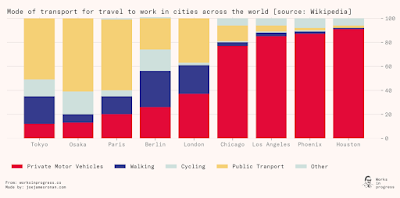
In Tokyo and Osaka just 12% and 13% of trips are by private motor vehicle, compared to 85% in Los Angeles, 77% in Chicago, 91% in Houston and 87% in Phoenix... There are 23.7 million residents in North America’s biggest metropolitan area, New York City, and these people are spread over 34,500 square kilometres. Only a small part of this is dense enough to sustain walking, cycling, and transit. By contrast, Tokyo metro area has a far larger population, with 38.1 million people, but they are four times more densely populated, across only 8,500 square kilometres. This means practically all of them can live car-optional lifestyles most of the time. Japan’s second city, Osaka, has 19.3 million: more than 45% of the country’s inhabitants live in the biggest two cities alone. By contrast, even at the most expansive definition, only around 12% of the US population live in its biggest cities.

This on the climate benefits of density

In 2018, the average Japanese person’s consumption caused 10.3 tonnes of CO2 emissions, while the average American caused 17.6 tonnes of emissions, or 74% more. Focusing on transport, we can see how much of that is explained by Japan’s denser, transit-rich, more walkable cities. In 2016 transport accounted for 1.63 tonnes in Japan, versus 5.22 tonnes in the US – over three times worse. Maps of the UK and US East Coast show clearly how the densely populated parts of cities like New York, Philadelphia and London emit far less carbon per head than the rest of the surrounding sprawl. The UK’s Centre for Cities estimated that people living outside cities accounted for 50% more carbon emissions than those living inside them.

All these being the case, the challenge is to make housing affordable enough. I have blogged here, here, and here on the issue. This summary is apt,
Ultimately there is only one solution to addressing the issue of affordability, expansion of supply. Given the more or less fixed stock of land mass within a city, the solution has to involve both building on unused lands (extensive margin) and vertical development on existing properties (intensive margin). Further, there has to be a simultaneous expansion in supply of premium, middle-class, and low-income housing supply so that price transmission happens across the market.

Given the vast affordability gap and the limited supply, market driven approaches that encourage housing development through easing regulatory restrictions and encouraging the entry of new actors like private equity are unlikely to make any significant dent on the issue of affordable housing.

Saturday, February 5, 2022

Weekend reading links

1. The WSJ has an article which points to the work of Nicholas Eberstadt which highlights the growing idleness among the male workforce. The US labour force participation rate has fallen precipitously from 67% in 2000 to 61.9% in 2020, lower than even Europe. This has taken out nearly 13 million workers out of the labour force. 

Mr. Eberstadt’s research reveals the dreary lifestyles of a rising number of nonworking Americans. “By and large, nonworking men don’t ‘do’ civil society,” Mr. Eberstadt says. “Their time spent helping in the home, their time spent in worship—a whole range of activities, they just aren’t doing.” His source is the Bureau of Labor Statistics’ American Time Use Survey, which compiles respondents’ self-reported habits. 

What is filling idle men’s time? “There’s a lot of staying at home, it seems. And what they report doing is ‘watching.’ They report being in front of screens 2,000 hours a year, like that’s their job.” Women again trail the men, but not by much. In 2019 childless women without jobs said they spent seven hours a day in “leisure,” a category dominated by entertainment. The pandemic probably sped up the trend by shutting people inside and making idleness easier. An abundance of streaming movies, videogames and social-media sites consume ever more of most people’s time. “This is not what Marx would have called the ‘higher pursuits’ of leisure,” Mr. Eberstadt says. “There’s something fundamentally degrading about this.”

2. China is the largest lender to emerging countries.

And this status complicates debt restructuring of low income countries since the terms of Chinese loans are opaque and not known, and the Chinese generally refuse to come together with other lenders for collective restructuring. 

3. Henry Mance points to an adulterated Turkish proverb to describe the shambles that's the British government under Boris Johnson,

“When a clown moves into a palace, he doesn’t become a king. The palace becomes a circus.”

4. As natural gas shortages grip Europe, it has provided a boost to LNG trade,

The ships can carry enormous amounts because, when chilled to minus 260 degrees Fahrenheit, natural gas reduces into a liquid that takes up only one six-hundredth of its volume as a gas. Liquefied natural gas, known as LNG, is loaded on ships and transported to any location with facilities to receive the chilled fuel and warm it back to a gaseous state. A large tanker, around the length of three football fields, can pack a powerful transfusion of energy — enough to light up to 70,000 homes for a year, according to an industry estimate... Taking advantage of abundant gas from shale drilling, the United States has over the last six years grown from almost nothing to one of the world’s largest exporters of liquefied gas, along with Qatar and Australia... so far this winter, liquefied natural gas suppliers from along the Gulf of Mexico and elsewhere have bailed Europe out of what could have been a dire situation even without the standoff with Russia over Ukraine... Liquefied natural gas was something of an afterthought in Europe, with cargoes mostly going to Asian countries like Japan, South Korea and China.

5. FT has a report on a damning investigation on work place culture in Rio Tinto.

The report by former Australian sex discrimination commissioner Elizabeth Broderick was thorough and damning: it found systemic bullying, experienced by almost half the 10,000 survey respondents, widespread sexism and racism, high rates of sexual harassment, multiple instances of sexual assault including rape, a “culture of silence” and lack of consequences when abuse of women, minorities and LGBTIQ+ employees was reported... Rio’s findings demonstrate the potential gulf for any company between warm words in the boardroom and grubby reality on the ground — and the emptiness of ESG investing that relies on assessing paper pledges rather than operational implementation... the risk factors highlighted by Broderick should resonate elsewhere: a hierarchical, male-dominated workplace; a culture of sexual bravado or posturing; low appreciation of the challenges of balancing work and family life; a highly performance-driven culture. Others point to a technically minded approach prone to focusing on processes rather than people.

Kudos to Rio Tinto for having published the report in full. 

6. The Big Mac Index of the Economist shows that the rupee is 56% undervalued against the US dollar.

Interesting that the Russian Rouble is the most undervalued currency as per this index.

7. Good briefing in The Economist on the savings glut in the world economy and its impact on interest rates. It points to three drivers - rising government foreign exchange reserves, corporate and household savings, and demographic shifts. 

Forex reserves have risen from 5.2% of global GDP in 1998 to 15% in 2020. Household savings have risen on the back of rising share of incomes accusing to the richest, who end up saving more. 
According to work by Atif Mian, of Princeton University, Ludwig Straub, of Harvard University, and Amir Sufi, of the University of Chicago, from 1983 to 2019, the share of American income going to the top 10% of the income distribution rose by 15 percentage points. Because of this “saving glut of the rich”, average annual saving by the top 1% of American earners alone has outstripped annual average net domestic investment since 2000... According to Peter Chen, of the Analysis Group, an economic consultancy, and Brent Neiman, of the University of Chicago, and Loukas Karabarbounis, of the University of Minnesota, annual global corporate saving rose from less than 10% of world GDP to nearly 15% between 1980 and 2015. The corporate sector has been acting as a net lender to the global economy, rather than as a net borrower from it.

The ageing global population means that there are more proportion of people in their prime working years, the highest saving periods. This has important implications for the long-term prognosis for interest rates,

Etienne Gagnon, Benjamin Johannsen and David López-Salido of the Federal Reserve Board suggest that ageing in America may account for about one percentage point of the drop in interest rates since the 1980s. (Other recent work finds still larger effects, of as much as three percentage points.) If past is prologue, rates seem sure to remain low. Barring a surge in procreation, or the embrace of a dystopian “Logan’s Run” approach to the aged, the world’s population will continue to get older. The share of global population over the age of 50 rose from 15% in the 1950s to 25% today, say Adrien Auclert and Frédéric Martenet, of Stanford University, Hannes Malmberg, of the University of Minnesota, and Matthew Rognlie, of Northwestern University. It is expected to rise to 40% by 2100...

economists say there are reasons to expect ageing to continue to depress interest rates. They note, for example, that it is the age profile of a population as a whole which matters. Even as more people retire, the age of the typical working person will continue to rise toward those prime saving years. There are boomers aplenty, but the median age in America is still just 38. Another reason is that, in the emerging world, a larger share of workers have their prime saving years still ahead of them. The median age in India is only 28, for instance. So long as financial markets remain reasonably integrated around the world, higher saving anywhere helps to depress interest rates everywhere.

This may well be another example of Japanification,

The world, in other words, may come to look ever more like Japan. There, the median age is 48, more than a quarter of the population is over 65, and the yield on a 30-year government bond is a cool 0.8%, despite a government debt load of 259% of GDP.

8. Fascinating graphic on the welfare spending by governments to mitigate Covid 19 impacts. As can be seen, almost all the $3 trillion have been in the rich and upper middle-income countries, with the rich countries alone making up 87%.

Whereas rich countries spent $847 per person to provide extra benefits, over the first year or so of the pandemic, the World Bank reckons, 17 of the poorest countries spent a pitiable $4 per person.
Interestingly, despite the dominance of cash transfers in the narratives, they came third in the nature of social stabilisation measures, behind social insurance and labour market programs. But it's likely that they formed the major share of support in low income countries. 

9. The Economist points to signatures of a global investment revival,

One feature of the pandemic, for instance, has been soaring demand for everything digital. As a result, investment in computers in America is 17% above its pre-covid trend. Roughly a year ago the Taiwan Semiconductor Manufacturing Corporation announced that it would spend $100bn over three years to expand its chipmaking output. In mid-January 2022 it upped the stakes, saying it would spend $40bn-44bn this year alone. Days later Intel, another chipmaker, said it would invest more than $20bn in two factories in Ohio. Blockages in the global supply chain for goods have also led to a splurge on new capacity. In 2021 shipping companies ordered the equivalent of 4.2m twenty-foot containers—a record, according to Drewry, a consultancy.

The article feels that the demand may remain strong in the foreseeable future. It sees three reasons. 

The first is that companies are likely to keep spending on their supply chains as they seek to strengthen and diversify them... The second reason to expect more investment is the growing optimism about the potential of new technologies to boost productivity growth... firms are increasingly betting on technological progress. Intellectual property now makes up 41% of America’s private non-residential investment, compared with 36% before the pandemic and 29% in 2005. In 2021 the big five technology firms—Alphabet, Amazon, Apple, Meta and Microsoft—alone spent $149bn on R&D... The third force driving investment higher is decarbonisation. A number of countries, together making up 90% of the world economy, have pledged to reduce carbon emissions to net zero over the coming decades in order to fight climate change. If that goal is to be achieved, the world will need everything from electric-vehicle charging infrastructure to battery storage and energy-efficient housing. Punters are pouring money into green-tinged investment funds, the assets of which amounted to $2.7trn in the fourth quarter of 2021, according to Morningstar, a data provider. Global investment spending on the transition away from fossil fuels reached $755bn last year, about half of which was spent on renewable energy, according to BloombergNEF, a research firm. Spending on electric vehicles has risen particularly quickly, by 77% since 2020 to $273bn.

10. A Bloomberg feature on the 20 richest Asian families, with combined net worth of $450 billion.

Thursday, February 3, 2022

Achieving industrial transformation

How do regions attract manufacturing firms and industrialise? How do manufacturing clusters develop? What are the requirements to achieve industrialisation? 

Even with examples of success, explaining the HOW of industrialisation has remained a mystery. I blogged here in the context of the success of Silicon Fen in Cambridge. All that can be said is that industrialisation just happens.

Much of the mainstream debates and literature is focused on the role of infrastructure provision, industrial policy and industrial promotion activities. But, for areas and regions seeking to find a foothold in the industrial landscape, is this sufficient? 

I want to point to two aspects of this issue which are less discussed - the importance of personalised engagement with investors, and the multi-layered nature of industrialisation. 

While the mainstream issues like enabling policies and infrastructure are important, a less discussed but equally important area is the need for personalised and continuous engagement. In fact, this may perhaps be the difference between success and failure in industrial transformations. 

Conditional on an enabling policy environment, what's required is continuous and high-level engagement all through down to commissioning of the project and its initial years. This is a deeply personalized play involving the political leadership and the top bureaucrats. In simple terms, it's about intense schmoozing to court the investor and then continuous handholding support to help them establish and operate the enterprise. It's about the unsexy and diffused art of long-drawn and persistent backroom implementation.

Given its personalised nature, this approach is clearly something only a few politicians and bureaucrats can pull off. And given the political economy of India, where such schmoozing is scorned upon, it's also an immensely challenging task. For example, a bureaucrat found to be dining and wining investors and businesses, even with the best of intentions, is most likely to attract the negative attention of media and commentariat and become the target of allegations and insinuations. I blogged here highlighting the contrast between India and China. 

This requirement for personalised engagement should be seen as a means to overcome the unpredictability and difficulties of doing business in India, especially for foreigners. The personal connections give confidence to the investors that they'll have a helpful ear when they face problems in the ground. 

However, these are only necessary conditions. Even with these, success is by no means certain. It's a long haul, require persistent effort, and lucky breaks. Once some big investors come in, the repeat game dynamics help reinforce investor confidence and bring more. At some point, it tips over. 

It's not for nothing that there are just a handful of examples of regions/countries having made this manufacturing breakout. Successful structural transformation is very rare. 

Now let's come to the second issue of multi-layered nature of industrialisation. 

There are perhaps three levels of industrialisation. The first, and most salient one, involves investments by large global companies - contractor manufacturers like Foxconn with their large plants or factories by large companies themselves. Their arrival most often is accompanied by the emergence of an eco-system of suppliers and ancillaries. The second level involves the medium scale enterprises, mostly domestic ones, which employ a few tens or hundreds of workers and have a smaller footprint than the large global companies. The final level constitutes the numerous small enterprises who provide the major share of job creation in a country as a whole. 

These three levels form an eco-system and are connected by a complex web of endogeniety in their respective growths. The first level provides the trigger for productivity growth through technology transfers and learning by doing spillovers, which cascade across levels. The third level provides the soil for growth of a business culture within the area and the basis for further expansion and growth of attendant infrastructure and support mechanisms. It can be argued that the strength of the middle level is one of the most important contributors to the aggregate productivity and competitiveness of the region or country. 

Successful industrialisations are likely to combine a mix of all three levels. How it emerges can, in theory, be top-down or bottom-up in terms of the levels. But both will take time. 

Monday, January 31, 2022

Market failures and political economy distortions in infrastructure sector

Private investment in infrastructure faces two important challenges. One, it demands large upfront investments which will have to be recovered over several years, often decades. Second, the project has to be operated and maintained (O&M) over its long-life cycle. 

This means that not only do the private investors have to mobilise the long-term financing required, but also, they should have the capacity and risk appetite to manage the project over its life cycle. The life cycle management challenge is compounded by the inherent nature of infrastructure projects with their deep political economy connections. This includes the site or right-of-way acquisition problems, politics of tariffs or user fees and their periodic revisions, management of the local stakeholders including unions, fending off rent seeking by entrenched local interests etc. In other words, in addition to the financing and O&M, the investors must manage the political economy too. 

This applies to any infrastructure sector – power plants, ports, airports, highways, gas pipelines, power transmission lines, metro railways etc. These challenges, formidable as they are with existing sectors, are amplified manifold in case of emerging sectors like city gas distribution or electric vehicles (EVs). These sectors face the additional co-ordination challenge required to create the eco-system to sustain the sector. They require someone to play the catalytic role. For example, EVs require complementary investments in charging infrastructure. Or city gas networks require gas supply and associated transmission pipes. 

All this introduce an interesting dynamic, which favours incumbent large companies. Who else can manage the funding, O&M, and stakeholders management of such assets? Who else have the appetite to assume such risks? Who else have the political influence to be able to keep entrenched local interests at bay?

In other words, just as platforms and network effects in technology sectors favours the big firms, similarly with long-term contracting and political economy in infrastructure. There is a clearly observed market failure in infrastructure in terms of the natural course of market dynamics resulting in the preference for big companies. 

This inherent bias towards large incumbents brings its set of problems – business concentration and private monopolies, crony capitalism and rent-seeking, political influence peddling and regulatory capture, etc. 

It also presents a difficult public policy dilemma. On the one hand, large businesses are likely to be more efficient and also more effective in overcoming the various challenges of constructing and crowding in infrastructure. But on the other hand, the inherent bias towards large firms threatens to subvert the market and corrupt the political economy. 

How can public policy respond to this problem? More specifically, how can it straddle the middle path of harnessing the efficiency of large firms without allowing it to weaken the market and destabilise the political economy? Is this an impossible dilemma – you can either have large infrastructure firms or efficient markets, but not both?

A recent welcome development in this area is the emergence of infrastructure funds as important financiers of infrastructure projects. Their very nature addresses the financing challenge. And they can outsource the management to well-suited locally relevant O&M operators. One would therefore imagine they would be agnostic to the operators and their funding would help generate a diverse supply side for infrastructure services. However, their share in the private financing of infrastructure is still a very small share. Further, these funds too are vulnerable to the same market failures and political economy risks. 

Sunday, January 30, 2022

Weekend reading links

1. In the latest episode of corporate corruption, Antonio Horta Osorio, the Chairman of Credit Suisse, has resigned following revelations of misuse of corporate hospitality and company jets for family use. This is a pervasive problem among high-flying corporate executives, but only a few get caught. 

Corruption in the private sector is about misusing shareholders money for personal purposes. As a moral issue, I don't know why it should be any less repugnant than similar corruption in government. 

2. Latest evidence of K-shaped recovery in India comes from the ICE360 survey, conducted by People's Research on India's Consumer Economy (PRICE).
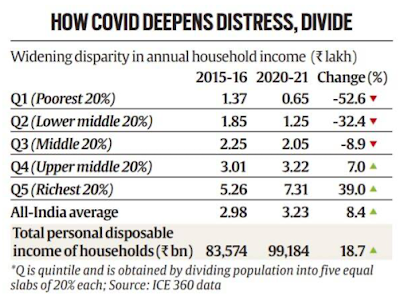
The annual income of the poorest 20% of Indian households, constantly rising since 1995, plunged 53% in the pandemic year 2020-21 from their levels in 2015-16. In the same five-year period, the richest 20% saw their annual household income grow 39%... The survey, between April and October 2021, covered 200,000 households in the first round and 42,000 households in the second round. It was spread over 120 towns and 800 villages across 100 districts... How disruptive this distress has been for those at the bottom of the pyramid is reinforced by the fact that in the previous 11-year period between 2005 and 2016, while the household income of the richest 20% grew by 34%, the poorest 20% saw their household income surge by 183% at an average annual growth rate of 9.9%...
The survey showed that while the richest 20% accounted for 50.2% of the total household income in 1995, their share has jumped to 56.3% in 2021. On the other hand, the share of the poorest 20% dropped from 5.9% to 3.3% in the same period... While 90 per cent of the poorest 20 per cent in 2016, lived in rural India, that number had dropped to 70 per cent in 2021. On the other hand the share of poorest 20 per cent in urban areas has gone up from around 10 per cent to 30 per cent now.

The share of poor belonging to urban areas increased, reflecting the likely greater impact of the pandemic on migrants and those living in slums.

3. More on slow recovery in private sector capex in India. A Business Standard analysis of the 500 most valuable companies by market capitalisation compared the performance of the top 5% and bottom 5% on a host of indicators. On gross block (all assets owned by the company)

On allocations going into investments

And on sales growth

4. The spectacular explosion in smart phone usage time in the US, which rose from 3% of waking hours to one-third over the last decade!

Will be pretty much the same elsewhere.

5. John Hussman points to the growing dissonance between the Federal Funds rate and objective functions of monetary policy like the Taylor Rule and various real economy variables. 

One observation from the graph is the consistency with which the Fed actions have overshot the objective functions when both raising and lowering rates. Fed invariably overshoots its monetary policy calibration. Is this time going to be any different?

6. This is the short history of US monetary policy over the last two decades,
The Fed lowered rates to the “zero bound” for the first time during the financial crisis of 2008. It was part of a great experiment, an effort to rescue the shaken financial system and the sinking economy when Ben S. Bernanke was chair. But the experiment never really ended. Because the economy remained weak, the Fed didn’t begin raising rates until December 2015, and it never got far. By 2019, when Mr. Powell was chair, the Fed funds rate had reached only 2.50 percent before signs of economic weakness made the Fed stop. In March 2020, it fell back to nearly zero. By contrast, the Fed funds rate was as high as 6.60 percent as recently as July 2000... 

The amounts involved in the Fed’s quantitative easing have been staggering. Back in 2008, the Fed’s balance sheet had assets of $820 billion. They reached $4.5 trillion — yes, trillion — in 2015 and dropped only as low as $3.76 trillion in the summer of 2019. With the coronavirus financial crisis, they have ballooned again, to $8.9 trillion, and may swell a bit more before the spigot shuts. Assets held by the Fed are already more than 10 times their size in 2008, and bigger, as a proportion of gross domestic product, than at any time since World War II. The Fed’s monetary stimulus accompanied a total of roughly $5 trillion in pandemic fiscal relief by the federal government.

This is the challenge with monetary policy adjustment,

Calibrating the combined effects of quantitative tightening and interest rate increases in real time is exceedingly difficult. Cut off stimulus too rapidly and the Fed could further unnerve financial markets. It could conceivably cause a spike in unemployment and a sharp slowdown in growth, plunging the United States into a recession. Move too gingerly, on the other hand, and the Fed could allow elevated inflation expectations to become embedded, making high inflation even more damaging.

7. A good NYT piece on the dilemma facing consumer brands in associating with China and the forthcoming Winter Olympics.

“The space to please both sides has evaporated,” said Jude Blanchette, a scholar at the Center for Strategic and International Studies in Washington. “When choosing who to upset, it’s either a bad week or two of press in the U.S. versus a very real and justified fear that you’ll lose market access in China.”... the issue of human rights violations in China has not generated enough protests to threaten the profits of multinational companies, while the angry Chinese consumers have fueled painful boycotts... “If any other government in the world did what the Chinese are doing in Xinjiang or even in Hong Kong, a lot of companies would just pull up stakes,” said Michael Posner, a former State Department official who is now at New York University’s Stern School of Business. He cited decisions by companies to divest in places like Myanmar and Ethiopia, as well as the campaigns to boycott South Africa when its apartheid government sent all-white teams to the Olympics. “China is an exception,” he said. “It’s just so big, both as a market and a manufacturing juggernaut, that companies feel they can’t afford to get in the cross hairs of the government, so they just keep their mouths shut.”

8. Interesting graphic about economic recovery in the US

Inflation-adjusted output last quarter was just 1 percent below where it would have been if the pandemic had never happened. Here’s another one: Ignoring inflation, output is 1.7 percent above where it would have been absent the coronavirus.

9. The Kerala government is planning a semi-high speed railway corridor, Silverline, planned across the length of Kerala. The Rs 63,940 Cr project to be financed through external loans would cut the travel time for the 530 km commute from Trivandrum to Kasargode from 12 to 4 hours. Indian Express has an article that points to the public opposition being faced by the project.

I had blogged earlier here about the value of such a project given the urban continuum nature of the state's demography and topography. However, it remains to be seen from the financials about how sustainable it will be. 

10. The bad bank is finally off the ground with the decision to transfer Rs 50,335 Cr from 15 accounts to the National Asset Reconstruction Company Ltd (NARCL) by March 31, 2022. Its private sector owned twin, India Debt Resolution Company Ltd (IDRCL) will be responsible for the resolution of the debts. NARCL will be majority owned by public sector banks and IDRCL majority owned by private sector banks. This is a good primer. 

The NARCL will purchase these bad loans through a 15:85 structure, where it will pay 15 per cent of the sale consideration in cash and issue security receipts (SRs) for the remaining 85 per cent. The SRs will be guaranteed by the government. The government guarantee will essentially cover the gap between the face value of the security receipts and realised value of the assets when eventually sold to the prospective buyers. The government approved a 5-year guarantee of up to Rs 30,600 crore for security receipts to be issued by NARCL as non-cash consideration on the transfer of NPAs. This will address banks/RBI concerns about incremental provisioning. Government guarantee, valid for five years, helps in improving the value of security receipts, their liquidity and tradability. A form of contingent liability, the guarantee does not involve any immediate cash outgo for the central government.
Once the bad loans are transferred to NARCL, a trust will be set up for each loan account, and the debt resolution will be handled by IDRCL, which will not carry any balance sheet.

11. Finally, on budget eve, this article has numbers which makes a strong case for higher long-term capital gains (LTCG) taxation in India. Those who declared more than Rs 1 Cr annually from LTCG was 8629, with Rs 40,000 Cr income for 2017-18. I imagine it would have doubled in these boom times by 2021-22. 

And India's LTCG rate of 10% pales in comparison to this from other comparable economies.

Friday, January 28, 2022

Some observations on the Chinese government policies

This post will look at some of the manifest priorities of the Chinese government and how it's pursuing them. It draws from earlier posts here, here, here, here, here, and here

The list of apparent priorities of the Chinese authorities in recent times. 

1. Structural transformation to increase the share of domestic consumption and realise "common prosperity" through, among other things, forced income redistributions from the rich.

2. Recalibrating away from debt-fulled economic growth towards more sustainable basis by, among other things, allowing over-leveraged firms to flounder and even fail. The most prominent example has been the efforts to deflate the bubble in the real estate market, a disproportionately important sector and the largest contributor to the country's economic growth. It has committed to introduce "traffic lights" to prevent "disorderly expansion of capital". 

3. Asserting control over the private sector by actively pursuing the regulation of the platform companies and  deepening institutional linkages between the Communist Party and private sector managements. The spectacular growth of platform companies like Alibaba and Didi have engendered several concerns which threaten economic and social stability and weaken the control of the Party over the economy. This necessitates regulation to rein them in. Similarly, while private business managements have always deferred to local Party officials, their influence has become more formalised and entrenched in recent years. 

4. Crackdowns on the likes of real estate speculation, private tuitions, effeminate men, superfandom, online gaming for children on weekdays so as to limit the spread of practices which are perceived as socially undesirable. The activities of these sectors are thought to be inimical to "common prosperity" and therefore require to be curbed. 

5. Maintaining the credibility of the government and internal discipline within the Communist Party through the anti-corruption drive. The provincial and lower government and party officials were important drivers and beneficiaries of the spectacular economic growth over the last three decades. This, as the likes of Yuen Yuen Ang have documented, invariably ushered in a Chinese Gilded Age, where transactional corruption flourished. Several party apparatchiks and leading government officials became immensely rich from rent-seeking. Xi identified this corruption as a corrosive factor and initiated a high-profile campaign to cleanse corruption in the Party and government. 

6. Focusing inward by prioritising domestic economic growth drivers through the dual circulation economic growth strategy. Exports and foreign investments should be secondary to the primary drivers of economic growth which are located within China. 

7. Doubling down on industrial policy with the objective of establishing Chinese dominance of the cutting-edge technologies. The Made in China 2025 program, launched in 2015, prioritises "indigenous innovation" to achieve "national rejuvenation" by transforming China into a "manufacturing superpower" in 10 priority high-tech sectors. It seeks to achieve global leadership in these advanced technology sectors. 

8. Demonstrating a new and assertive China which has "arrived" and is therefore no longer willing to "hide its strength" through its "wolf warrior" diplomats. This has meant ratcheting up tensions with neighbours on both land and sea. It has also meant taking strong objection to perceived offending of China - suspension of rare earth exports to Japan after a maritime clash off Senkaku, curbs on Norwegian salmon imports and Nobel Peace Prize to a dissident, ban on Australian wine and barley imports in retaliation for its demand for inquiry into origins of Covid 19, and removal of Lithuania from Chinese Customs Administration's country list on December 1 in retaliation to the country allowing the opening of a Taiwanese representative office in Vilnius etc. 

9. Renewing efforts to unify China with Taiwan, one of the highest long-term priorities of the Communist Party, so as to restore the full glory of the Middle Kingdom.

Barry Noughton and Rush Doshi have good books on the emerging China. I have not read Michael Pillsbury, whose works were an important influence in the Trump administration. 

There are some observations from these priorities and the way in which they are being pursued.

1. All of these measures have a common theme. They assert the supremacy of the Communist Party and, in particular, the subsidiarity of even the richest Chinese and the biggest Chinese companies. The Communist Party has long been wary of political liberalisation, as exemplified by Mikhail Gorbachev's Glasnost and Perestroika reforms, as an existential threat. It has left no opportunity to highlight this risk and take measures to ensure China does not go the way of the Soviet Union. 

2. The means being followed on some of the priorities, especially on letting the property, is extremely risky and can potentially threaten the system itself. For example, deflating an asset bubble through calibrated policy interventions is the stuff of policy dreams and rarely materialised. There are so many ways in which even the best calibrations can go wrong. 

3. Given the risks associated, one cannot but not admire the conviction to go ahead with some of these measures. Rana Faroohar wrote about them in a recent oped,
The troubled property giant China Evergrande may yet melt down and take out the remainder of the sector with it, but I have to admire Beijing for doing exactly what the US did not do in the run-up to the subprime crisis, by identifying problematic companies in advance of a crash, and attempting to let the air out of a bubble before it brings down the rest of the economy... sending executives who have broken the law to jail after a fair trial, and checking corporate excesses in advance of crisis, is a good thing. China has recently made some improvements in investor protection schemes and securities law. In November, Kangmei Pharmaceutical, formerly one of China’s largest publicly traded drugmakers, was found guilty of fraud and had to pay out $387m to investors. Chair Ma Xingtian and his wife, along with four former executives, were held personally financially liable, and Ma himself was jailed. Would that any number of American executives had received the same treatment amid the countless financial crises and corporate scandals of recent years.

4. The implementation of these policies have required the centralisation of the policy making in the Presidency, which in turn has ended up marginalising the traditional institutional structures even including the separations between the government and the Party, and the Party and the leadership.