This post will analyse metro railway projects in India, highlight their failings and make some suggestions.
There are three reasons why metro projects globally struggle to be sustainable, even on the Opex. One, the original traffic projections were on the higher side, making the revenue forecasts a non-starter. In other words, the metro should never have been built. Second, the ticket prices were kept too high, resulting in less demand. Third, there is limited induced ridership due to the lack of TOD, parking facilities, and modal integration.
The first is a common factor associated with projects globally (optimistic forecasts to justify otherwise unviable projects). The second is a tricky problem insofar as lowering it further risks significantly worsening the financials of the metro. Besides, there is enough evidence that metro ticket prices are reasonable across cities. And the real problem is less the fare level than the generalised cost of the trip, or the fare plus the last-mile penalty (arising from the need to change modes, and the lack of any modal integration).
The last one is especially important since the metro is a large investment that is made to shape the city's growth, specifically by densifying the walkable vicinity of its stations and thereby inducing captive ridership. This is the biggest source of sustainable passenger ridership for the metro. Thin station catchments may well be the binding constraint to the operational viability of India’s metro systems.
India's experience with TOD has been disappointing. None of its 900-odd metro stations is a TOD (densified residential and/or office spaces, which enable walkability from the station to house/workplace). This is unsurprising since the TOD policies generally suffer from poor design. There is also the reality that very few metro projects globally can recover even opex with the farebox collections and rely on real estate and other commercial revenue streams. More on it later.
In addition to the three demand or revenue-side challenges, there is also a cost-side problem. They include the wrong mode selection - choosing an underground full metro when light rail or bus rapid transit system would have sufficed. The low-cost foreign loan is deceptive since a depreciating rupee inflates the cost (though the Yen, the major source of metro debt, has been depreciating or holding steady against the rupee). Further, the linear stunted network topology, as against a connected grid, limits ridership. Most Indian systems are linear stubs, so they sit permanently below the ridership threshold at which farebox economics turn. As an illustration, Chennai’s finances turned around dramatically once Phase 1 closed the loop, with ridership surging from 13% of projection at CAG FY20 to now ~60%.
I asked Claude to generate certain parameters for the leading Indian metros. First, the difference between the DPR ridership projection and the actual realised ridership points to strategic misrepresentation with inflated estimates to secure project approval. As can be seen, apart from Delhi, the shortfall is very high, with the majority not even able to generate a third of the estimated ridership. This points to clear strategic misrepresentation to get the project sanctioned by exaggerating the ridership estimates.
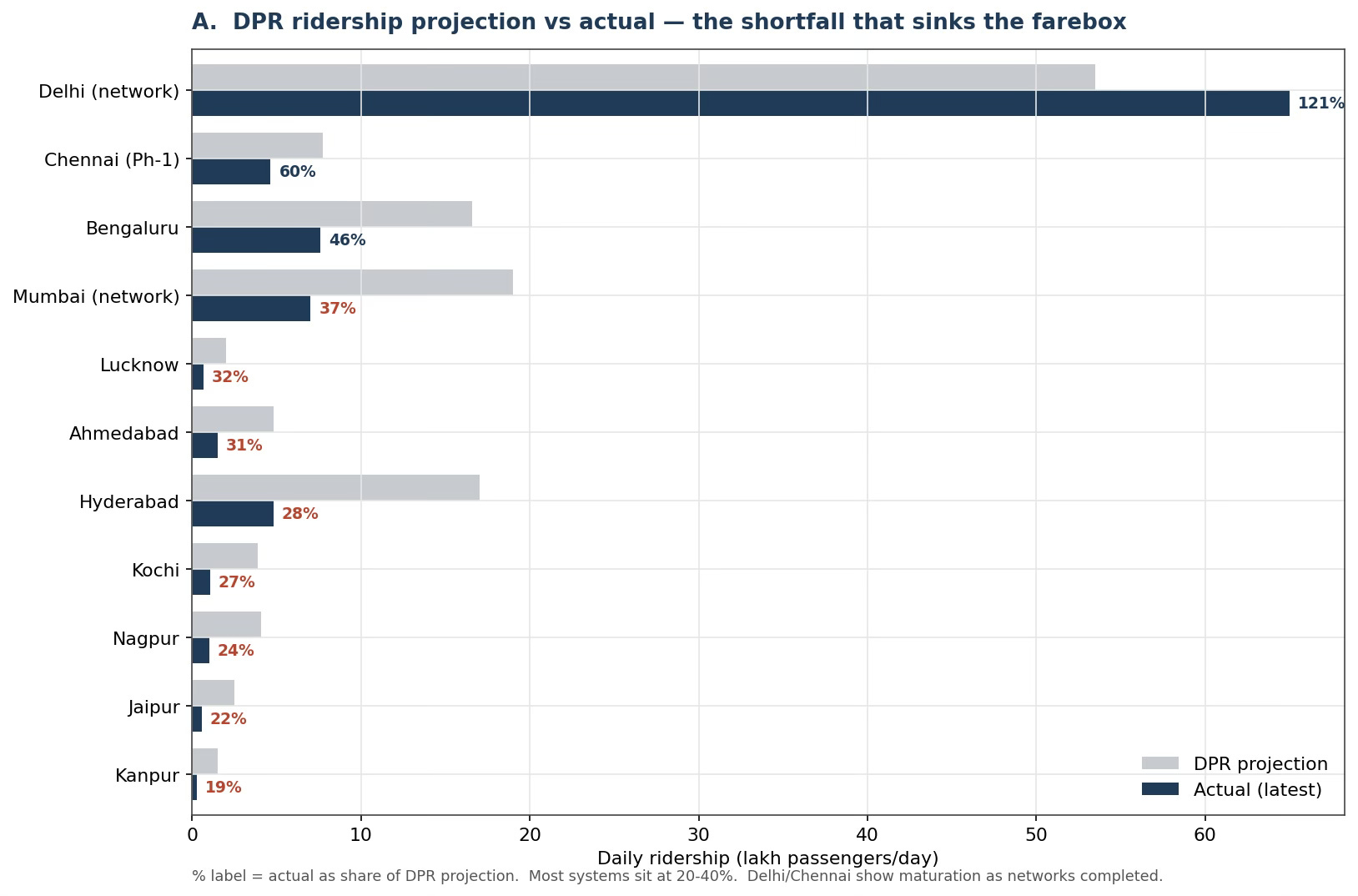
Delhi is now above its old 2019-20 target after Phase-III/IV and post-COVID recovery. This points to the fact that maturation and network completion, and not fare tweaks, are likely to move the needle.
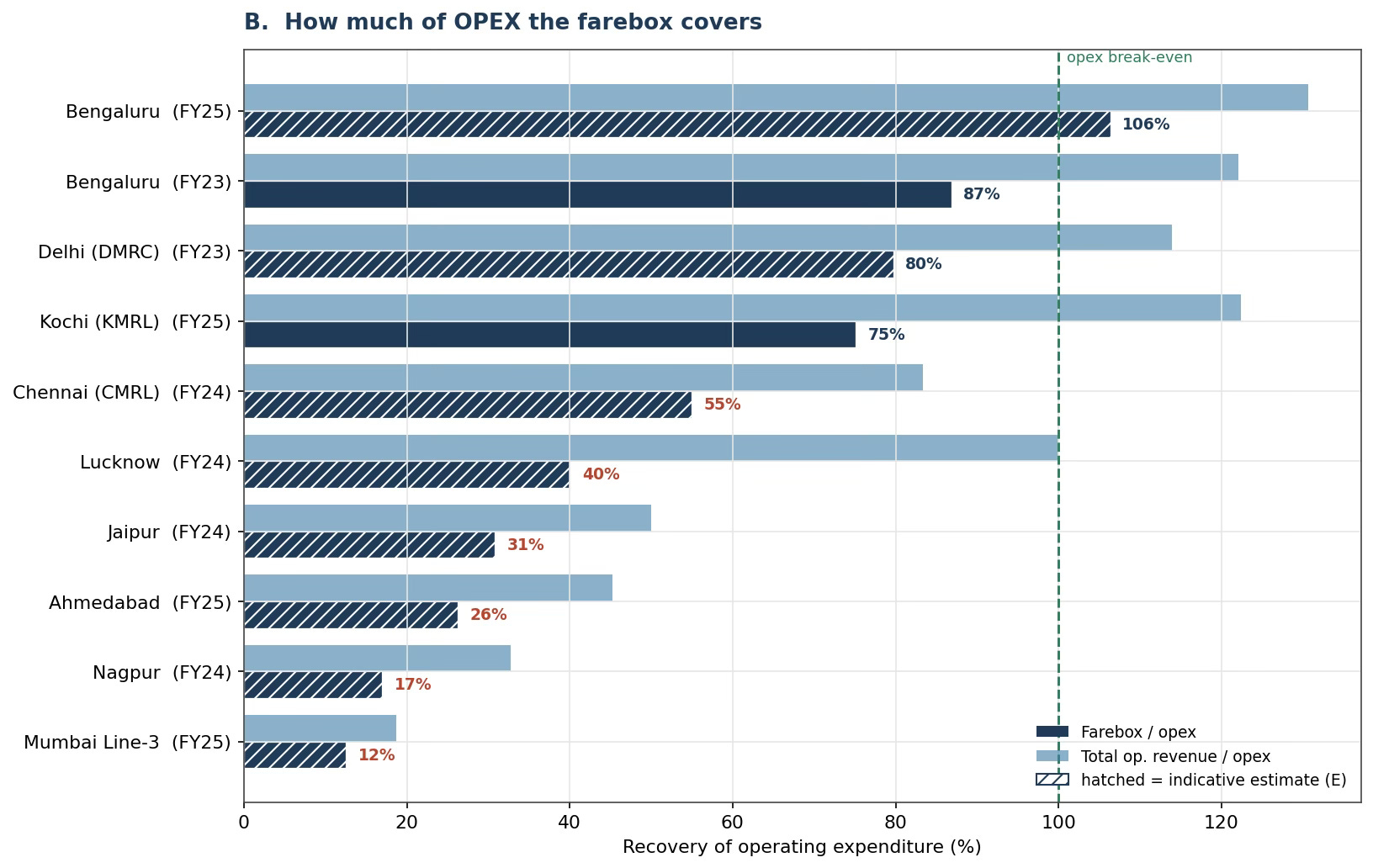
In terms of the percentage of just the opex covered by farebox revenues (or ticketing), it is very low in many metros. However, when combined with the other revenues, five metros are able to cover the opex.
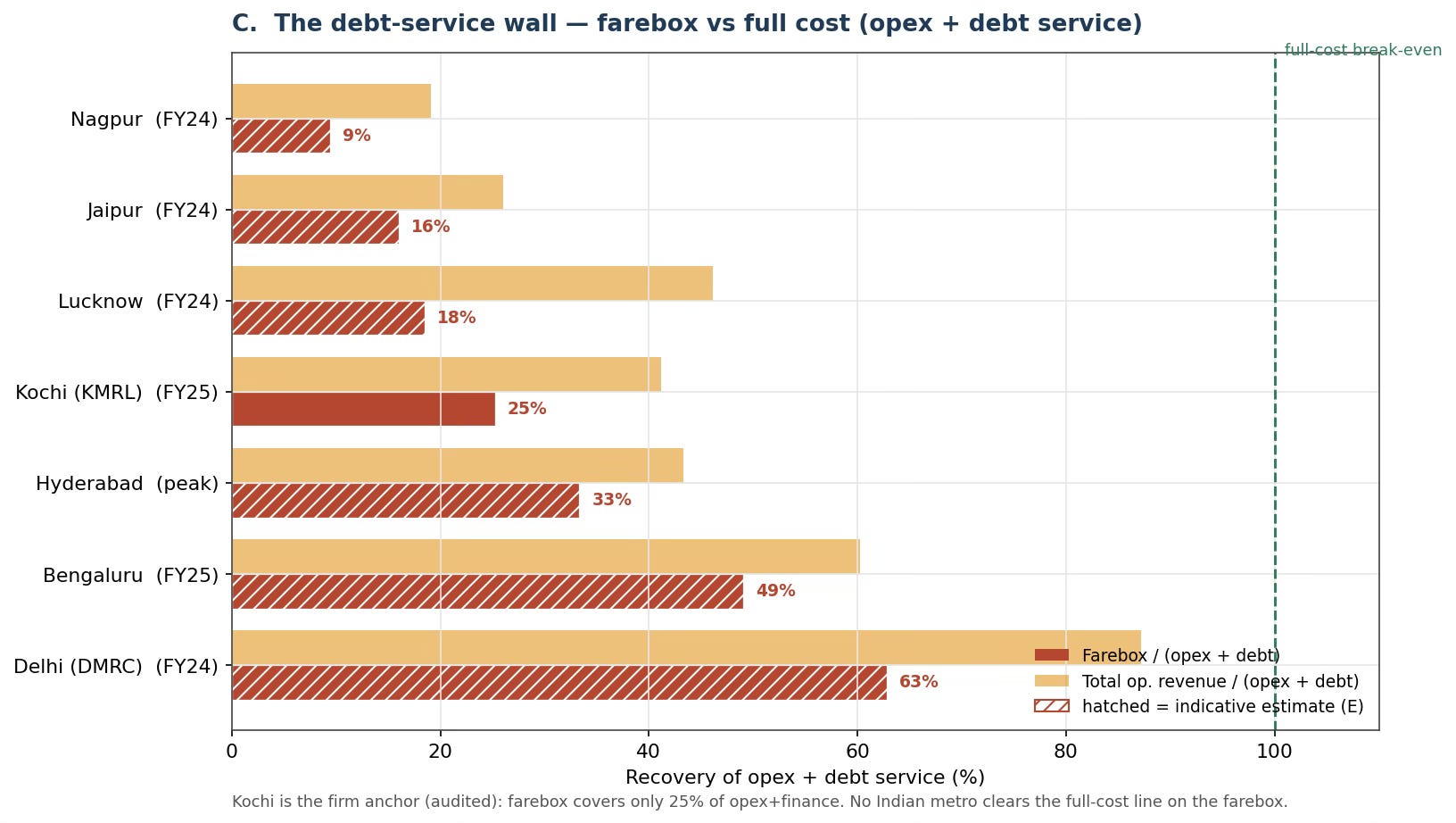
But if we include debt-service, the picture becomes extremely bleak. Most Indian metros are deeply in the red.
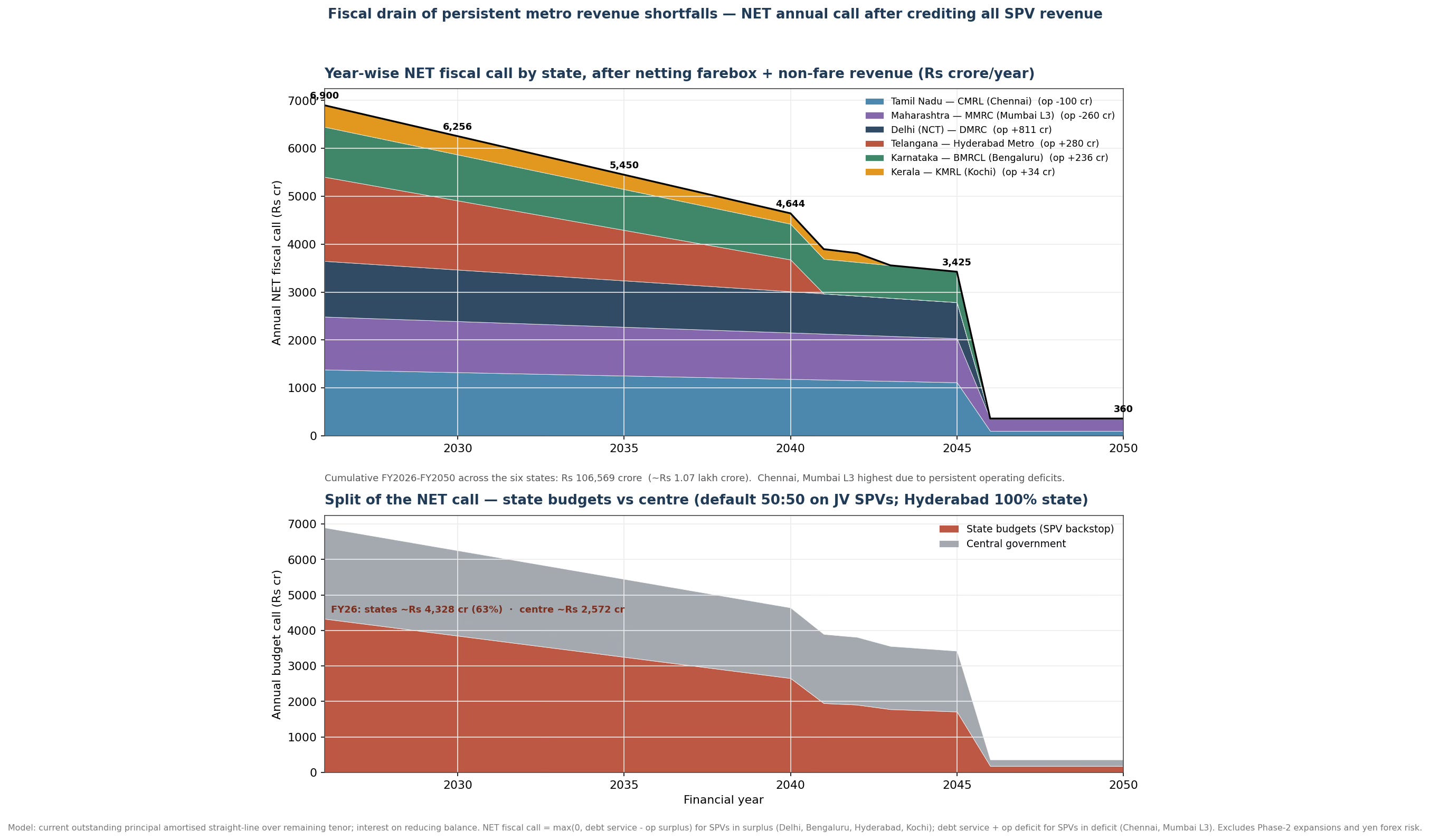
This has important fiscal implications. I took six major states, and assumed their current ridership trajectory and fare growth to calculate the gap between their total revenues (farebox and non-farebox) and total opex and debt service. This assumption overlooks that ridership trajectory may improve over time. In any case, this analysis points to an undiscounted 25-year total gap of ₹1,06,569 cr, or NPV of ₹64,423 cr when discounted at 7%. The state share is around 60% or ₹38,582 cr, and the central share is ₹25,840 cr, amounting to a total annual budget requirement of ₹6,900 cr for FY26 to ₹6,256 Cr for FY30.
A global comparison yields interesting results. Apart from Northeast Asia, generally, metro railway systems struggle to cover even Opex through farebox collections.
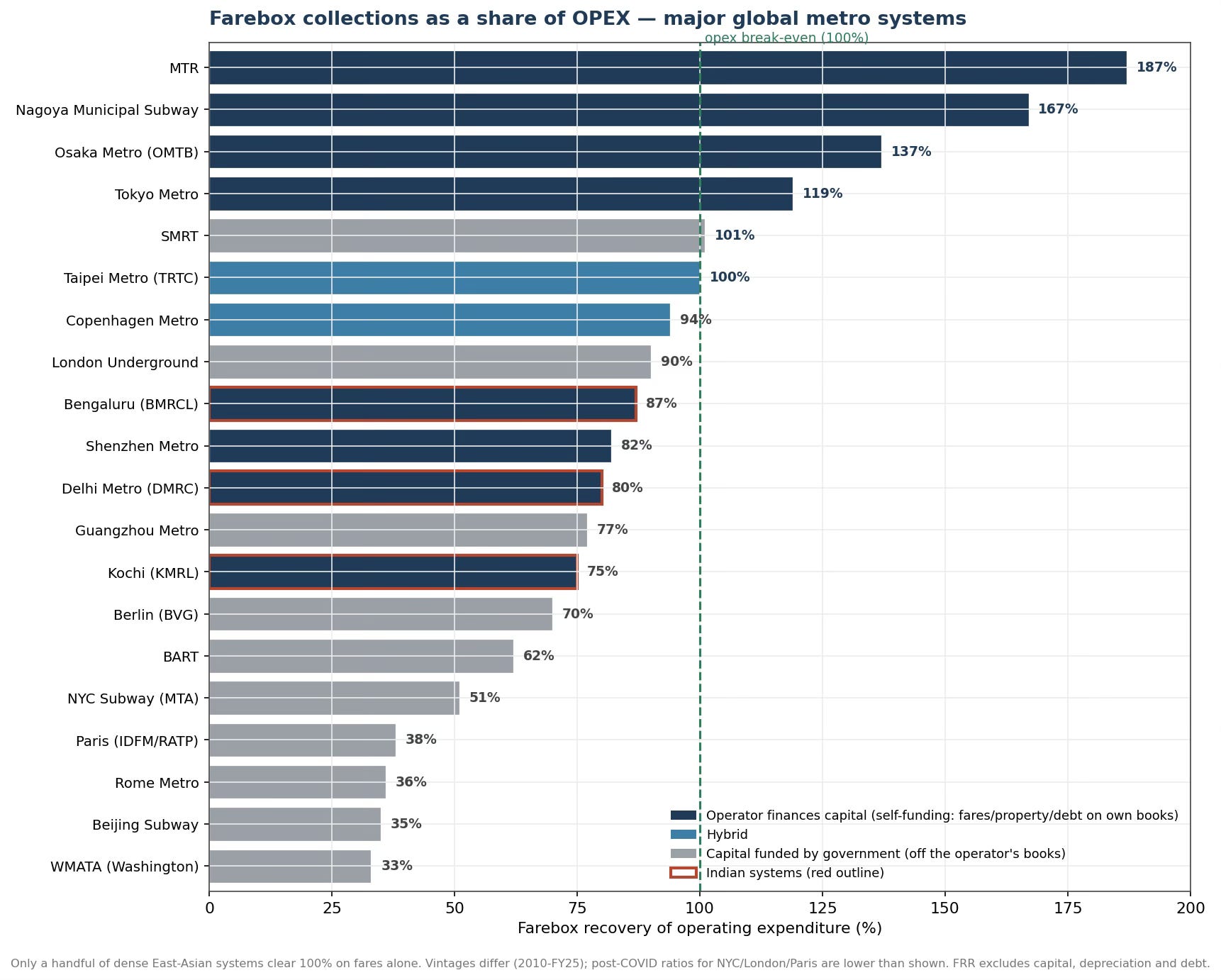
In all western cities, their governments funded the infrastructure (versement mobilité in Paris, LTA asset ownership in Singapore, TfL/Treasury grant in London, MTA authority-level bonds backed by dedicated taxes in New York). The operator, therefore, never sees the debt service, which has been socialised as a public subsidy up front. Only Hong Kong MTR and Tokyo make the operator carry capital and still clear cost, and they do it through property and ancillary income, not fares.
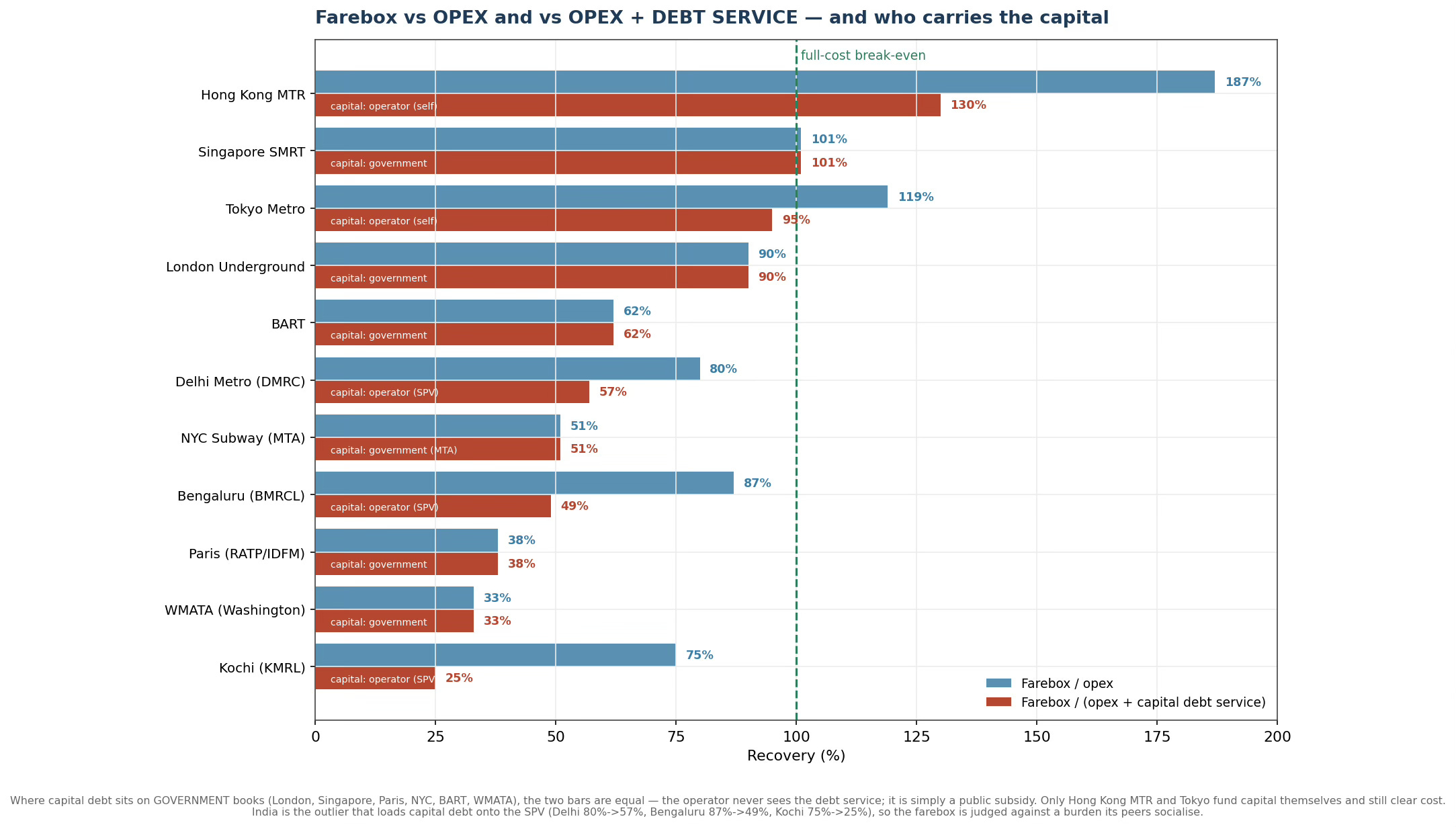
India is a structural outlier in loading the capital debt onto the SPV's own balance sheet. The Indian farebox is being judged against a burden every comparable peer either socialises to the budget or funds from property. The sustainable systems didn't find a magic farebox - they either kept capital off the operator (the European/American subsidy model) or monetised the land (the Hong Kong/Tokyo model). India did neither.
So what can be done?
A systemic reform requirement is to orient the design and implementation of metro railway systems away from being primarily a railway construction project to an urban planning initiative. This would entail tight integration of the planning of metro rail projects by the municipal authorities.
The TOD influence zone (TIZ) around each station should be seen as a genuine opportunity for redevelopment and densification. The planning regulations applicable to the TIZ should make it significantly more attractive to build insidecompared to outside - 3-4 times higher FAR, remove parking minimum, TDR-driven land assembly, TDRs brought in with higher multiples, etc. Equally important, the regulations should make it attractive to redevelop the built-up areas (and not be like this). Instead of being prescriptive on land use, it should be left to market forces to determine the appropriate shares of different types of uses in each zone. It would also allow the markets to crowd in the right kinds of commercial amenities, such as groceries, retail, restaurants and cafes, and services, into the zone, depending on its broader land-use mix.
An important reason for the failure of TOD is the lack of attention given to its public realm elements, specifically the street configuration for connectivity and walkability, and public amenities. This is a bad omission given that walkability (from/to commute and for amenities) is the primary objective of TOD zones. An area without these elements contradicts TOD. Unfortunately, in built-up areas (which form the major part of TIZ), these elements don’t emerge overnight. They require master plans that are configured to enable walkable street connectivity, higher density, and mixed-use developments. Once the master plan is in place, its implementation should be facilitated proactively through the development control regulations and building bye-laws that allow for TIZ preferences and incentives, and instruments like the Town Planning Schemes. These are 10- to 15-year agendas.
The TIZ preferences should be complemented with feeder buses, multi-modal fare integration, and e-rickshaw access so as to extend the catchment beyond the TIZ. Further, as the Chennai example shows, metro lines should complete the loop or connect the grid, and not remain as linear stubs.
For financial sustainability, the TIZ should deploy appropriate value capture finance instruments. I blogged about it here. They would include betterment levies (brownfield areas) and impact fees (greenfield areas), station-area commercial development, air-rights leasing, and purchaseable FAR. However, care should be taken to ensure that these levies do not detract from the commercial attractiveness of building inside the TIZ. These revenues should be assigned to the SPV balance sheet. This is how HK MTR earned 65% of its 2024 profit from property, not fares.
These urban planning and other policy requirements should be tightly incorporated into the approvals given for these projects. Every new metro DPR must include statutory master plan amendments, FAR densification for station catchments, mixed-use zoning, land assembly strategy, and the land-value-capture financing plan. They should be preconditions, not annexures. The rail alignment should be a subset of the urban plan.
There should be no sanction without station-area FAR increases, TDR-driven consolidation, betterment-levy design, and air-rights leasing, all routed to the SPV. TDR can pre-fund land assembly before construction starts. These should become an approval veto. Further, any ongoing support from the Government of India must be made contingent on compliance in letter and spirit with these requirements to pre-empt backsliding and subversion by the states.
The planning elements discussed above would have to go against the conventional wisdom on urban planning held close to heart by town planners across India and the vested interests of builders and others. It would therefore require strong resolve at the highest political and bureaucratic levels to overrule objections and enforce them.
For new projects, central funding should become conditional on a corridor-density threshold, independently audited ridership models, and ex-post accountability. There should be an end to the practice of a self-certified 14% IRR. Anything below the threshold should qualify only for a MetroLite / MetroNeo / BRT.
In conclusion, the urban metro should be used as an opportunity to redraw the metro as an urban plan by densifying station catchments, capturing the value, and servicing the construction capital.


No comments:
Post a Comment