Transit-Oriented Development (TOD) remains an elusive urban planning goal for India despite nearly two decades of efforts. I blogged on TOD implementation in India here.
In simple terms, TOD is about minimising commute times, ideally by locating both homes and workplaces within walking distance of mass transit stations, or at least one location within walking distance.
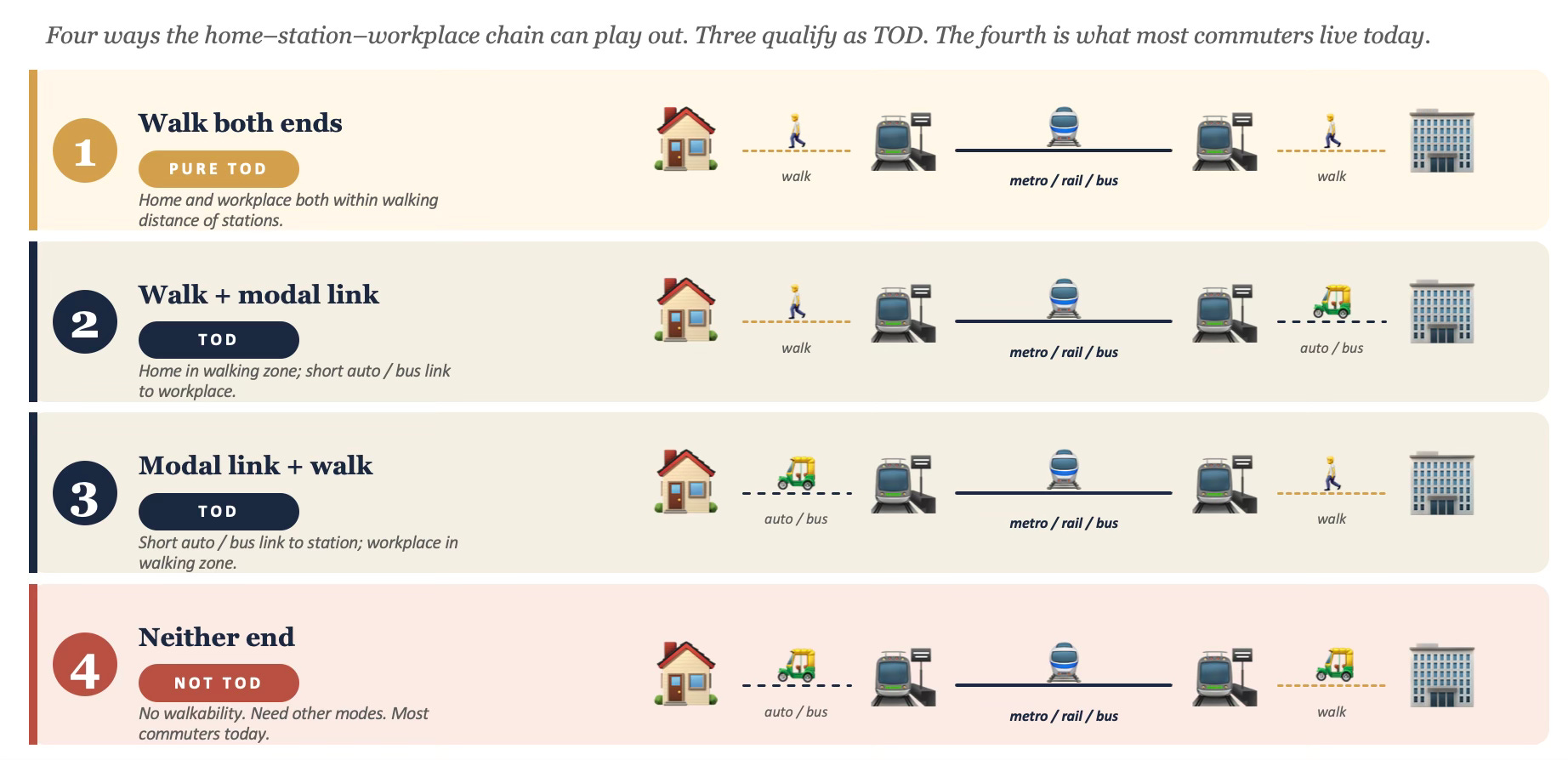
This would entail crowding in high-density residential, office, commercial, and institutional developments around the station. This requires making it attractive for developers to prefer building within the TOD influence zone, despite its much higher land costs.
There are perhaps four big failings with the TOD policies over the years.
1. The biggest problem is that metro and commuter railway projects are primarily seen as infrastructure projects and only distantly as opportunities for urban development and economic growth. This is manifest in the limited involvement of the municipal corporations in their design. TOD is planned and executed mainly by the transportation entities without adequate ownership by the local governments.
The railways, Road Transport Corporations (RTCs), mass transit entities, state governments, and Urban Development Authorities (UDAs) view TOD primarily as station-based real estate development opportunities that lead to monetisation and revenue mobilisation. A second consideration is to increase housing supply. The UDAs tend to view TOD as an instrument to develop or monetise their own lands, mostly to increase housing supply.
The idea of minimising commute times is rarely explicitly considered as an important factor.
2. Policymakers have internalised a belief that the attractions of connectivity and higher (this too is mostly marginal) FAR are sufficient for developers to choose TOD influence zones.
But, as I blogged here, this assumption is seriously flawed. The global experience on TOD clearly points to the need for fiscal concessions to make it attractive enough for real estate development in the pricier TOD influence zone.
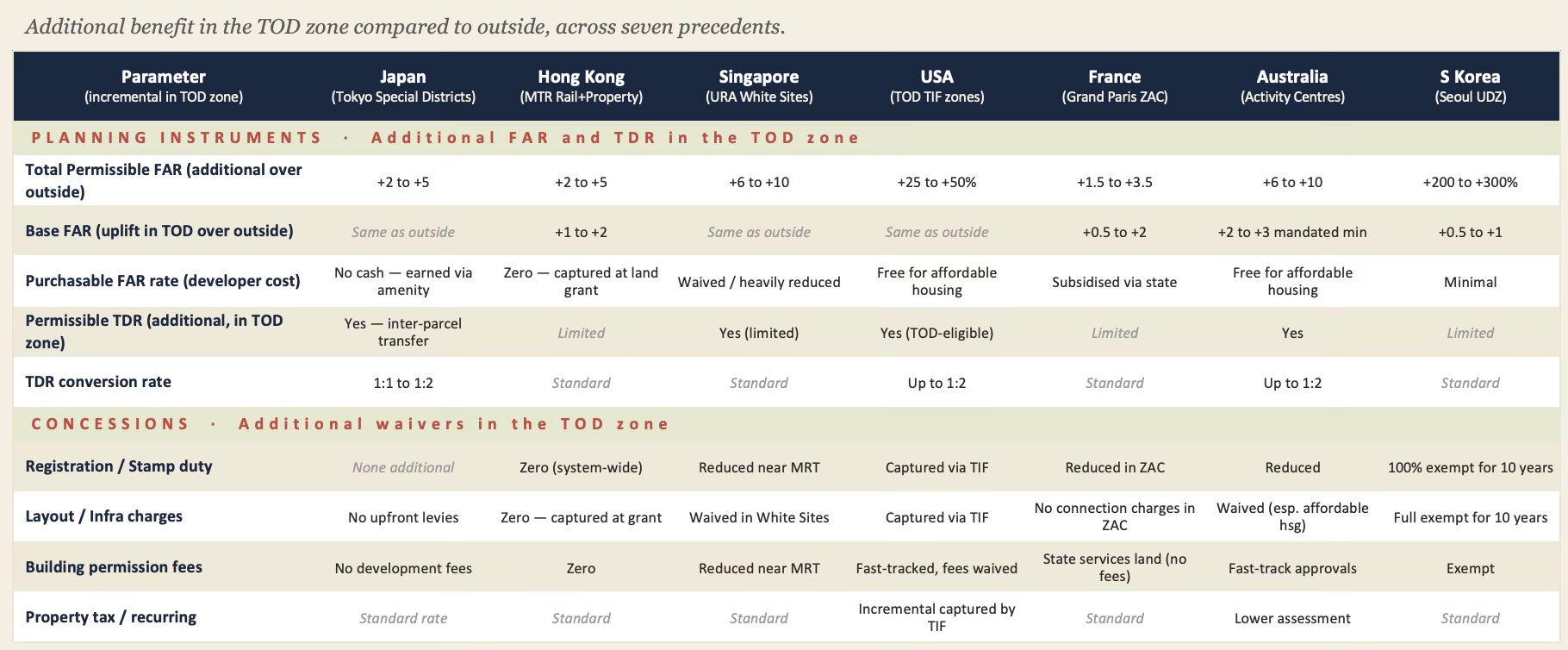
Given the higher land costs in TOD zones, the case for fiscal incentives to offset them and attract developers should be obvious. A TOD policy can therefore be effective only if the conflict between the objectives of minimising commute times (or densified development around stations) and maximising revenues is resolved in favour of the former, at least in the initial years
Planning officials are averse to dense high-rises. Bureaucrats are averse to foregoing revenues. Taken together, we have a TOD gridlock. The common ground is mid-rise residential property development where government lands are available around transit stations. This is the reality of TOD in India.
3. By its very nature, there cannot be a uniform TOD policy with tightly prescribed norms on use categories. However, governments (especially UDAs), struggling with the problem of housing, tend to view TOD primarily as an instrument to address housing problems in cities. This creates a pronounced bias towards housing in TOD zones. This, too, is a seriously flawed assumption.
The proportion of the different use categories varies across stations. So, for example, the vicinity of a large metropolitan downtown station would be more suitable for predominantly institutional and office uses, whereas that around a smaller suburban node would be suitable primarily for residential and commercial uses. This would allow the satellite nodes to grow by feeding off the metropolitan node, and the latter to decongest and grow sustainably. A prudent policy choice, therefore, may be to leave it to the market to decide the proportions of different uses within the TOD zone depending on the strengths and opportunities of each node.
4. TOD demands a high level of coordination among different government agencies. But it is a daunting challenge to coordinate across the universe of stakeholders involved in TOD - the municipal corporations, the UDAs, the RTCs, the metro or commuter rail SPVs, and Indian Railways.
This is best illustrated with modal integration - the seamless integration across the different modes of transport at a station, including ticketing - an essential requirement for TOD. This has proved elusive despite numerous serious efforts. Further, because each view focuses on real estate development and revenue mobilisation (or housing), and overlooks the primary objective of minimising commute times, their incentives pull in different directions.
Even something as apparently simple as the integration of the facilities of distinct metro, commuter rail, IR, and RTC in one station becomes a challenging exercise. Their physical integration as one unit to share and optimise space and services can be a bureaucratic nightmare. Instead of planning and developing the area as an integrated unit, each entity pursues its priorities with limited synergies.
There are no easy answers here. When a problem has proved elusive for a long time, a good starting point would be recognition of its complexity and piloting it. It may therefore be prudent to focus on implementing TOD at 1-2 stations in a bespoke manner.
What would be the nature of a TOD (the mix of categories of developments) appropriate for the station? What package of interventions and incentives would be sufficient to attract private developers to invest in the TOD influence zone? What governance arrangement can get all stakeholders on board at a high-enough level to ensure effective coordination?


No comments:
Post a Comment