This post compiles a few articles on AI’s emerging impact on the economy.
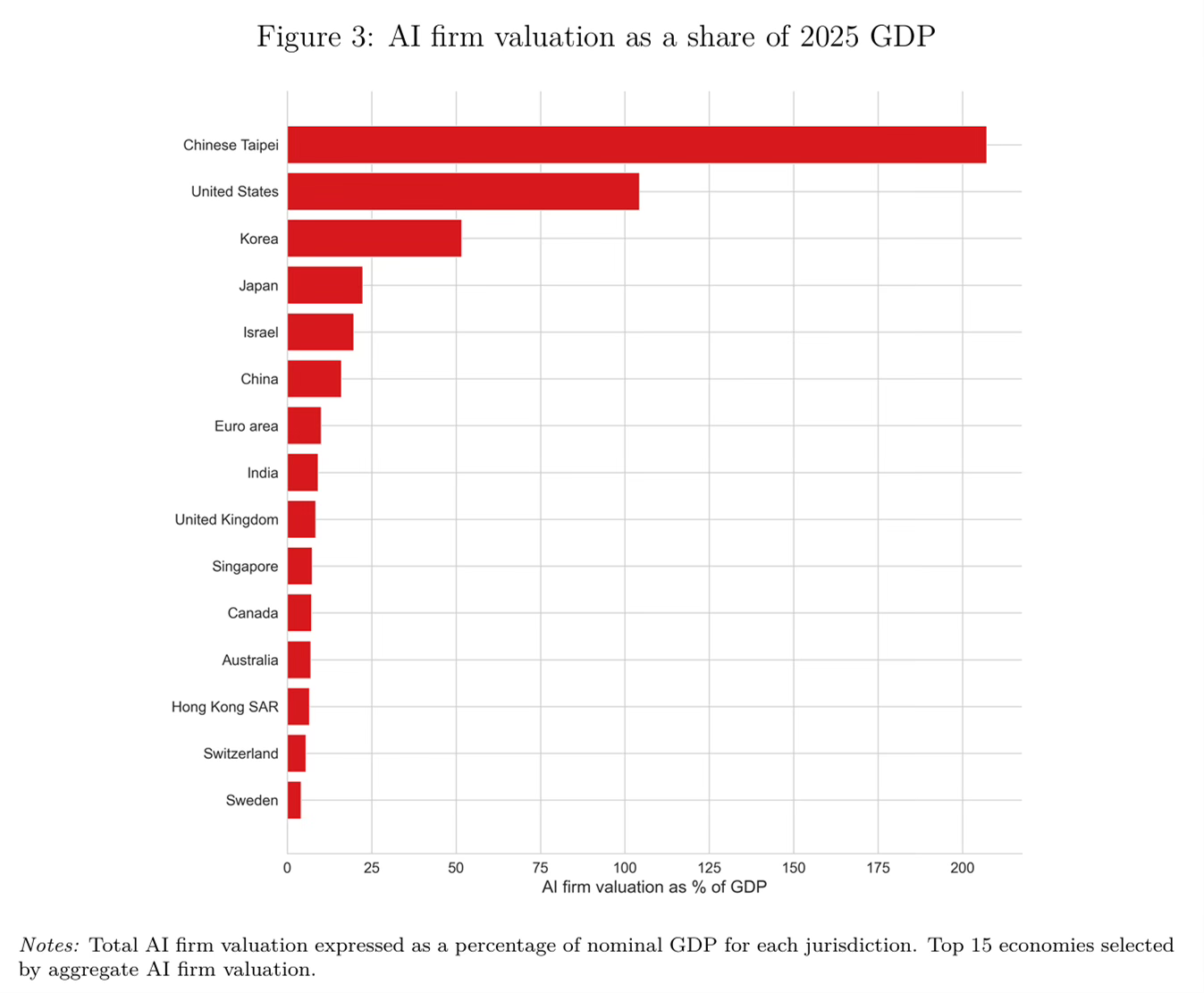
If the chatter is to be believed, AI is eating the economy. One striking graphic on the importance of AI firms came from John Mauldin’s weekly newsletter.
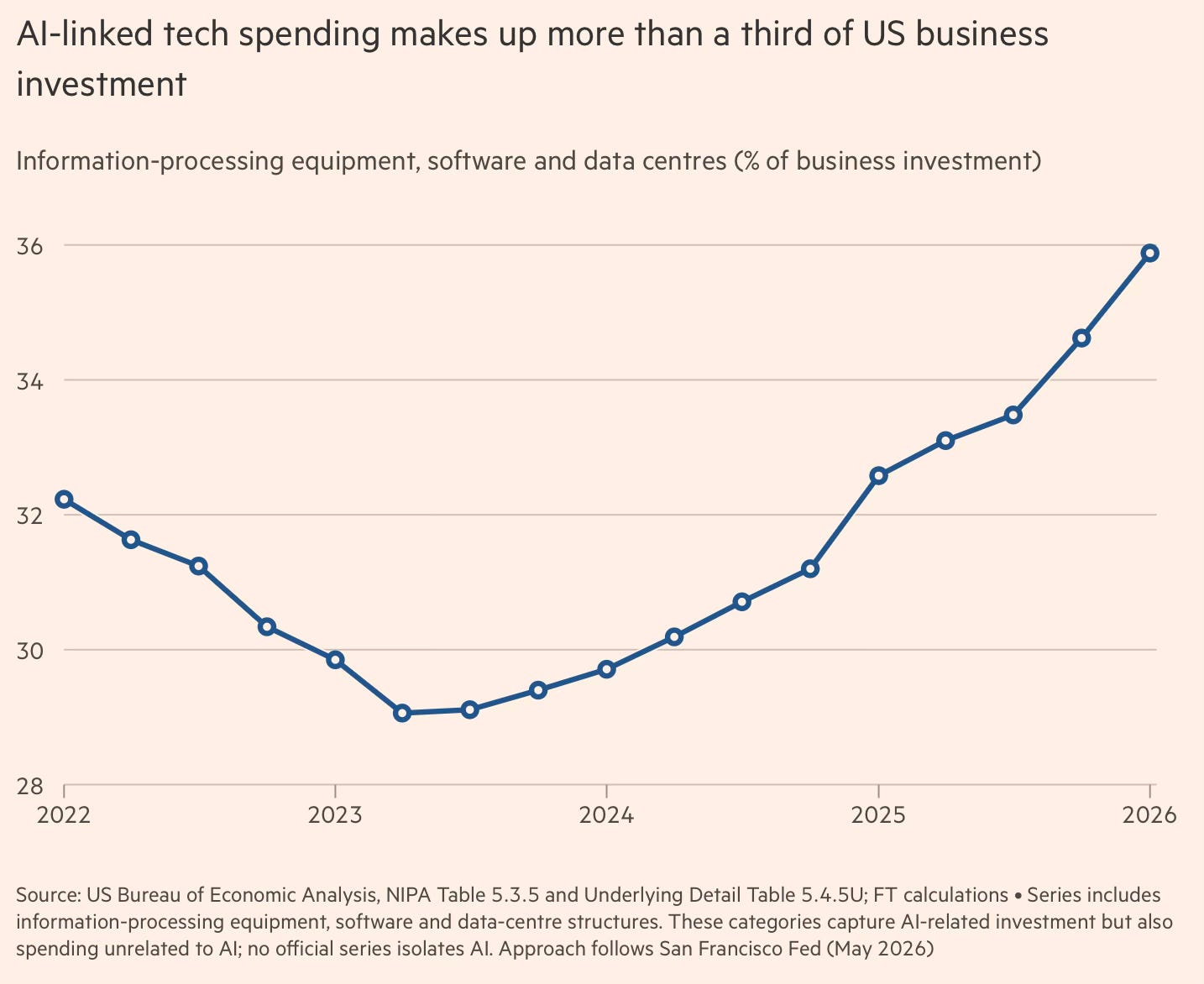
Nowhere is AI’s role in economic growth more pronounced than in the US, contributing more than a third of US corporate investment.
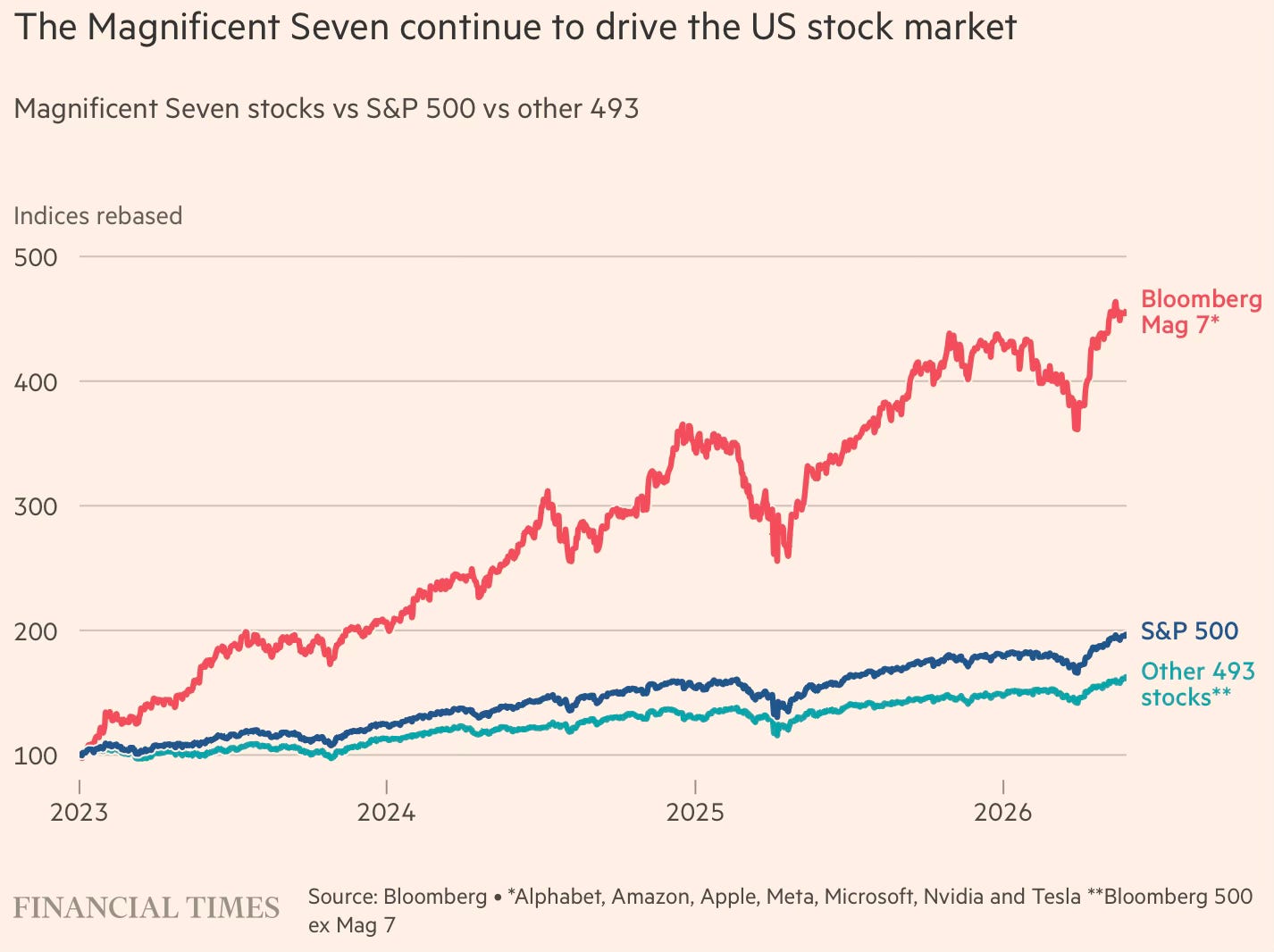
Of course, the most salient manifestation of the outsized role of AI is in the stock markets (notwithstanding some pullback).
The McKinsey Global Institute identified 18 arenas of future growth, in which they placed what they described as the AI foundation, consisting of three industries - semiconductors, cloud services, and AI software and services - at the top.
They mapped the economic profit across the chip and compute value chain, with profits being concentrated in chip designers, foundries, cloud providers, and now memory.
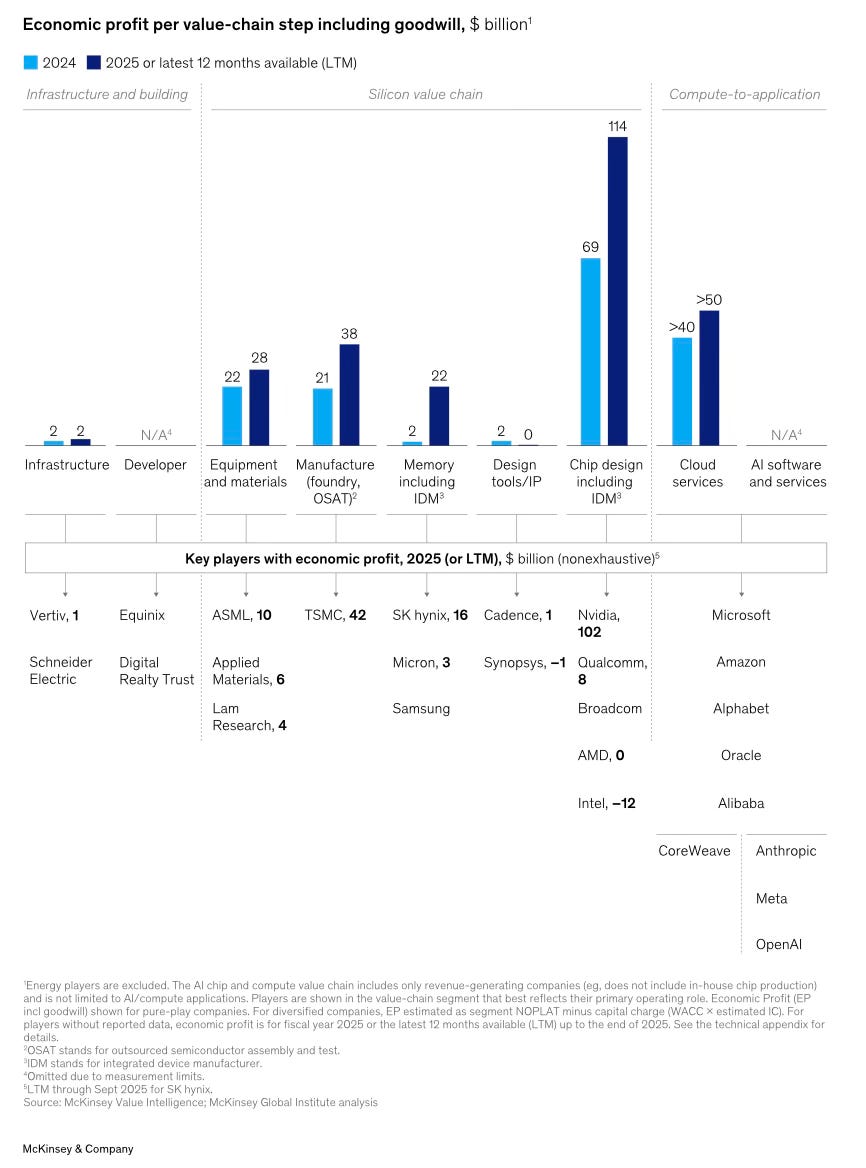
In what could have serious implications for competition, the report highlights the ever-tightening linkages downstream of the chip value chain. These linkages also raise entry barriers across the ecosystem.
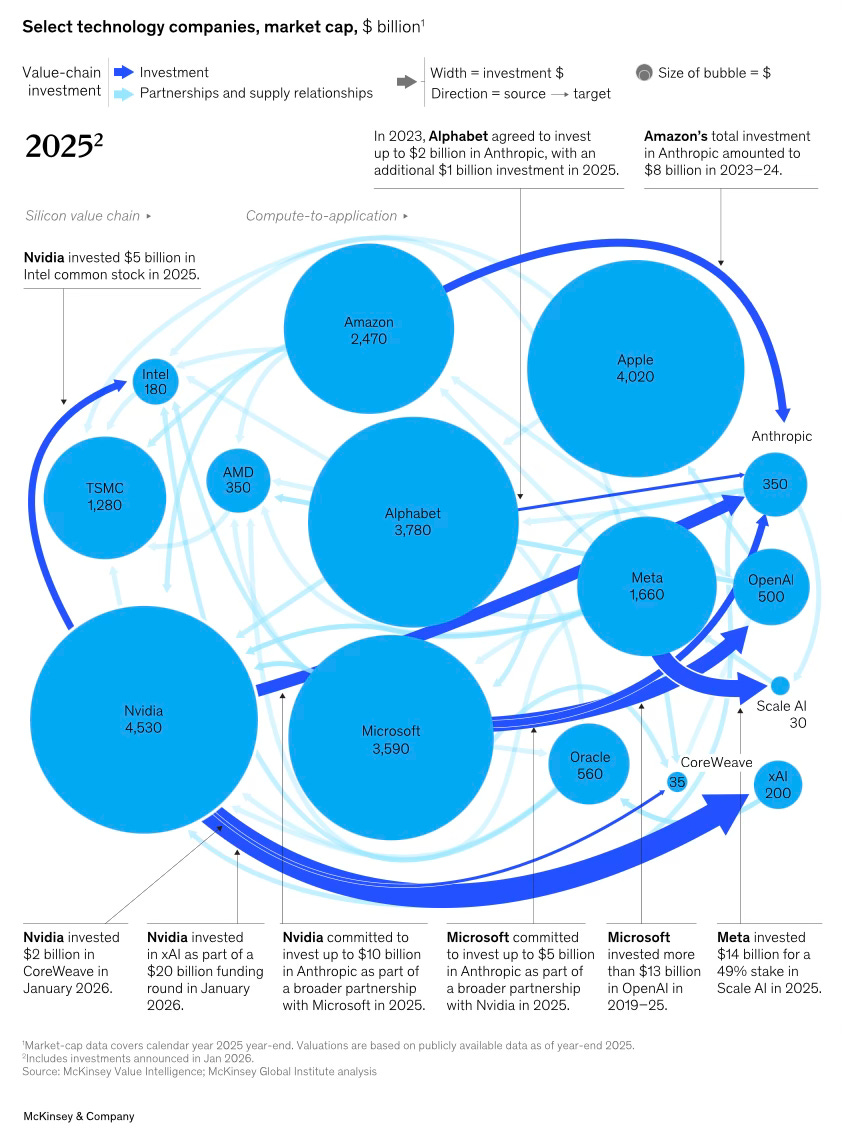
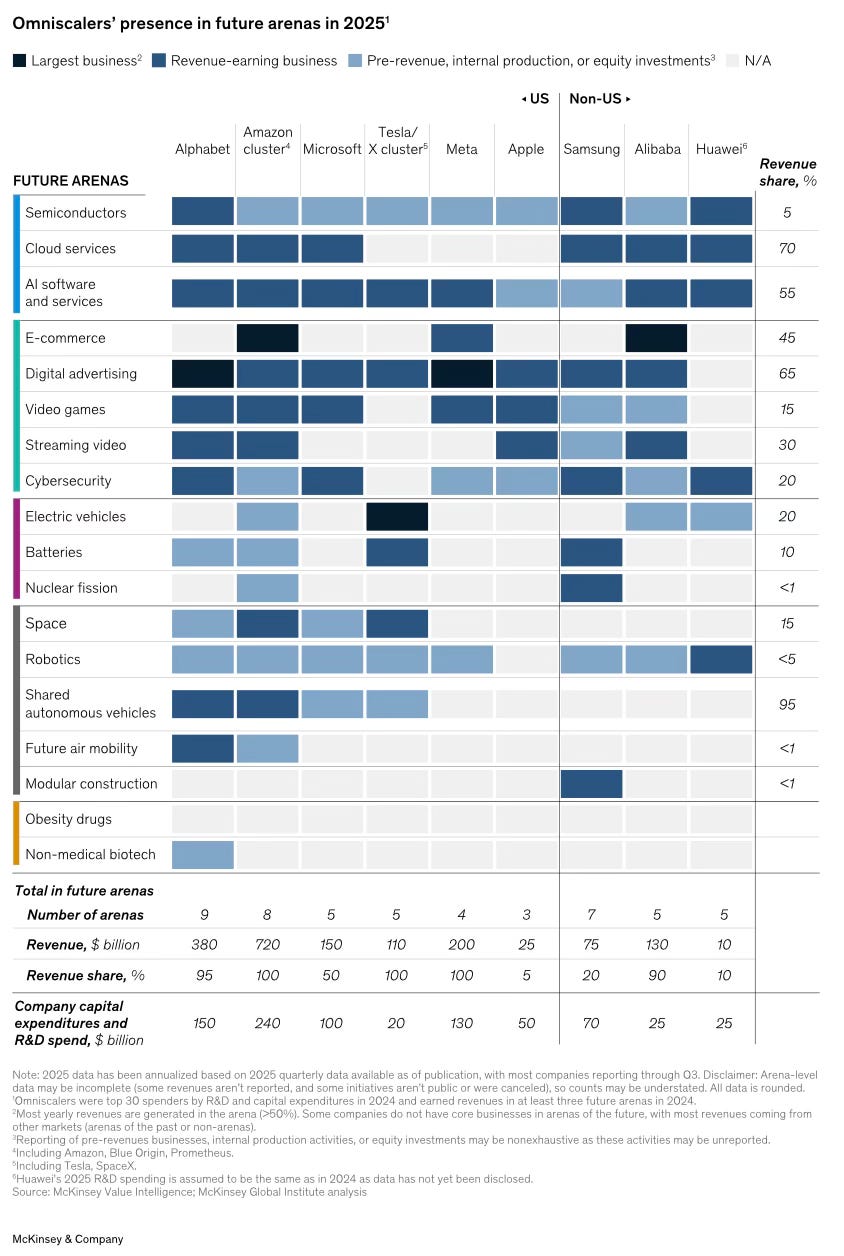
It identifies nine omniscalers - Alibaba, Alphabet, Amazon, Apple, Huawei, Meta, Microsoft, Samsung, and Tesla - as investing and dominating across the 18 arenas. The average omniscaler participated in six arenas and is rapidly expanding and deepening across and within arenas.
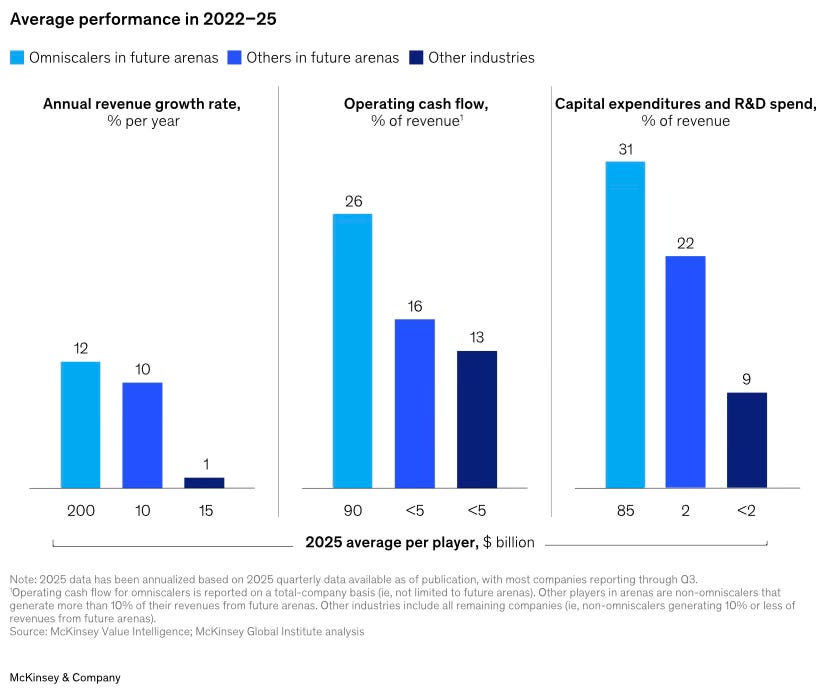
These omniscalers generate more cash and invest more than others in the same arenas and those in other industries.
Both in terms of market capitalisation and revenues, US firms dominate across the 18 arenas.
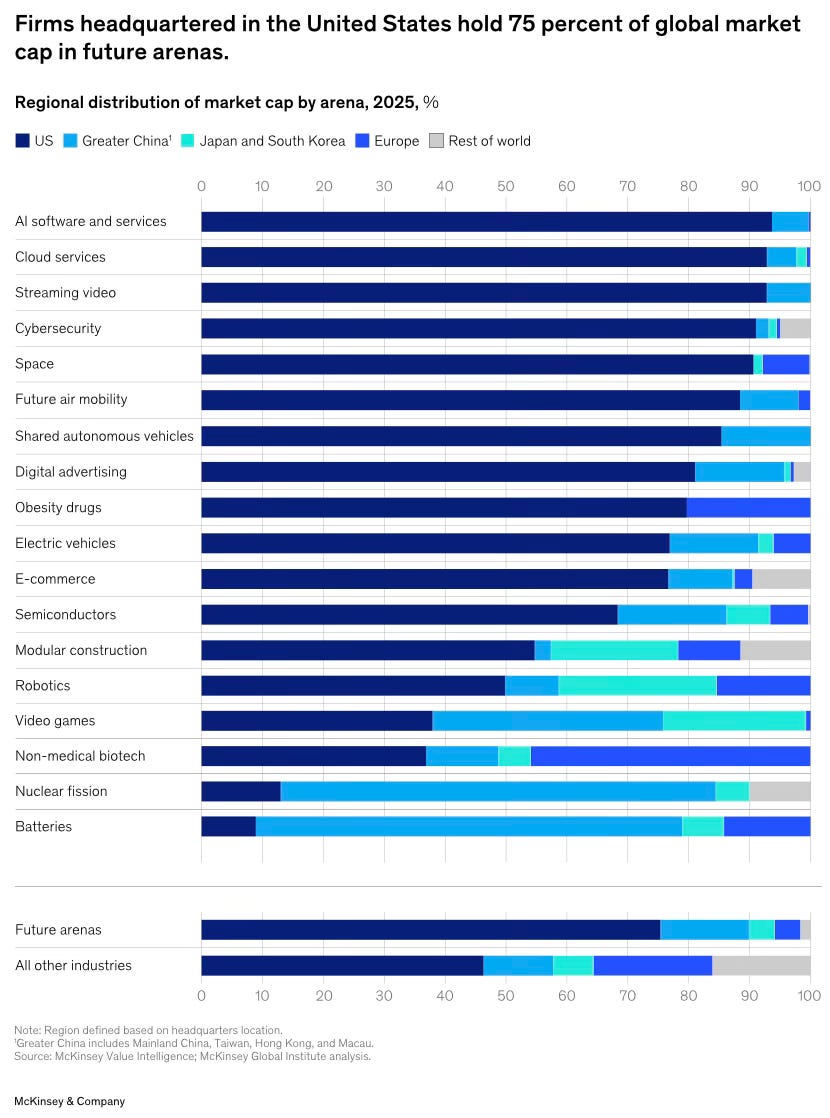
In revenues, US firms generate over 50% of the revenues in these arenas, with those in the Greater China area (China and Taiwan) contributing 30%. Another threat to competition is the adjacency of arenas and the possibility of the omniscalers and other dominant incumbents in an arena also shifting to an adjacent arena.
While AI dominates investments and equity markets, especially in the US, there is also growing interest in sectors that are by nature insulated from interest in sec AI development.
Josh Brown, chief executive at Ritholtz Wealth Management in New York, has coined the term Halo, for Heavy Assets, Low Obsolescence, to signify sectors which have business models difficult for any AI model to replicate.
These can be capital-intensive electric utilities, miners or oil companies, groups such as Italy’s Enel, or Rio Tinto and Shell in the UK… Halo businesses combine substantial physical capital with long-lived economic relevance. That means they should have sustainable business models in a world where “AI bots” could not just replace people but also any software programming and intellectual property previously thought to complement this new transitional technology… Commodities, for example, had already begun to attract interest from investors last year, helped by the weakness of the dollar.
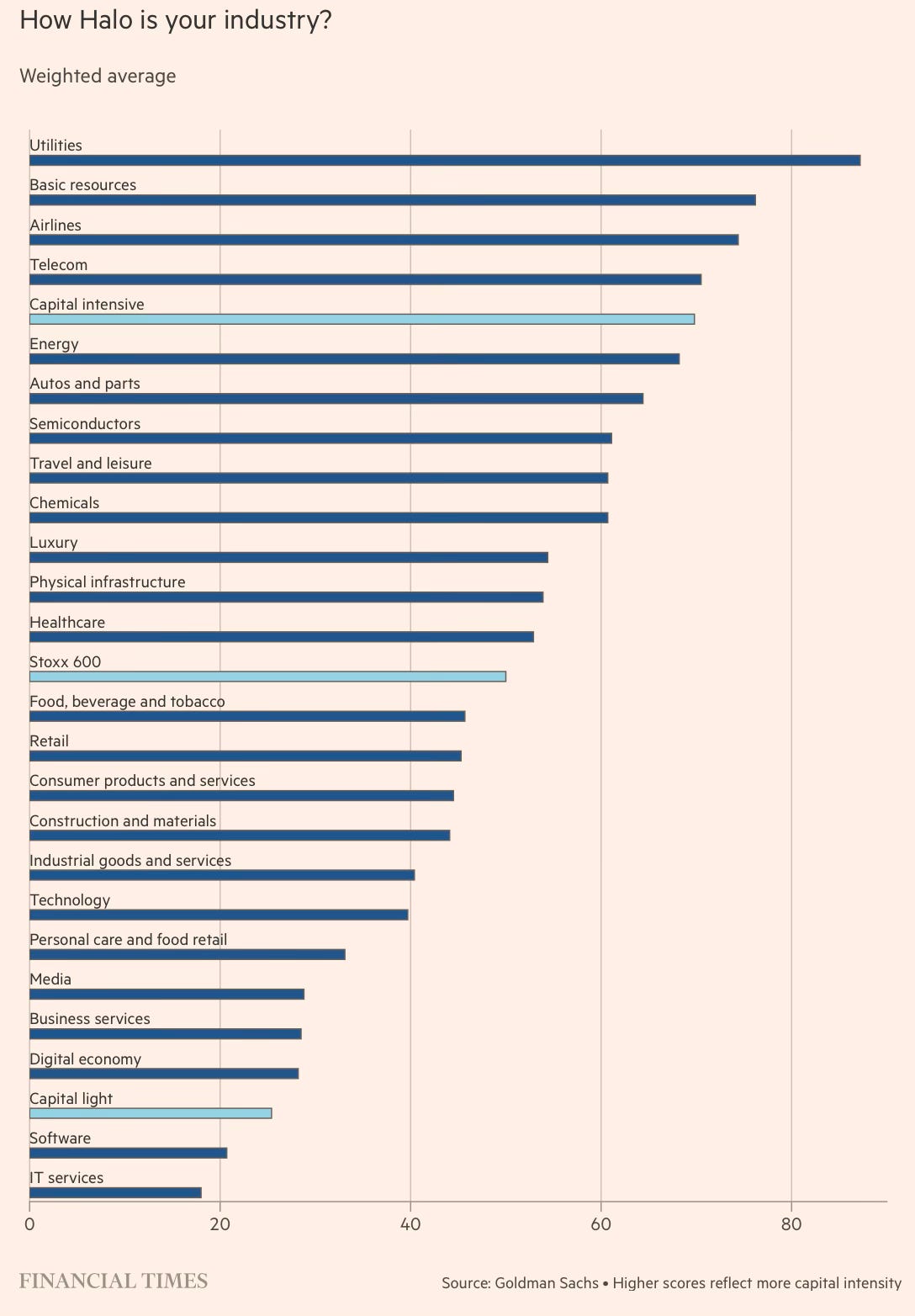
Across the world, asset-heavy sectors like utilities, mining, and energy have been good investments, with their MSCI All Country World price indices outperforming the broad world index, even before the Iran war began in March.
On a historical scale, where does the ongoing AI capex stand, as of now?
The Economist has an article that points out that the ongoing AI capex boom may well be the largest investment surge in history. The biggest US technology companies that spent $450 bn on AI infrastructure in 2025 are expected to spend $900 bn this year, and another $1.4 trillion in 2027!
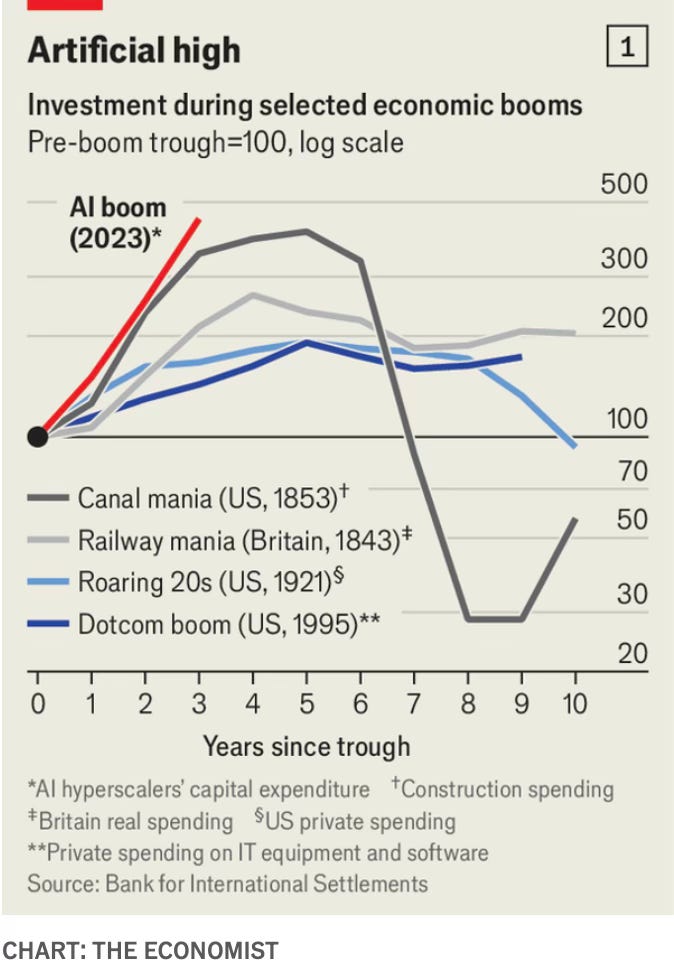
However, as the folks at a16z show in a blog post, while the AI-related arenas are dominating today and the capex surge (so far) is unprecedented, they are not in the same league as the railways or finance were in their respective periods of dominance in the nineteenth century.
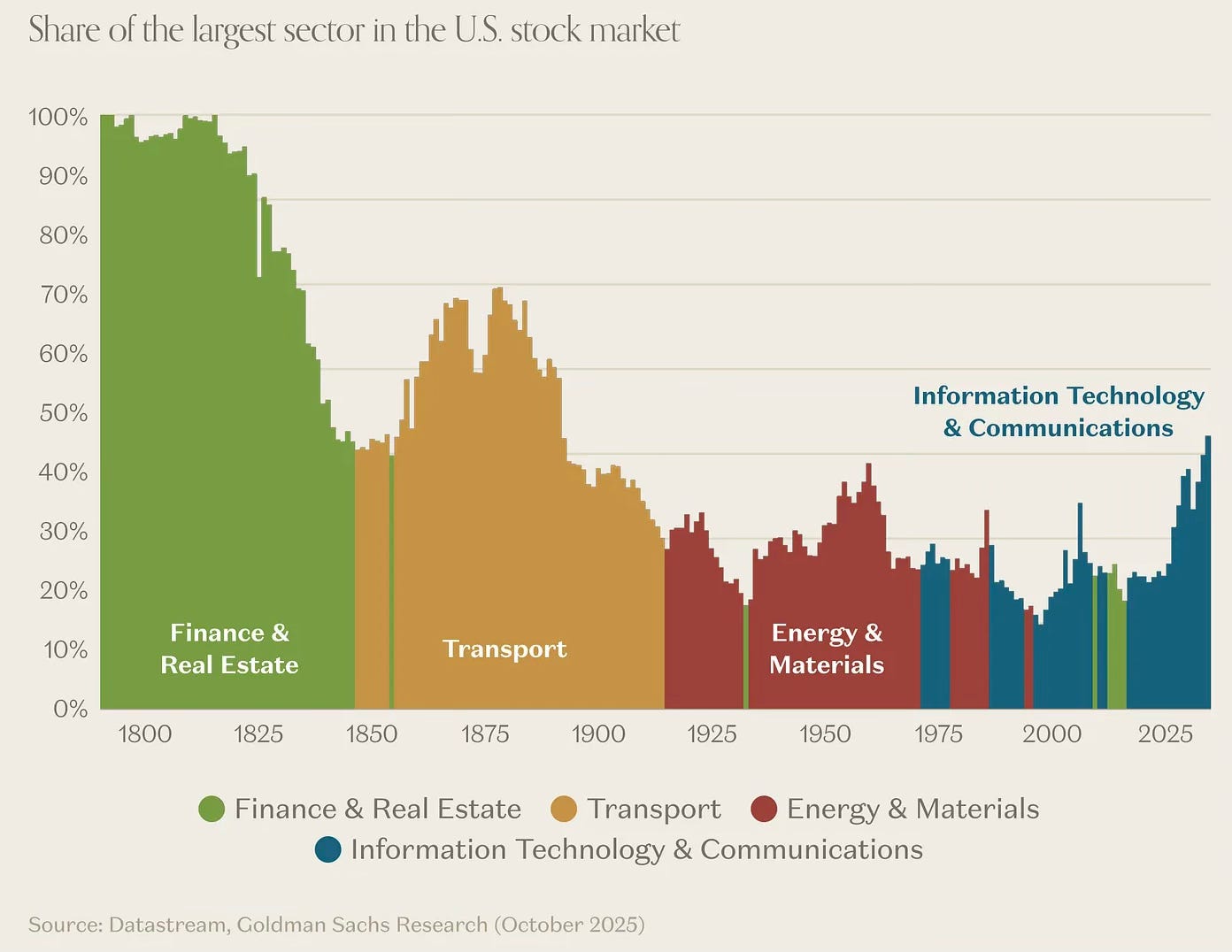
One caveat here is that the 1900 economy was basically textiles, iron, coal, steel, and tobacco, the rails to transport them, and the banks to finance them, whereas today these sectors are a tiny fraction of the output.
In fact, even the $5 trillion estimated to be spent on AI and AI-related infrastructure by 2030 pales in comparison to that made on railways.
By 1890 railway companies in the US alone had issued about $5bn worth of bonds. Adjusting for inflation that equates to about $180bn in today’s money. However, this understates the enormous scale of the undertaking, because the US economy was much smaller then. In 1890, $5bn was about one-third of America’s GDP, so the investment spree was arguably the equivalent of spending over $10tn today. It also resulted in an epic, generation-defining crash. In 1873, Jay Cooke & Co, the premier investment bank run by America’s dominant financier at the time, suddenly collapsed under the weight of unsold railway bonds. This caused a giant financial crisis and ushered in what was long known as the Great Depression, until the even larger one in the 1930s.
There are already questions being raised about the viability and sustainability of the AI capex surge. This is most salient in the valuations of the primary AI firms, which have pulled back sharply in recent months and lag many broader market indices this year. The Economist article discussed above has some very interesting revenue numbers about what would be required to justify such massive capex.
A rough calculation finds that covering AI capex through identifiable AI income requires revenue on the order of $2.5trn per year, more than tech’s entire combined revenue today. Only a small minority of consumers seem willing to pay for personal AI subscriptions, so the real money will have to be made from selling to enterprises…For AI revenues to soar, more firms will have to use AI (what economists call an increase at the “extensive margin”) and use it more deeply (the “intensive margin”)… If, say, a third of firms across the OECD club of mostly rich countries adopt AI, then to generate $2.5trn of AI revenues the firms would have to spend about $100,000 a year on average.
Against this requirement, the actual revenue estimates are in the range of just $150-200 bn!
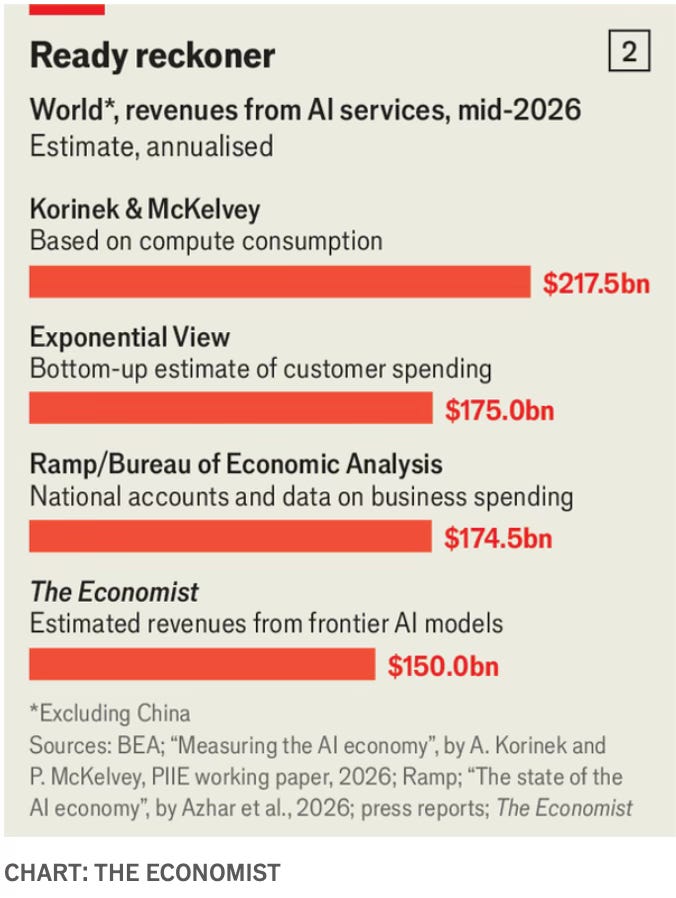
Further, the signs of uptake and growth are not very promising, especially given the multiples of growth required.
In May, economists at the Census Bureau… found that about 33% of people now use AI at work, down from a peak of 46% in mid-2025… Researchers at the Bundesbank find that about half of German firms using AI do so for 5% of working hours or less. Ivan Yotzov of the Bank of England and his colleagues estimate that the average American executive uses AI for 1.7 hours a week—enough time to create a decent PowerPoint presentation, but not much more. For these dilettantes, free or ultra-cheap AI models are often good enough. Official data from Britain suggest that close to half of businesses using AI do not pay for it, presumably making do with the free tier of an American model or an open-source Chinese one… The median firm’s monthly spending per worker in June, however, was $10.66. Intuit, a software firm which tracks small and medium-sized businesses in America, Britain and Canada, reports that about one in ten has paid for a dedicated AI tool.
Furthermore, while the capex till date has been mostly driven by the large free cash flows of the omniscalers, it is now increasingly reliant on debt, drawn from risky segments like private credit markets. As a result, the four Big Tech firms are all expected to register their first deficit in years.
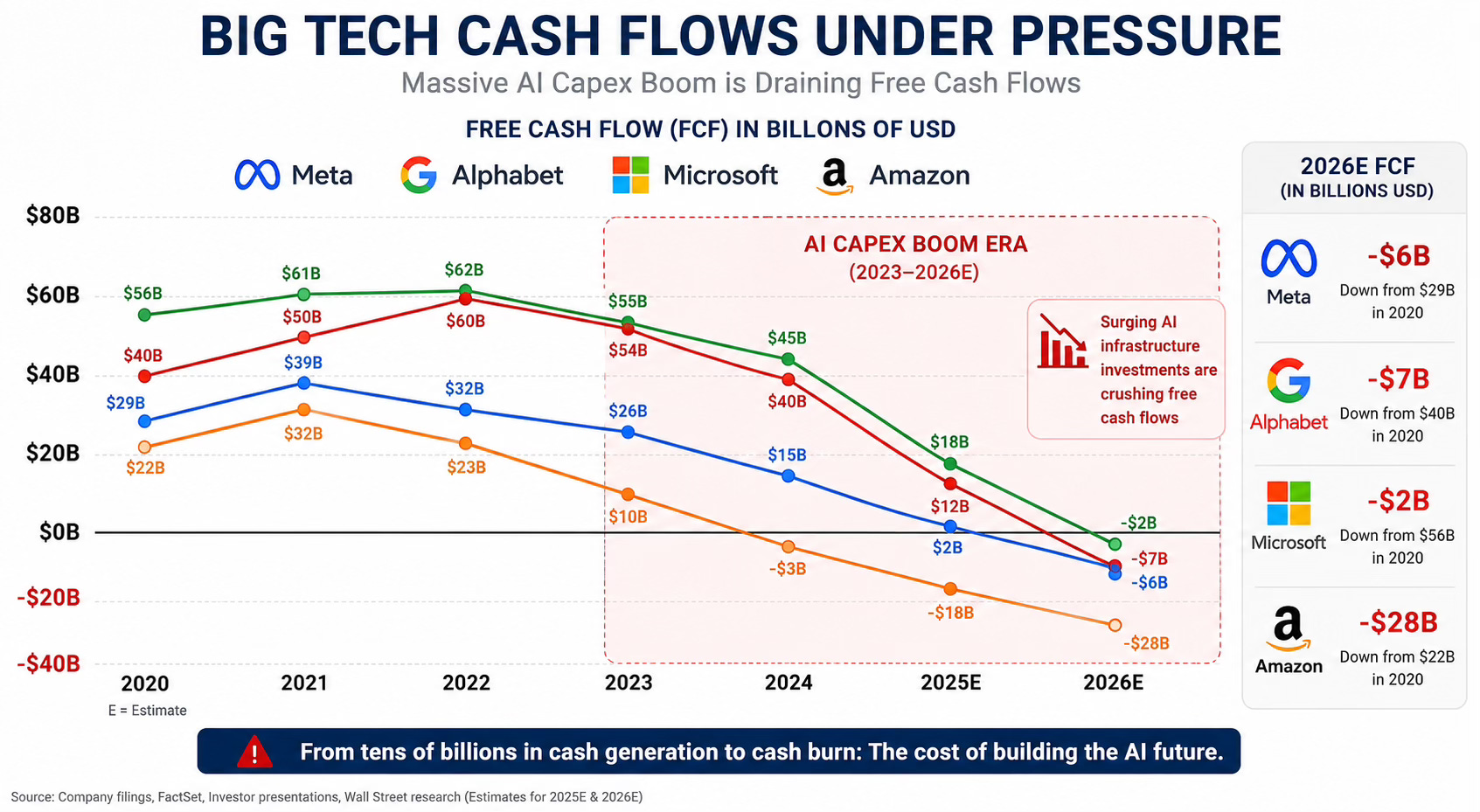
And all this comes at a time when the richer world's citizens appear more wary of AI than those in the developing world.
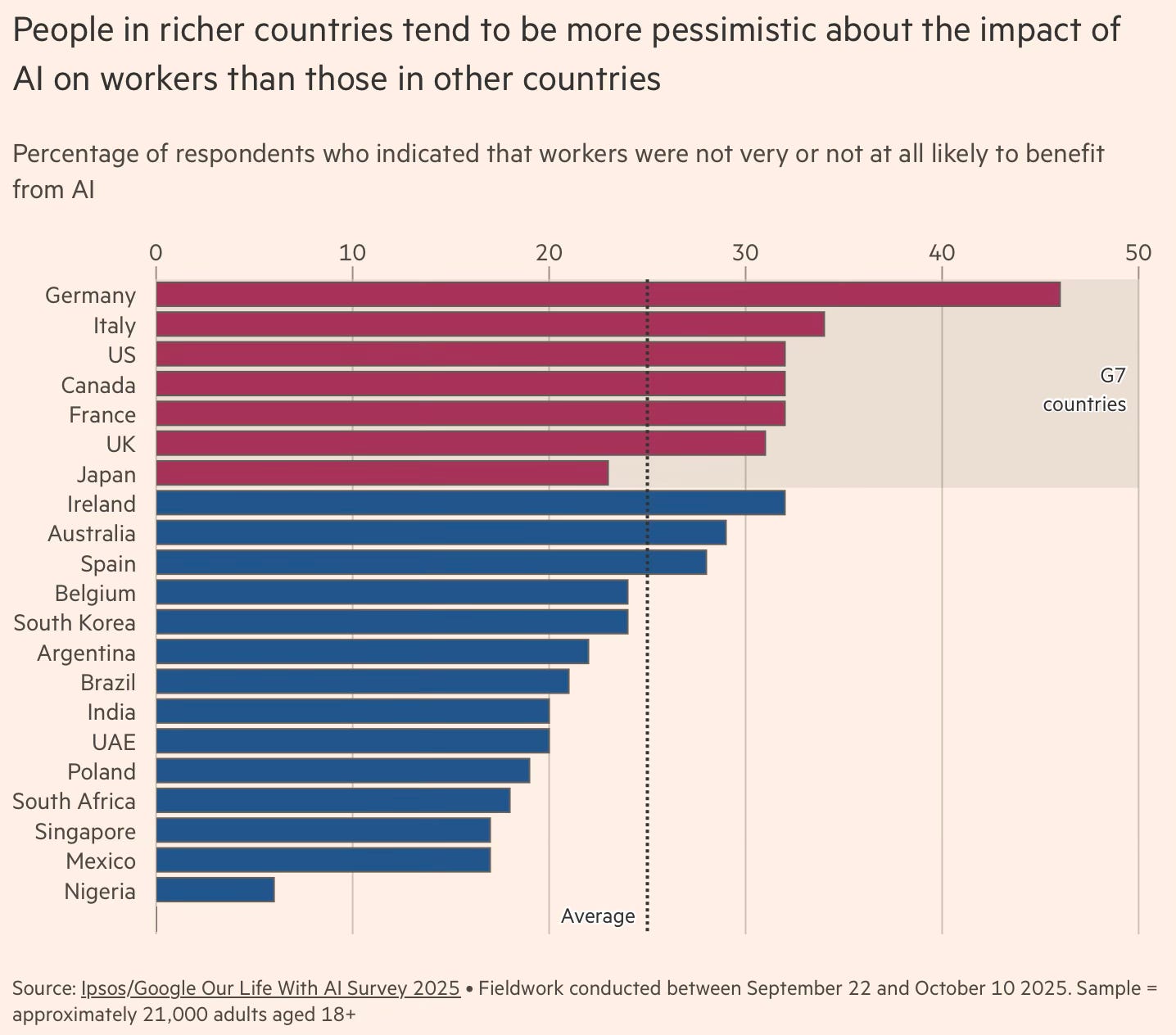
And this
According to the Annenberg Public Policy Center, 61 per cent of Americans now oppose one being built in their backyard. The politics of the upcoming midterm elections reflect this, with candidates from both parties trying to portray politicians who favour the building of data centres as in hock to big corporations.
As a result, the regulatory free run that the AI industry has had, especially in the US, also thanks to the Trump administration, may be ending. It now stands on the substance of the technology to demonstrate its value proposition to drive the multiple-fold growth (and that too in a manner that accommodates the concerns of the political economy) required to justify the massive capex commitments. And interest rates are rising, and debt service costs are mounting. All this makes things even harder.
No comments:
Post a Comment