Richard Baldwin has multiple blog posts that mine the data to add nuance to the Chinese manufacturing dominance, which, while undoubted and growing, includes some important subplots.
For one, rapid productivity gains have widened China’s competitiveness gap but also reduced manufacturing employment, though it appears to be reversing slightly or stabilising since 2019, with Xi Jinping’s push toward high-technology industries and the Make in China 2025 campaign. But while manufacturing employment has been declining in the advanced economies, it has been rising in the emerging economies (excl China).
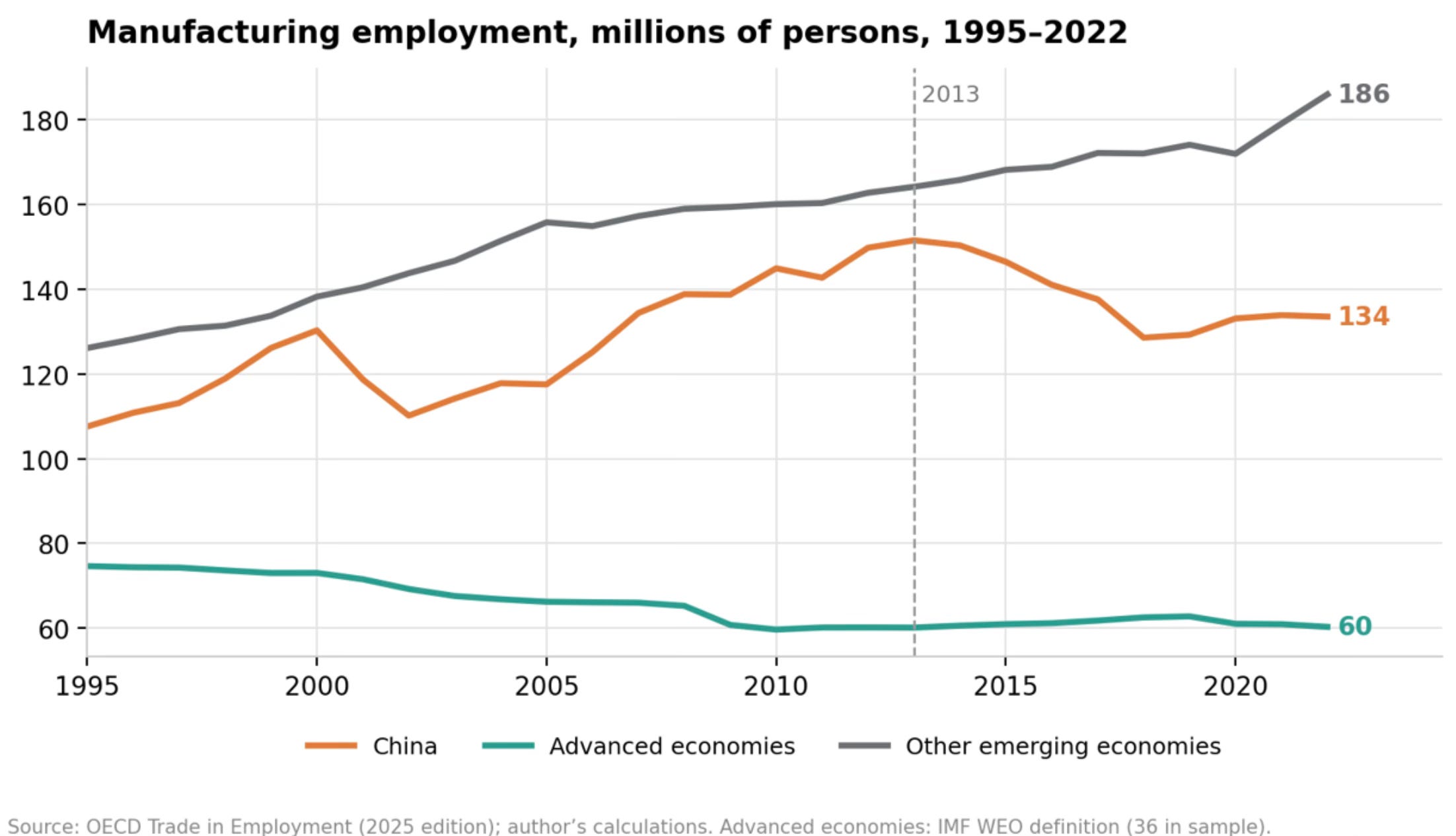
The rise in emerging economies is especially pronounced since the pandemic. It has also been inching upwards in the advanced countries too.
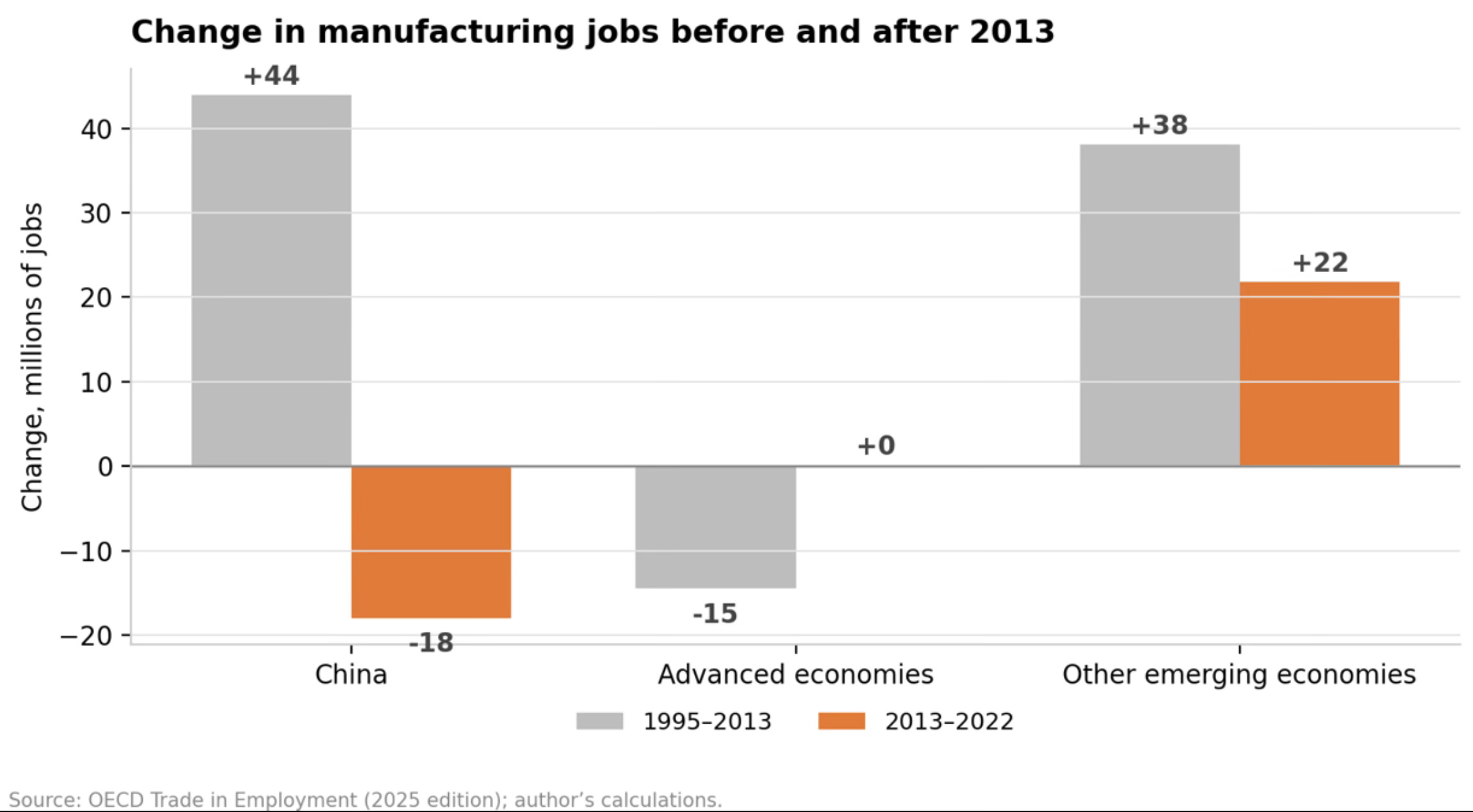
Putting both together, Baldwin makes the case that since 2013, while China has been shedding manufacturing jobs, losing about an eighth of its base, emerging economies have been gaining and advanced economies have plateaued. However, with 134 million factory workers, China has twice more than the advanced countries combined.
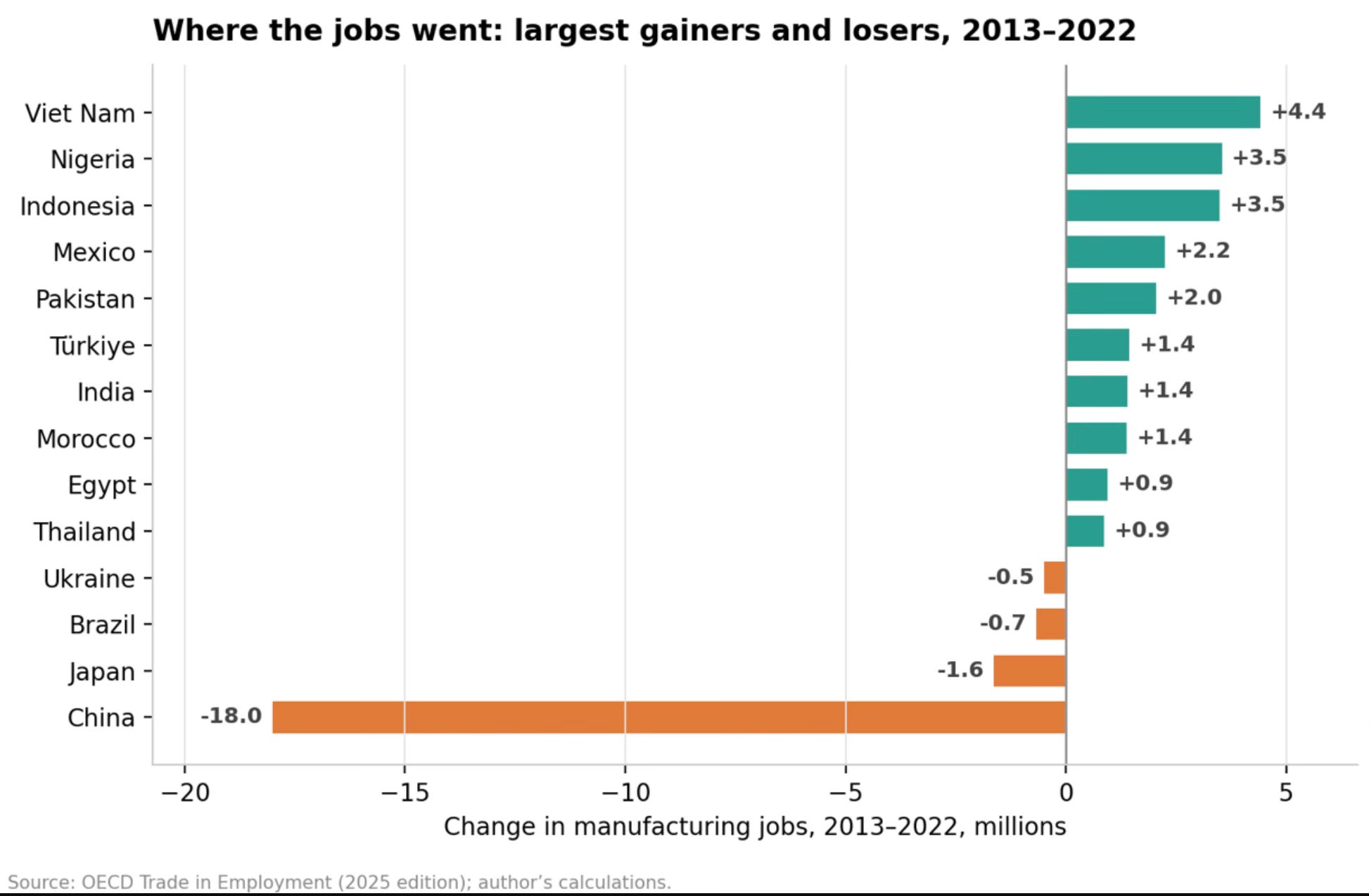
Among the gainers in this giant manufacturing jobs reallocation, Vietnam, Nigeria, and Indonesia lead. Nigeria and Pakistan are surprising candidates. India has been a notable laggard. Together, the developing countries added 22 million.
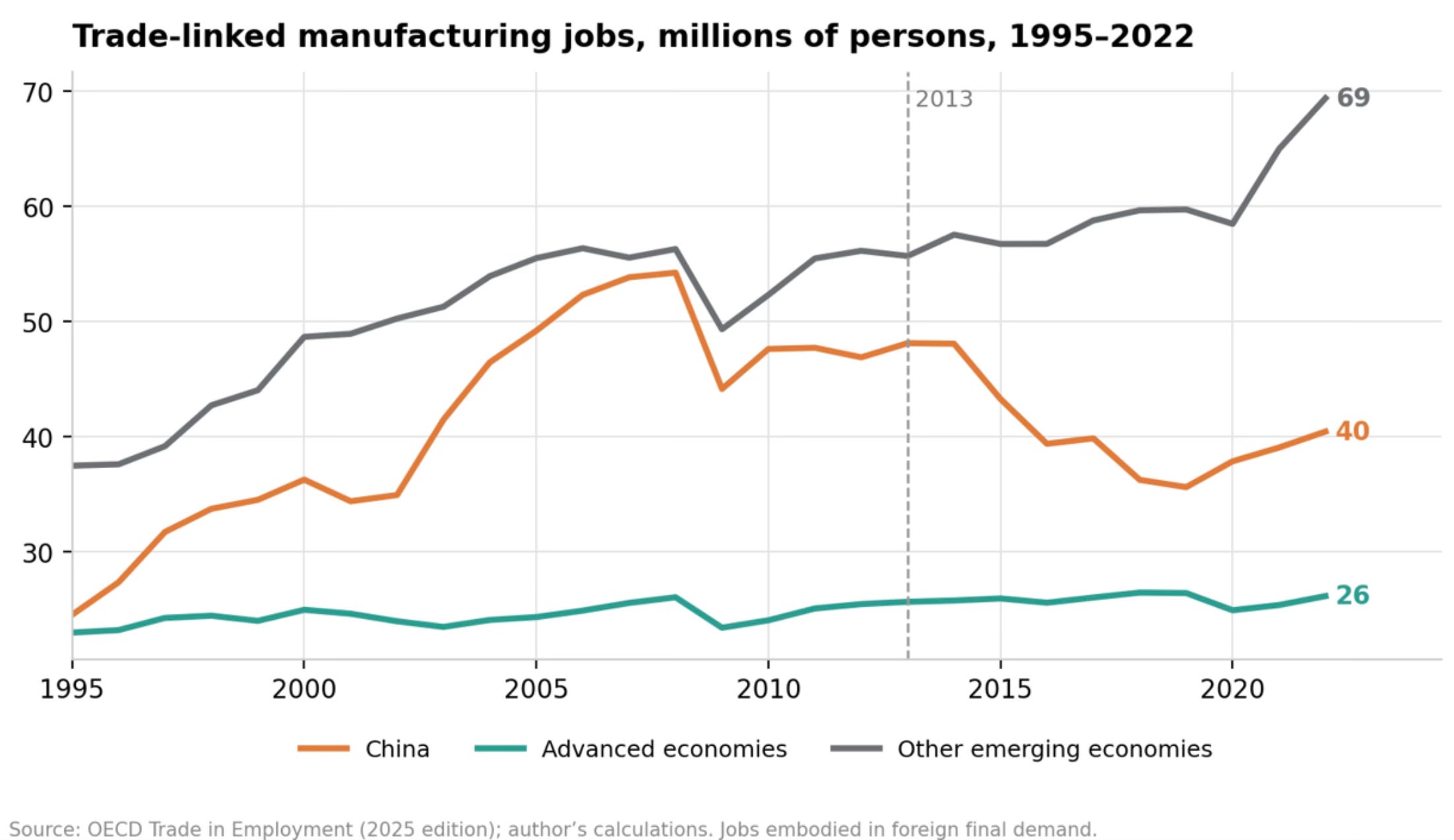
China’s export-supported factory employment is down 16% since 2013 and its share of the world total has fallen from 37% to 30%… China’s factory employment is now doing what the advanced economies’ did decades earlier: shrinking as productivity rises and as labour-intensive stages migrate to lower-wage locations.
This decline in Chinese manufacturing employment comes alongside a steeper decline in its manufacturing value added as a share of GDP. Its manufacturing GDP share has fallen over 15 years, from a peak near 32% in the mid-2000s to under 25% today.
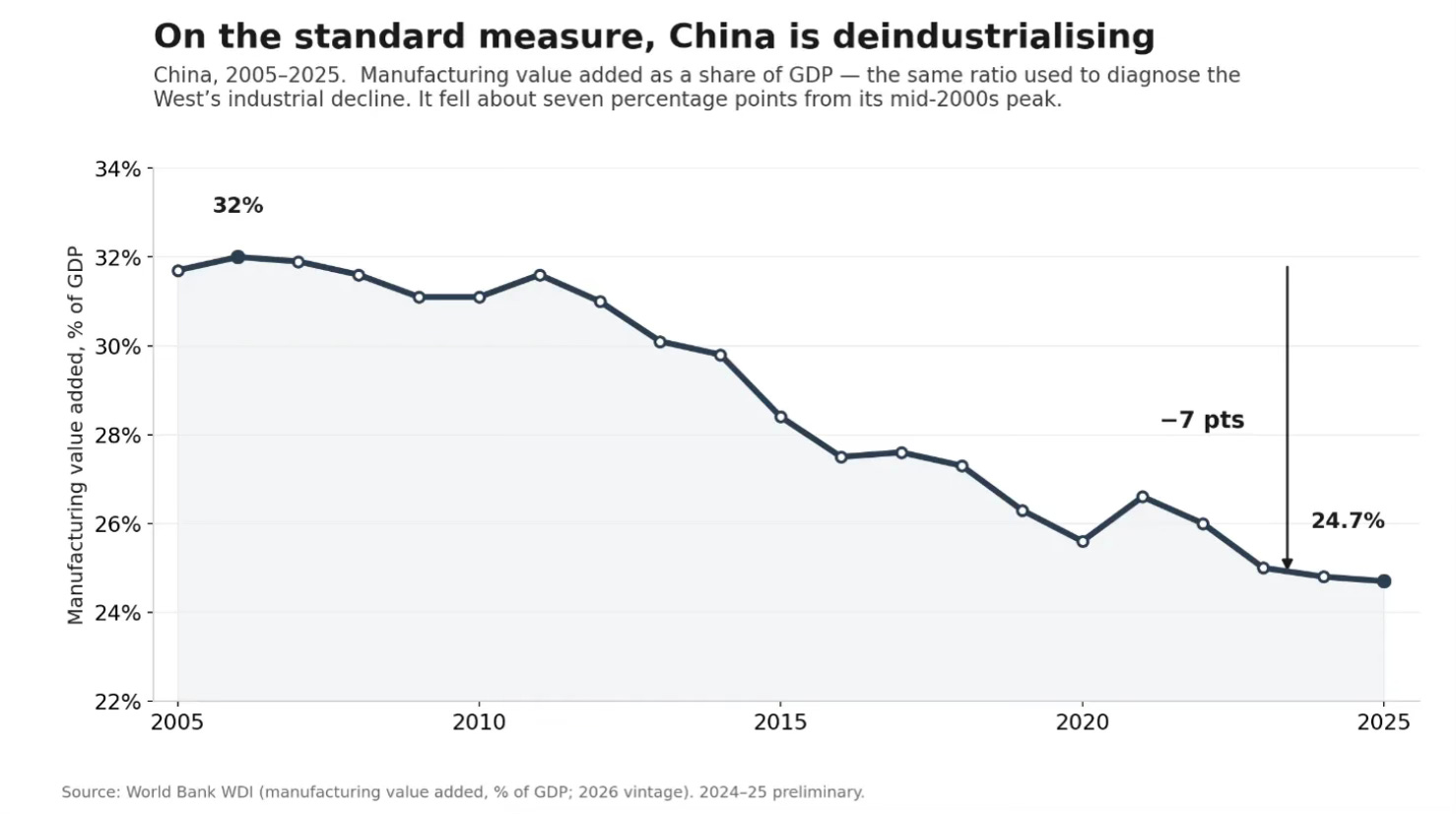
However, declines in manufacturing employment and share of value addition do not mean China’s dominance and vice-like grip on manufacturing is on the way down. Far from it. In fact, China’s manufacturing merchandise exports as a percentage of world GDP have been rising, even as they have declined for the rest of the world.
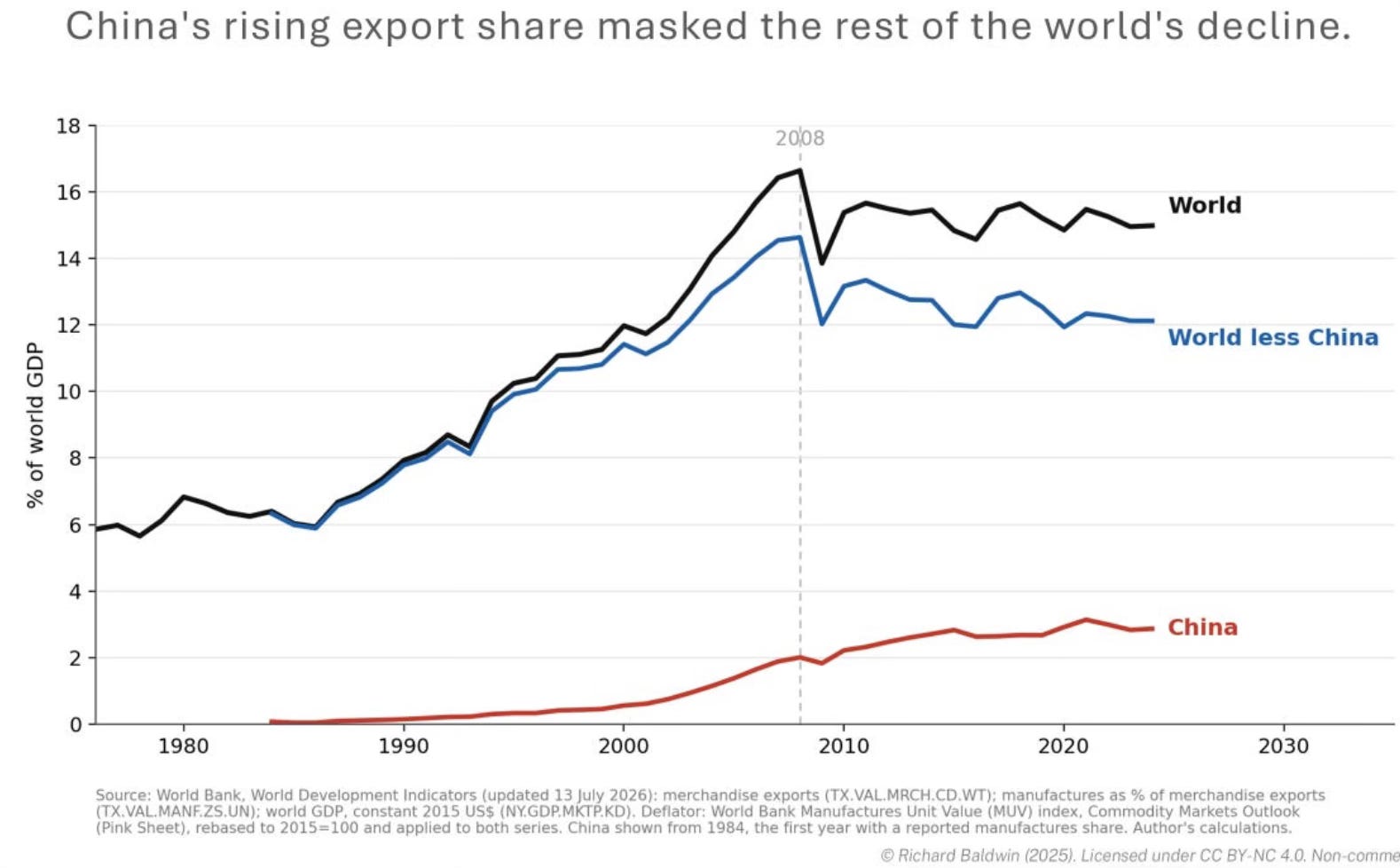
In fact, the percentage has nearly doubled in the same period. It has also risen for Vietnam and India. The advanced countries have been the clear losers.
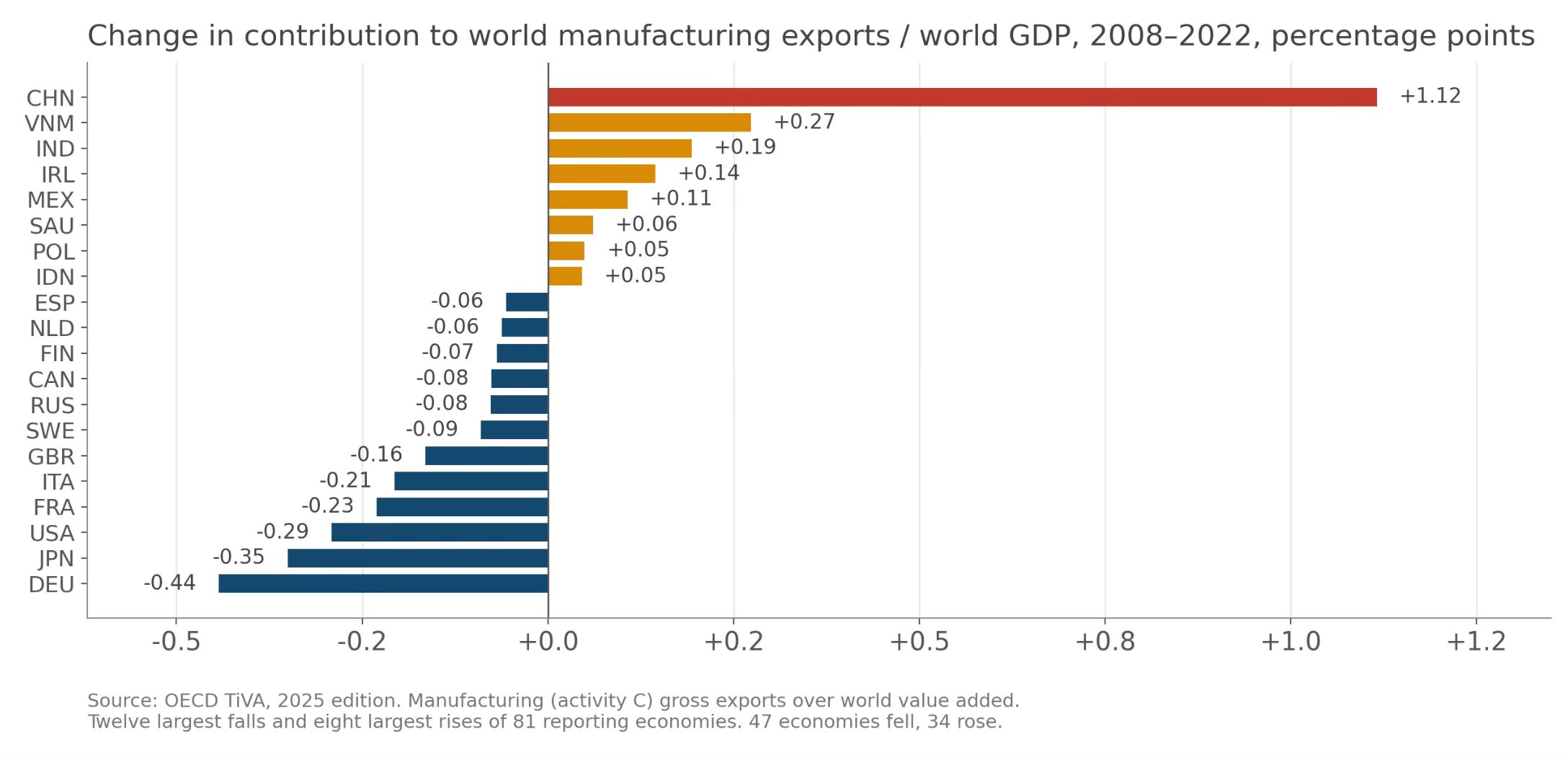
So, what explains this apparently contradictory trend of deindustrialisation in employment and value addition, co-existing with the doubling of global manufacturing export share?
The answer appears to lie in productivity. Over two decades, the price of a unit of China’s manufacturing value added fell by nearly half, which explains the whole of the decline in value addition by manufacturing.
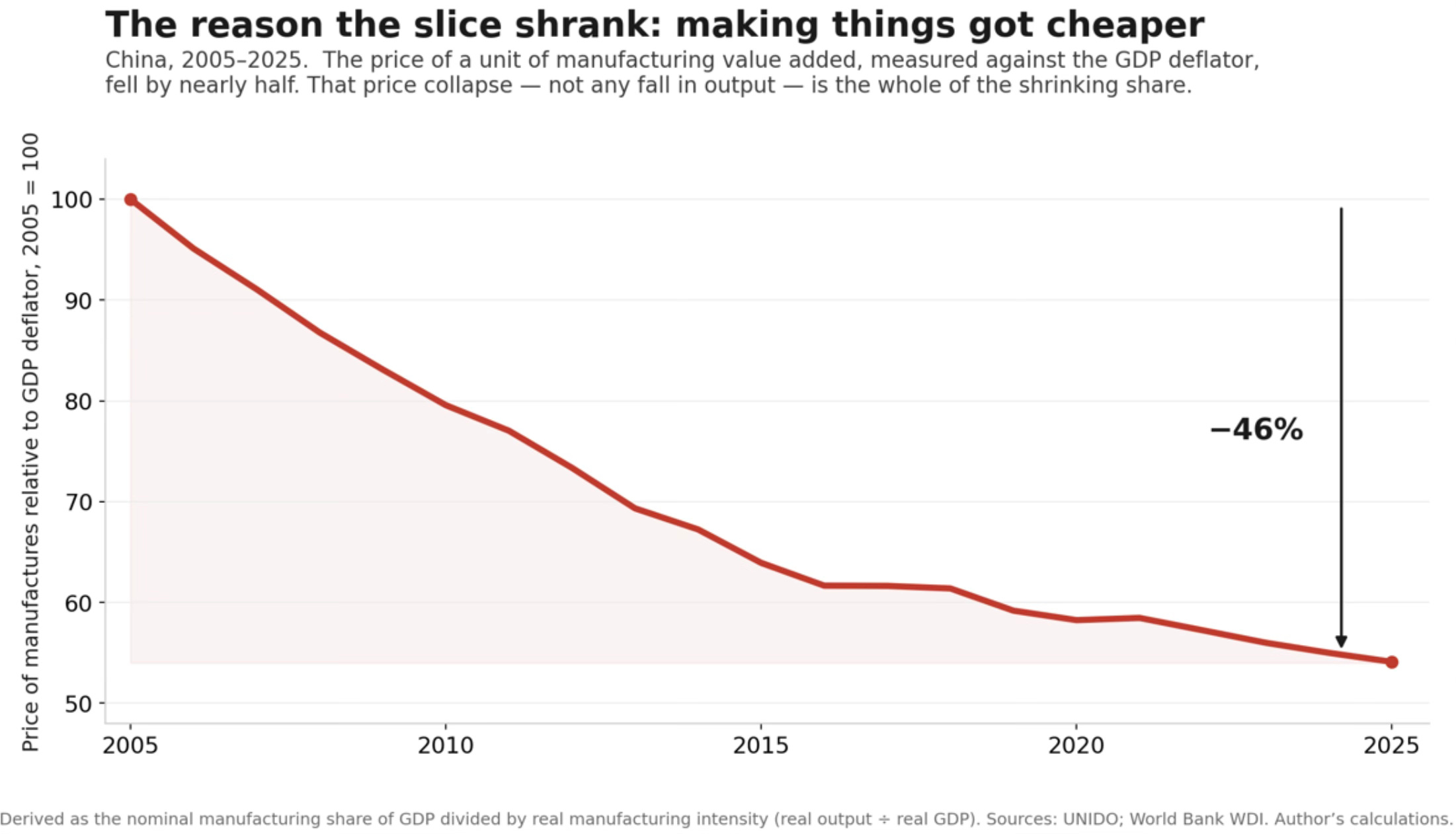
It reflects the most consequential fact about Chinese manufacturing: Chinese goods are getting cheaper at an astounding pace. Fast enough to distort the whole economy, maybe even the whole world economy. That price collapse is also why the Chinese are such fearsome competitors globally. It is why the rest of the world’s industry feels squeezed, and why politicians are responding with plans to hobble Chinese exports.
… there is a China-specific factor that is driving down manufacturing prices even faster. In China they call this competition “involution.” If you think the competition is tough outside of China, you should see it inside the country. China experts talk about the ruinous internal scramble in which too many domestic firms, egged on by rival local governments, drive down prices until nobody makes money.
This comes out clearly if we map the nominal and real price shares of manufacturing value addition. Since about 2014, the manufacturing sector has grown at the same real rate as the economy as a whole.
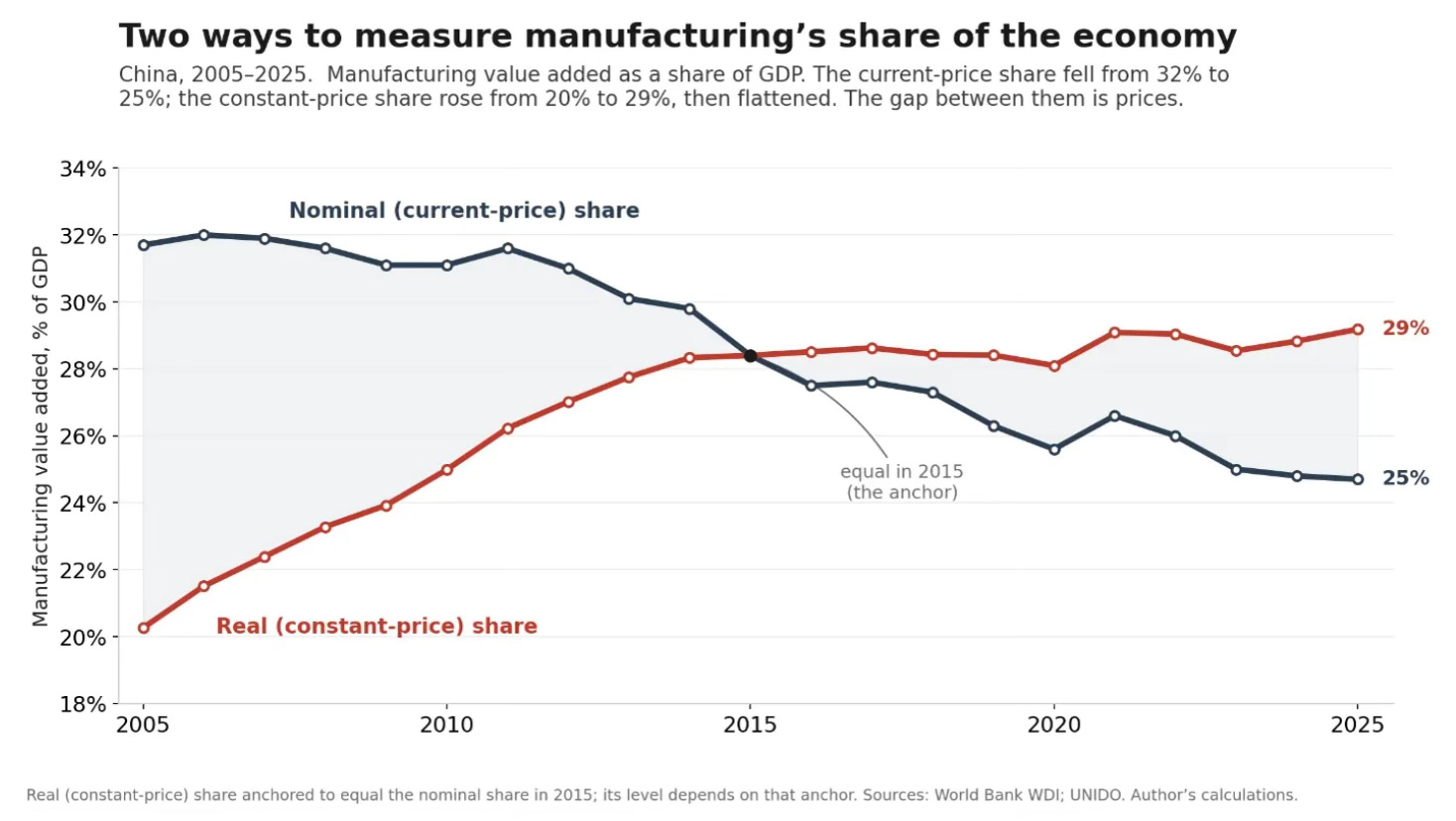
The Chinese economy has made much more with a smaller set of resources.
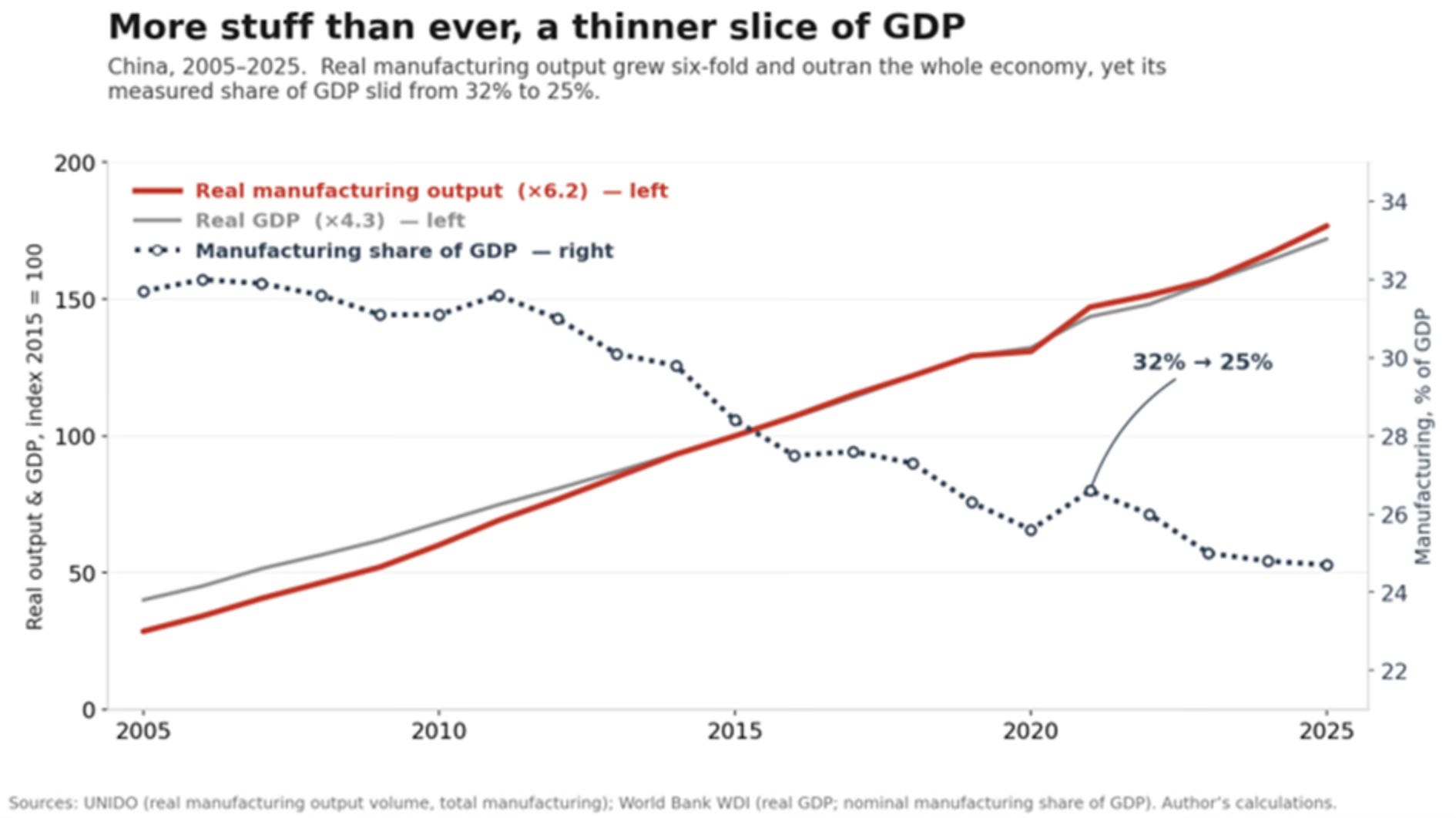
There is no doubt that the expansion of the Chinese manufacturing sector has been an era-defining phenomenon. The rise can be seen in the red line in the chart below. Real manufacturing output in 2025 is more than six times its 2005 level. That’s amazing. That’s the China shock 1.0 and 2.0 in a nutshell. Over the same twenty years, the whole economy (the grey line) grew only four-and-a-third times. So, manufacturing did outrun the economy. But only up to the mid-2010s.
Finally, he disputes the oft-cited deglobalisation argument. He points out that while the global manufacturing trade ratio fell by 2.6% in the 2008-22 period, it rose slightly by 0.3% if we exclude China.
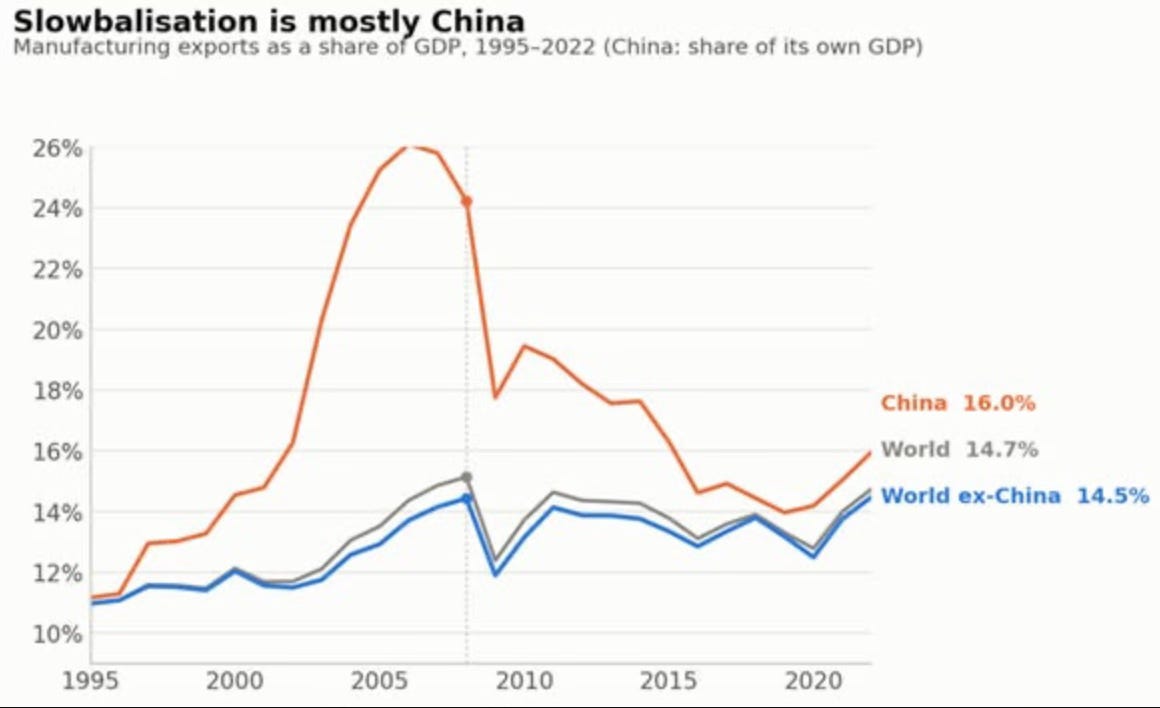
The main contributor was China’s GDP growing faster than its manufacturing exports.
China’s manufacturing exports boomed, but its GDP boomed more. China’s share of world manufacturing exports rose from 11.5% in 2008 to 19.3% in 2022. China’s share of world GDP went from 7.2% to 17.9%. Exports relative to China’s own GDP fell from 24.2% to 16.0% as it morphed into a normal mega-economy and became its own best customer.
Another driver of this was the reshoring of supply chains into China. However, this deglobalisation by China did not mean similar trends elsewhere. The rest of the world expanded the global value chains in their manufacturing.
China’s domestic value-added share fell from 83% in 1995 to 72% in 2004, as the processing-trade boom stuffed Chinese exports with imported parts. It then climbed steadily to 81% by 2022. From the 2004 trough, that is nine percentage points of genuine input localisation… For the world excluding China, the domestic value-added share moved the other way: 68.7% in 2008 to 66.4% in 2022. Everyone else’s manufacturing exports became slightly more dependent on foreign inputs, not less. If you special-case China, there hasn’t been any localisation of manufacturing. The domestic content share has not risen and seems to be continuing to fall.
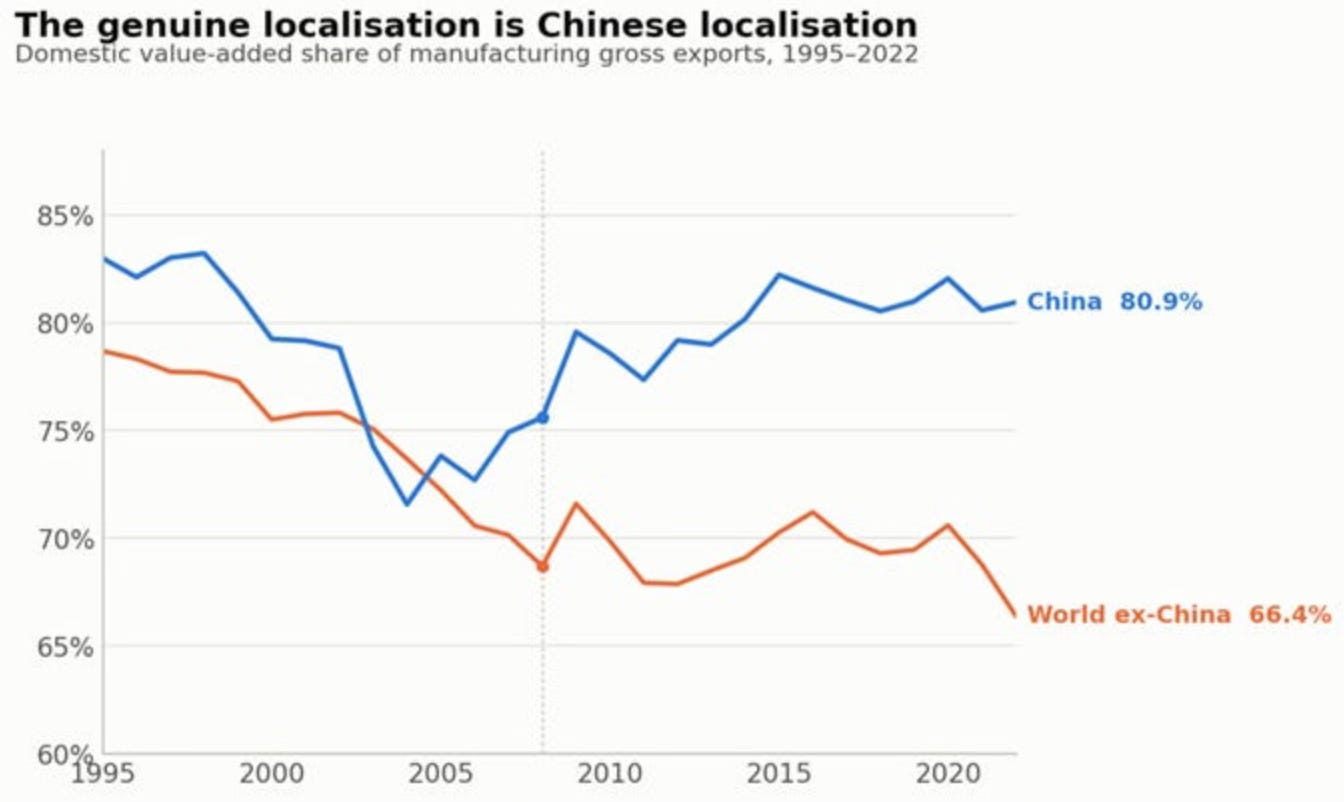
It would be useful to disaggregate the value addition destinations of the manufacturing exports of countries excluding China. It will not be surprising that a significant share of that value addition is coming from China.
So, not only is China increasing the localisation of its own manufacturing, but it is also capturing a greater part of the value addition of its trade partners’ exports.
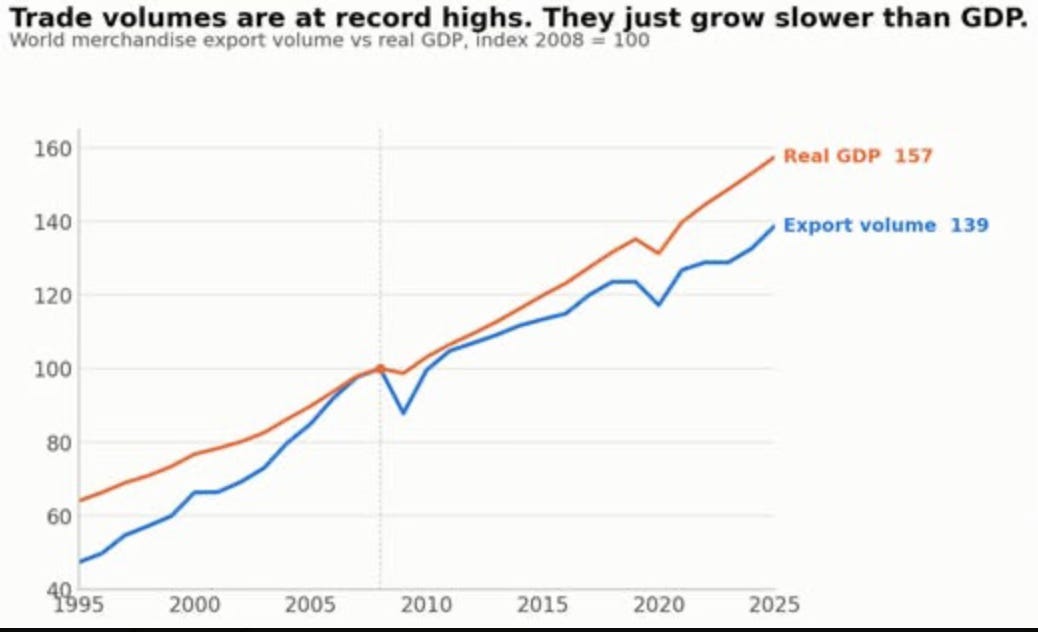
Baldwin also points to how global export volumes continue to rise unabated, thereby contradicting talk of deglobalisation. He says that world trade never stopped growing, but only stopped outgrowing the world economy, pointing to a deceleration but not a reversal.
None of these nuances and qualifications take away from the reality of the world economy’s China problem. Its manufacturing dominance and export dumping is among the biggest problem facing the world economy.
China inverts the conventional wisdom of a large developing country in its development trajectory being a large importer of goods and services. Instead, even as its own market remains largely walled off, it has become a massive exporter of components and goods spanning the full spectrum of sophistication.
China also contradicts the orthodoxy of developing countries vacating lower-skilled industries and moving up the value chain as they develop. Apart from some limited vacation of space, as discussed above, China has uniquely retained its competitive advantage across the value chain of industries. Its competitive advantage spans across sectors, supply chains, and value chains.
This has also meant that even as the world has globalised supply chains, China has ended up increasing its localisation. As mentioned above, this means that China’s manufacturing dominance is boosted by both the localisation of its own manufacturing and by capturing an increasing share of the rest of the world’s supply chains.
All this has meant that China neither offers its large consumption market nor vacates any significant part of the manufacturing landscape for its trading partners. Further, it wants to use the rest of the world as a dumping ground for its heavily distorted manufacturing industry. Furthermore, it is now showing an increased willingness to weaponise its manufacturing dominance not only for national security and strategic reasons, but to also prevent efforts to diversify supply chains away from the excessive dependence on China.
No comments:
Post a Comment