Public recruitments come with a one- or (mostly) two-year probation period. The idea is to correct a Type I error (a false positive recruit) in the recruitment process.
Underlining its importance, the DoPT Master Circular on Probation/Confirmation of 2019 has this to say about probation:
‘Probation should not be treated as a mere formality. The existing powers to discharge probationers should be systematically and vigorously used so that the necessity of dispensing with the services of employees at later stages may arise only rarely.’
Unfortunately, while it is part of all recruitment rules, it is widely believed that there are few instances of discharge during probation in any local, state, or central government recruitments.
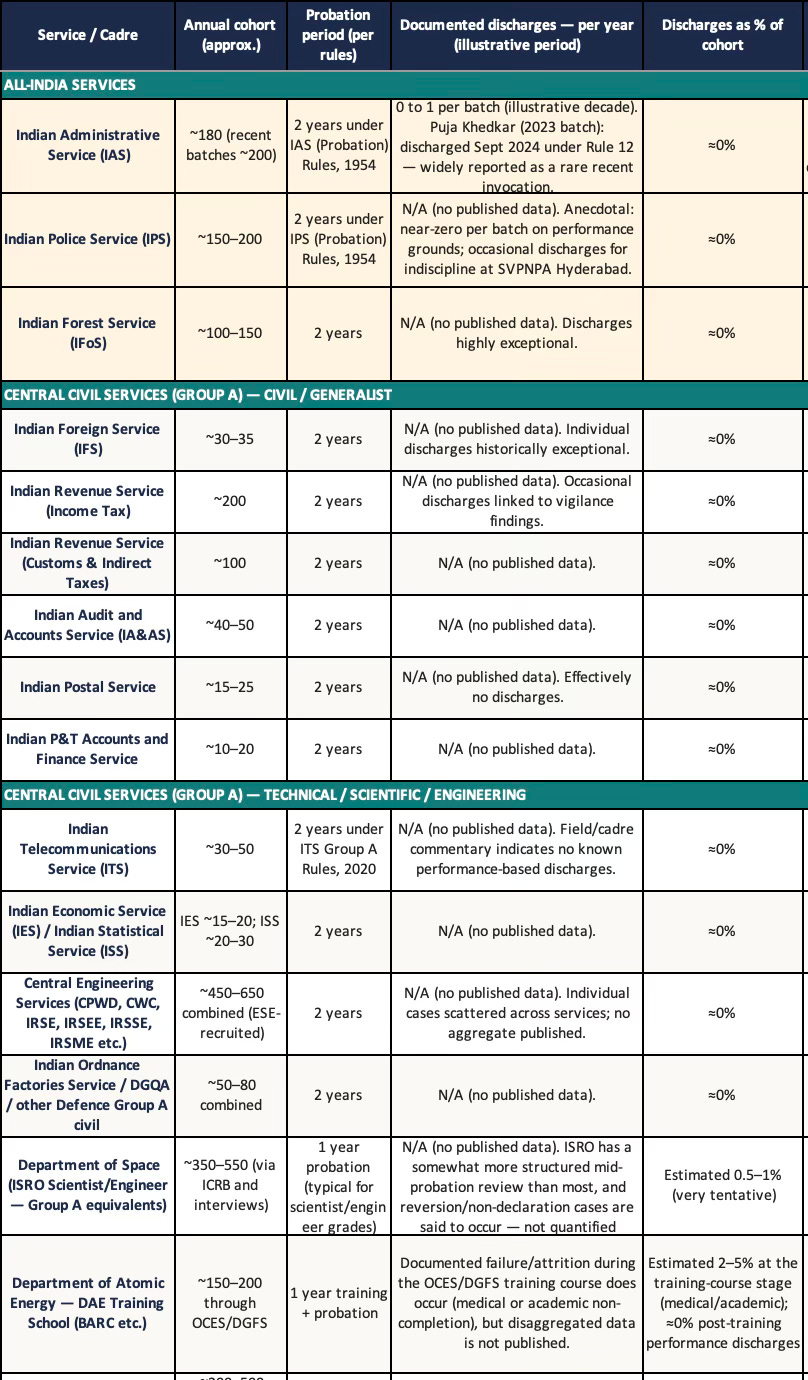
Before we analyse this, it must be clearly stated that data on this is very patchy in the absence of disclosures by either the DoPT, UPSC, state PSCs, or the central or state government cadre controlling agencies. Empirical evidence, or whatever can be gathered, shows that across every service - All-India Services, central Group A civil, central Group A technical, state civil services, state police officers, state medical services, the great mass of teachers, constables and healthcare workers - the discharge rate on performance grounds is effectively zero.
This is what Claude gathered about central government cadres.
And this about state government cadres.
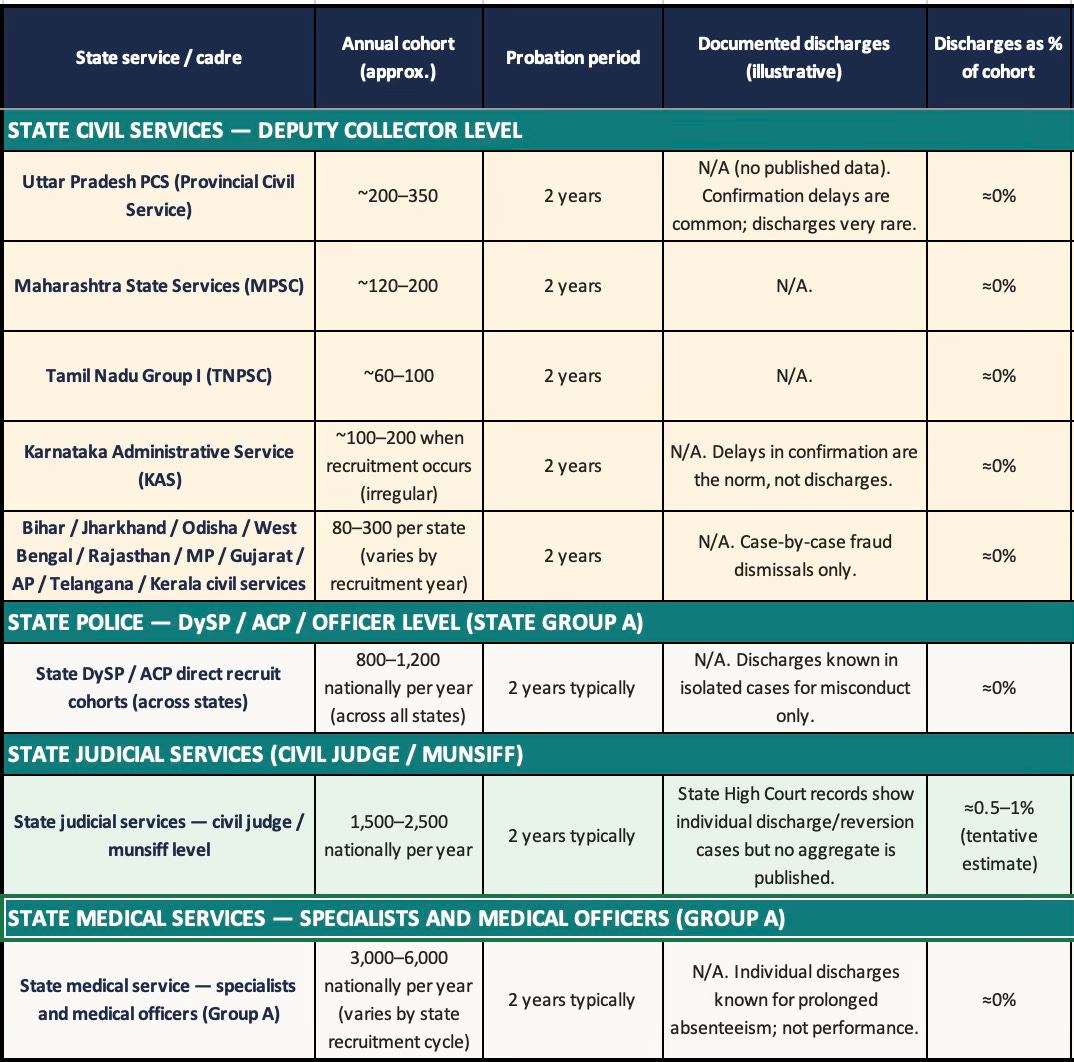
It must be disclosed that both the data are not validated, but conforms to the widely known anecdotal knowledge.
The rare discharges that do occur are almost invariably for fraud (fake caste, disability, TET or degree certificates) discovered post-selection, or for medical/physical failure during pre-probation training. Fraud detection and physical fitness testing are legitimate filters, but they are not the probation function. This has been confirmed by every major civil-service review (Hota 2004, Yugandhar 2003, Second ARC, Baswan 2016).
There are three examples of probation discharges outside of fraud and medical or physical ineligibility. An estimated 2-5% of the scientists and engineers recruited by the Department of Atomic Energy are discharged for non-completion of the academic curriculum. An estimated 3-15% of the police recruits by state and central government paramilitary forces are discharged for physical and disciplinary reasons (not deficiencies in the acquisition of policing capabilities). Thanks to supervision by the High Courts, an estimated 0.5-1% of every batch of state civil judges and munsiffs are discharged for failure to meet defined output and quality metrics during probation.
The absence of any discharge deterrent increases the stakes associated with the recruitment process itself. This most likely contributes to the fraudulent practices that are pervasive across recruitments at all levels.
This is a comparative assessment of probation discharges globally and from India’s own private sector.
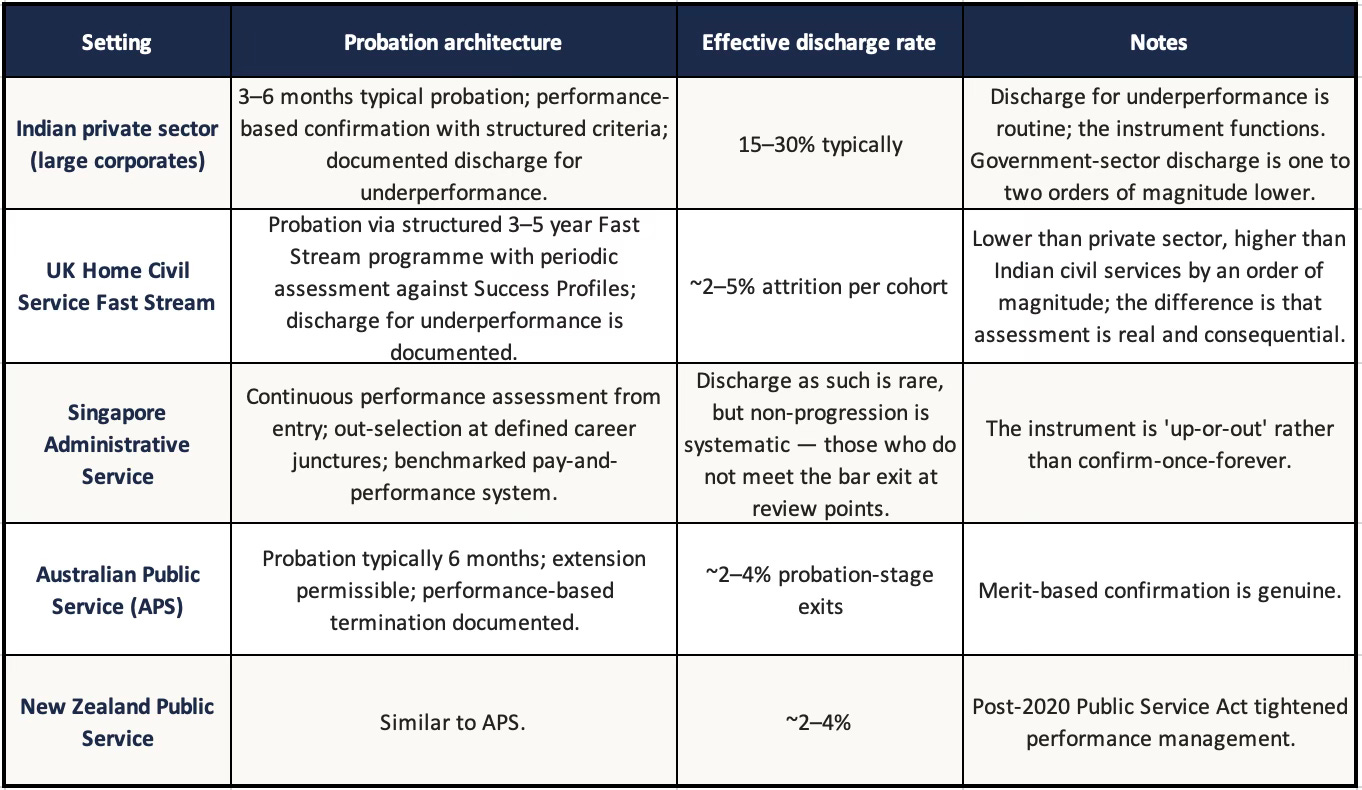
The deterrent effect of even a few discharges can be significant.
So what can be done about this?
The probation instrument has not served its purpose because the framework it operates within provides neither the assessment infrastructure (objective performance criteria linked to a role profile), disclosure requirement (not even DoPT publishes data on probations), nor the political-economy incentive (senior officers who discharge a subordinate invite litigation and administrative-tribunal action). In the circumstances, reforming the probation clause without reforming both the criteria and the incentive structure will change nothing.
A low hanging fruit is to shine light on the problem and make it mandatory for all departments to disclose the status of probation confirmation, extensions of probation, and affirm that all the probationers met the requisite benchmarks for the same.
The first step in any systematic effort would be to define a few objective and easily captured metrics of probation performance that are proximate to their roles. This would usher in transparency and shape expectations among probationers about their roles.
Second, the probation performance evaluation should be made a mandatory exercise, by a committee consisting of the Departmental head (or representative), officer responsible for training within the Department, and the Director of the Training Academy. This would mitigate the political economy deterrent to discharges.
Third, there could be a mid-way evaluation of the probationers by the same committee, which discusses any laggards and inform them about where they are falling behind. The same should be documented. This could shape expectations and ensure that the probationers are forewarned before any discharge.
Fourth, the evaluation reports should be submitted every year by the Departments to DoPT (and its state government equivalents) and the UPSC/SPSC, failing which no recruitments by the Department should be allowed. This would bring departmental accountability to the process of probation confirmation.
The aforesaid measures would constitute a simple and realistic start to addressing one of the most farcical features of the recruitment process.
No comments:
Post a Comment