Many state governments in India have issued executive directions increasing the permissible Floor Area Ratios (FARs) in their cities. However, these upzoning reforms are likely to struggle to meet the objective of densification due to restrictive conditions to avail the increased FAR. Specifically, three gate-keeping elements - minimums on road width and plot size, and a maximum on height - leave the upzoning reforms largely stillborn.
To understand why, we need to keep in mind the street layout of the typical Indian city. The colony street widths are typically 9 m (30 ft) or less, and at best 12 m (40 ft). Even the connecting roads are no more than 12 m. In any city, a very small proportion of properties, and an even smaller proportion of residential land use, will have road widths greater than 9 m. Only the arterial roads, which are in any case mostly commercial and higher-valued, are above 12 m.
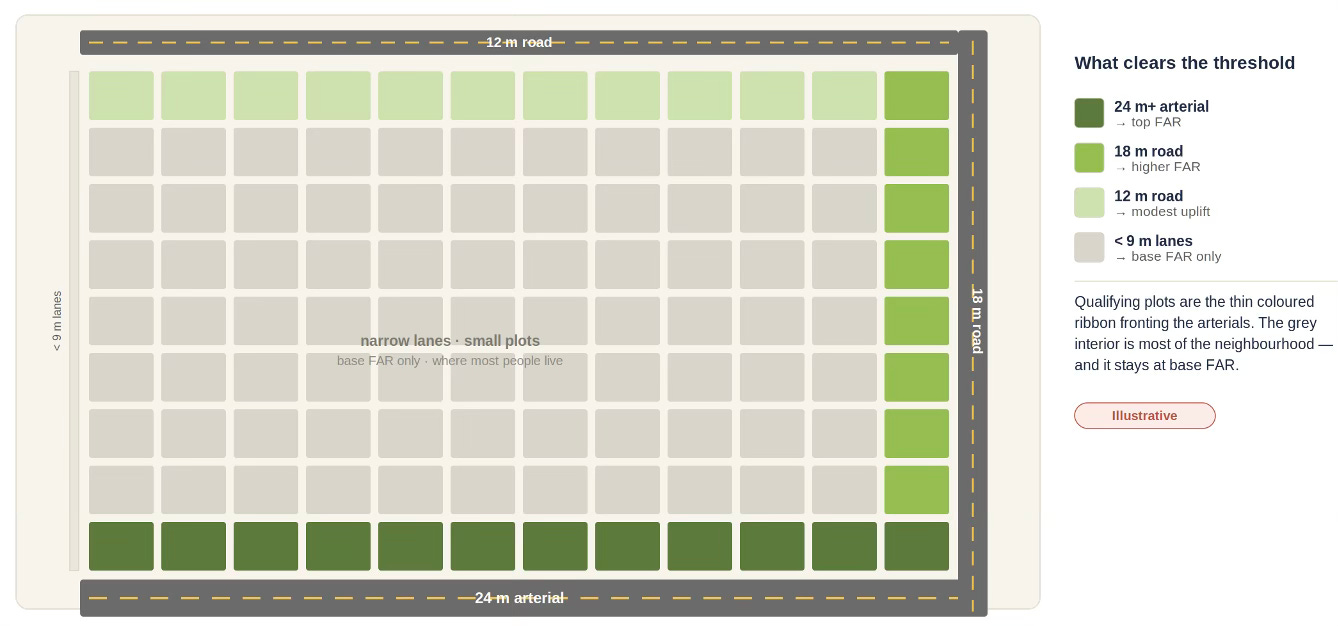
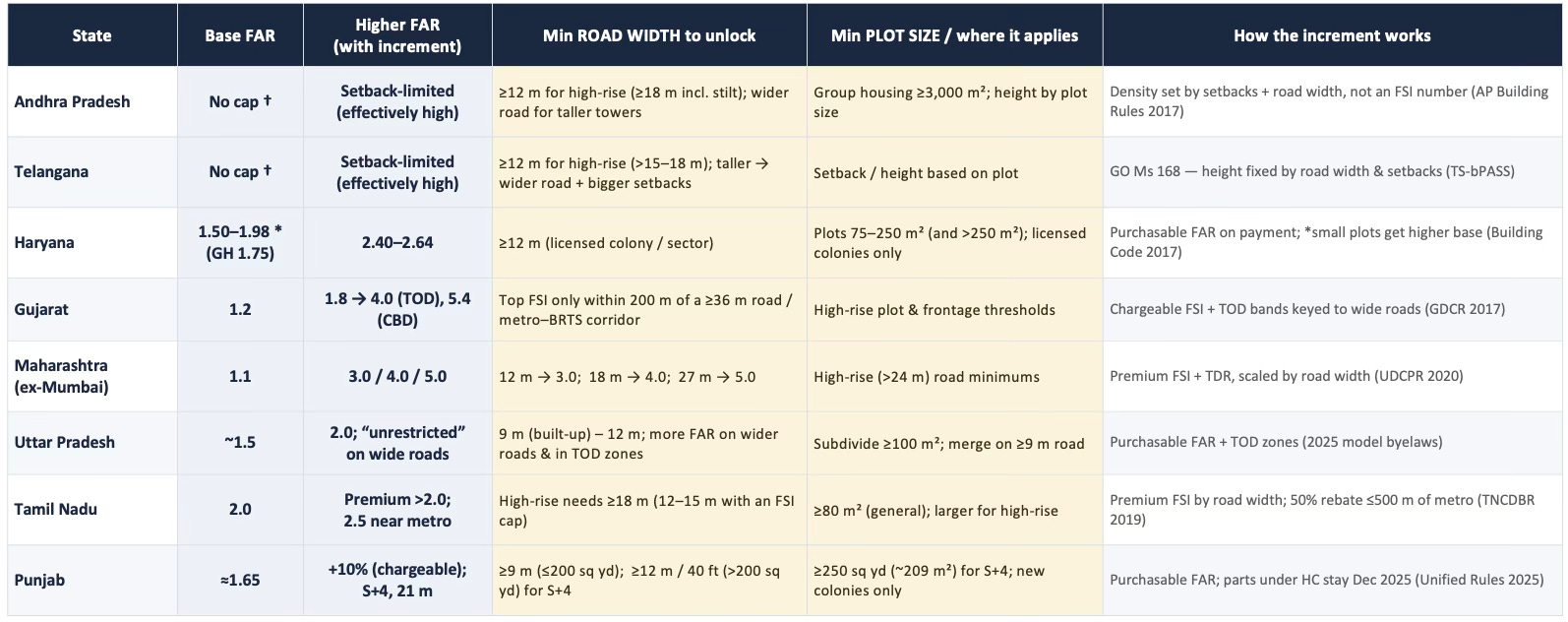
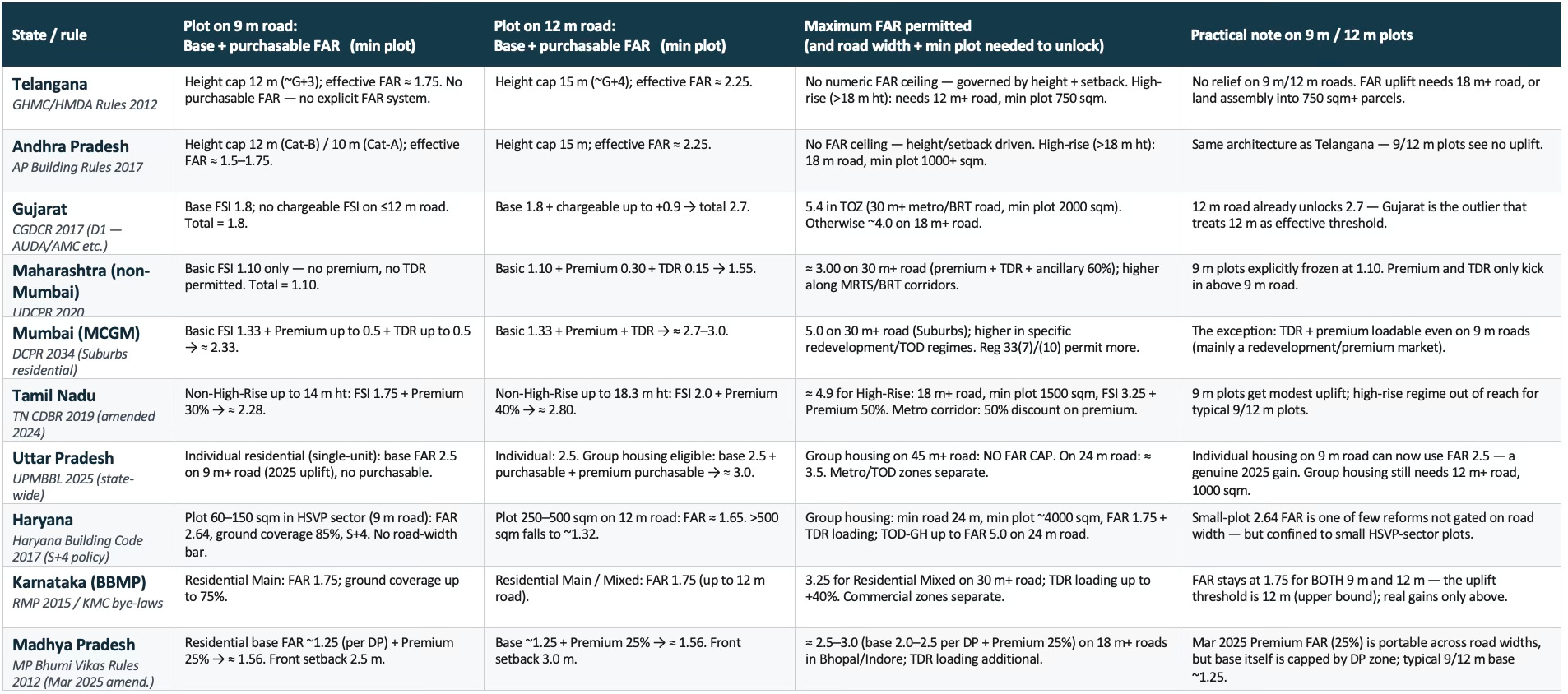
A comparison of upzoning reforms across the ten biggest states reveals some interesting insights. For a start, the upzoning itself is generally marginal, and even where significant, the higher FARs can be realised only on wider roads. In simple terms, the upzoned FAR apply to a tiny minority of parcels - greenfield layouts and edge plots on arterial roads. Every state except Gujarat, UP (individual) and Haryana (small plot) sets the FAR uplift threshold above 12 m - typically 18 m, 24 m or 30 m. But even for the three, the uplift is marginal and only for a few categories of properties. Also, none of the three touches group housing or vertical redevelopment on narrow-road plots.
Further, plot size and setbacks compound the problem of a minimum road-width gate. Even where a 12 m road technically qualifies, high-rise / group-housing rules require minimum plot sizes of 750–2000 sqm and setbacks of 6–12 m. In existing settlements, individual plots average 60–150 sqm, and assembling five to twenty of them is legally and commercially nearly impossible without a TDR/land-pooling instrument. Even then, practical challenges are daunting.
This also means that even the TOD zones cannot benefit from the upzoning. In existing town cores, which are where TOD catchments actually sit, FAR reform delivers almost nothing until the road-width and plot-size gates are lifted or bypassed.
In other words, the upzoning reforms largely bypass the built-up city and are relevant only to the greenfield areas. In these areas, the uplifts linked to higher road widths end up benefiting only the large developers. They, in turn, build high-rise gated communities of higher-end housing, mostly unconnected to mass transit and with multiple car-users in each household. Ironically, this also ends up expanding the sprawl, flooding the roads with cars, thereby worsening traffic and increasing pollution.
On the other hand, it does nothing for the smaller developers who are likely to develop affordable mid-rises (say, 6-12 floors) inside the existing colonies. Instead, they end up constructing low-rises (up to 4-5 floors). Further, the unit economics given high land prices mean that even these low-rises gravitate towards the suburbs.
It is these mid-rises that are likely to contribute meaningfully to expanding supply and addressing the affordable housing problem. Unless the upzoning covers the 9 m road width and smaller plots (which make up the vast majority of the potential developable properties in any city), there cannot be any significant impact on housing supply and the affordable housing problem.
Further, to realise the full potential of such upzoning, it must be complemented with sharply increased mass transit services, especially buses, that cover these colonies. The quality, frequency, and connectivity of the bus network must be high enough to induce people to shift from car usage.
No comments:
Post a Comment