The debate rages about the extent of AI’s likely impact on the economy and human lives. So far, there has been an apparent lack of commercial value creation to justify the gigantic and exponentially increasing volume of AI investments.
I blogged here on the distinction between horizontal and vertical use cases of AI, with success on the latter being limited, here cautioning about the likely impact of AI on development and in developing countries, and here on some possible high-impact use cases for AI in lower-income countries.
The most common horizontal use of AI is in personal productivity improvements. Claude, ChatGPT, etc., are already having large effects on personal productivity. But its translation into vertical use products is muted.
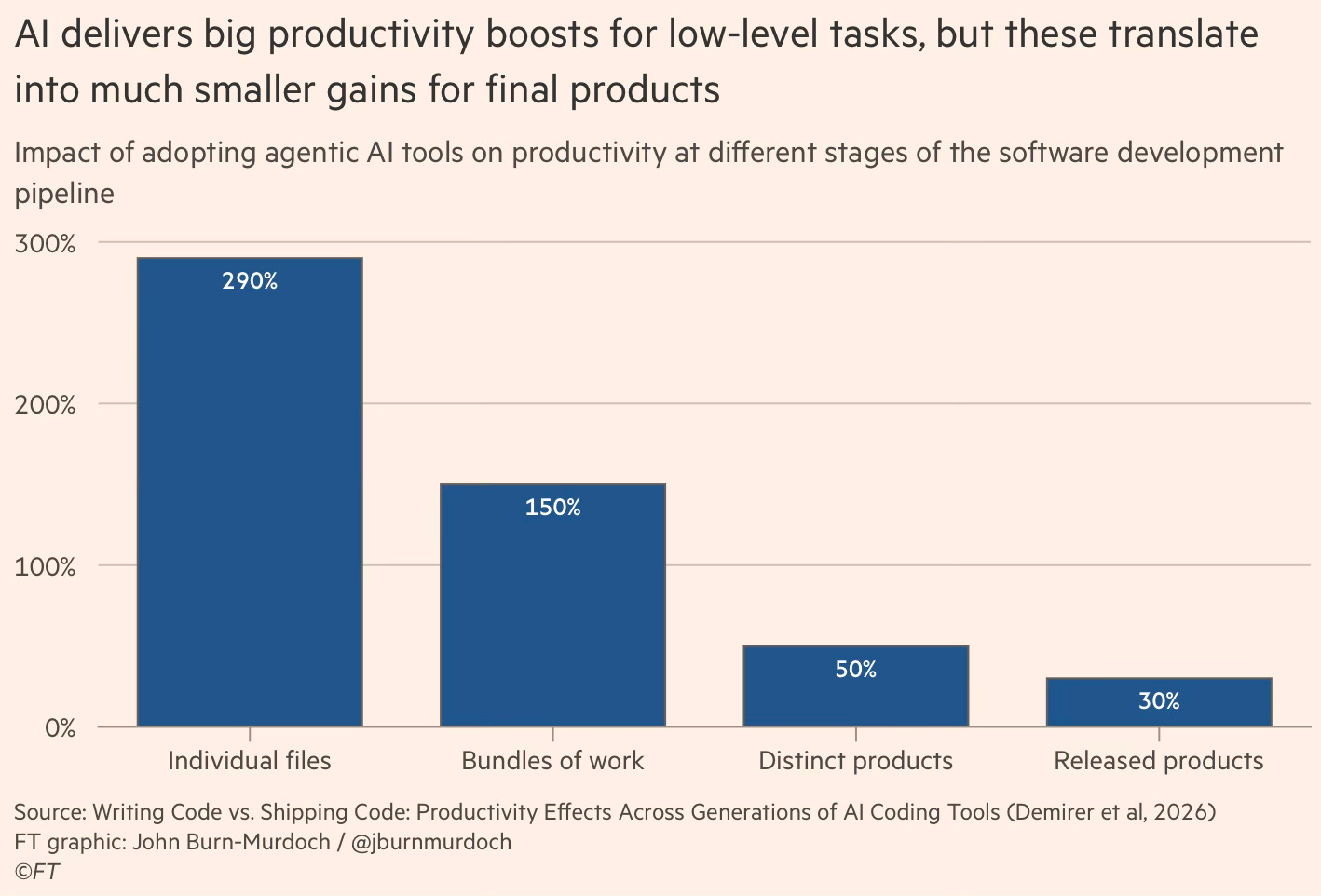
On this, John Burn-Murdoch points to the work of Mert Demirer, Leon Musolff and Liyuan Yang to make two important points. The first point is the “disconnect between reported increases in coders’ output and the apparent lack of a corresponding boom in product or value creation,” which creates a very steep funnel between inputs and outputs.
The study by MIT’s Mert Demirer and co-authors tracked software developers’ work before and after they adopted AI tools. Importantly, they measured this at several different levels, from the amount of code written, to the number of discrete files edited, to the number of projects or features worked on, to actual releases of new software. They found an explosive impact at the top of this funnel — coders created or edited almost 300 per cent more files — but that boost was halved to 150 per cent by the time they got to the number of discrete pieces of work submitted for review, and that in turn shrunk fivefold to a roughly 30 per cent uplift in the number of full software releases.
The authors also found little evidence of AI-assisted increases in software development, leading to increased consumption of Apps.
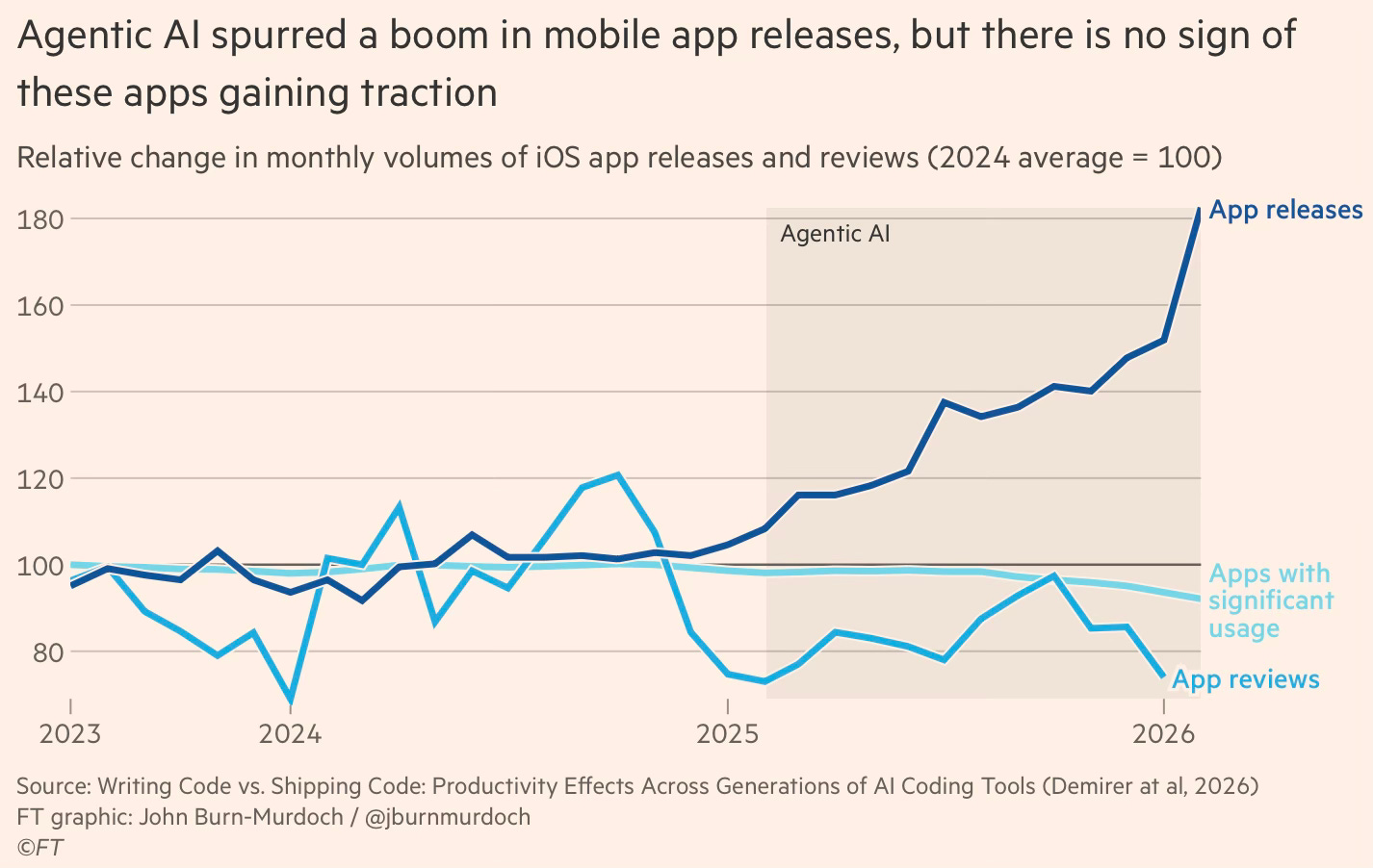
This brings us to the second point made by the authors about AI’s impact - it is likely to be fully realised only when new organisational structures, markets, and business models emerge.
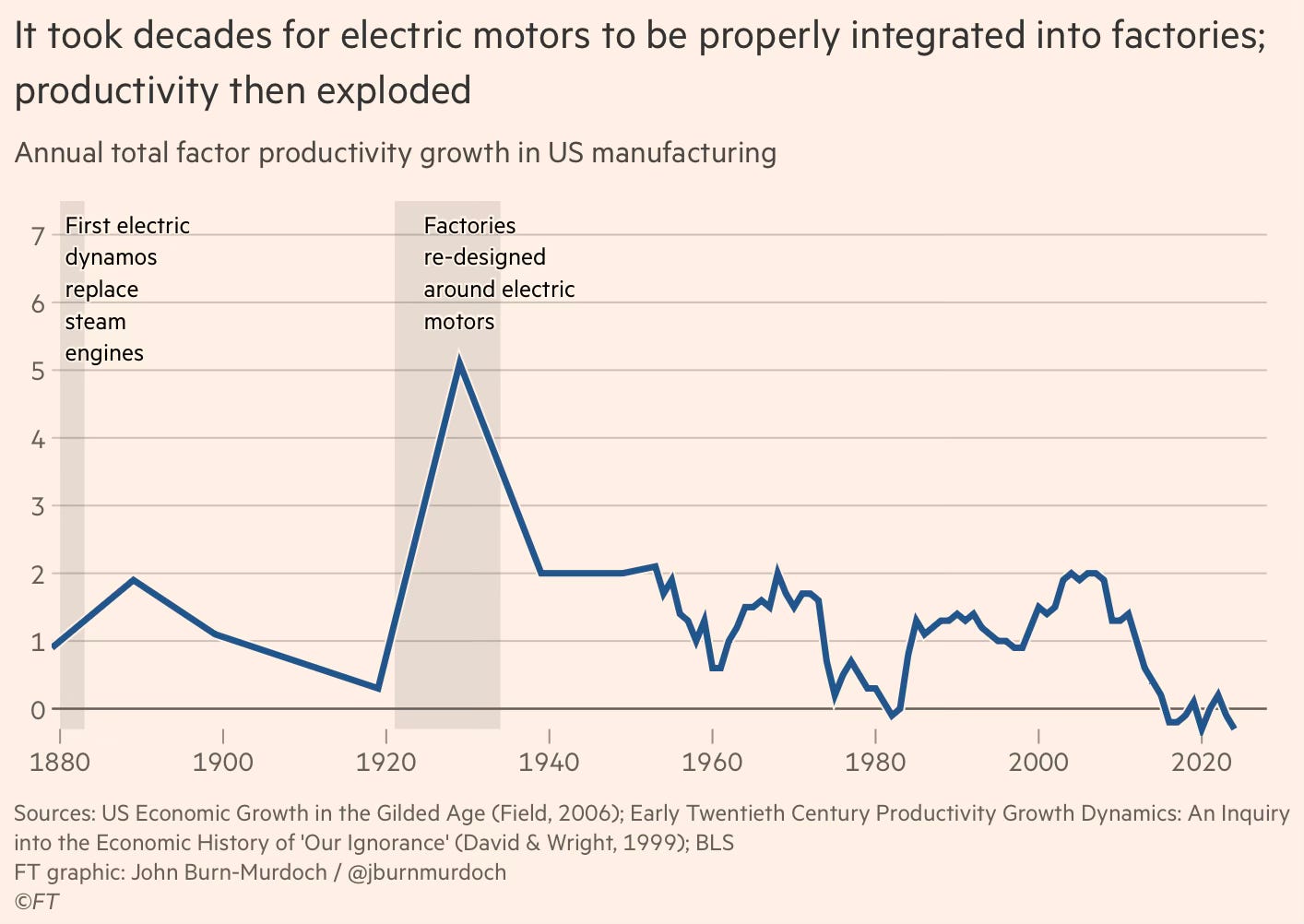
But Demirer and his co-authors feel the more likely explanation is that current organisational structures and marketplaces are not set up to take advantage of real underlying gains. That view is supported by the evidence from past technological revolutions, where the real jumps in productivity and job displacement came from new companies and processes rather than incumbents grafting new technology on to existing workflows. In the case of electricity in the late 19th and early 20th century, productivity gains were modest where factories simply replaced giant steam engines with giant electric motors but left the rest of the machinery and layout unchanged. The boom arrived decades later when engineers fitted individual workstations with their own small motors.
In this backdrop, Jack Dorsey and Roelof Botha have an insightful article on organisational impact. Specifically, they claim that AI’s productivity-enhancing value can address the fundamental coordination problem in large organisations that manifests in the form of a trade-off between span-of-control limitations (which add organisational layers) and speed of information flows. They argue that AI sharply increase people’s span of control, thereby reducing organisational layers and hastening decision-making.
The first organisational models emerged in the military to organise large numbers of soldiers into a coherent and effective fighting unit. It involves a hierarchical chain of command that allows for a span of control and a seamless flow of information and instructions. The model then entered the corporate world through the US railroads in the 1840s and 1850s, which borrowed West Point-trained engineers from the US Army. They trace the evolution of the modern organisational form,
In the mid-1850s, Daniel McCallum of the New York and Erie Railroad created the world’s first organizational chart to manage a system stretching over 500 miles with thousands of workers… McCallum’s chart formalized the same hierarchical logic the Romans had used: layers of authority, defined reporting lines, structured information flow. It became the blueprint for the modern corporation… Frederick Taylor (1856-1915), often called the “Father of Scientific Management,” optimized what happened within that hierarchy. Taylor broke work into specialized tasks, assigned them to trained experts, and managed through measurement rather than intuition. This produced the functional pyramid organization - a structure optimized for efficiency within the information routing system that the military had pioneered and the railroads had commercialized…
In 1959, McKinsey’s Gilbert Clee and Alfred di Scipio published “Creating a World Enterprise” in the Harvard Business Review, providing an intellectual framework for a matrix organization that combined functional specialties with divisional units. Under the leadership of Marvin Bower, McKinsey helped companies like Shell and GE implement these principles, balancing central standards with local agility. This became the “professional” or “modern” corporation that propelled the postwar global economy… The McKinsey 7-S framework, developed in the late 1970s by Tom Peters and Robert Waterman, distinguished the “hard Ss” (Strategy, Structure, Systems) from the “soft Ss” (Shared Values, Skills, Staff, Style). The core idea was that structural elements alone were insufficient. Organizational effectiveness required alignment across cultural traits and the human factors that determine whether a strategy actually succeeds.
They suggest that AI makes it possible to solve the fundamental coordination problem within large organisations that necessitate hierarchical formations.
For the first time, a system can maintain a continuously updated model of an entire business and use it to coordinate work in ways that previously required humans relaying information through layers of management… In a traditional company, a manager’s job is to know what’s happening across their team and relay that context up and down the chain. In a remote-first company where work is already machine-readable, AI can build and maintain that picture continuously. What’s being built, what’s blocked, where resources are allocated, what’s working and what isn’t. That’s the information the hierarchy used to carry. The company world model carries it instead…
In a conventional company, the intelligence is spread throughout the people and the hierarchy routes it. In this model, the intelligence lives in the system. The people are on the edge… The edge is where the intelligence makes contact with reality… the edge doesn’t need layers of management to coordinate it. The world model gives every person at the edge the context they need to act without waiting for information to travel up and down a chain of command… Everything else the old hierarchy did, the system coordinates, and everyone is empowered, with a role that’s much closer to the work and the customer.
They identify three roles - Individual contributors (ICs) who are deep specialists and experts who build and operate system capabilities; Directly Responsible Individuals (DRI) who own specific cross-cutting problems or opportunities and customer outcomes; and player-coaches who replace the traditional manager whose primary job was information routing, who do both building and handling people.
All this makes great sense and points to how corporate organisational models are likely to emerge as the application of AI progresses. There will be frontier firms in a few sectors that will lead the way for others to follow.
AI applications are a promising opportunity to address inefficiencies and coordination failures in public bureaucracies, too, and improve the quality of public administration.
For a start, it has the potential to restore internal capabilities, which have eroded steeply. Over the years, thanks to practices like outsourcing all analytical and documentation work to consulting firms and the hiring of individual consultants (most notably now, the system of Young Professionals, YPs, in governments), there has been a complementary erosion of in-house expertise. The capabilities to articulate proposals for internal deliberations and file circulation have atrophied. Given that bureaucracies run on deliberations and files, this trend is an underappreciated aspect of state capability weakness.
AI provides an opportunity to reverse these trends and develop internal capabilities. The primary reason for the reliance on external expertise is the extent of analytical work and documentation required during the deliberative process (everything from a concept note on the proposal to reports for appraisals, and Cabinet Notes). The bureaucratic leaders who are burdened with a multiplicity of tasks, work under tight timelines, face increased fetters from oversight agencies and courts, and must rely on an increasingly enfeebled internal bureaucracy. In the circumstances, they prefer to outsource the thinking and documentation to outsiders. I have blogged earlier on the perils of this approach.
AI tools like Claude are excellent at analytical work and the generation of these documents in response to clearly articulated prompts. It becomes a simpler proposition if bureaucrats can quickly and easily obtain a draft concept and supporting documents, and then scrutinise, validate, and refine it before circulation for approval. AI tools can then become a force multiplier for bureaucratic leaders, who are now constrained by their limited bandwidth and acute dependencies.
This would also empower bureaucratic leaders, or at least some among them, and could enhance the quality of their engagement with the decision-making process. Besides, by minimising the drudgery of the bureaucratic process, it would also allow bureaucratic leaders to apply their minds and exercise judgment more effectively, thereby improving the quality of decisions and policy design and implementation. It would also lower decision-making delays.
It should therefore become a priority of the National Informatics Centre (NIC) (or an AI division within it) to develop or license AI application that is embedded in the e-office software and enables officials to sift through large documents and generate proposals/presentations, circulation notes and reports using prompts. This has transformative potential for productivity improvements, not only stopping the erosion of internal capabilities but also helping rebuild them.
If this can be done, it opens up opportunities for far-reaching administrative reforms. The current bottom-heavy pyramid can be rationalised to make it fit-for-purpose.
A major inefficiency is the presence of multiple layers within the administrative system. It is a widespread practice across governments to have YPs, and those recruited as data entry operators originate the note file (a task earlier performed by the clerical staff). The note then gets circulated across several layers, often seven or eight till the approver. This can be radically pruned down to no more than three or four, including the approving authority.
Such de-layering is especially relevant for technical ministries and departments whose activities are more amenable to AI-based support. Such ministries should have a separate administrative staffing plan, one that takes into account the role that AI can play in generating documentation and considerably reducing any drudgery associated with analytical work.
As a general illustration, there are perhaps three kinds of activities in any department - shared services (HR, procurement, establishment issues, statutory matters, etc.), administration of departmental programs, and analytical and technical work. There are significant low-hanging likely process-efficiency improvements in all three, and substantive value-addition potential in the third activity.
This would also necessitate a reassessment of public recruitments. The advent of AI applications means that, unlike in earlier times, apart from merely documenting the issues in a note file, the case worker (the ASO or SO) can now be expected to do some analysis and provide comments. This also means that a smaller base can serve the clerical roles (the entire paraphernalia of clerical cadres can be collapsed into just two functional levels - maker and checker), and their educational qualifications and skills must reflect the requirements for the revised scope of work. I’ll blog separately on this.
The increased use of AI applications to analyse and document, and a compact and delayered deliberative process captured in the file circulation can also increase the quality of collective engagement and ownership of the bureaucracy in decision-making. It lets (and nudges or forces) everyone contribute meaningfully to the process instead of being passive pass-throughs of instructions and note files. It presents the opportunity to shed reliance on outsourced expertise and build back state capabilities.
This is deep work and, even in the best case, is likely to be adopted only by a few units in the first phase. The objective should be to create the conditions that encourage the emergence of these lighthouses and channel them to diffuse change more widely.
No comments:
Post a Comment