The FT has a long read that describes how China’s battery manufacturers are building supply chains outside the country.
There are two main drivers of this trend. One is to overcome the protectionist barriers being erected by its major trading partners. In recent weeks, the European Union has announced localisation rules to take effect from next year and slapped quotas on hybrid EV imports. The EU also wants to fully localise its battery supply chain by the end of the decade. And these restrictions will only get tighter and more widespread geographically with time. Second is the profitability squeeze on manufacturers due to the excessive domestic supply of EVs and energy storage battery-making capacity that is forcing them to look outward. All the battery makers are struggling, with CATL missing third-quarter results, and its shares have almost halved since early June.
For now, they are maximising exports from domestic factories, but realise that localisation is the way forward. To this extent, they are also pushing their Chinese suppliers to invest in overseas facilities.
As a headline, the likes of CATL, BYD, Sungrow, CALB, and Gotion have announced investments of $12 bn across 14 deals this year, taking investments since 2023 to about $90 bn, composed of $52 bn in cell manufacturing and $38 bn in materials manufacturing.
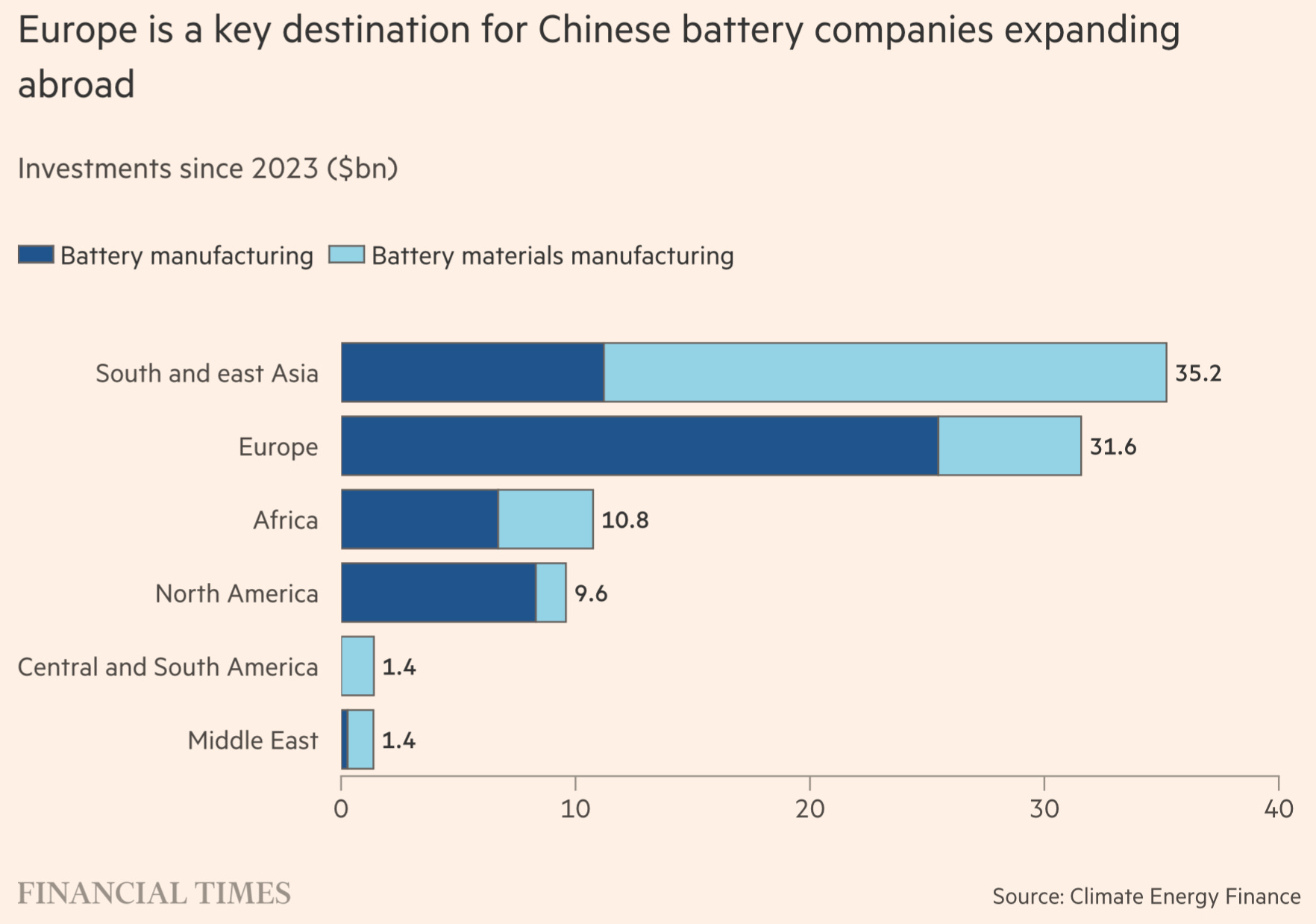
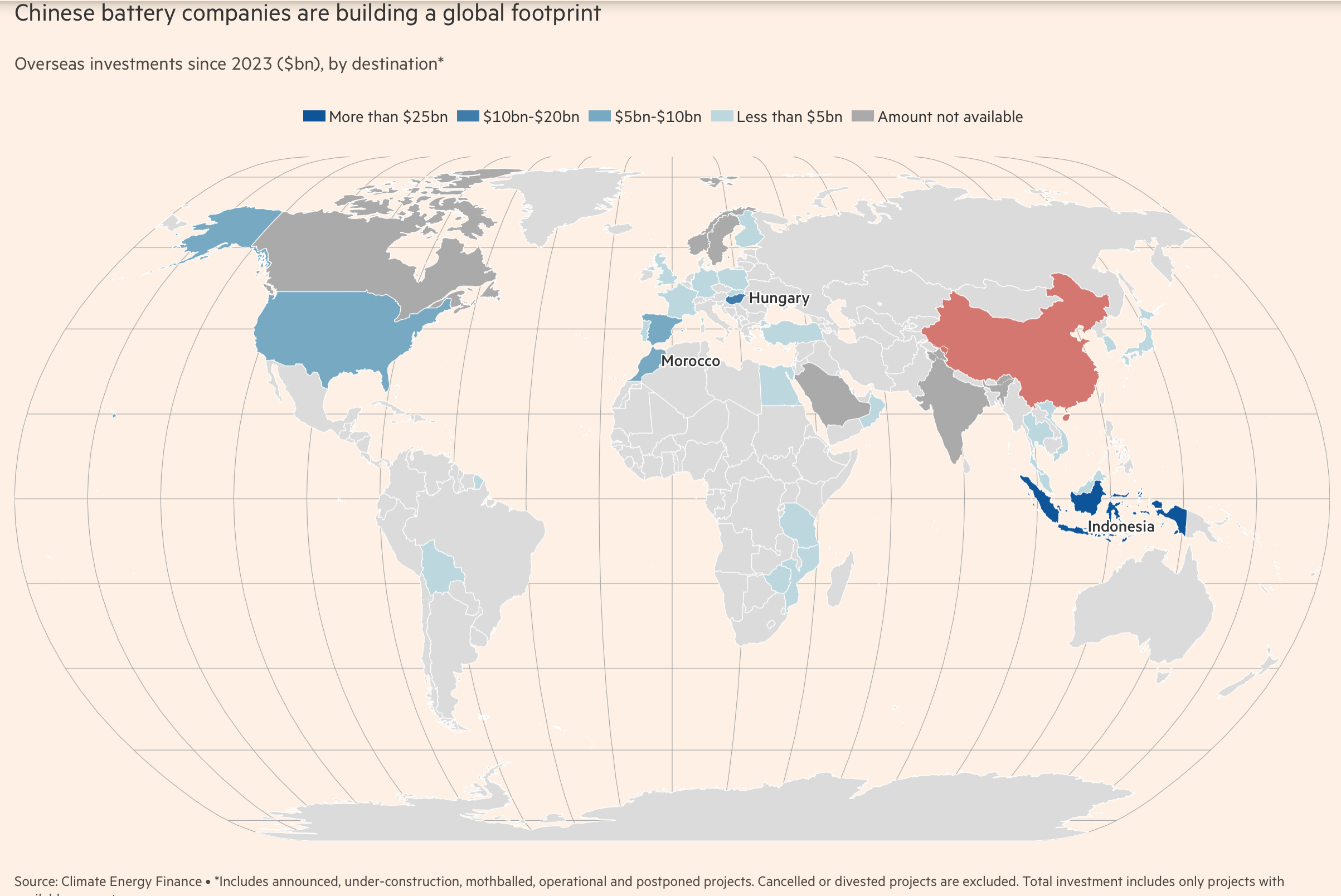
The investments are geographically spread out, covering all major regions. The glaring exception is South Asia. In simple terms, given the overwhelming dominance of China, India appears almost completely absent from the battery supply chain.
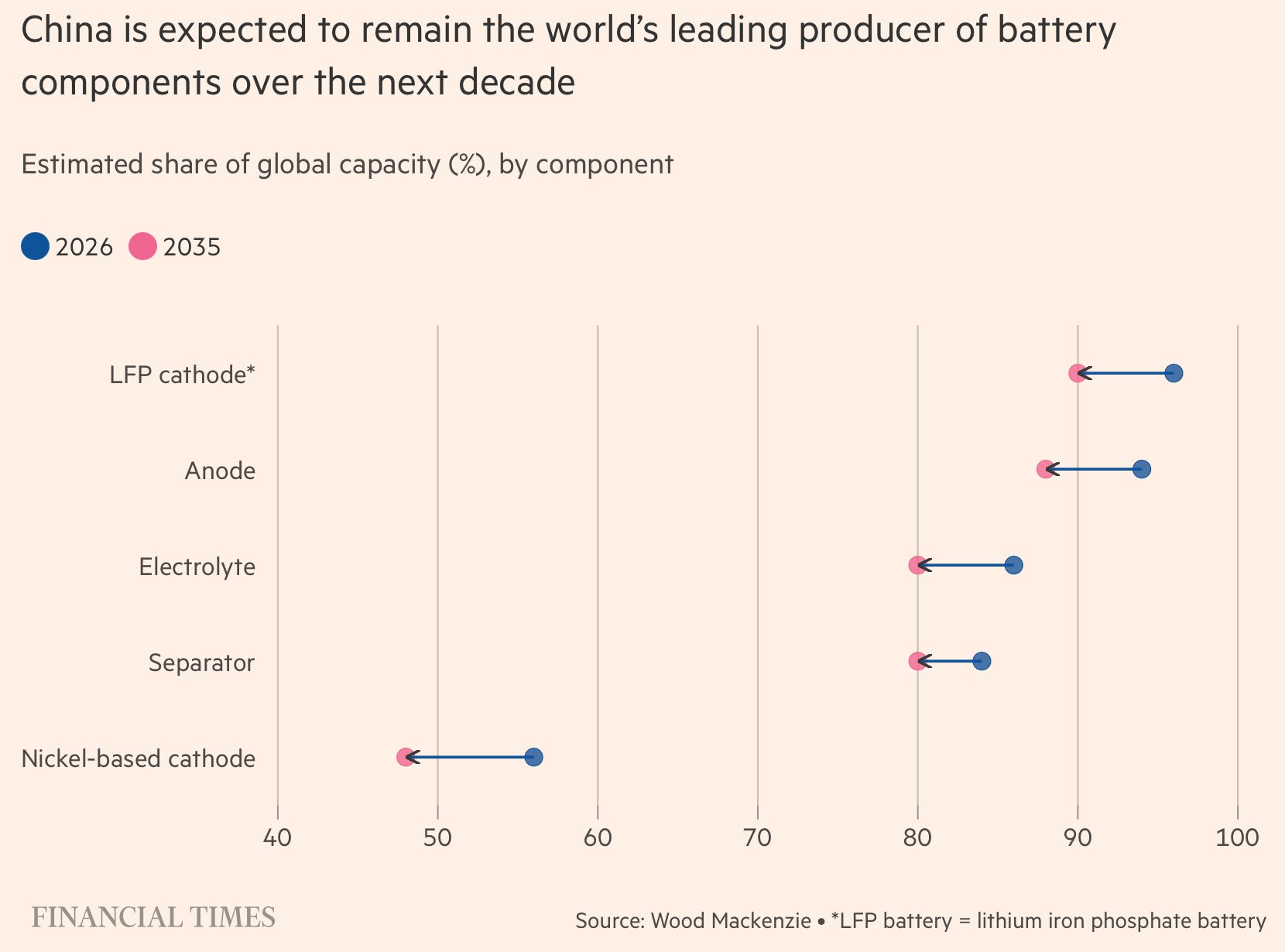
This is disturbing also because not only is China currently dominant, its dominance in technology, battery materials, and price competitiveness is such that it is expected to continue well into the next decade.
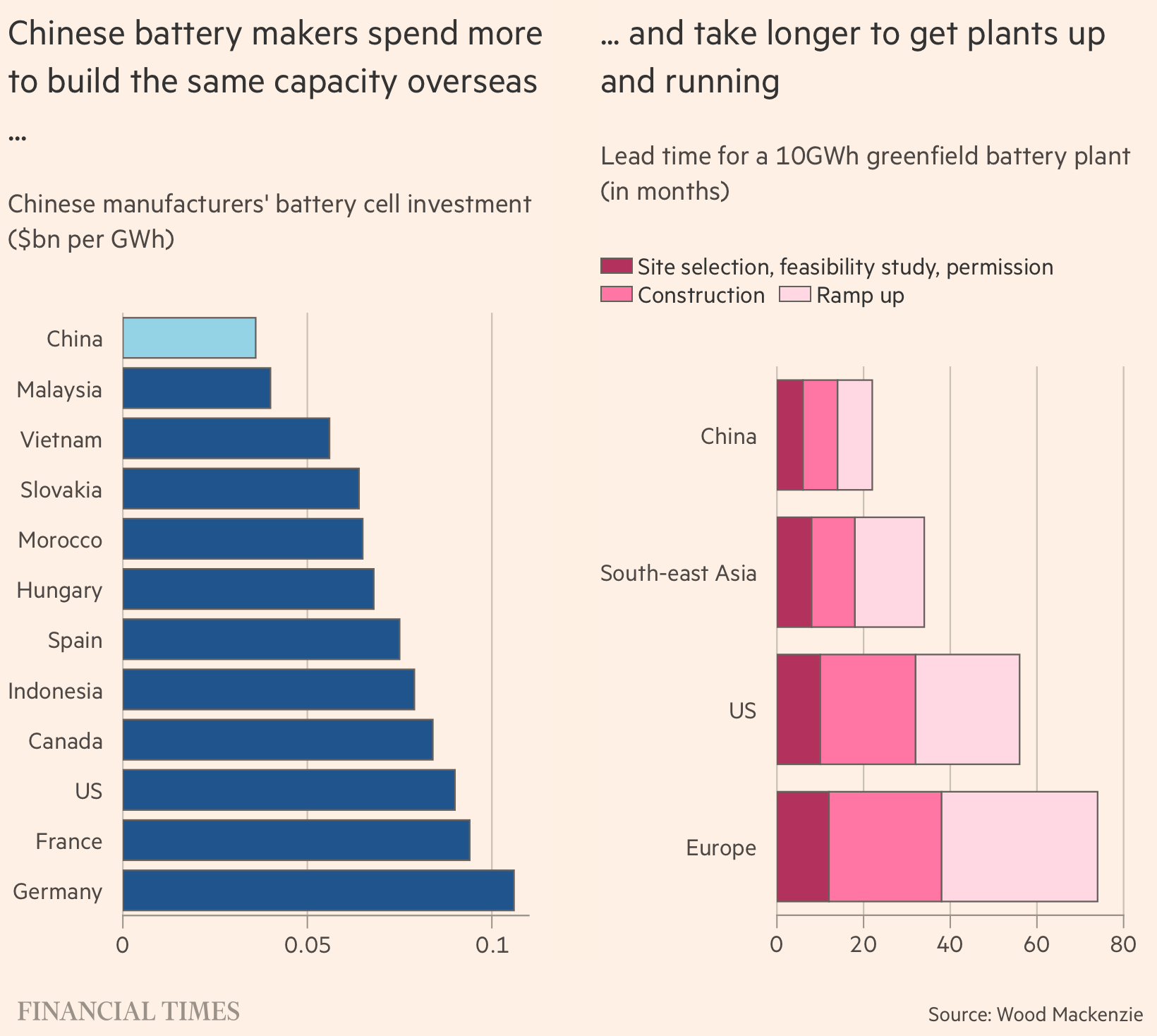
While the Indian market is significant, it may not be big enough by itself, and the bigger attraction for the Chinese manufacturers would be to use it as a hub for exports. Here, India might have a competitive advantage with its lower construction and ramp-up costs compared to the US and Europe.
Battery manufacturing may perhaps be an extreme illustration of how shunning Chinese manufacturers threatens to cut India out of the global battery supply chain. But the same risk exists in many other industries where domestic capabilities are weak and Chinese dominance is too big to be surmounted for the foreseeable future.
This is a teachable illustration of the formidable dilemma that countries like India face. On the one hand, it must not allow its domestic manufacturing base to be destroyed by Chinese imports and become dependent on China. But on the other hand, it must not only not miss out on frontier technologies but also build its domestic industrial capabilities.
This was the exact dilemma China faced with the Western manufacturers in the late nineties and early noughties. It played the long game of luring the biggest Western multinationals (Apple, Tesla, Volkswagen, and GE are only some examples) by dangling the country’s large domestic market and skilled workforce, and with attractive bespoke deals. In due course, it extracted joint ventures, forced technology transfers, cultivated its own domestic champions across industries, and finally forced out the foreigners.
This trajectory of localisation requires three things. One, the government displayed single-minded dedication and purpose, along with high state capability, in dictating the pathway and calibrating policy accordingly. Two, its companies played their part by learning diligently and quickly, and exhibiting an ambition and risk appetite that matched the government’s objectives. Three, the foreign multinationals were both complacent and greedy enough to fall for it and share technology with their Chinese partners.
The best example of this kind of localisation is the story of Apple and the iPhone in China. As I have blogged here, Apple made the iPhone in China, and the iPhone made China!
So how have other countries been responding?
Indonesia has been the most successful example of forced localisation by leveraging its raw material resource base, specifically nickel and cobalt. It is part of its hilirisasi strategy to promote downstream development. The goal is to ensure that the value generated by Indonesia’s vast reserves stays in Indonesia, not in the factories and refineries of foreign investors. Starting in 2014, it banned the export of nickel ore and forced Chinese stainless steel makers to localise refining and processing. In 2020, it extended the ban to similarly force Chinese EV battery makers to establish local manufacturing facilities.
The most consequential step was the establishment in 2021 of two high-pressure acid leaching (HPAL) facilities in Central Sulawesi’s PT Indonesia Morowali Industrial Park (IMIP), as a joint venture between a Chinese consortium of Tsingshan, GEM, CATL, and Hanwa, and Bintang Delapan Group, a prominent local mining and energy conglomerate, as a minority partner that facilitates local operations, land concessions, and mining logistics. Since then, CATL and partners broke ground in 2025 on a $6 billion integrated project spanning the entire chain from mining to recycling. Indonesia has also drawn non-Chinese capital, from an LG Energy Solution–Hyundai integrated battery deal worth $9.8 billion. It has also established the state-owned Indonesia Battery Corporation to partner with foreign investors. In April 2026, President Prabowo broke ground on 13 new natural resource processing projects worth $7.6 billion.
Spain is another example worth studying. There are at least three joint ventures —Ebro Motors-Chery, Stellantis-CATL, and Santana Motors-BAIC — of note. The JVs require meeting two benchmarks — procurement from Spanish suppliers and technology transfer.
The Europeans are now trying to emulate China with its draft Industrial Accelerator Act (IAA) that seeks to lift manufacturing to at least 20% of EU GDP by 2035 from 14% in 2024. While its details are not finalised, it proposes local content requirements to qualify for selling in the EU, and access state incentives and public procurements. For vehicles accessing incentives or public procurements, it sets a three-level definition of a “European vehicle” - assembly in the EU, an immediate 70% local content threshold for automotive production in the region, and a 50% threshold for critical components - to be achieved within three years. It also proposes a pre-approval regime for FDI in strategic manufacturing to ensure that it strengthens EU capacity rather than merely assembly. It is pertinent that the EU is proposing this despite it being clearly in violation of WTO regulations.
The real test of these efforts is genuine technology transfers and serious localisation. Chinese firms, and more importantly, Beijing, will do its best to avoid this so as to prolong its dominance. The Indonesian example offers cautionary notes. The localisation of production has not translated to localisation of ownership or know-how, with Chinese firms controlling roughly 75% of Indonesia’s refining capacity.
Much the same applies to the Spanish JVs. It now emerges that CATL plans to send 2,000 of its own skilled workers to the €4.1bn Zaragoza plant to commission it, and Stellantis feels that the Chinese don’t want to share the know-how required to set up a battery factory. It is also becoming apparent that CATL and Chery will license their technology rather than transfer it outright, with no clear timeline for shifting underlying IP to Spanish ownership and no targets for local R&D.
The clear lessons from these case studies are that while market access and raw-material gates are powerful enough to compel a Chinese firm to locate production and even enter a JV, they do not, by themselves, compel it to surrender the crown-jewel know-how — they control the pace of transfer and can substitute licensing, expatriate labour, and retain process secrets for genuine capability-building. The genuine transfer of technology to Indonesian and Spanish firms has been thin. This risks replacing an export dependency with a manufacturing dependency and defeats the objective of moving upmarket to higher value-added segments.
However, Indonesia is also showing the way how leverage can be exercised once the Chinese investments are sunk, in much the same way China has done to foreign investors. It has gradually introduced several regulatory restrictions aimed at increasing domestic value capture. They include an increase in taxes and levies, a requirement to retain forex earnings onshore, a reduction in nickel ore production quotas, and increased restrictions on work visas.
The Chinese firms, having invested nearly $14 bn over the last decade in smelters, HPAL processing plants, and integrated supply chains calibrated to Indonesian ore, know that these assets cannot be relocated.
The Ministry of Energy and Mineral Resources set the 2026 national nickel ore quota at 260-270 million wet metric tonnes, down from 379 million the year before, while reverting to an annual approval cycle that gives the government tighter, year-by-year control over supply… The combined weight of these policies, alongside rising input costs driven by conflict in the Middle East, hit three of China’s biggest players in Indonesia with concrete force in 2026.
Tsingshan, Indonesia’s largest single nickel investor, saw its flagship Weda Bay mine quota collapse from 42 million tonnes in 2025 to just 12 million tonnes in 2026, a cut of over 70%… Huayou Cobalt, operator of the Huafei project, paused roughly half of its production capacity from 1 May 2026. The revised pricing formula pushed smelting costs up by an estimated $300 per tonne… And Brunp Recycling, the battery materials subsidiary of CATL, saw its Indonesian nickel feedstock supply disrupted, threatening the upstream end of one of the world’s most critical EV battery supply chains…
In April 2026, President Prabowo broke ground on 13 new natural resource processing projects worth $7.6 billion. He called downstreaming the path to national revival, with nickel as the centerpiece. Quota controls serve the same purpose as the export ban: by concentrating ore supply toward domestically-oriented processors, Jakarta is trying to shift the value chain in its favor. Beyond controlling its own supply chain, Indonesia has pursued a more ambitious goal: becoming the OPEC of nickel… The ambition has since taken more concrete form: last month, Indonesia and the Philippines established the IndoPhil Nickel Corridor working group to coordinate mining activities. Together, Indonesia and the Philippines account for roughly 75% of global nickel production, which is in theory enough to exercise pricing power if the coordination holds..
Chinese companies, too, are accommodating in responding to the requirements of hosts. In a recent instance, Ming Yang Smart Energy, one of China’s largest wind turbine manufacturers, is seeking to address European national security concerns by placing data beyond the reach of Chinese law by establishing separate European legal entities with independent governance and IT systems. This is also to insulate its European customers from the reach of China’s National Intelligence Law requiring companies to cooperate with state agencies. The decision follows the UK government’s decision to disallow the use of its turbines in British offshore wind farms, which aborted the company’s plans for a £1.5bn factory in Scotland. Ming Yang is also responding to the UK decision by forming a joint venture with Octopus Energy, with the UK energy retailer providing software and control systems.
There are lessons for countries like India.
For one, given the dominance of Chinese firms in the supply chain from raw materials to components, there is no alternative but to rely on them for now. Even countries like the US have realised this and reconciled to accommodation, at least for some time. In the circumstances, the strategy can only be to gradually reduce the dependence.
The strategies will vary across sectors. But generally, the objective should be to start by forging joint ventures, even with minority partnerships, and encourage technology licensing. The important factor here should be the domestic partner. It is necessary to ensure they are deep-pocketed and well-connected, who can work the system both here and outside. Indian public sector units cannot play this role.
India’s case-by-case approvals to date reveal a requirement for JVs. JSW’s JV with SAIC for MG Motor India, which was cleared in 2024, and Uno Minda’s EV-components JV with Inovance Automotive of China for advanced powertrain technologies, including inverters, e-axles, motors, and combined charging systems, cleared in June 2026, are good examples. Equity-free technical alliances (licensing of technology) like Dixon Technologies with HKC for display modules, Bhagwati (Micromax) with Huaqin, and PG Electroplast with Shanghai Highly for AC compressors are less useful, but acceptable if there is no other choice.
The insistence on JVs with Indian majority shareholding, no Chinese leadership, and technology transfer is a more demanding version of what Indonesia or Spain has done. While ideal, it risks throttling Chinese FDI in India and the much-needed access to advanced manufacturing technologies. And the evidence so far concurs.
The Indonesian example also shows that once significant investments are sunk and supplier ecosystems transplanted to make relocation difficult and further expansion the natural choice, there is considerable leverage with the host country in extracting concessions. And in India’s case, the by then larger domestic market and more advanced manufacturing ecosystems would make staying and expanding more attractive. Incidentally, this is also the game that China played with Western multinationals during its manufacturing expansion journey.
The other important aspect is to encourage the biggest corporate groups into striking JVs with the Chinese. Areas like solar generation, battery energy storage systems (BESS), electric vehicles, electronics, smart meters, petrochemicals, etc., are only some examples where India’s corporate behemoths are also active. I had blogged here on how large domestic corporate groups can help with domestic manufacturing and localising value addition.
No comments:
Post a Comment