This post will raise a conceptual point about the size of India’s affordable housing market and the targeting of policy measures aimed at them.
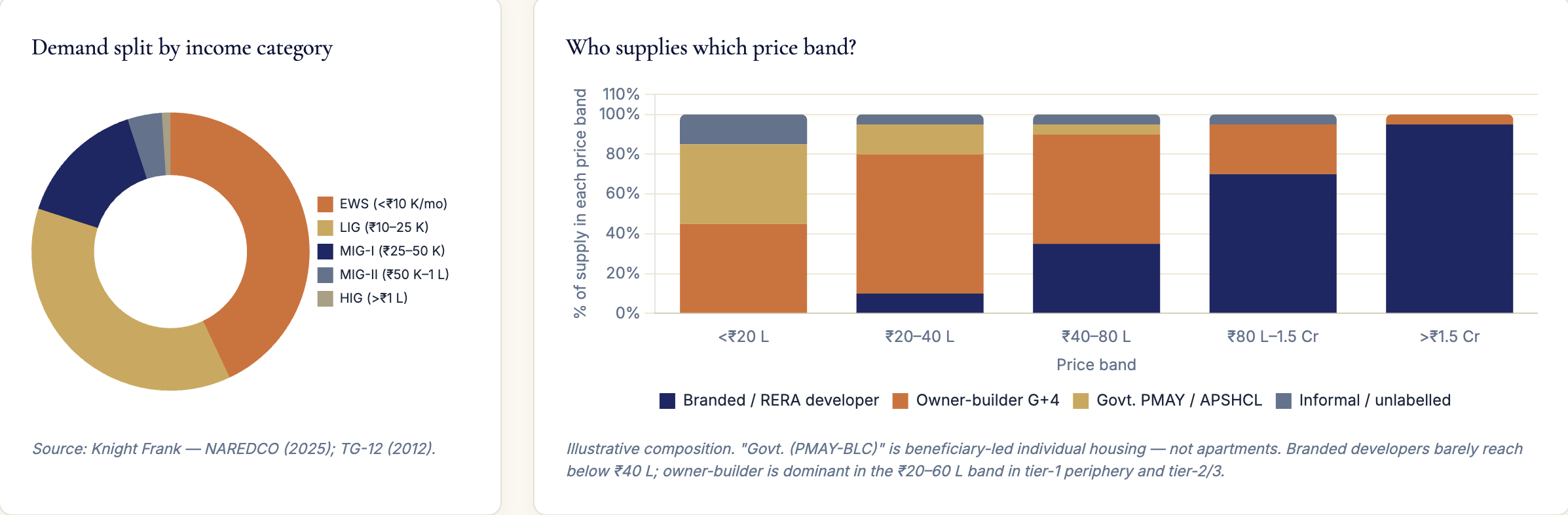
The vast majority of urban housing construction are apartment units that come not from the formal branded / organised developers in big plots with large numbers of units but from the informal small owner-builder segment in smaller plots with fewer units (typically 4-5 floors on about 500 sq yards). The vast majority of the latter belong to the affordable housing (AH) segment. However, state RERA rules, with their eligibility thresholds on the plot size and number of units, exclude the informal owner-builder segment.
One implication is that the commonly reported numbers by real estate consultants are likely vastly overstating the deficit, which nevertheless is real and big, but also not reporting the quality, standards, and buyer protection problems that impacts affordable housing supply (by the latter). A bigger problem is that these owner-builder units are ineligible for all the policy benefits that the government provides on AH – GST, PMAY, PSL, etc.
In other words, we have the perverse situation where all the policy benefits are cornered precisely by the formal / branded developers who hardly supply AH, whereas those informal owner-builders who supply almost all the AH are ineligible for these benefits.
It is a challenge to get good data to assess the extent of the problem.
The public debates on housing are anchored around the data supplied by real estate consultants. However, they are confined to the formal organized / branded developers in the top 7–8 cities, who develop RERA-registered gated-community projects with titled land and institutional finance. They contribute the vast majority of the units visible in the Credit Linked Subsidy Scheme (CLSS), 1% GST, 80-IBA, and Priority Sector Lending (PSL) developer construction finance.
In contrast, it is a challenge to get good data on the builder-owner units. Three states — Telangana, Andhra Pradesh and Delhi — have built self-certification approval systems calibrated to exactly the owner-builder G+4 band. The approval volumes in those systems are the hardest evidence we have to assess the magnitude of supply of such units. The Telangana government’s TG-bPASS database informs that for the period from November 2020 to December 2023, the average number of owner-builder permits every year in Telangana urban for sub-500 sqm plots is about 35,000.
Three independent estimations - extrapolation from the TG-bPASS, residual from housing stock accounting, and finance-implied - all point to about 0.6-1 million such units being constructed each year nation-wide.
Based on the above, the graphic below captures a snapshot of the demand-supply landscape for housing. About four-fifths of urban housing demand is EWS and LIG. The formal / branded sector targets MIG and above. The owner-builder channel is the only channel at scale that reaches the middle of the LIG band and upper EWS.
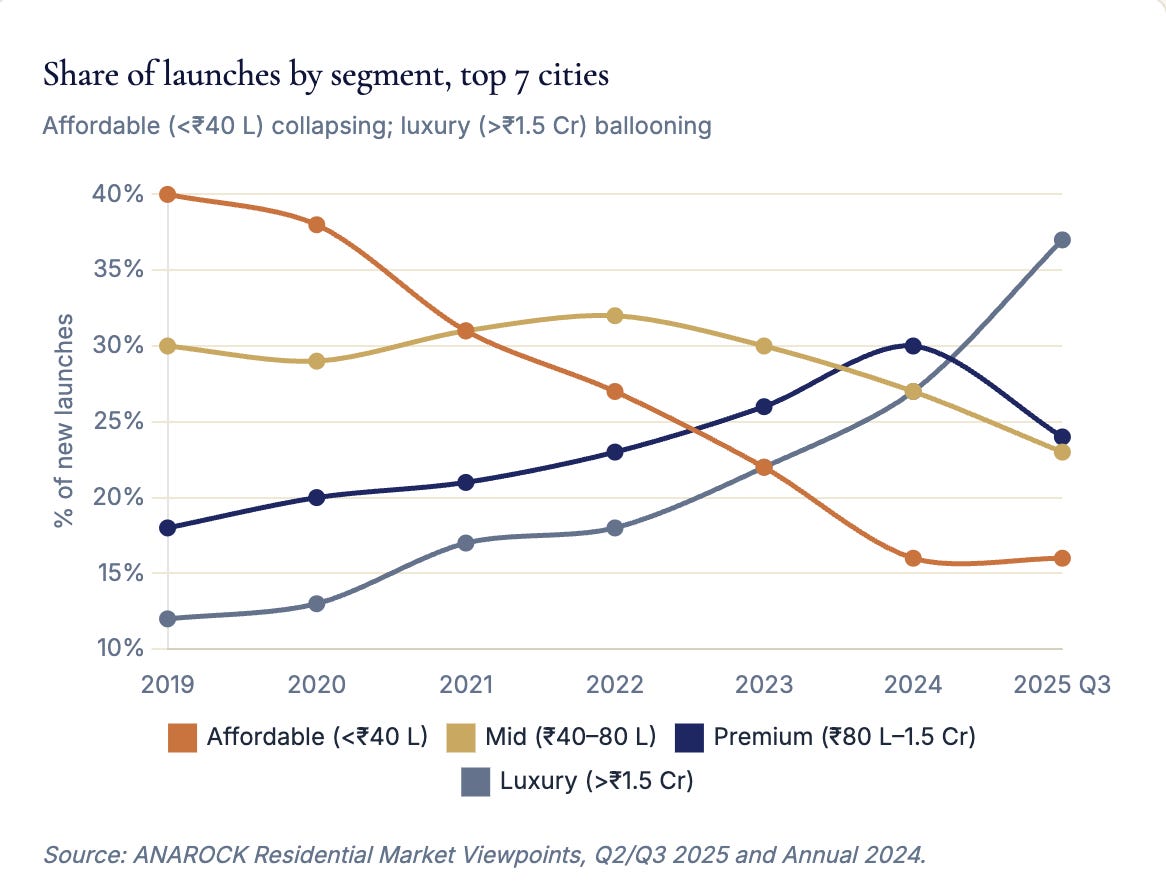
Let us first look at the AH market served by organised / branded developers, who build large numbers of units in each project in big land plots. Their share of housing launches that are AH (<₹40 L) was down from ~40% of the pipeline of the top 7 builders in 2019 to about 16% in Q3 2025. Note that the share of even mid-level housing has been declining. In stark contrast, luxury housing has been climbing steeply. Difficult to miss the K-shape. It can be safely argued that organised developers are quietly exiting the AH segment, and this is the big problem.
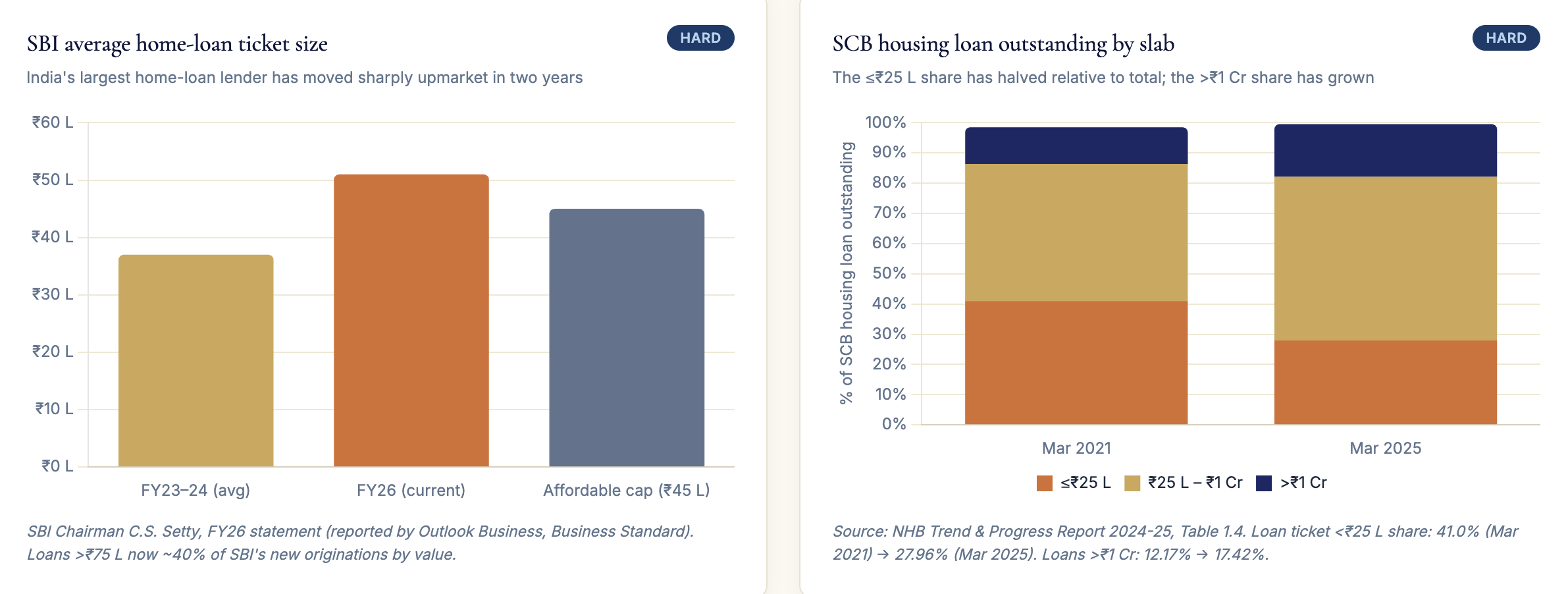
This is validated by the loans data from scheduled commercial banks, which are also drifting upmarket. Below ₹25 lakh, the SCB loan book share has fallen from 41% (Mar 2021) to 28% (Mar 2025).
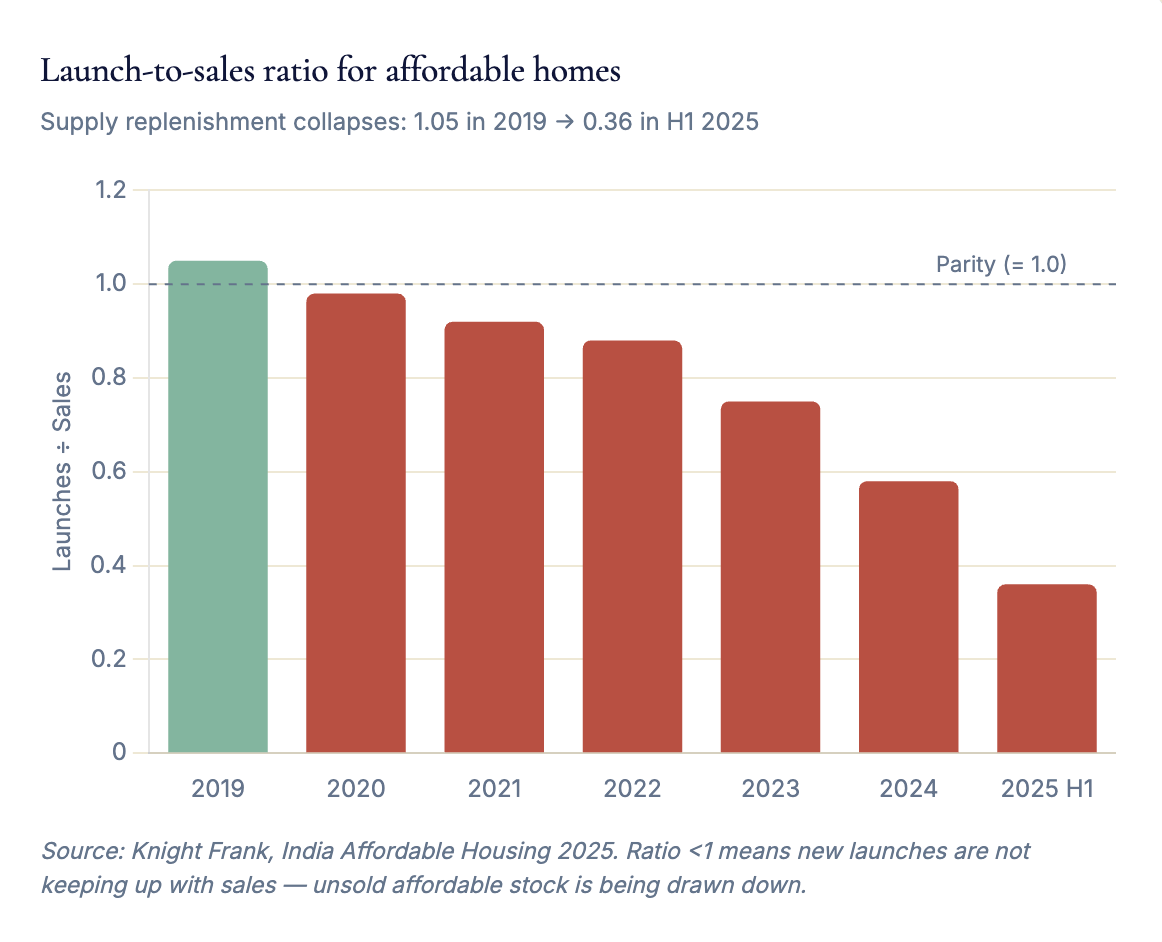
New AH launches too echo this trend. The developers have been drawing down the accumulated inventory, instead of starting new projects.
The unit economics of a owner-builder house makes them much cheaper. These are mostly individual plot-owners partnering with a small local contractor to build typically G+4 on 300–500 sq yd (~250–420 m²) in tier-1 periphery and tier-2/3 towns, with 4-8 units and statutorily exempt from registration under the Real Estate Regulatory Act (RERA). They are sold directly, often before launch, and have minimal advertising, and is transacted in a large share of cash and with personal loans.
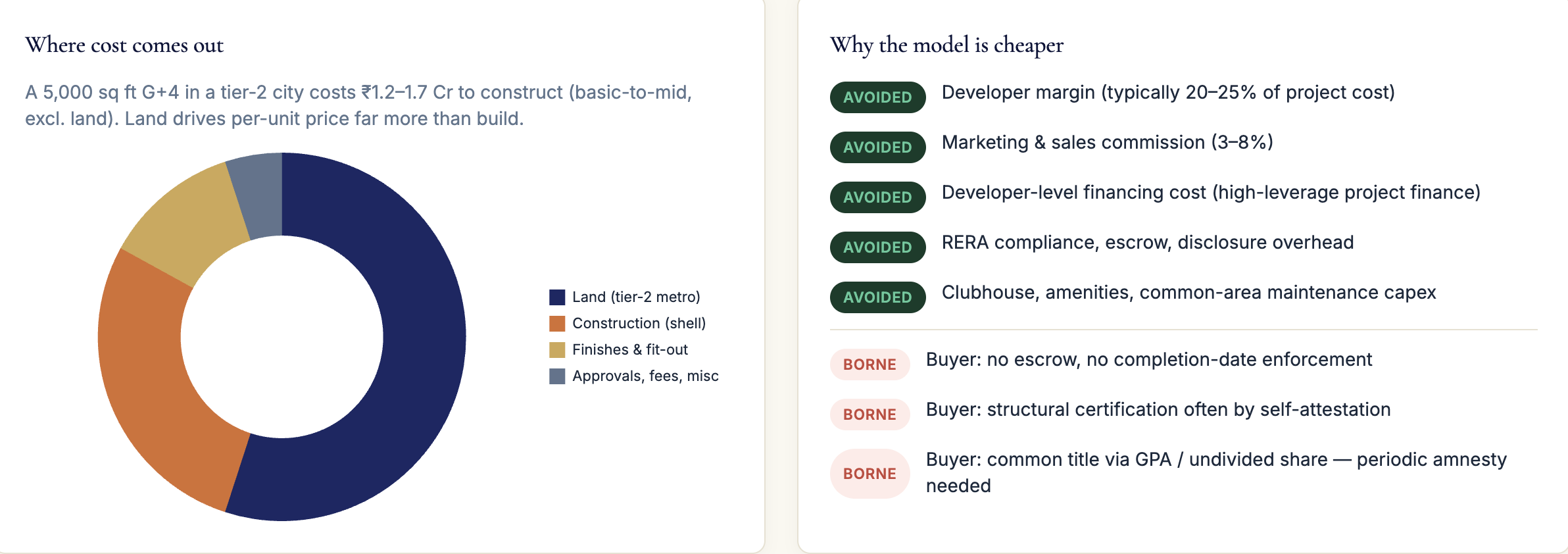
While pricing and area ranges vary by city tier, the owner-builder model is remarkably consistent, consisting mainly of 800–1,100 sq ft carpet, independent floor on a residential plot. And the favourable unit economics allows it to come at a steep discount on the branded unit of same size.
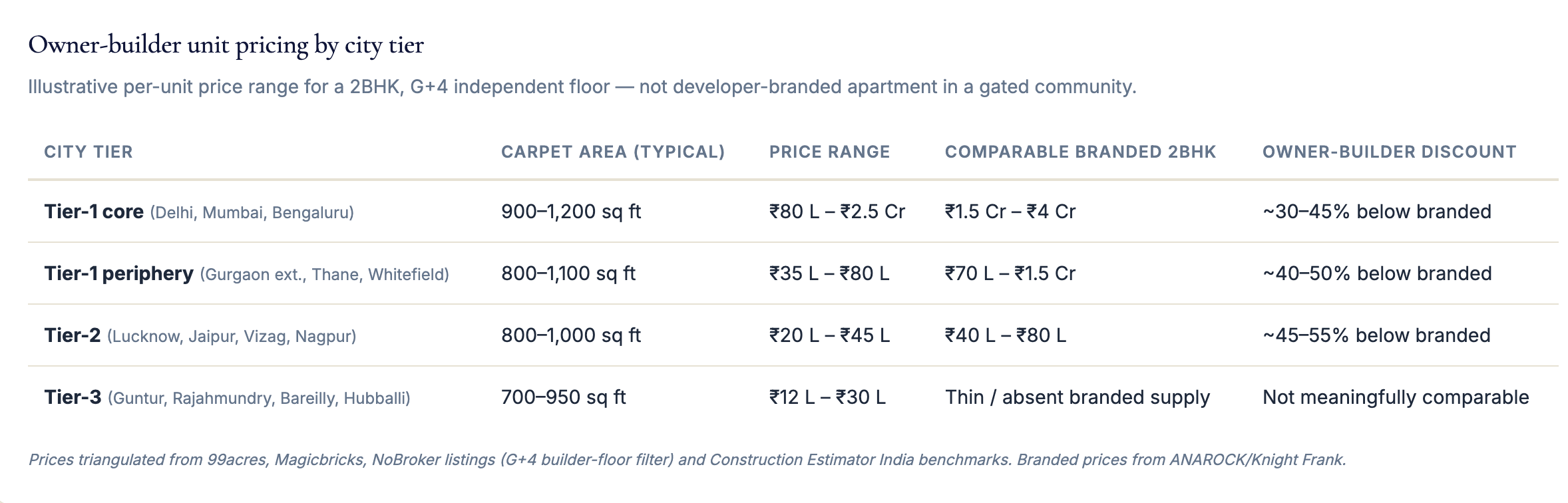
Now let’s look at the policy benefits available for AH. Interestingly, all policy benfits are gated through RERA registration.
Under Section 3(2)(a) of the RERA Act, projects on land of 500 sqm or less, or with 8 or fewer apartments, do not require registration. Most states have adopted the central threshold. The G+4 structure on 500 sqyards sits almost exactly at the exemption line.
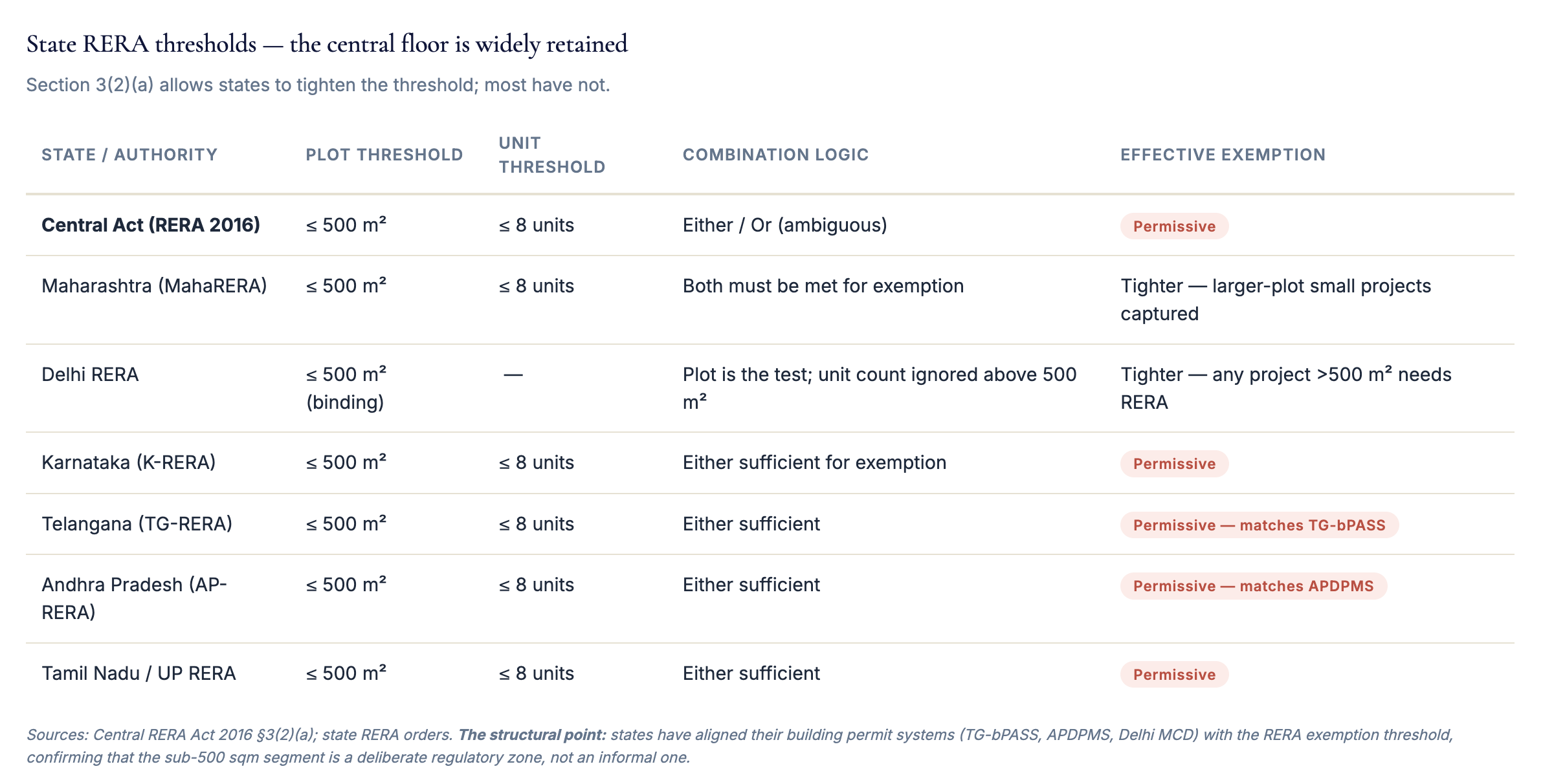
The table below summarises the housing category-wise policy support provided.
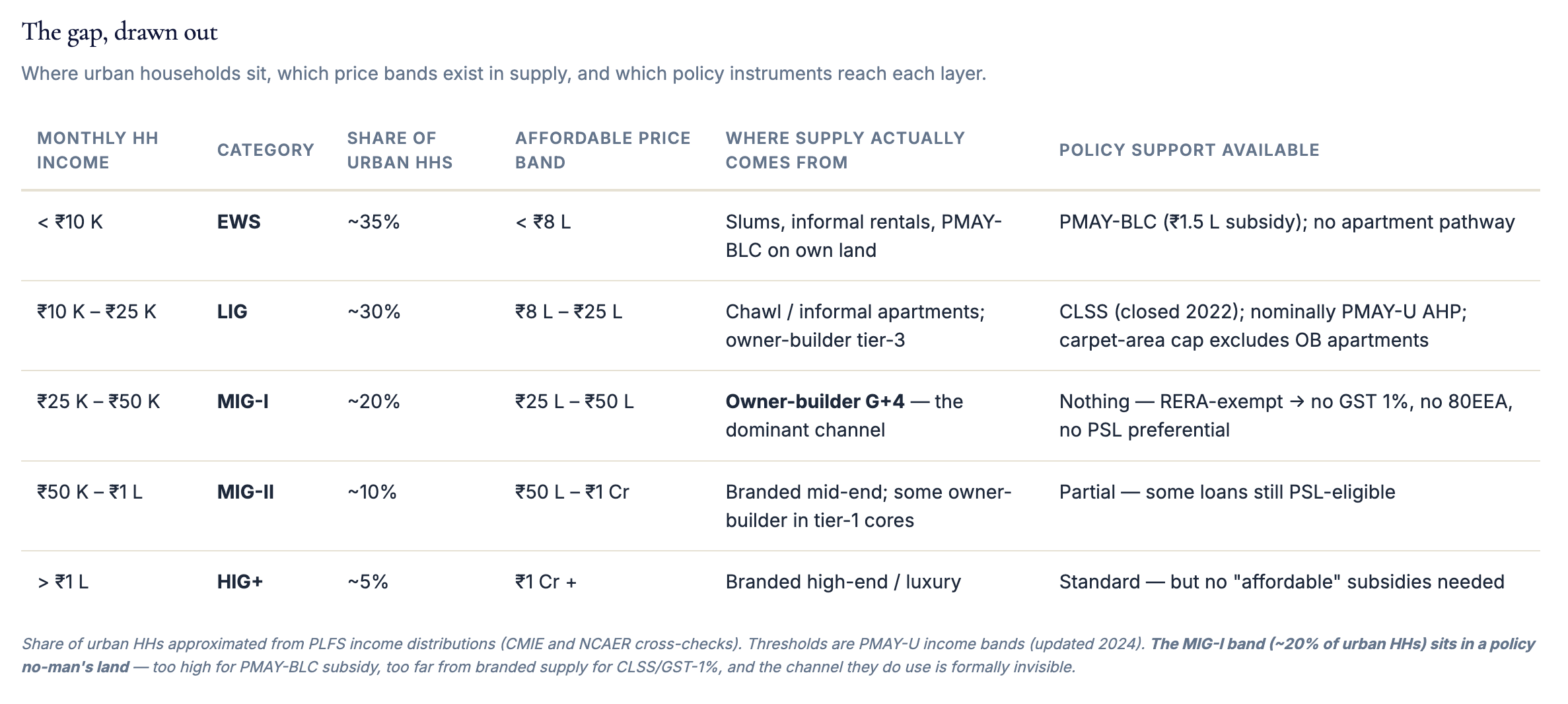
The next table points to which among the different policy support measures are accessible to owner-builder projects. As mentioned, every single policy instrument designed for affordable housing uses RERA registration (directly or via tied eligibility conditions) as the gatekeeper, which ends up statutorily excluding the owner-builder segment. This is in keeping with the broader policy focus to formalise the informal.
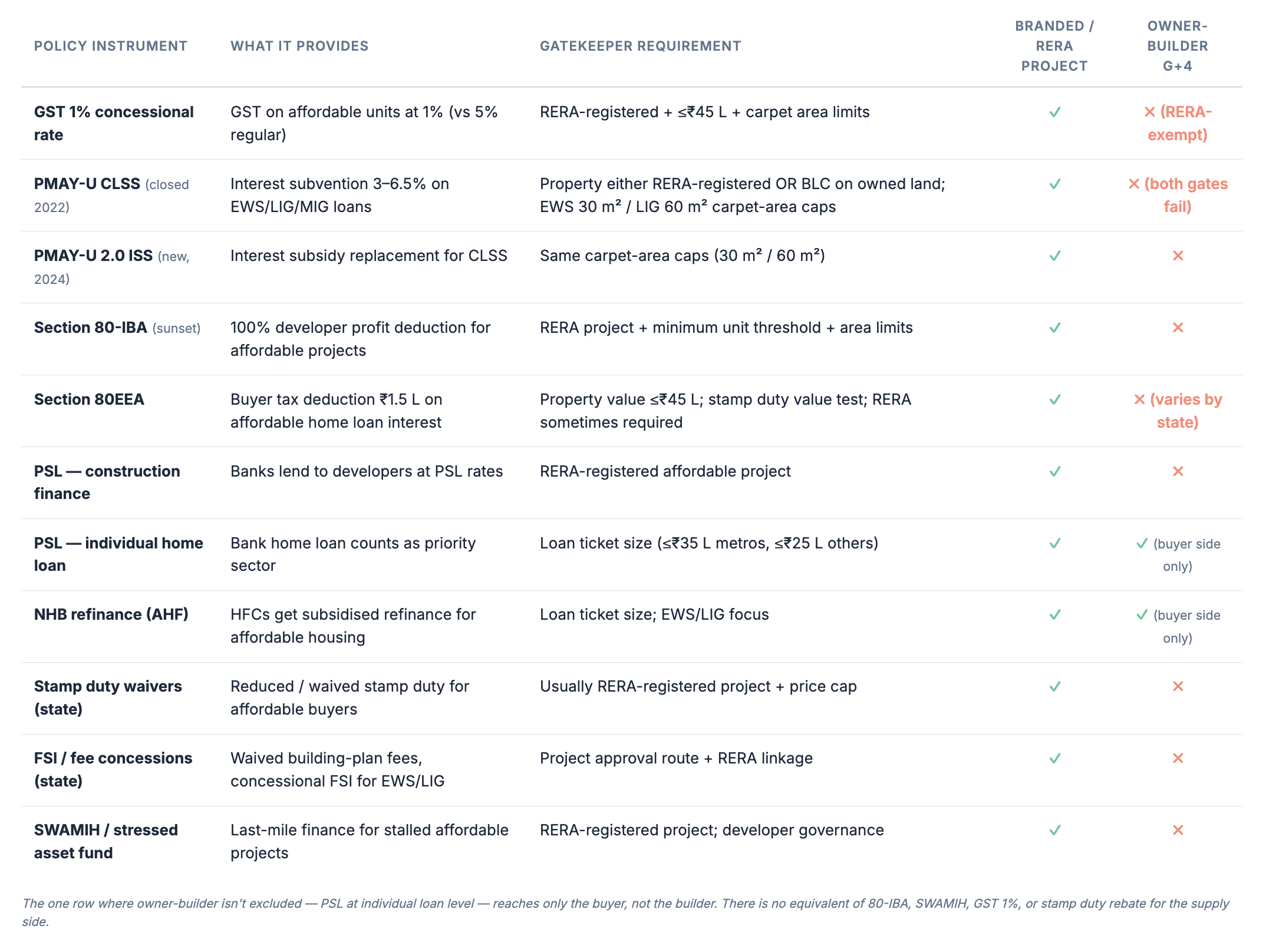
All this produces a perverse outcome. The branded / organised developer segment, which produces at most ~70,000 affordable units a year in the top 7 cities, captures the full stack of fiscal and regulatory benefits designed for "affordable housing", whereas the owner-builder segment, which likely produces 8–14× that volume of genuinely affordable apartments, captures effectively none of them! The graphic below tells a tale.
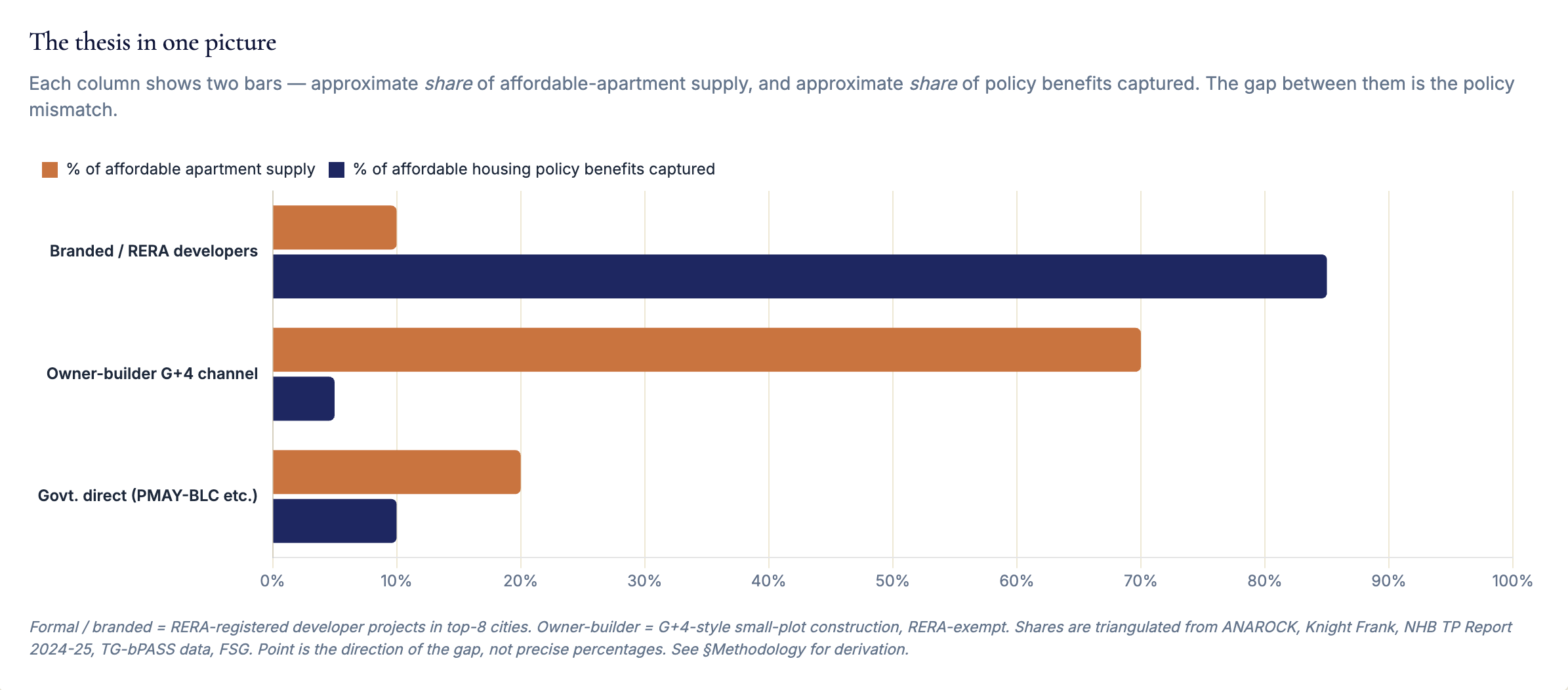
Putting everything together, it becomes clear that while the owner-builder G+4-on-500-sq-yard model probably supplies the majority of India’s urban affordable apartments, it sits outside RERA by statutory design, and therefore outside almost every fiscal and policy benefit the state offers for AH. Instead, all the benefits accrue to the formal / branded sector, which barely builds any affordable at all. Classic mis-targeting of scarce public policy resources.
The big takeaway is that India has a serious affordable-housing policy problem, and less an affordable-housing supply problem. The channel that supplies most of the affordable apartment stock is not the one the policy architecture is currently designed to reach.
So what on the way forward? Four responses come to mind.
On the measurement side, since the published AH supply numbers systematically overstate the shortage by excluding the owner-builder channel, it may be useful to build a supply tracker that captures RERA-exempt stock using municipal building-permit data (TG-bPASS, APDPMS, Delhi MCD, etc.), AHFC self-construction disbursals, and listing-site scraping. The state-level building permit systems should be standardised along the TG-bPASS model.
On the regulatory side, instead of lowering RERA thresholds wholesale, thereby raising costs, it may be prudent to have a lighter-touch “RERA-lite” tier for sub-500 sqm / sub-8-unit projects, with structural safety certification, simple possession-timeline disclosures, and a public register.
On the fiscal side, AH fiscal benefits (GST 1%, 80EEA, stamp duty waivers) should be decoupled from from RERA registration, and eligibility should instead be based on unit characteristics (carpet area and price, differentiated across tier cities). It may also be appropriate to create a specific PSL category for owner-builder project finance (small plot, G+4), channeled through Affordable Housing Finance Companies (AHFCs) and Small Finance Banks (SFBs) with structural certification as the gate.
Finally, on the policy architecture, it may be useful to shift the policy frame from the excessive push to formalise the informal. I have blogged here and here about how forced formalisation adds layers of costs and can end up creating more perversions than good.
AH is a teachable example of how a well-intentioned formalise the informal policy focus has ended up creating distortions without serving the purpose. Instead, here the policy focus should be to serve the channel that actually serves the demand, the owner-builder model.
No comments:
Post a Comment