I have blogged here making the case for doing Transit-Oriented Development (TOD) around mass transit stations in India, here about the challenges with TOD implementation, and here about the low traffic realisation problems facing metro railway systems in India and the ₹1.07 lakh crore (undiscounted) fiscal burden.
This post will argue that TOD is the critical requirement for the commercial viability of India’s regional and metro railway systems. TOD is a combination of densified, mixed-use development (supply-side), and walkable streets andintegrated feeder services (demand-side) around mass transit stations.
In other words, regional and metro railway systems in India can become commercially viable only if they can induce ridership, and this shift would require adoption of TOD at both ends of the commute.
But India’s regional and metro railway systems are encumbered by structural problems compounded by bad design.
For a start, unlike the successful global mass transit systems which precede real estate development and emerge from an integrated land use and transit plan, Indian railway systems follow it. They try to retrofit into the built-up city and suburbs. Second, as I wrote here, Indian regional and metro rail systems unfairly put the burden of capex on the operating entities without endowing them with the real estate that can be monetised to finance capex. Third, the railway construction entity does not control land use decisions, and those making them do not bear the consequences if their decisions erode the financial viability of the mass transit systems. Finally, making matters worse, they are primarily railway construction corporations, for whom urban planning integration and real estate development are afterthoughts. This is unlike in Japanand other East Asian cities where the metro operators are primarily real estate developers who also build and operate railway networks.
Given the circumstances of India’s mass transit journey, the best that can now be done is to create conditions to induce ridership and improve commercial viability of metro and regional railway systems. And, as aforesaid, TOD is central to this objective.
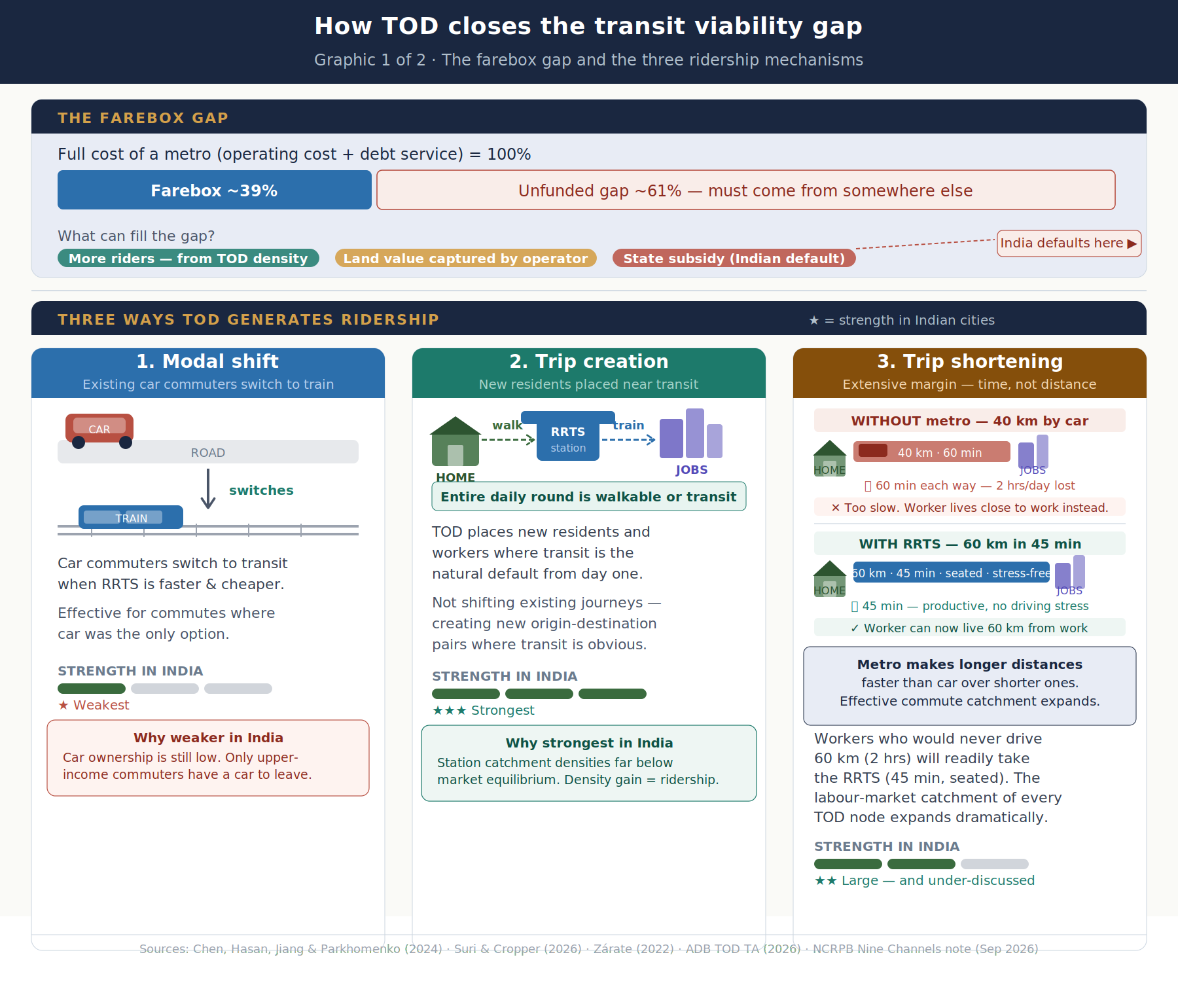
The first order requirement is to induce ridership. This can come from two directions. At the intensive margin, ridership can be induced by shifting existing car users to mass transit. At the extensive margin, it would involve locating commuters within walkable distance of the station and expanding geographical access through feeder services, and shortening the transit trip.
The intensive margin relies on modal shift among people whose destination and origin are fixed, whereas the extensive margin creates new origin-destination pairs of which mass transit is the obvious mode from the outset. An important, but less discussed, mechanism of the extensive margin is that of trip shortening. The regional or metro rail shortens the commute time to distant places (besides also eliminating the hassle of car-based trips) and brings workplaces closer (in time) to homes and thereby expands its potential users. This trip-shortening effect is typically larger than the modal-shift effect, and second only to ridership induced by locating people inside the TOD zone.
However, while convenience (of avoiding road traffic and walkability at both ends) can induce some mode shifts, getting people who would otherwise not prefer living near a station at all to relocate entails going beyond convenience and also making the place itself liveable and financially attractive. Further, the inducement is significantly likely only if there is a workplace within walkable distance at the other end of the commute.
In the case of metros, it is about densified developments (at both home and work sides) around stations with walkable streets, supplemented with feeder services. In the case of regional railway systems, this is the classic downtown-satellite town mode of development. However, in India, since the satellite towns are already well-developed towns and cities, the station vicinity requirements are similar to the metros.
The walkability part is critical, and one completely overlooked. Densification alone without the ease of walkability at both ends will not induce ridership. Walkability and street connectivity are central to expanding the pool of users. If a commuter who lives 800 metres from a regional railway station still needs to find an auto or shared vehicle because the intervening streets are not well connected, unwalkable, and unsafe, the catchment effective radius collapses to perhaps 200 metres, and the ridership projection drops accordingly.
The demand side (walkability) and the supply side (density) are complements, not substitutes. Building one without the other produces either pleasant low-rise neighbourhoods that don’t fill the trains, or towers in traffic that people can’t walk through. Further, the walkability (and associated liveability), in addition to the mass transit commute convenience, are perhaps critical for also incentivising people to trade-off living in a cheaper and larger housing unit distant from the zone with a pricier and smaller one inside the TOD zone.
Finally, the mixed-use part is also important. For one, it should provide market participants the flexibility to determine the demand responsive and commercially viable nature of development around the nodes. Further, a node that densifies the area around a station but retains single-use zoning (apartments that connect to the city’s existing car-commute grid) will produce less additional ridership than a node that places offices, retail, and housing within walking distance of each other and of the station. The ridership gain from the second type of node comes not only from the peak commute trip but from the off-peak trips that only a genuinely mixed-use, walkable neighbourhood generates. The former will end up creating a mass transit system that is used only in the 3-4 hours of peak commute times. Mixed-use is therefore critical to generating two-way, all-day ridership.
In other words, ridership of a transit system is determined predominantly by the land use in its catchment — how many people live, work, shop, and study within a walkable distance of its stations, and whether those people can get to and from the station without a car. Building the station but leaving the land use unchanged will not change much. It will produce the infrastructure, but underproduce the demand. This has been India’s metro reality.
All this means that densified, mixed-use, walkable zones around the station, with convenient feeder services, or TOD, is an essential requirement to achieve significant inducement of ridership.
The case for TOD is likely more relevant and its impacts greater for Indian cities than counterparts in developed countries. For one, the spatial mismatch between job availability (in the city centres) and affordable housing (in the periphery) is very large. A system that closes this gap generates much greater welfare gain, and therefore much greater demand, than the same system operating in a less mismatched city.
Further, given India’s low car ownership base, the marginal ridership gain from TOD does not come mainly from convincing existing car users to take the train, but from improving trip quality for those already transit-dependent, and from expanding the pool of riders. Finally, India has a low-hanging fruit to harvest in terms of its low FAR baseline, which allows for significant densification and location of potential transit riders. Relaxing FAR therefore would have an unusually high ridership yield per unit of policy change in Indian cities.
The summary from the Indian context is that the inducement from modal shift is likely marginal, and confined to only those whose commute is already partly walkable and partly by car, or whose car commutes are very long. The larger and more structurally significant opportunity is at the extensive margin from locating new workers and from bringing the workplace closer to homes. TOD is therefore the primary demand generation mechanism for a rail transit system.
Unfortunately, India’s TOD policies have consistently focused on the supply side (FAR uplift), and that too inadequately, while under-specifying the demand side (street design, parking, block structure). Getting both right is the institutional challenge. It is also something that the argument for TOD-for-viability of metros implicitly assumes but rarely makes explicit.
No comments:
Post a Comment