Does India have a problem of risk capital deficiency? More specifically, is there a disproportionately greater bias towards public markets among India’s savers, especially among high-net-worth individuals (HNIs)?
I blogged here, arguing that India suffers from a deficiency of risk capital to finance the formation and growth of small and medium enterprises (SMEs). After that, I received some pushback, pointing to the spate of SME IPOs in recent times.
I had been thinking of digging up the numbers and seeing how they stack up. In this context, I came across this review of a book by Ameer Shahul that argues that private equity is damaging India’s health care. While I’m sympathetic to this argument, the point that is relevant to this post is the dominance of foreign investors in these PE deals. I had blogged hereabout PE in India’s hospitals.
I used Claude to look deeper into India’s numbers on risk capital, how they compare with global peers, and what their trends have been.
The headline story is that India does not lack risk capital, but it channels it into liquid public markets, leaving the control of market segments like essential-service assets, and the value created in the private phase, largely to foreign capital.
The decomposition goes something like this. The Gross Domestic Savings (GDS), contributed by households, the private sector, and governments, gets distributed between physical (primarily land and gold) and financial (deposits, risk capital, and pension/insurance). Risk capital, in turn, gets further distributed between public (stocks and mutual funds) and private (alternative investments) markets. Business formation requires a deep pool of the risk capital flowing into private markets.
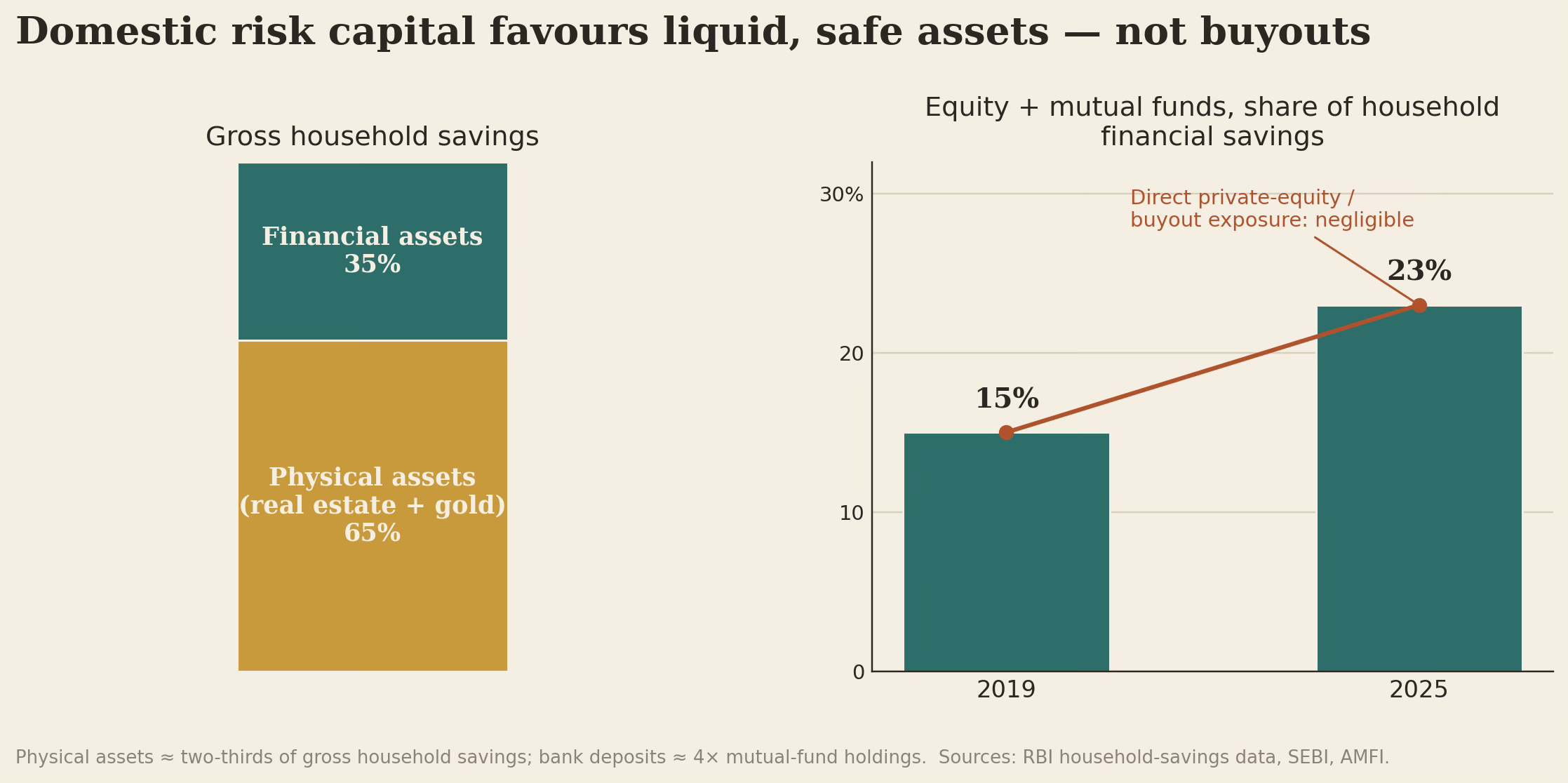
So, let’s start with the GDS. Clearly, India is second only to China in domestic savings as a share of GDP, though given its fast growth ambitions, it must increase this share. The problem is that over 40% of household savings are invested in illiquid assets.
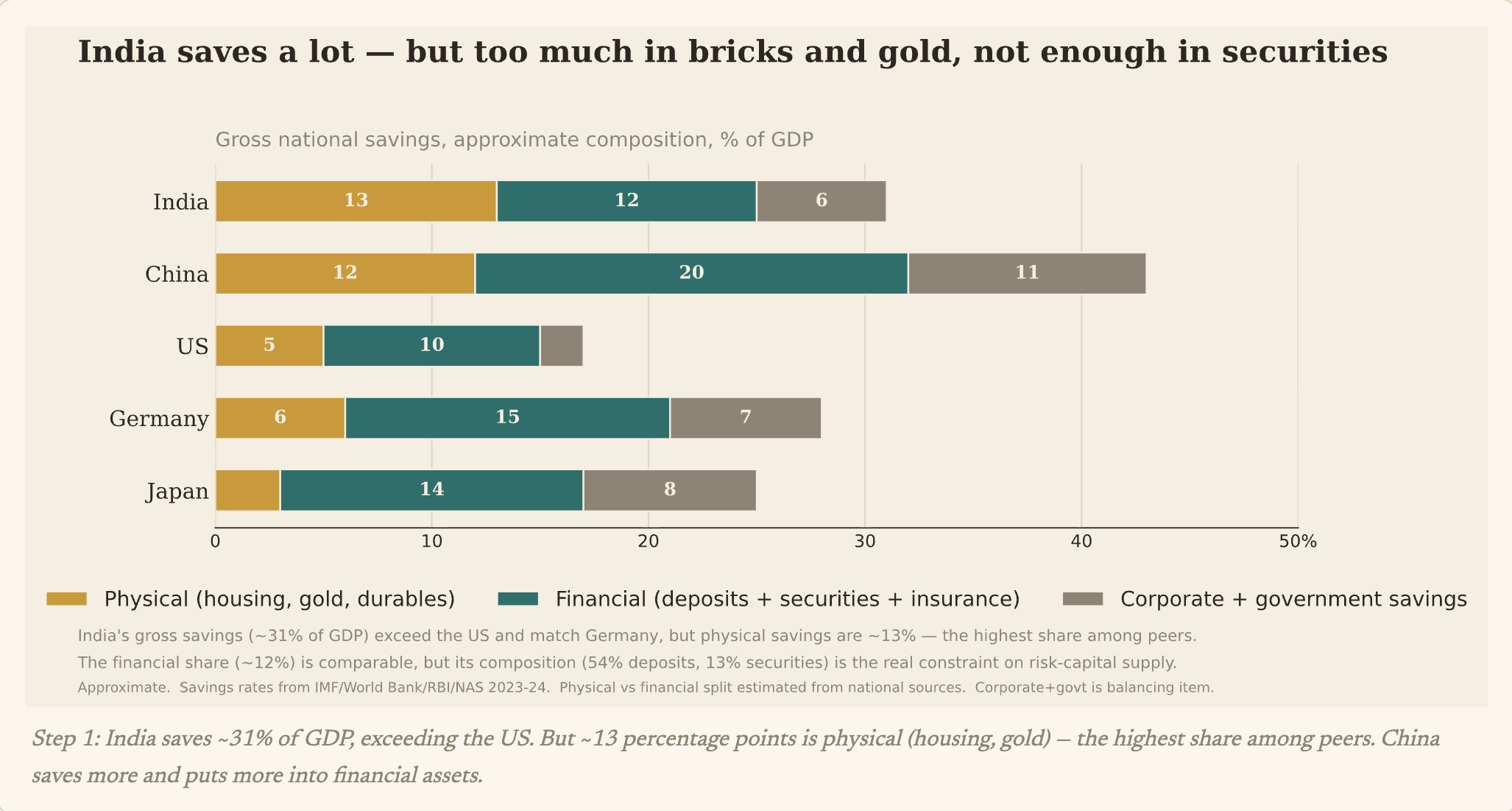
More disturbingly, 54% of the financial savings go into deposits, and just 13% goes into any kind of risk capital investments. On the positive side, 33% goes into long-term investments like insurance and pensions.
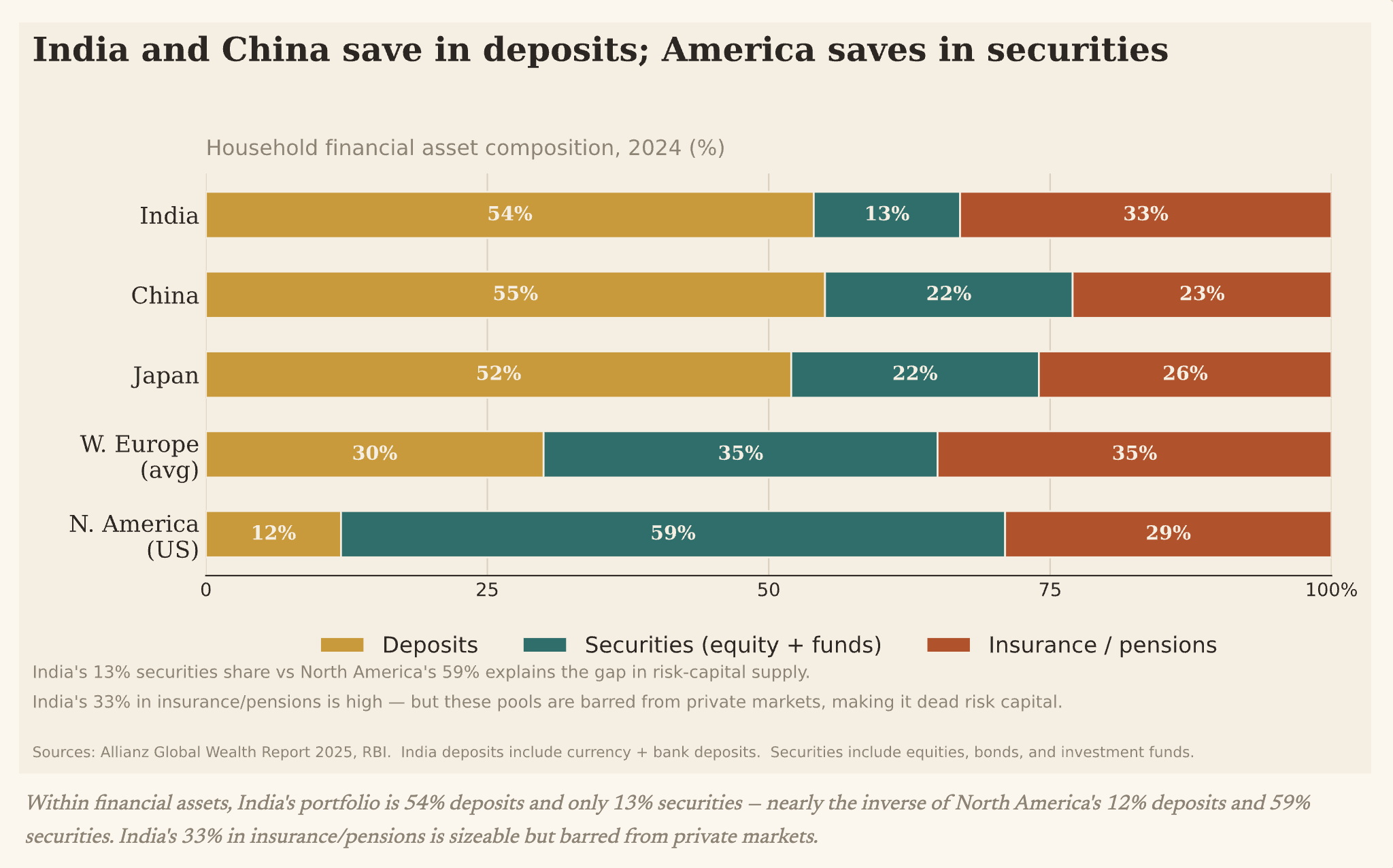
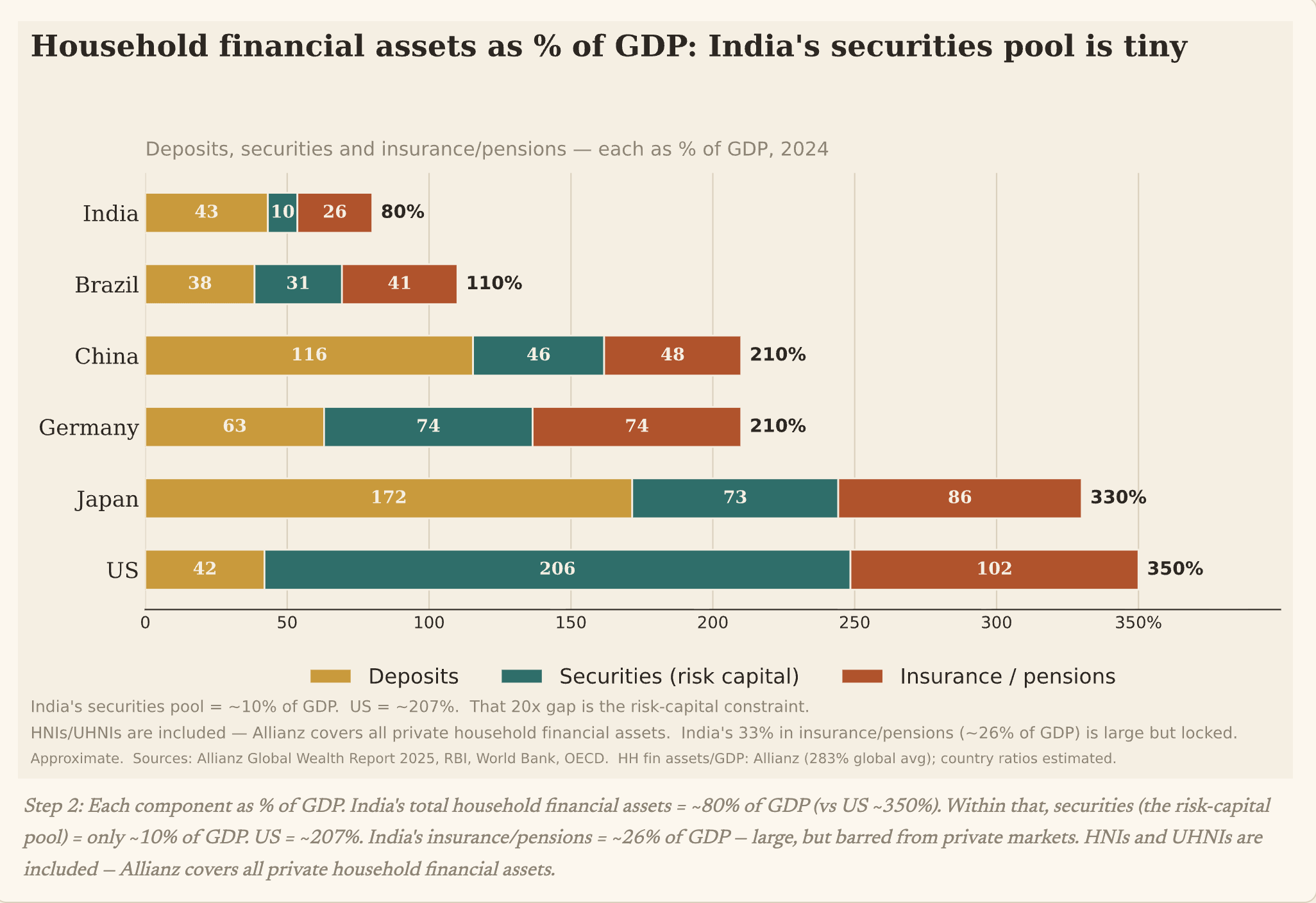
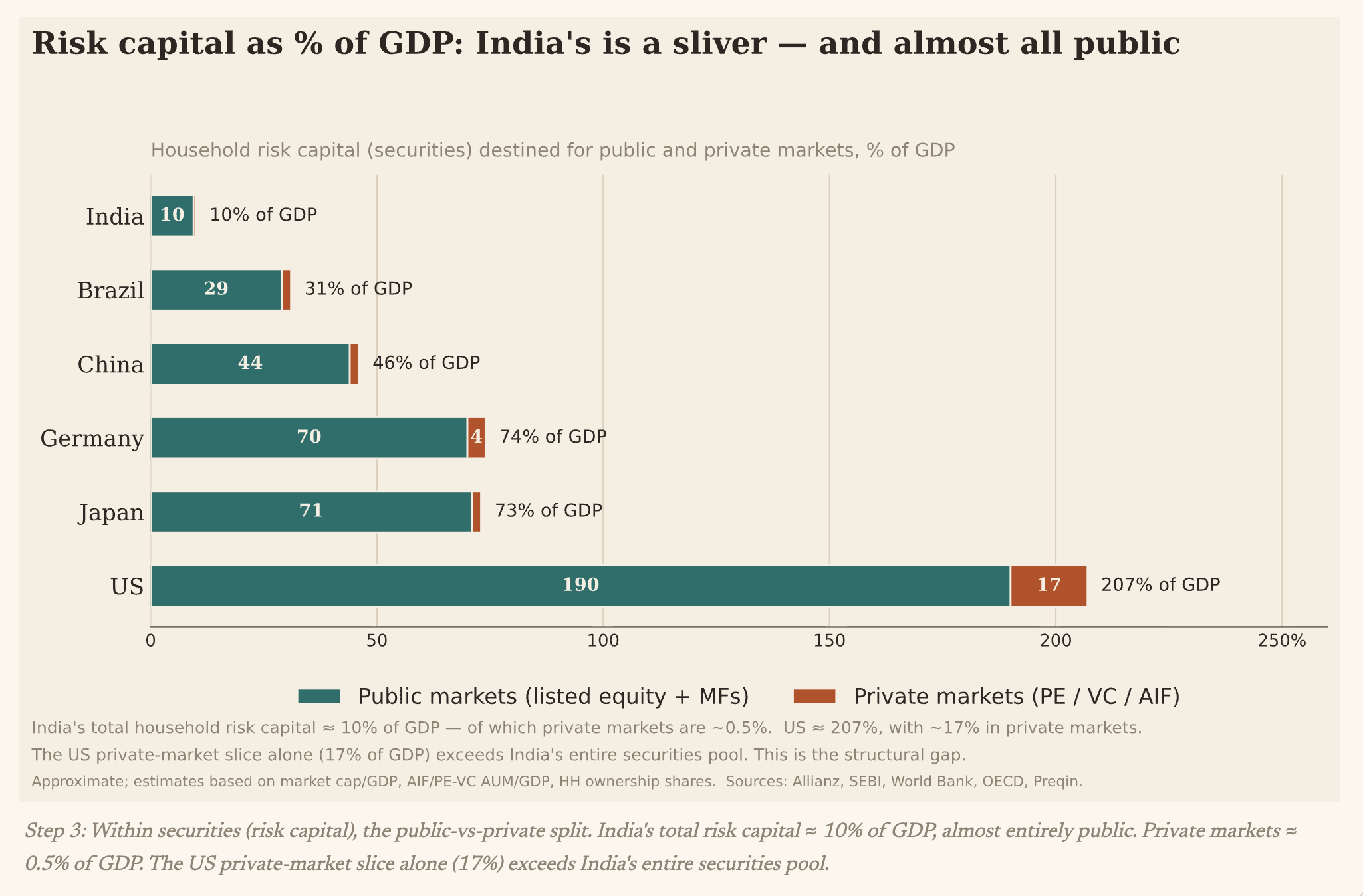
However, as a percentage of GDP, these numbers on financial savings pale in comparison to even its emerging market peers. Risk capital assets (public and private markets) make up just 10% of GDP.
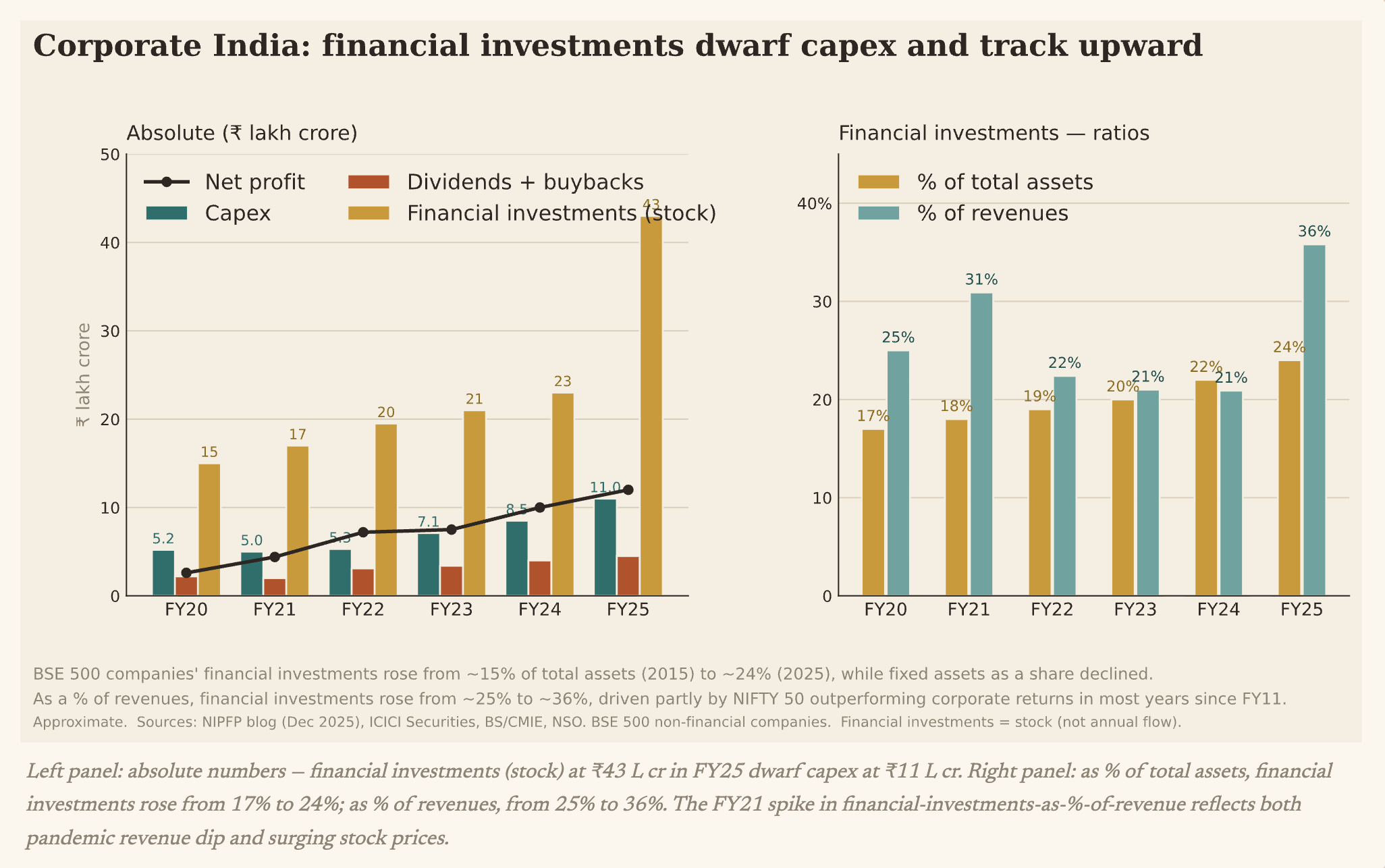
Interestingly, among corporates, financial investments and dividends and buybacks have been rising at the expense of capex, in both absolute and relative terms.
Back to household savings. Within the basket going into securities, as the CRISIL/IVCA/360 ONE Unlocking Domestic Capital report informs, what goes into private markets, the genuine risk capital, is a tiny sliver. And this is a big problem. The envelope of capital available for business formation is truly small.
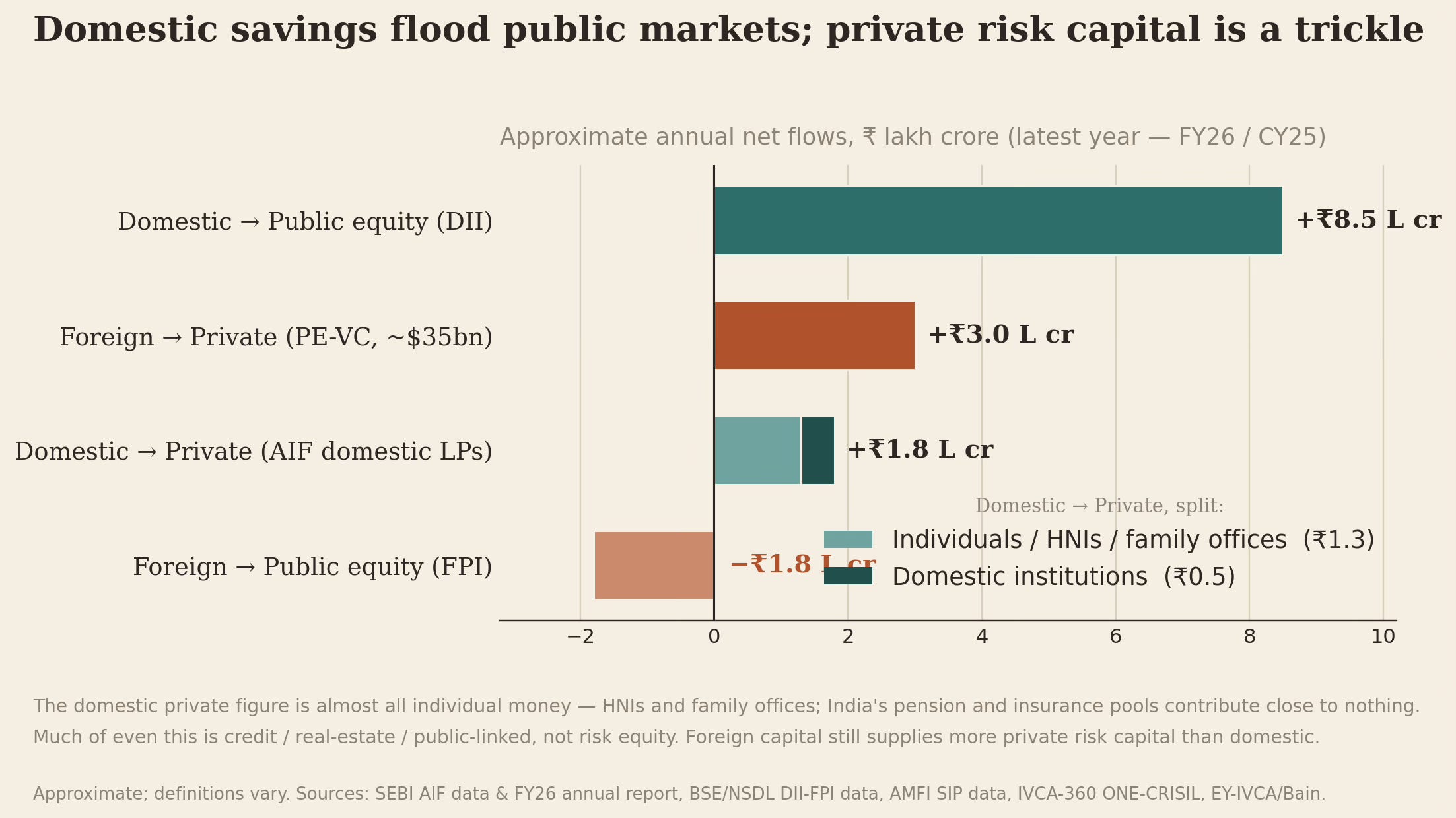
Let us disaggregate the risk capital basket further. Whereas roughly ₹1.5–2.0 lakh crore a year flows to private markets through domestic LPs in AIFs, much of that is private credit, real estate, and Category-III (hedge funds, private-public hybrids) rather than genuine growth equity. So domestic public-equity inflows run at four to five times domestic private risk capital, and foreign investors still supply much more private risk capital (₹3.0 lakh crore) than Indians do.
All this means that we have a very interesting situation where, while foreigners are net sellers of listed equity, they remain the dominant suppliers of private capital. In stark contrast, domestic money flows the other way.
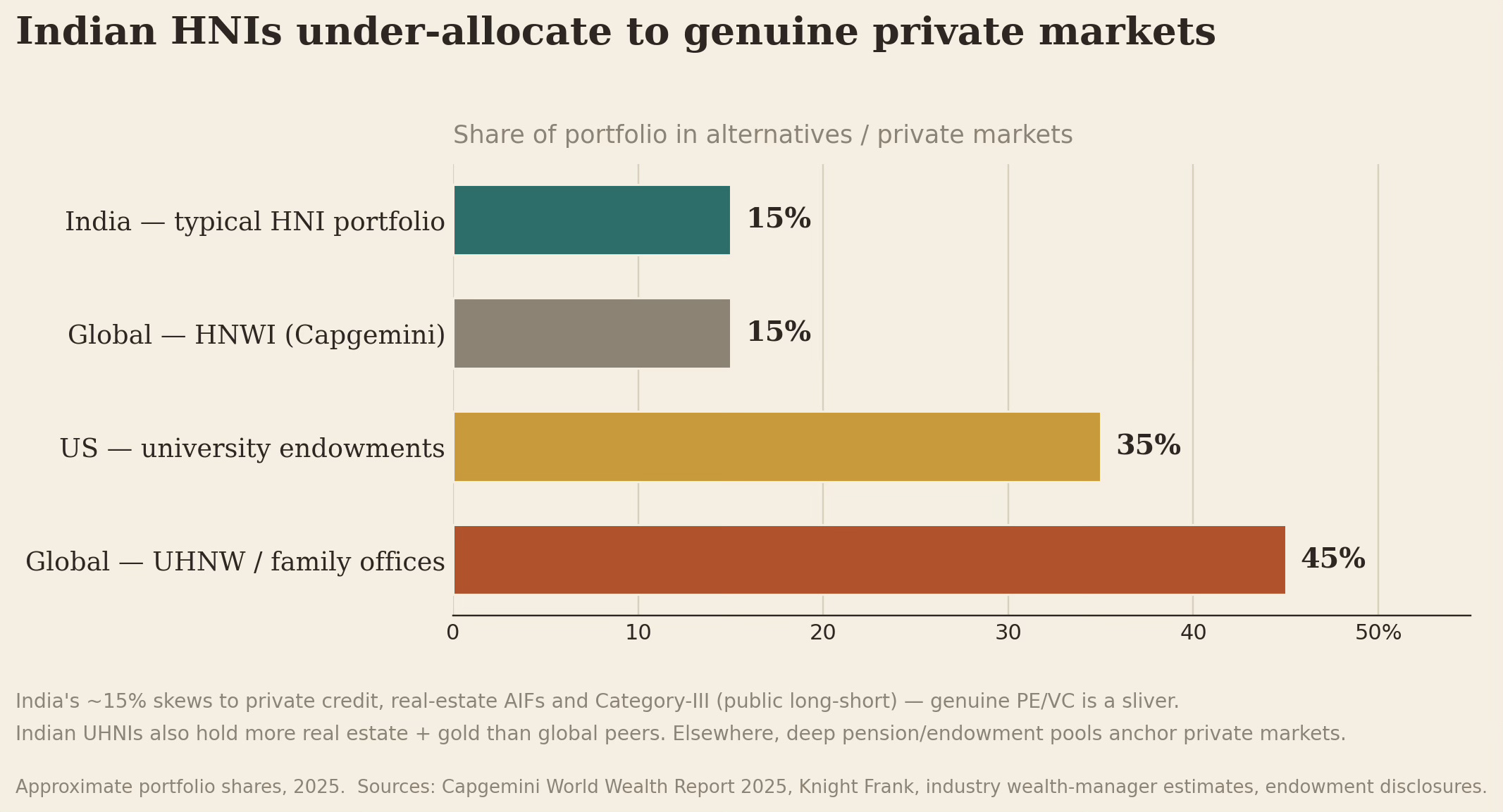
Indian HNIs park around 15% of portfolios in alternatives, the same as global HNIs. The gap opens for the segment that actually anchors private markets, the ultra-UHNW investors and family offices who allocate 40–50% to alternatives, with private equity typically the single largest bucket. In contrast, Indian UHNIs hold more real estate and gold than global peers and route their alternatives into yield and public-linked structures. In other words, Indian private wealth under-supplies illiquid equity risk, not alternatives in general.
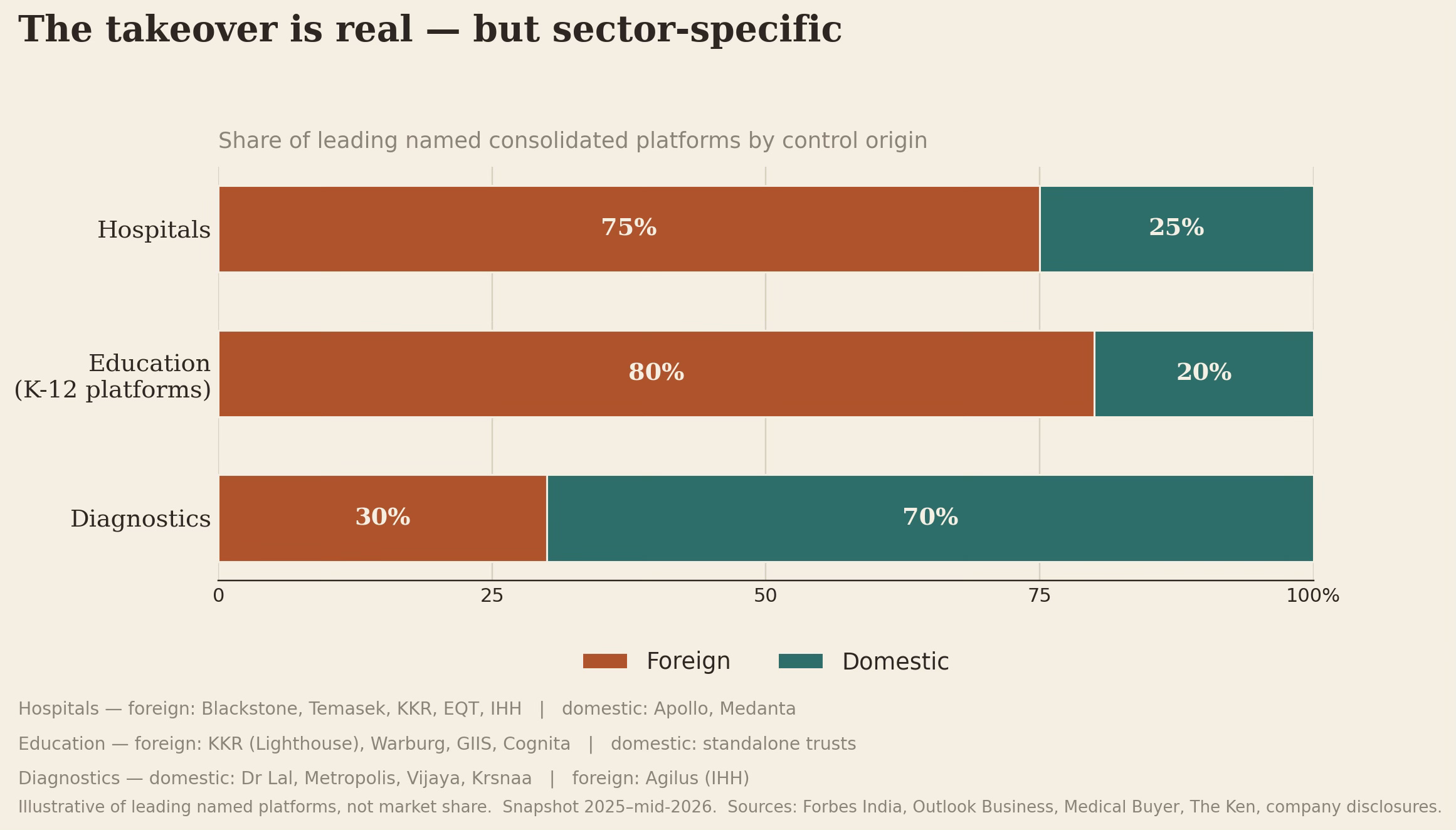
This scarcity of private risk capital makes India, with its very large foreign investor base, very attractive for foreign Global PE and sovereign funds put roughly $15.5bn into Indian healthcare over the past five years, with hospitals taking about 68% of it. For example, Blackstone holds around 80% of KIMS Kerala and 73% of Care Hospitals, and Temasek holds about 59% of Manipal. The domestic exceptions are the listed, promoter-anchored chains like Apollo and Medanta/Global Health. Much of the foreign PE inflows are actually SWF/pension capital. In education, it is the K-12 market that is attracting the attention of foreign PEs.
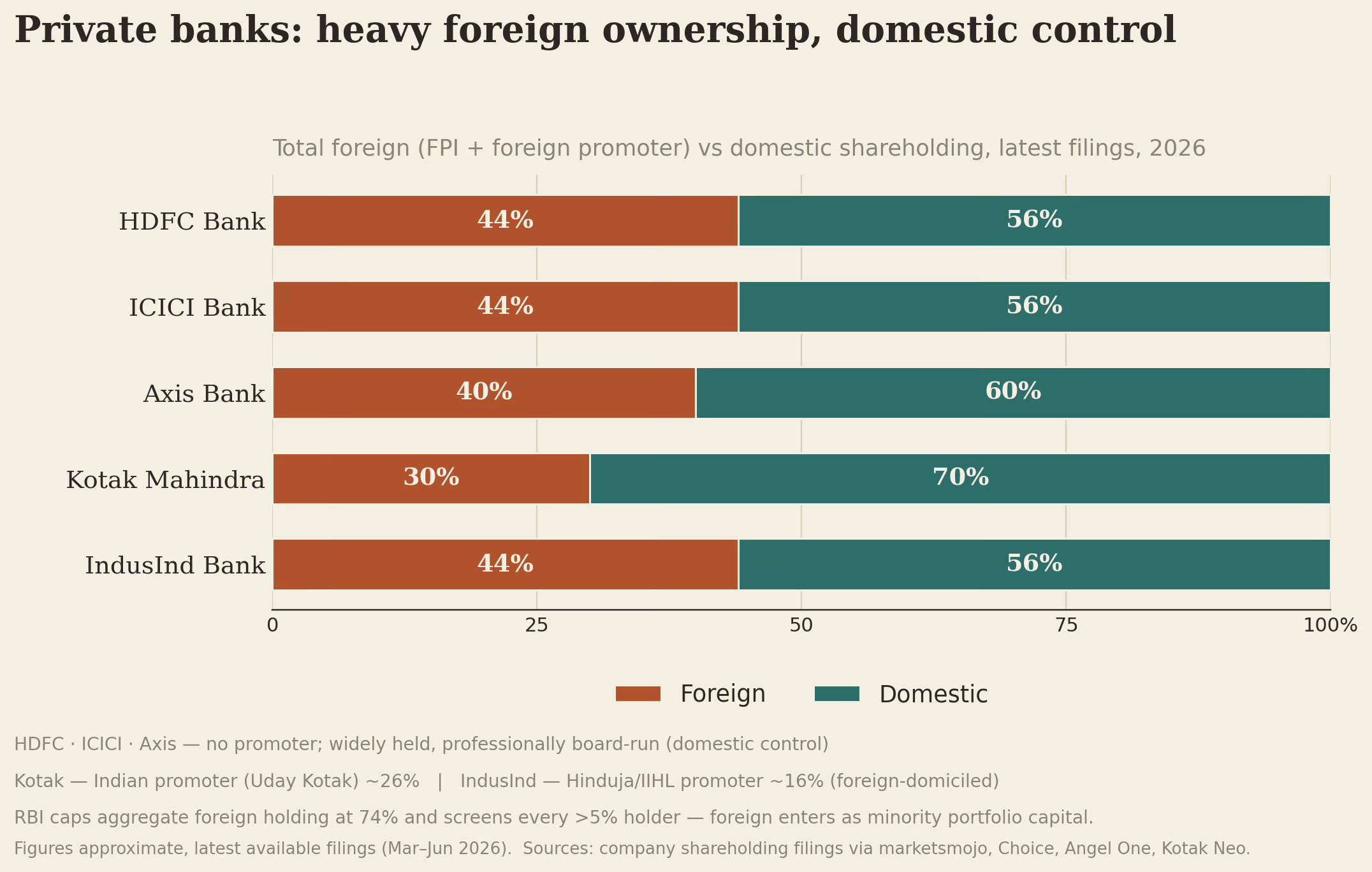
Banking is a counter-example where heavy foreign capital and domestic control coexist perfectly well. This is also because a sectoral regulator caps ownership, screens holders, and enforces diffusion.
India’s risk capital challenge starts with unlocking the roughly two-thirds of household savings that sit in real estate and gold, and further increasing the share that goes into risky capital investments, specifically private risk capital markets.
So how have been the trends over time?
Encouragingly, the share of household financial savings going into public equity and mutual funds has grown from 15% to 23% over the 2019-25 period. Thanks to mutual funds and SIPs, the number of individuals investing in capital markets has risen nearly fivefold since 2020 to around 135 million. This has been a truly transformational change, a genuine big-bang success.
For context, domestic institutions poured a record ₹8.5 lakh crore into equities in FY26, of which mutual funds supplied ₹6.4 lakh crore, while foreign portfolio investors were net sellers of ₹1.8 lakh crore. That domestic flow is driven by SIPs, which came at around ₹28,464 crore a month (or about ₹3.4 lakh crore a year) across 9.7 crore accounts. Further, in a reflection of the trend of exodus of foreign capital from the equity market, the domestic institutional ownership of NSE-listed stocks crossed foreign ownership in 2025 (roughly 17–19% versus FPIs’ 17–18%) for the first time.
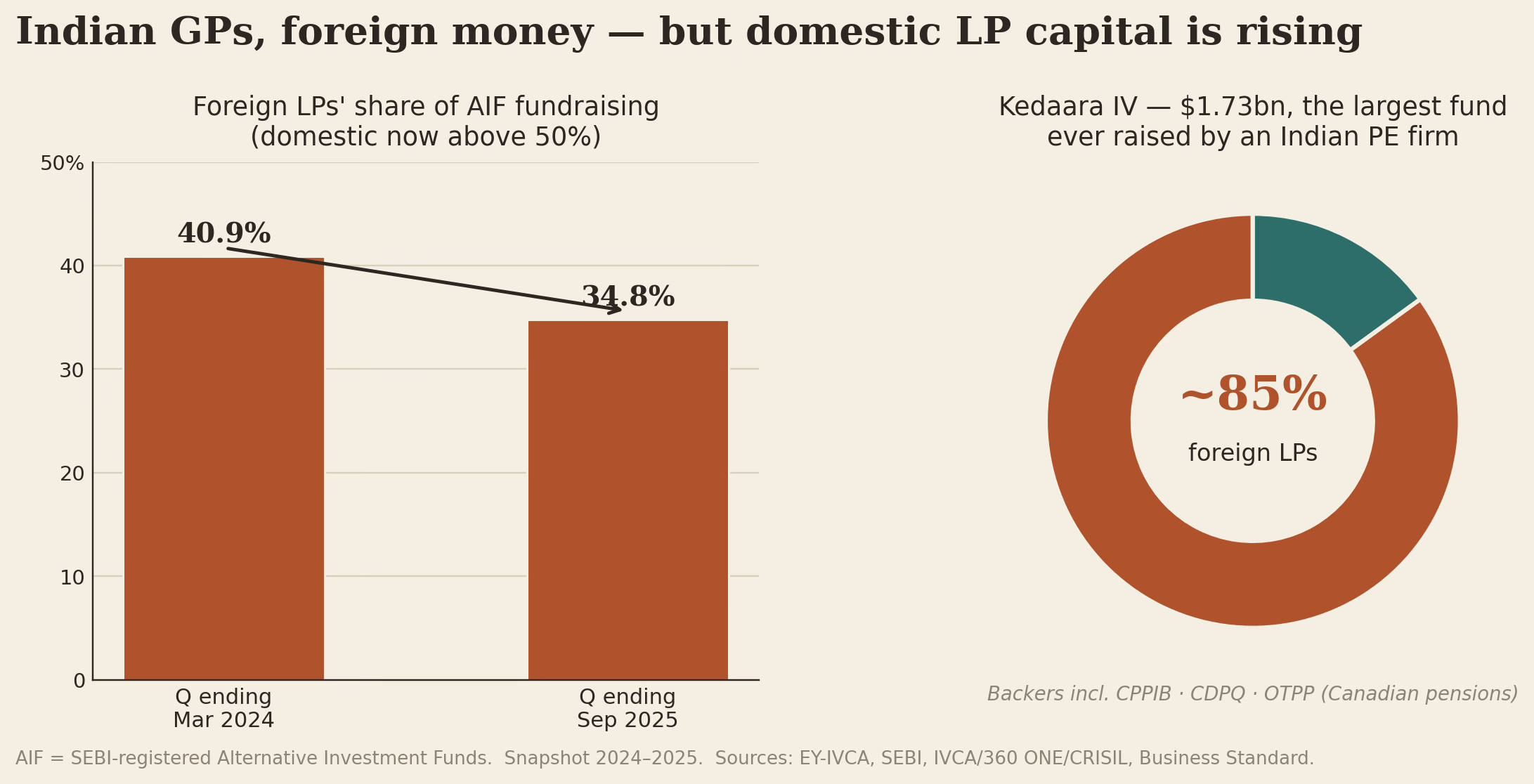
On the private capital side, for a long time, even for Indian GPs, the majority of capital raising came from foreign LPs. As an illustration, 85% of the funds raised in India’s largest PE fund came from foreign LPs. Large control buyouts remain predominantly foreign. However, encouragingly, Indian LPs have been stepping up. Foreign LPs’ share of AIF fundraising by Indian GPs has been declining, now contributing only about a third of the total capital raised.
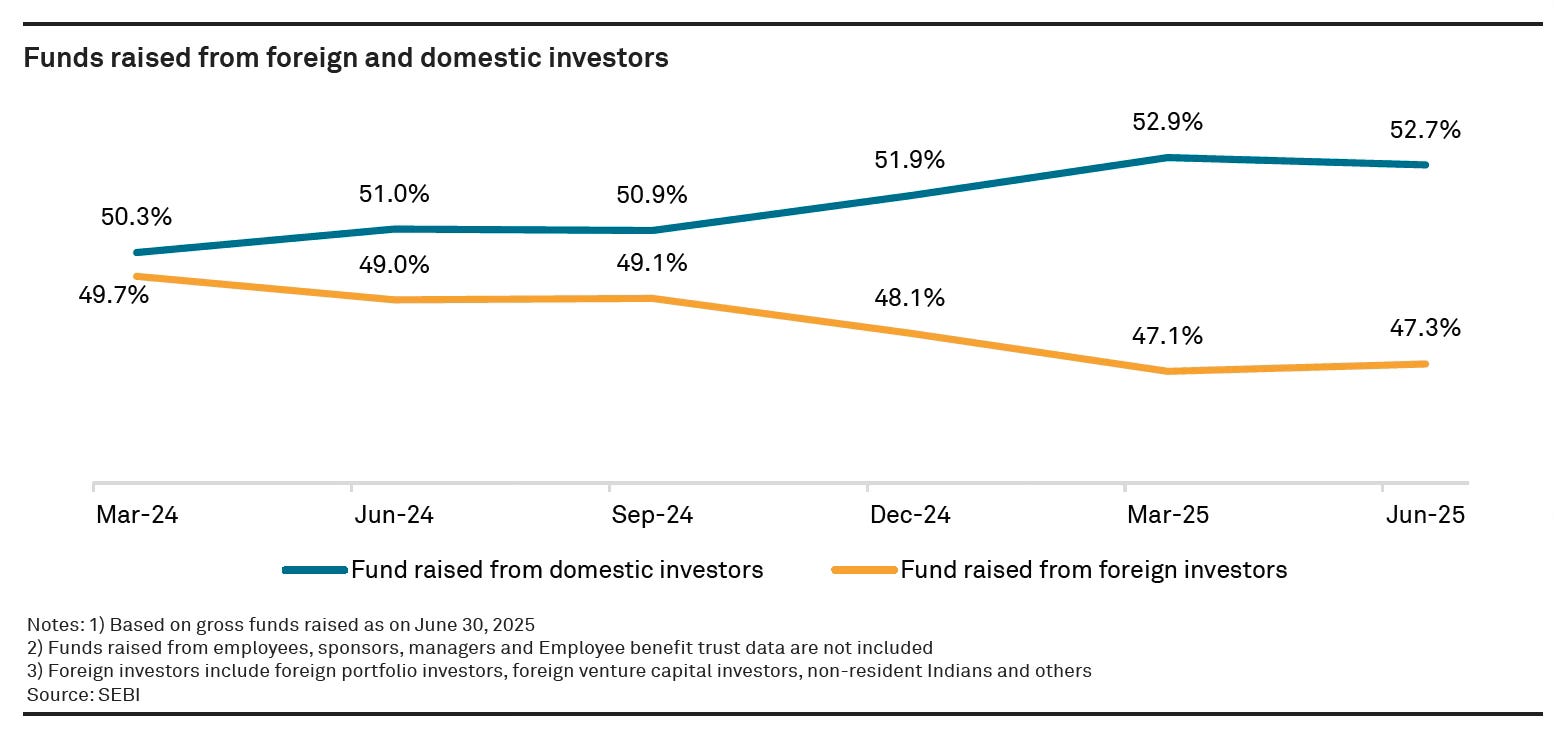
In the aggregate for all private capital raising too, Indian investors are stepping up. The CRISIL/IVCA/360 ONE Unlocking Domestic Capital report shows that domestic investors have now surpassed foreign investors in fundraising by Category I and II AIFs. The share of domestic investors as a percentage of gross funds raised across them has touched 52.7% by June 2025.
The good thing is that the domestic private pool, especially the AIF commitments, is growing fast. AIF commitments climbed from roughly ₹6.4 lakh crore (Mar 2022) to ₹8.3 (Mar 2023), ₹11.3 (Mar 2024), ₹13.5 (Mar 2025) and ₹16.94 lakh crore by March 2026, a near 30% CAGR, with Category II (PE/RE/credit) about three-quarters of it.
The report also disaggregates the changes in the destinations of private capital investments over the 2020-25 period. Startup and growth capital are useful for business creation and growth, whereas buyout capital reflects confidence in acquiring established businesses. They come mainly from the AIF I and II universe. The growing shares of private investments in public equity (PIPE) (mainly by the family foundations of HNIs) and private credit are matters of concern.
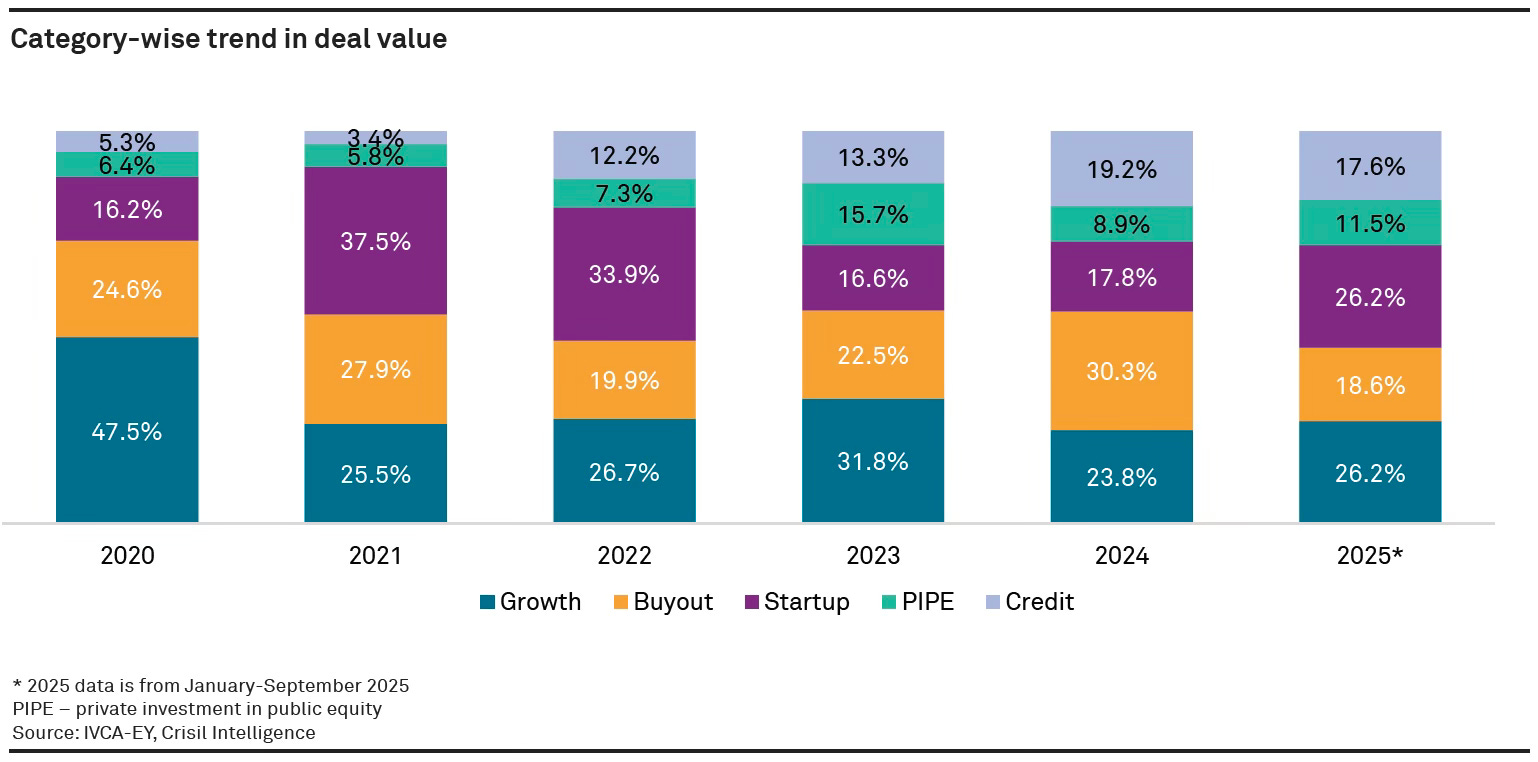
The graphic below consolidates everything into one figure. It is clear that domestic capital, whether retail, institutional, or HNI, overwhelmingly favours public markets over private capital markets. HNIs too favour liquid public equity, credit, and real estate. Even the ultra-HNIs tend to avoid illiquid growth equity.
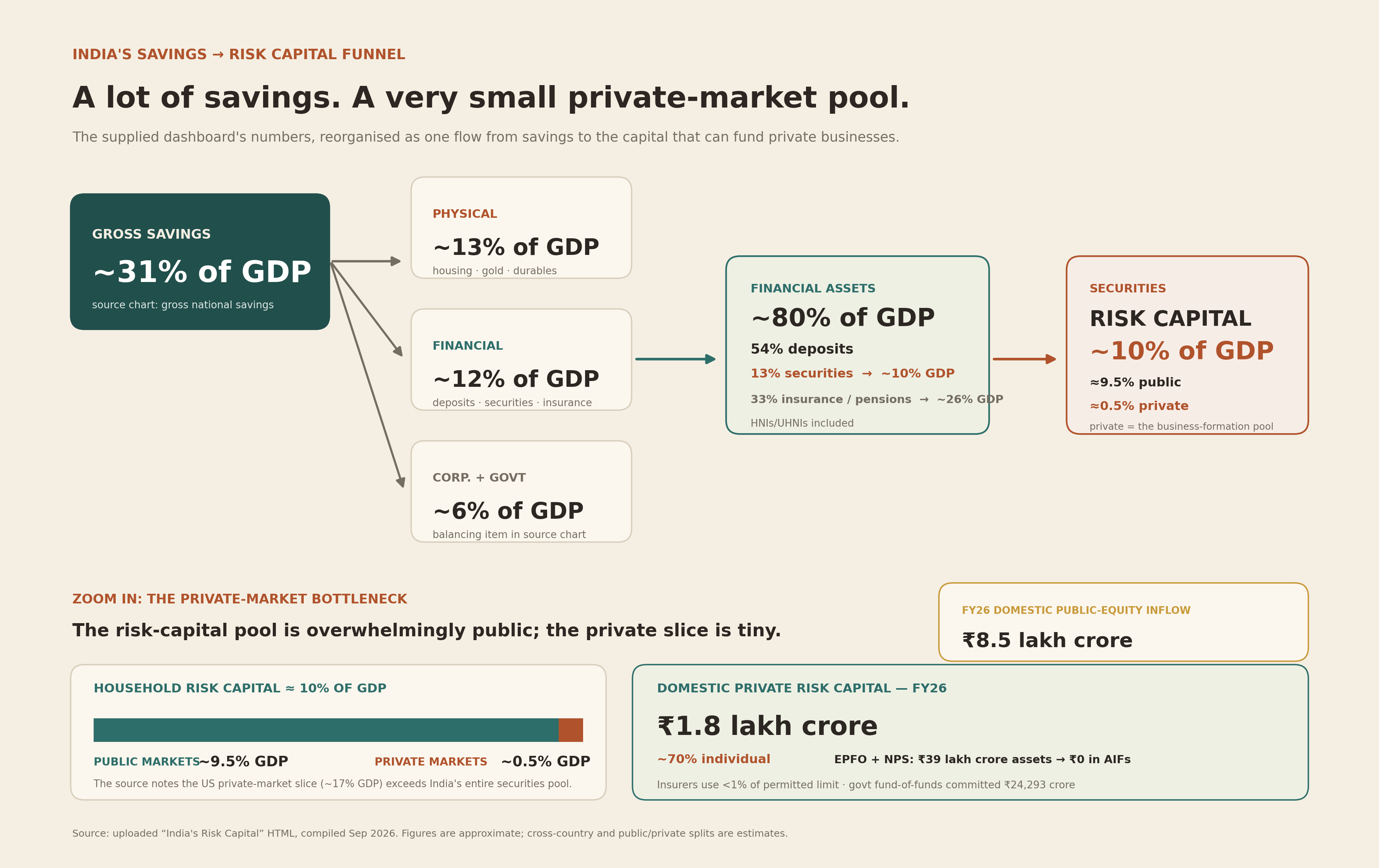
One important channel for private risk capital is institutional investors. As we saw, at 26% of GDP, the share of household financial savings going into pensions and insurance funds is 2.5 times that going into all kinds of risk capital.
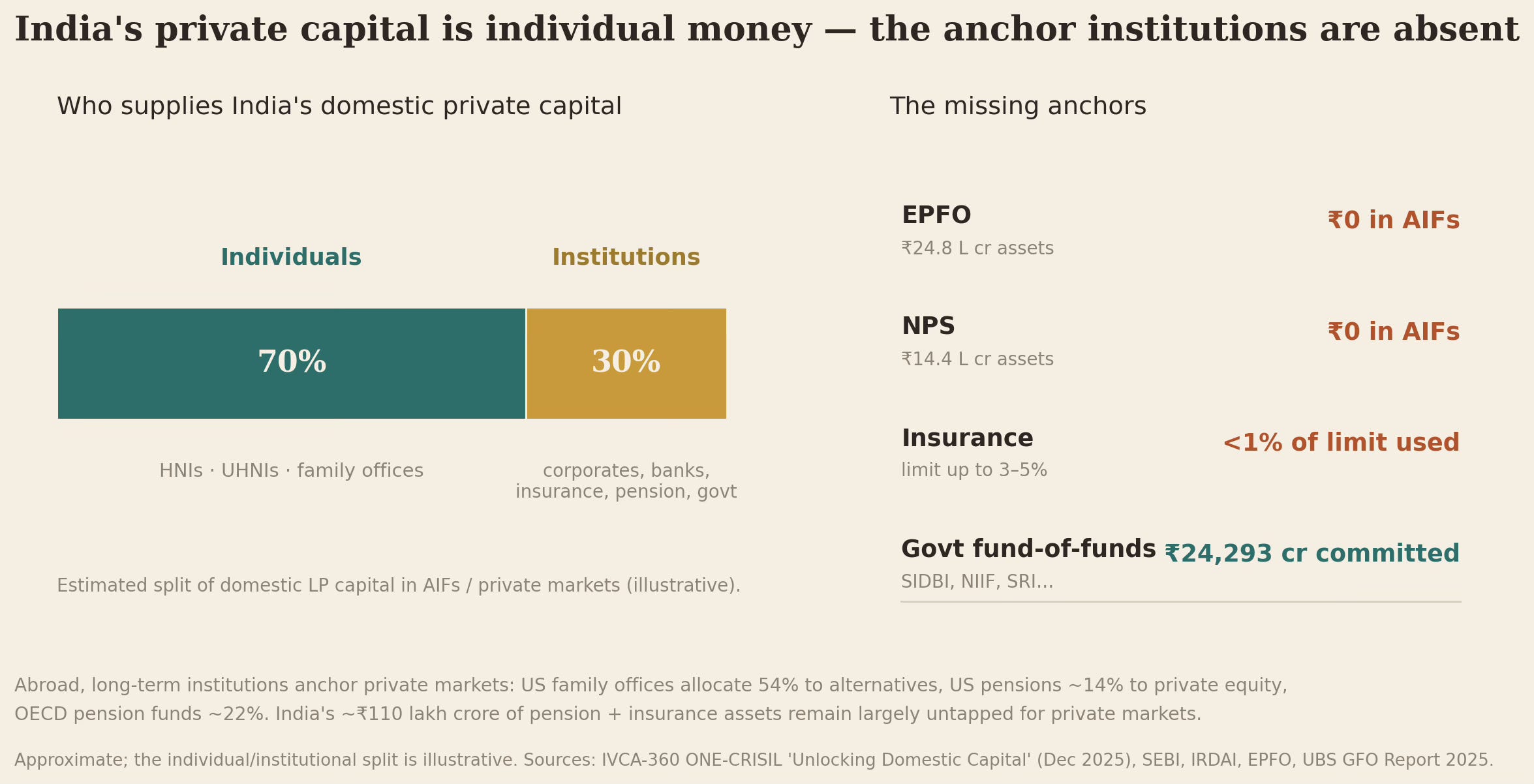
But if we look at domestic private market flows, while the actual flows into growth equity is itself small, the share coming from institutional investors is tiny. Of the domestic capital going into private markets (AIFs), roughly 70% is individual (HNIs, UHNIs and family offices) and only about 30% is institutional, and even that institutional slice is mostly corporate treasuries and government seed funds, not the long-horizon pools that anchor private markets abroad. In this too, India stands as the mirror image of every mature market.
As an illustration, EPFO, the country’s largest retirement fund with about ₹24.8 lakh crore of assets, has nothing invested in AIFs, despite being permitted up to 5% of incremental flows. The same is the case with NPS, with about ₹14.4 lakh crore. Whereas life insurers are allowed up to 3% and general insurers up to 5%, less than 1% of their limit has been invested. It is estimated that LIC alone could put in ₹1.3 lakh crore if it used its full headroom. The institutional share comes mainly from government-backed funds-of-funds (SIDBI, SRI Fund, NIIF, NABARD, BIRAC and others), which have ₹24,293 crore committed. The pension–insurance–endowment complex that dominates private markets elsewhere is missing.
Globally, institutional investors form the private-market LP base. In the US, university endowments like Yale invest roughly 30–40% in private equity and venture, and the US, Canadian, and Dutch pension funds and insurers are enormous private-market LPs. The CRISIL report says that US family offices allocate 54% to alternatives, US pension funds have gone from 9% to 14% in private equity over 2021-25, and OECD pension funds across 15 jurisdictions average about 22% in alternatives, up from 12% in 2001. In stark contrast, India’s own pension and insurance systems hold more than ₹110 lakh crore of assets, almost none of it in private markets.
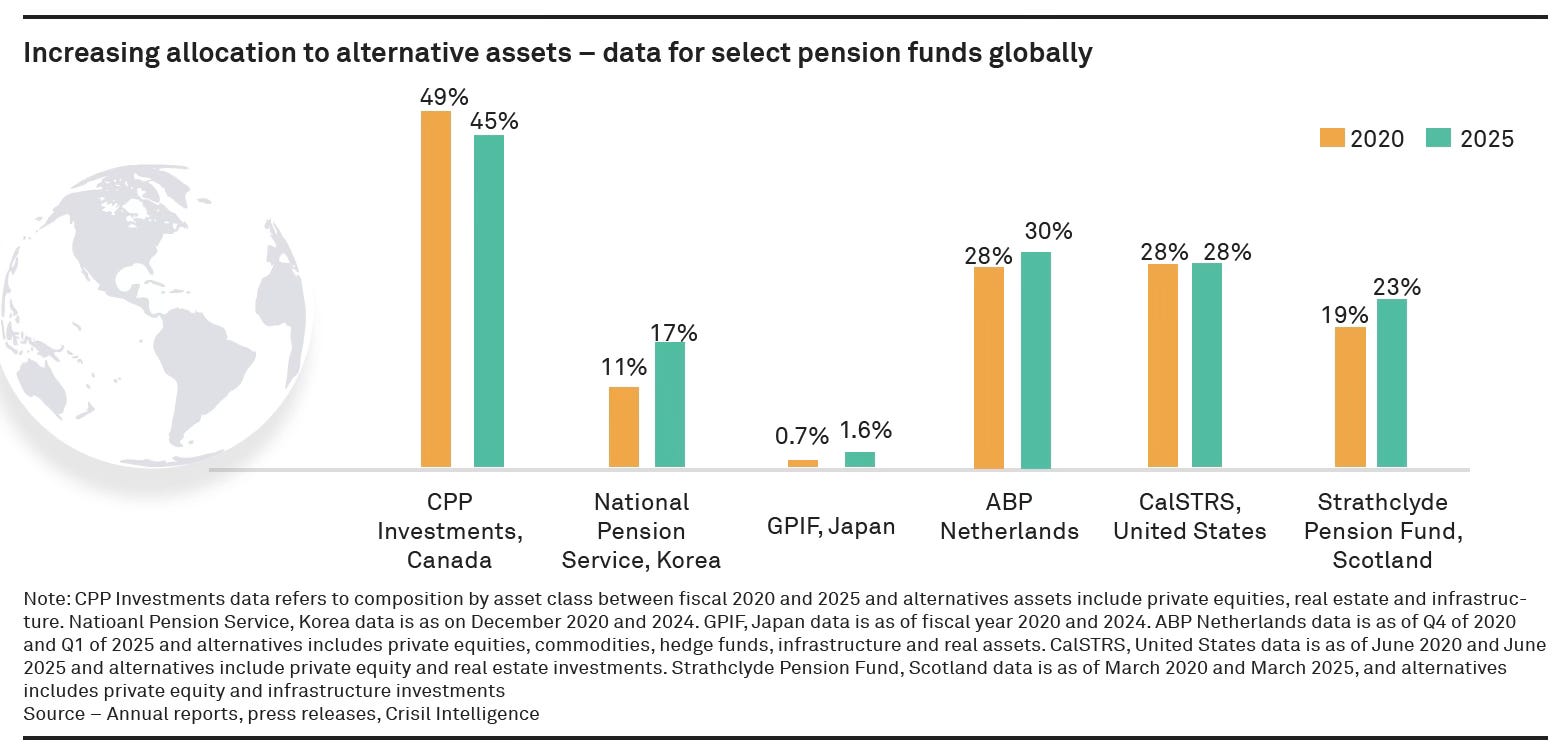
The likes of China and Israel closed exactly this gap by mobilising domestic pension and insurance capital to anchor their private ecosystems.
Because the anchor institutions are absent, the domestic private pool is thin and individual-funded, which is exactly why even the largest Indian GPs still raise ~85% of their capital abroad. Building the institutional LP base and deepening the private capital pool requires institutional investors to shed their risk aversion and start utilising their permissible limit for alternatives. This should be followed up with gradual reforms to SEBI accredited-investor and co-investment regulations, and gradual loosening of PFRDA/IRDAI mandates.
Apart from the substantive requirement of such private risk capital to sustain the country’s high growth aspirations, the global geopolitical risks and the likelihood of capital wars make these aforesaid reforms imperative.
No comments:
Post a Comment