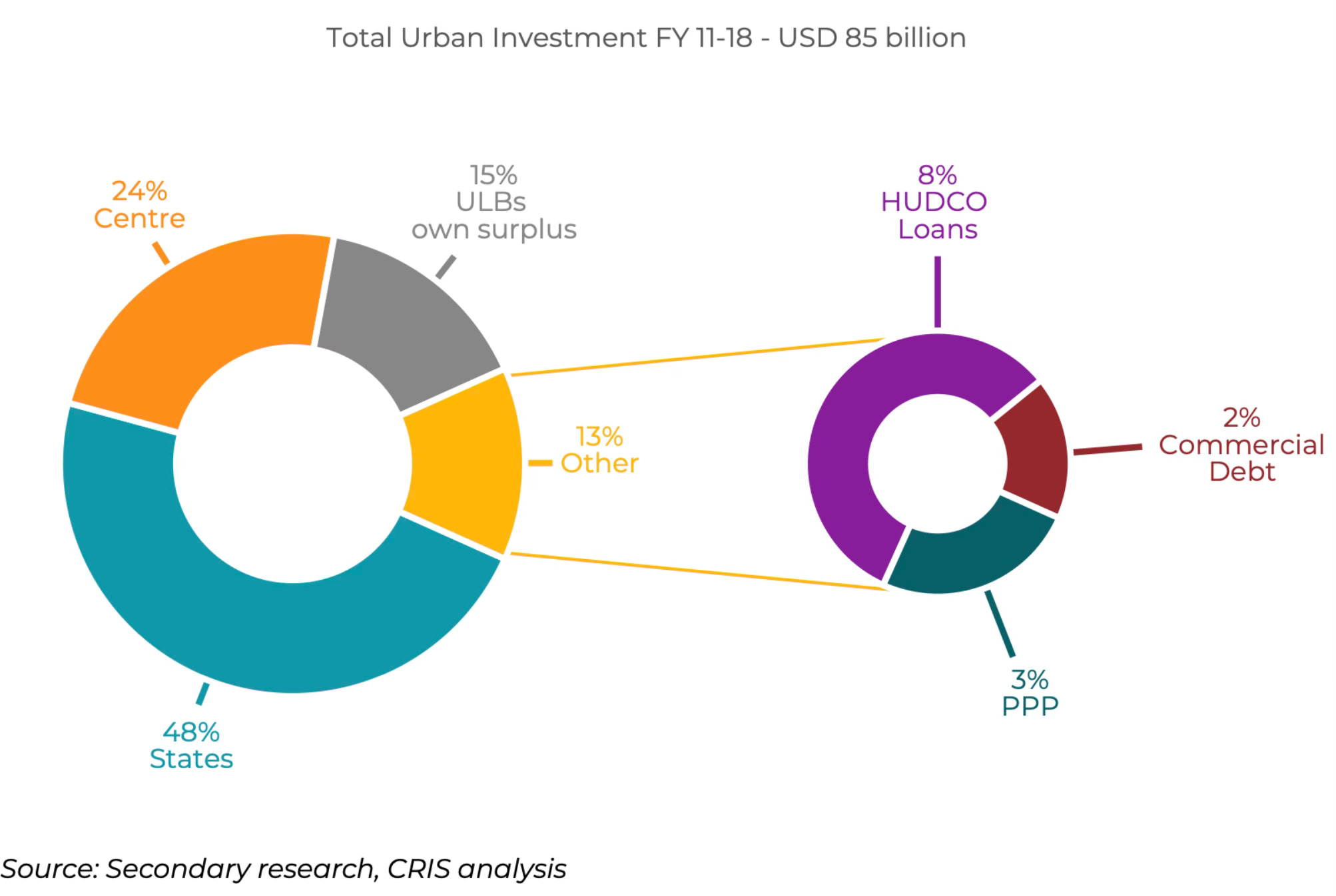
A striking feature of urban infrastructure financing in India is the negligible role played by debt, especially bank loans. It should be a policy priority to significantly increase the mobilisation of debt prudently and sustainably for urban infrastructure projects.
In this context, I have blogged here with a proposal to leverage the viability gap funding (VGF) scheme of the Department of Economic Affairs, Government of India, to mobilise bank loans and other debt. The idea is to use VGF to transform the project economics to make it commercially viable for banks to lend to municipalities without a sovereign guarantee and against project revenues. This would be an incentive-compatible form of desirable debt, and also provide a pathway to boost the uptake of the struggling VGF window.
The newly announced Urban Challenge Fund (UCF) of the Government of India is a step in this direction. The ₹1 lakh crore scheme seeks to transition cities toward market-based financing by providing central assistance up to 25% of the total project cost for projects that are able to mobilise at least 50% of the project cost from market sources like commercial bank loans or municipal bonds. The remaining 25% is to come from state and municipal governments.
The UCF should avoid the kind of incentive-misaligned recourse debt mobilised against the municipal general funds and/or with state government guarantees. Instead, it should try to ensure that the debt is non-recourse, mobilised against project revenues and without any sovereign guarantee. This kind of debt ensures fiscal discipline and a sustainable pathway to financing urban infrastructure. The UCF guidelines are silent on this important distinction. In fact, there is a case for a substantial incentive within the scheme itself to nudge cities in this direction.
However, initiatives like the UCF and VGF are unlikely to generate adequate uptake if they are implemented as a regular government scheme, and directly between the central and state governments. For one, the rigid and bureaucratic nature of project appraisals, approvals, program administration, and payment tranche releases is unsuited to finance projects involving private capital. Further, the operationalisation of such financing will require getting a few things right on both the demand and supply sides, which requires a market-making role.
On the demand side, it requires the creation of a shelf of projects that can be structured to access project finance. Developing a good quality pipeline of ready-to-finance projects entails a non-trivial cost and requires a project development fund. The category of projects, like those in water and sewerage, solid waste management, bus transit, electricity distribution, etc., are best placed to benefit.
On the supply side, it requires derisking and increasing banks' appetite, in particular, to finance such projects. Nothing is more effective than a few successful demonstrations of project finance for municipal projects. Today’s commercially attractive infrastructure sectors like national highways, thermal and renewable power generation, parking, etc., got derisked over time through a handful of successes.
This facilitation of the demand-side and easing of supply-side concerns requires active market-making. The infrastructure development finance institutions (DFIs) like National Infrastructure and Investment Fund (NIIF) and National Bank for Financing Infrastructure and Development (NaBFID) are well placed to act as infrastructure investment banks to make this happen by providing technical assistance to develop the project and structure project financing (without recourse to general municipal funds or state government guarantees), mobilising lenders to help achieve financial closure, and contributing the derisking financing layer.
Accordingly, at least a part of the grant allocation for schemes like VGF and UCF could be made available for these DFIs to build a pipeline of projects and finance them. A proportionate share of the Project Preparation and Capacity Building Fund (PPCBF) under the UCF should also be transferred to them. This should be part of an explicit mandate for these DFIs to derisk projects clearly specified sectors for bank and bond finance.
If successful, it would be a powerful example of market catalysis of the kind that is central to the mandate of DFIs.
No comments:
Post a Comment