I have blogged earlier (see here and here), highlighting the importance of broad-based economic growth and the creation of good jobs as essential requirements for India’s sustained high-growth prospects.
This post has been triggered by two articles. First, a recent op-ed in Business Standard by Kavitha Rao of the NIPFP, which analysed the Periodic Labour Force Survey (PLFS) for the composition of jobs in India and found,
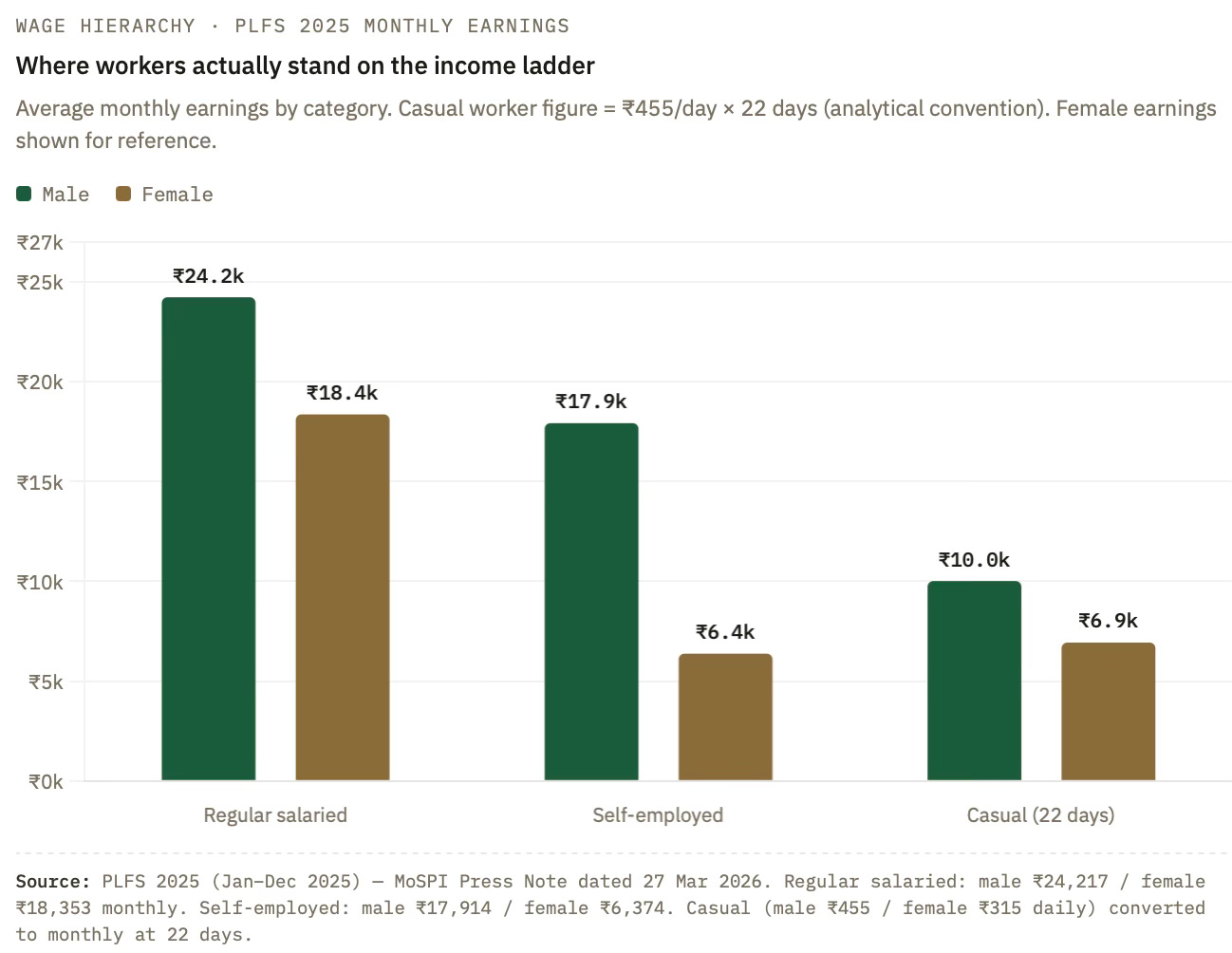
The PLFS classifies information on the composition of workforce into regular workers, self-employed and casual workers and the corresponding wages. The share of regular workers in total workforce was 23.6 per cent in 2025, a little more than half being in government or public enterprises. The self-employed account for more than half (56 per cent), with the remaining being casual workers. The average wage for regular worker was reported to be at ₹22,699, which is higher than the monthly earnings of self-employed ₹14,861, and of casual workers at ₹10,000, assuming a worker works for 22 days in a month. Even among the regular workers, there is considerable variation — over 50 per cent have no written job contract and no social security benefits.
To understand the differences in wages across activities, the survey reports a number of occupation divisions — the ratio of the highest to the lowest wages within regular workers is 4:1. Juxtaposing the highest-wage-earning occupation with casual workers, the differential is 7.4 times, assuming that casual workers get to work 22 days in a month. To top this off, there is a public-sector premium, especially in lower-level jobs. On the other hand, the self-employed category includes a number of unpaid family workers, suggesting significant underemployment in the economy and poor returns to effort. Fewer well-paying jobs and a wage premium for public-sector jobs drive a sharp demand for these jobs.
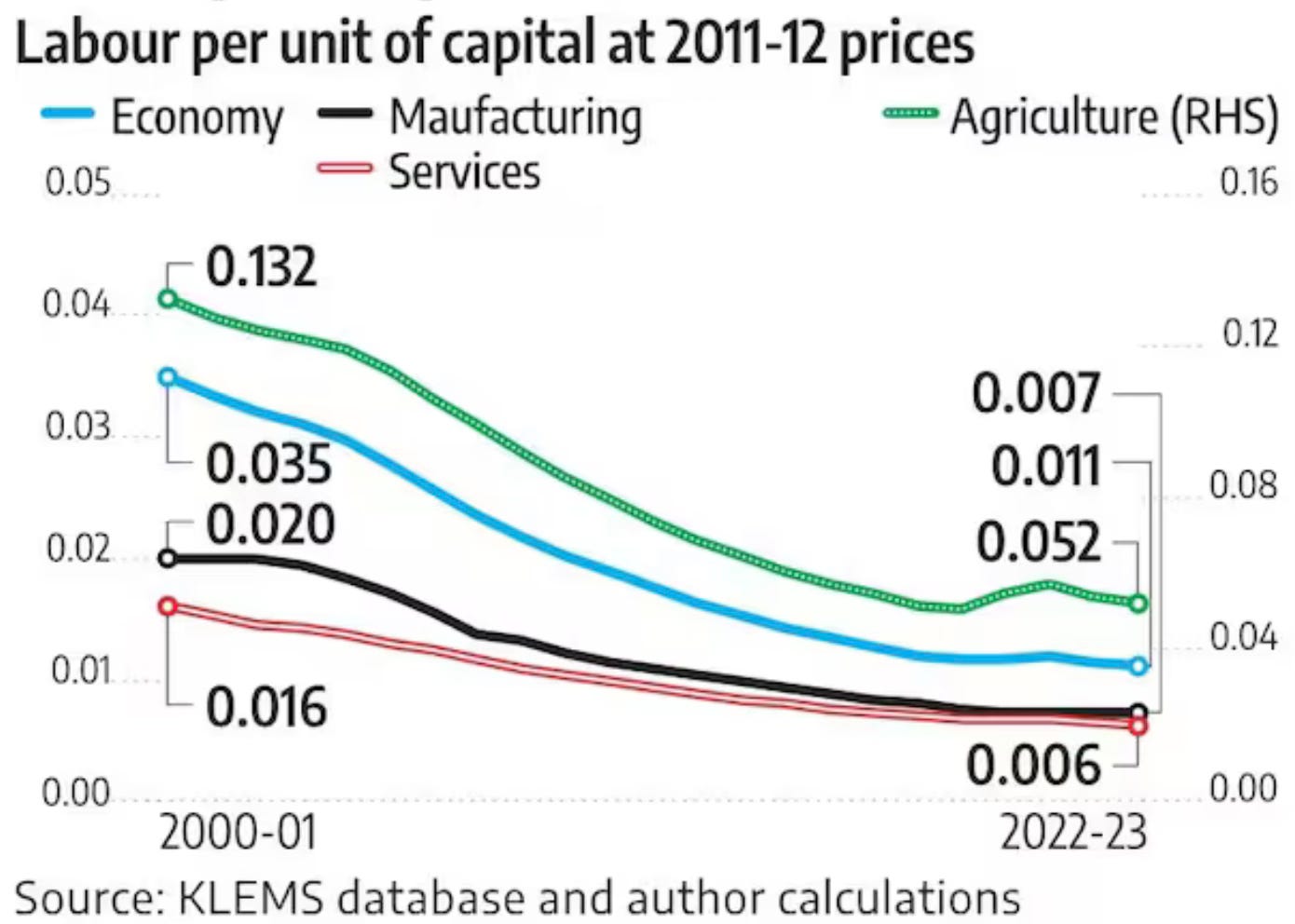
She also points to the increasingly capital-intensive nature of job creation across sectors, and the convergence of labour intensity in manufacturing with that in services.
Second, The Economist had this graphic on the rising number of graduates and their declining monthly salaries.
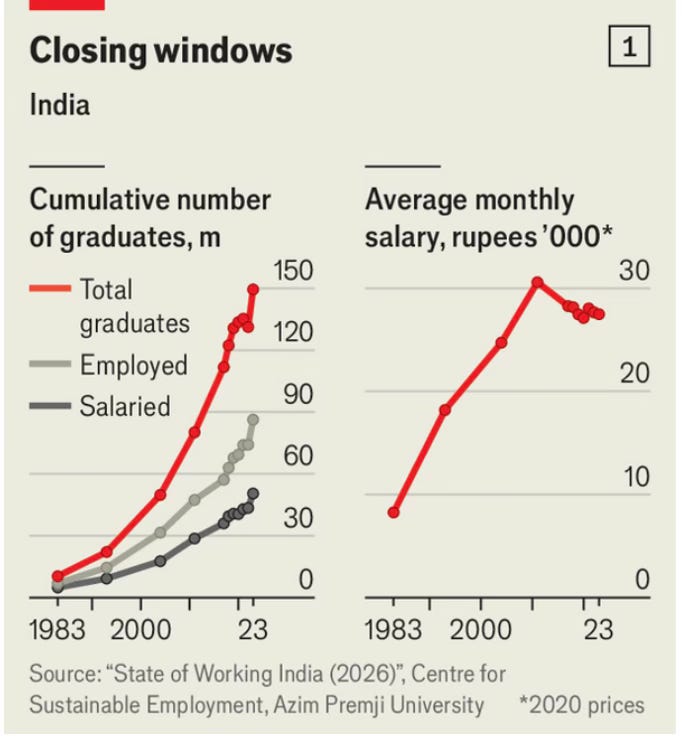
Research by the Azim Premji University in Bangalore shows that each year between 2004 and 2023 roughly 5m graduates were added to the workforce; but the number in employment rose by only about 2.8m… Of the young people who report themselves unemployed, fewer than 7% of graduates find permanent salaried work within a year…Education-fuelled aspirations have pushed enrolment in tertiary education to 30% of 18- to 23-year-olds, while the number of higher-education institutions has grown from 6,000 to around 70,000 in the span of 30 years, thanks to a boom in private education… around 45% of Indian graduates have degrees in arts or commerce rather than, say, engineering or medicine. A report by a business body in 2024 estimated that only 55% of India’s graduates were employable.
With this backdrop, I used Claude to dig a bit deeper into the economic growth and labour market. As a framework, broad-based economic growth works at the intensive margin of the labour market to raise disposable incomes, and good job creation works at the extensive margin to expand the meaningful consumption base.
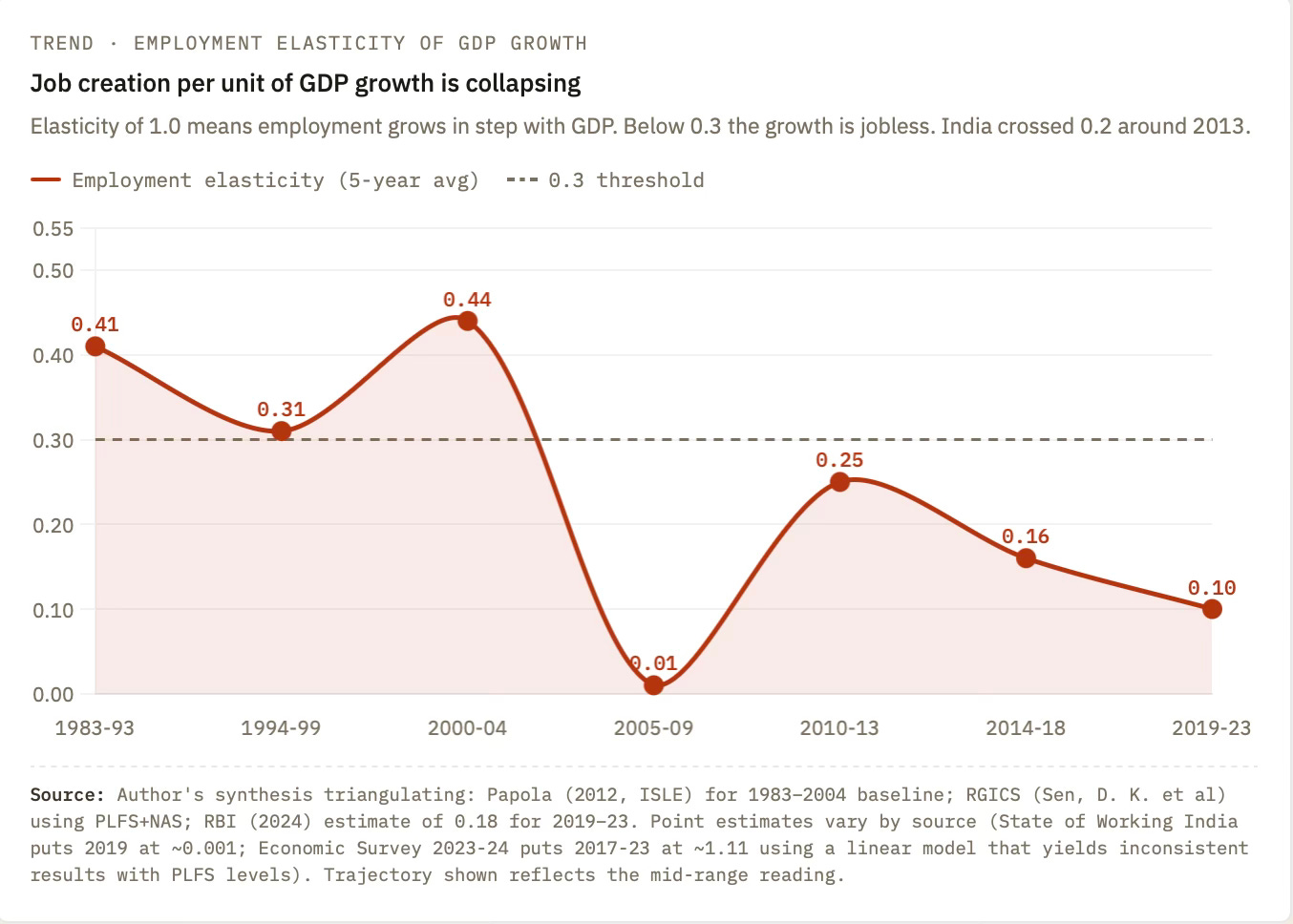
Consider the headline numbers. The employment elasticity of GDP growth has fallen from ~0.4 in the 1980s to 0.26 for 2000–2012 and near-zero by 2019 (RBI 2024 estimate: 0.18).
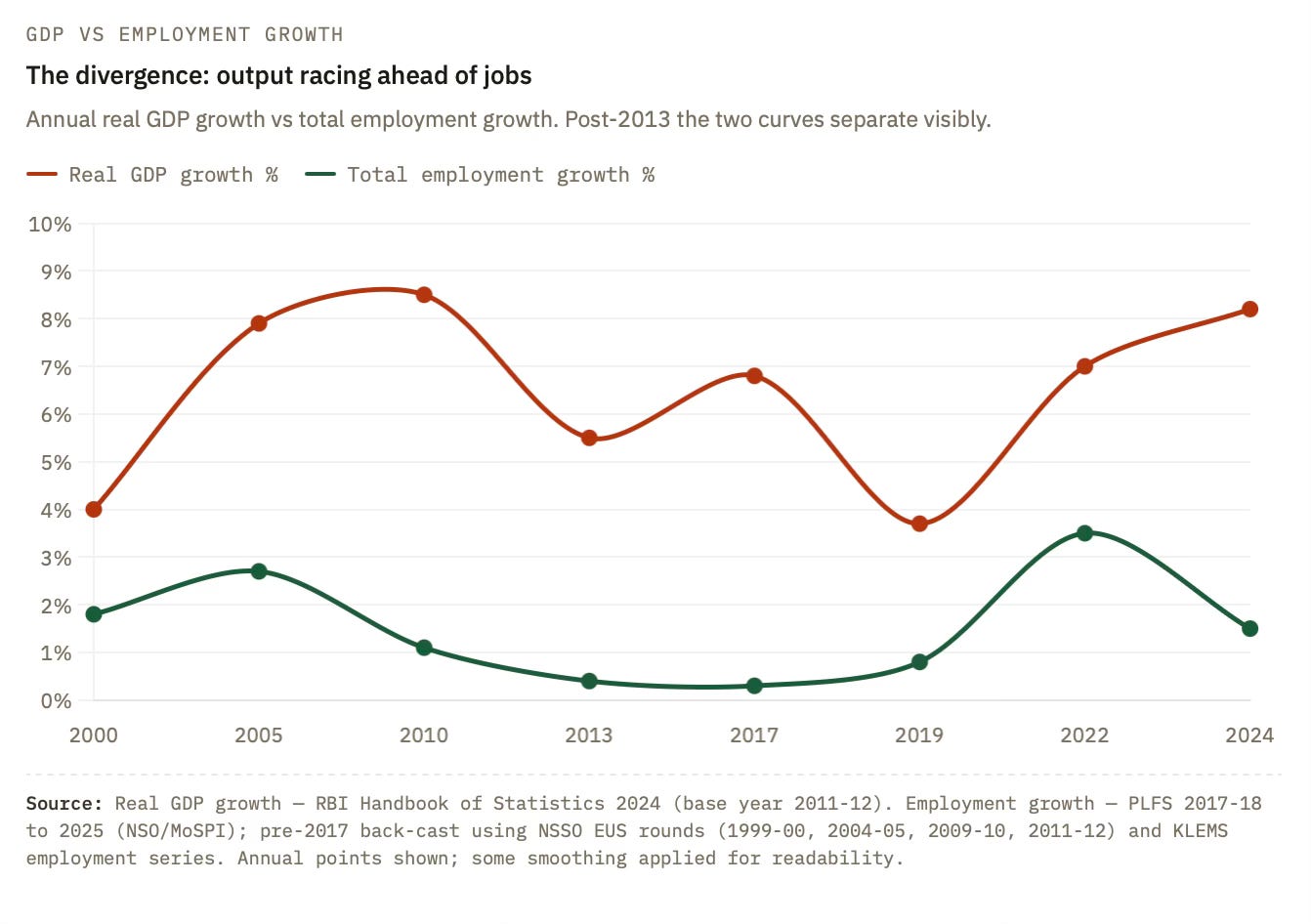
This is also borne out in the widening wedge between aggregate output and employment growth rates.
The economy needs roughly 20 million new non-farm jobs a year to absorb the demographic bulge, whereas formal-sector job creation runs at about 4 million.
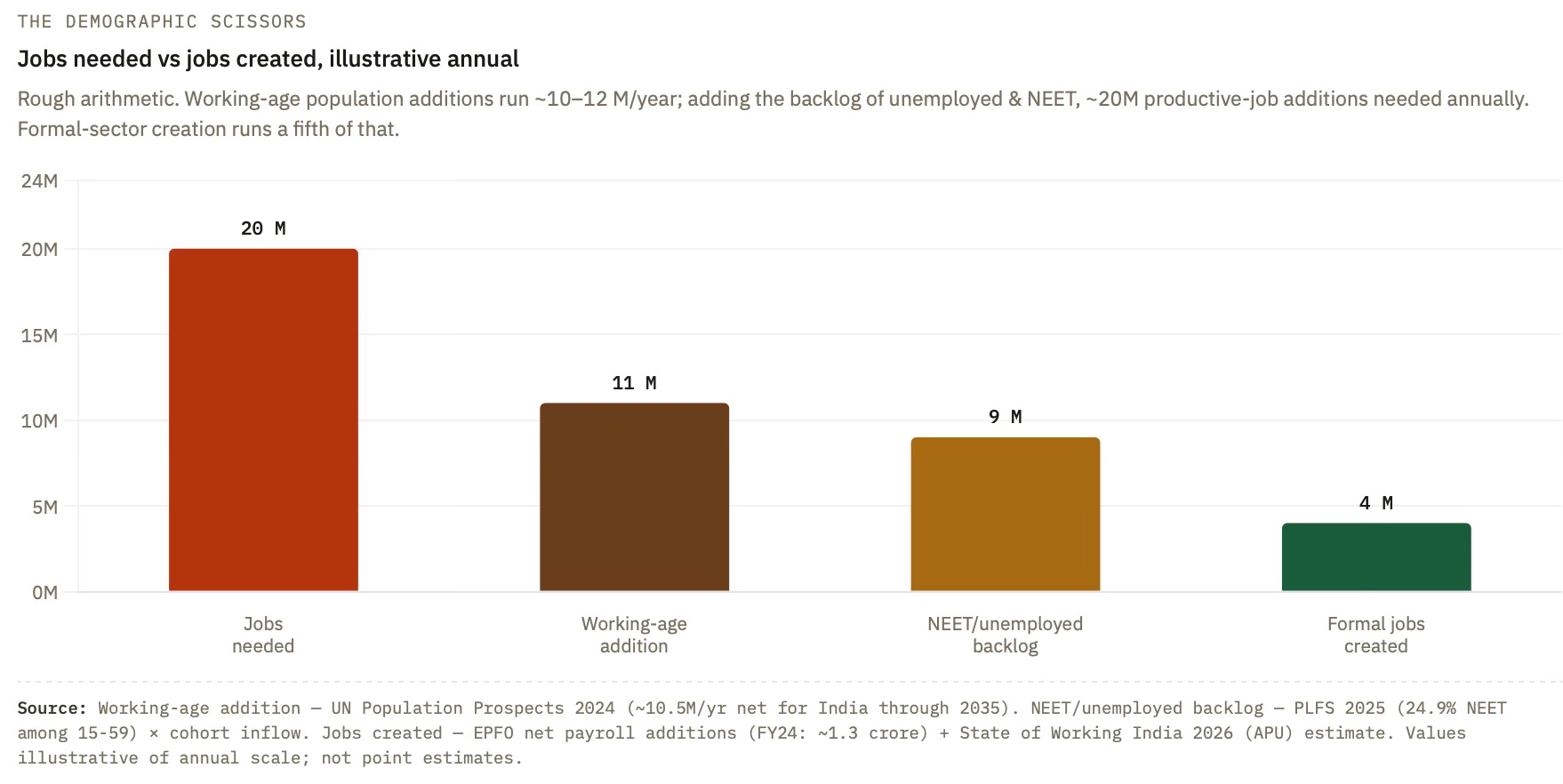
It should be a matter of concern that India, one of the world's largest economies, has one of the smallest formal-sector labour-absorption engines relative to size. It does not help, as I blogged here, that manufacturing’s employment share is stuck at 12%, and every export dollar now buys less domestic employment than a decade ago. As mentioned earlier, the State of Working India 2026 report documents that just under 7% of male graduates secure a permanent salaried job within a year of graduation.
In addition to quantity, another dimension of the extensive margin is the quality of jobs created - i.e., those that pay enough, and reliably enough, to enter the consuming class. Seven rounds of PLFS data (2017-18 to 2023-24) reveal a labour market where employment quantities are rising but quality (measured by contract security, social protection, paid leave, and income sufficiency) has stagnated or worsened for most workers. As a headline number, only 23.6% of workers are regular salaried.
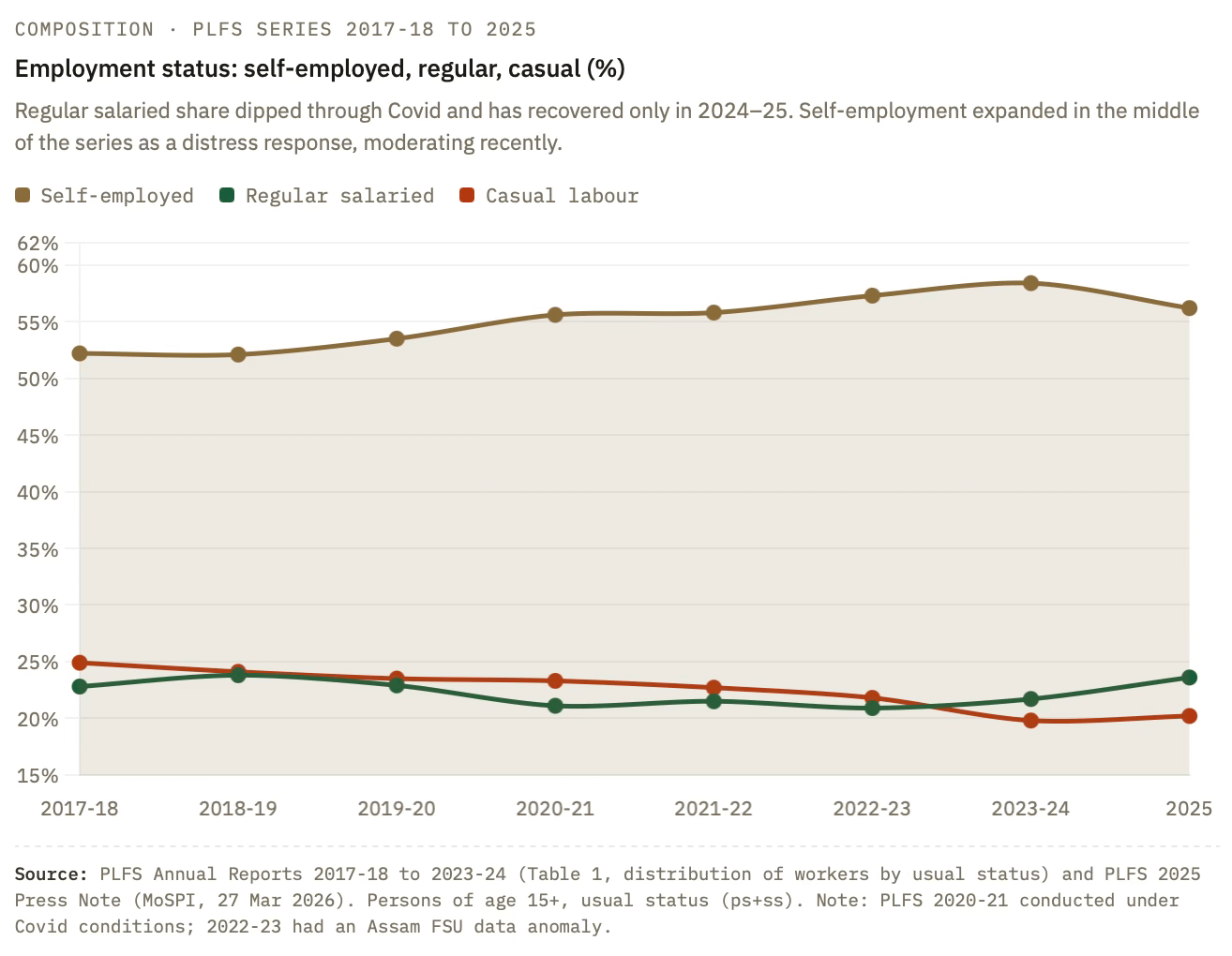
Further, only about 11% are regular salaried with a written contract and social security. Everyone else is either self-employed at very low earnings (56%), a casual daily-wage worker (20%), or a regular worker without protection.
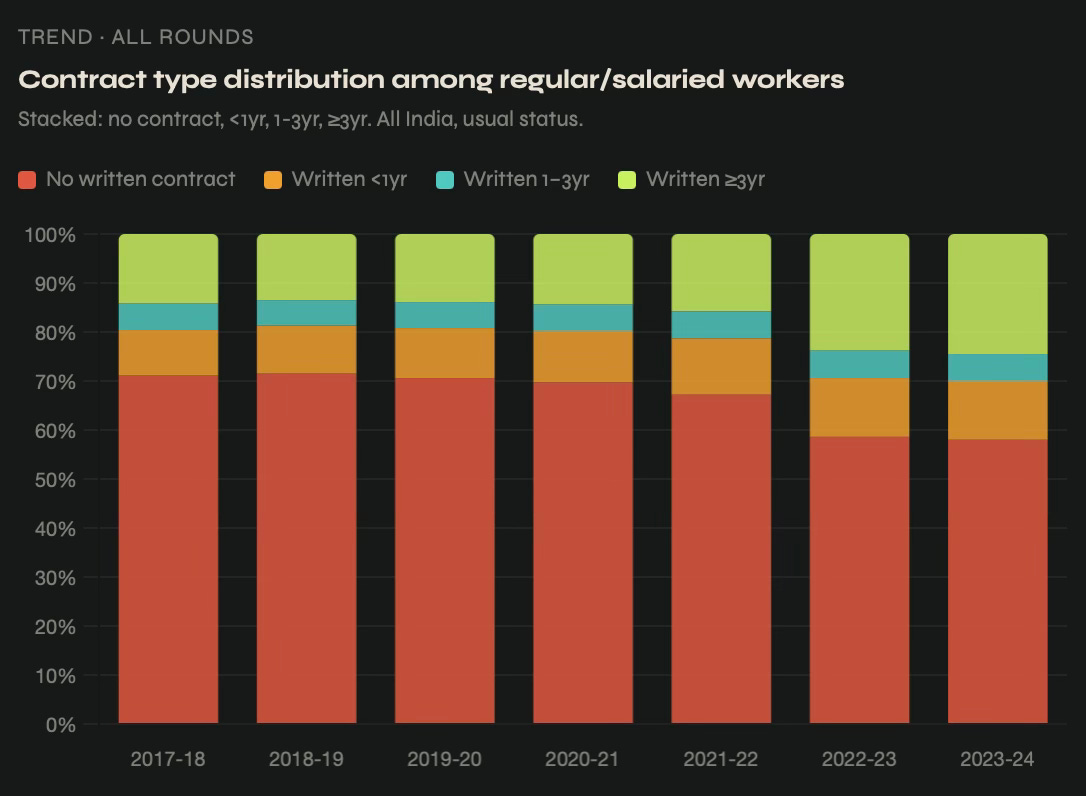
Of the 23.6% who are regular salaried, more than half have no written contract and no social security. It is good that the share of those in regular employment with all three protections has been rising gradually.
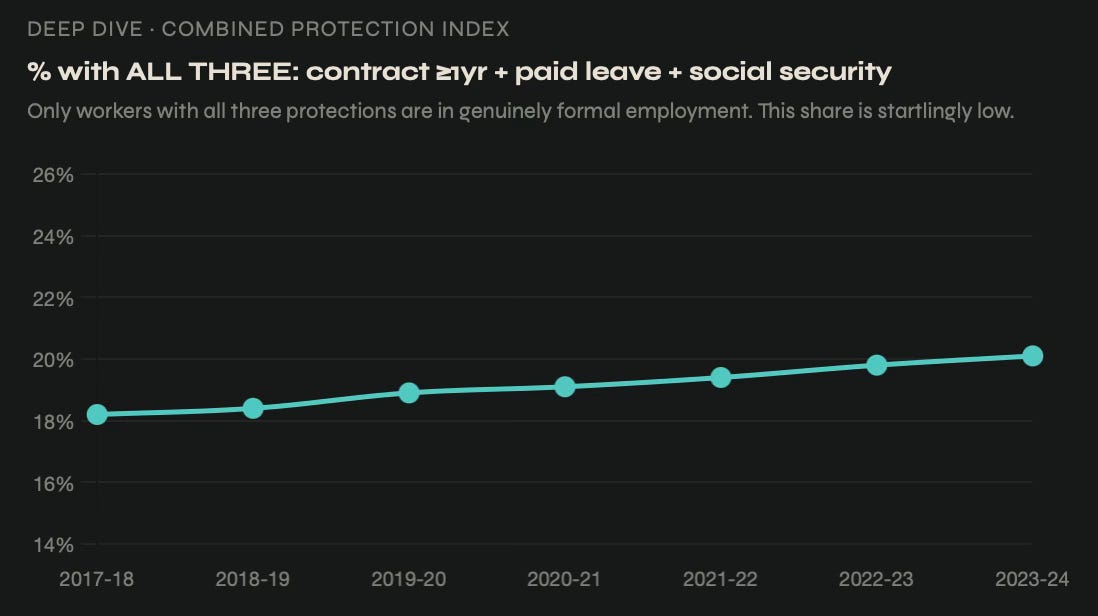
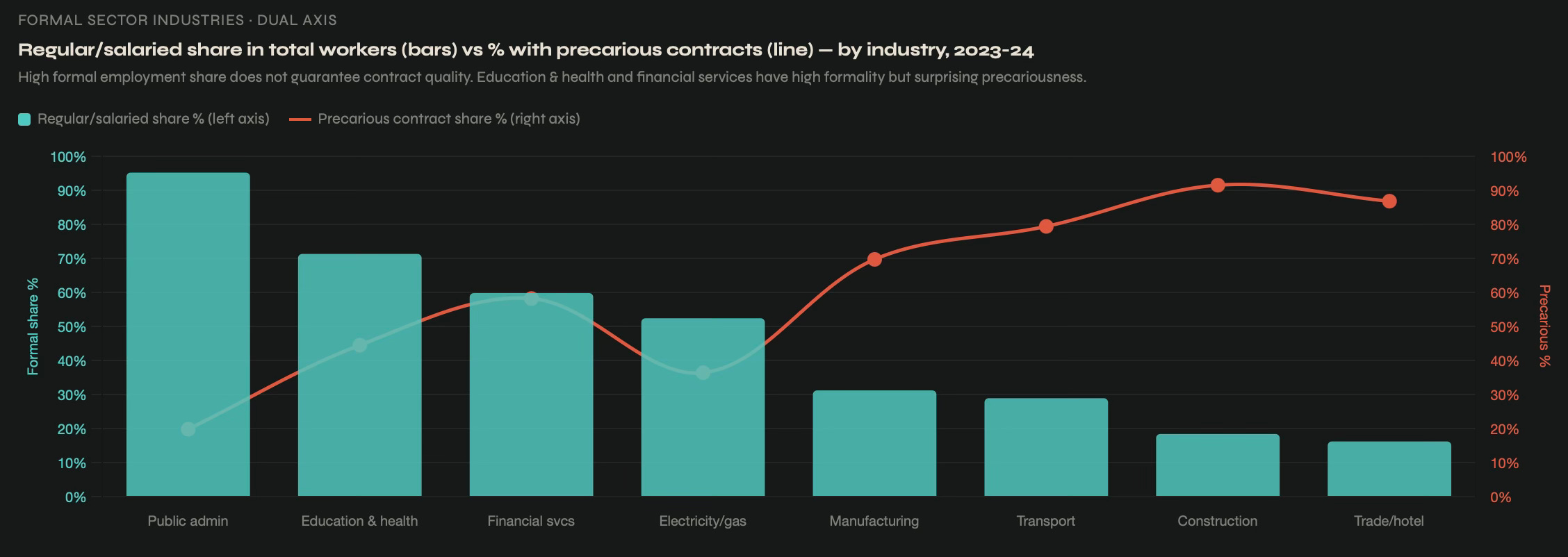
The problem is compounded by the quality problem not sparing even the well-educated, and even worsening for them. From 2017-18 to 2023-24, among graduates, precarious contracts (no contract or less than a year) rose from 49.3% to 53.9%; among post-graduates it rose from 38.7% to 44.1%; among technical diploma holders (who should command skill premiums) it rose to 65.8%.

The numbers on quality are likely to be even worse if we exclude government jobs. They have high shares in public administration, education and health, financial services, utilities, and transportation.
On salaries, the average monthly earnings across categories are low enough and vary sharply. The ratio of the wages for regular workers in their highest-paid occupation vs lowest-paid occupation is 4:1, and that for the highest regular vs casual worker earnings is 7.4:1.
The table below captures the summary statistics on India’s employment market today. Only about 11% of India's workersare in the genuinely formal employment cell (regular salaried with a written contract and social security). And within regular salaried work, the 4:1 within-category wage ratio (for regular workers) and the 7.4:1 regular-to-casual ratio mean that even the "good" tier splits sharply.

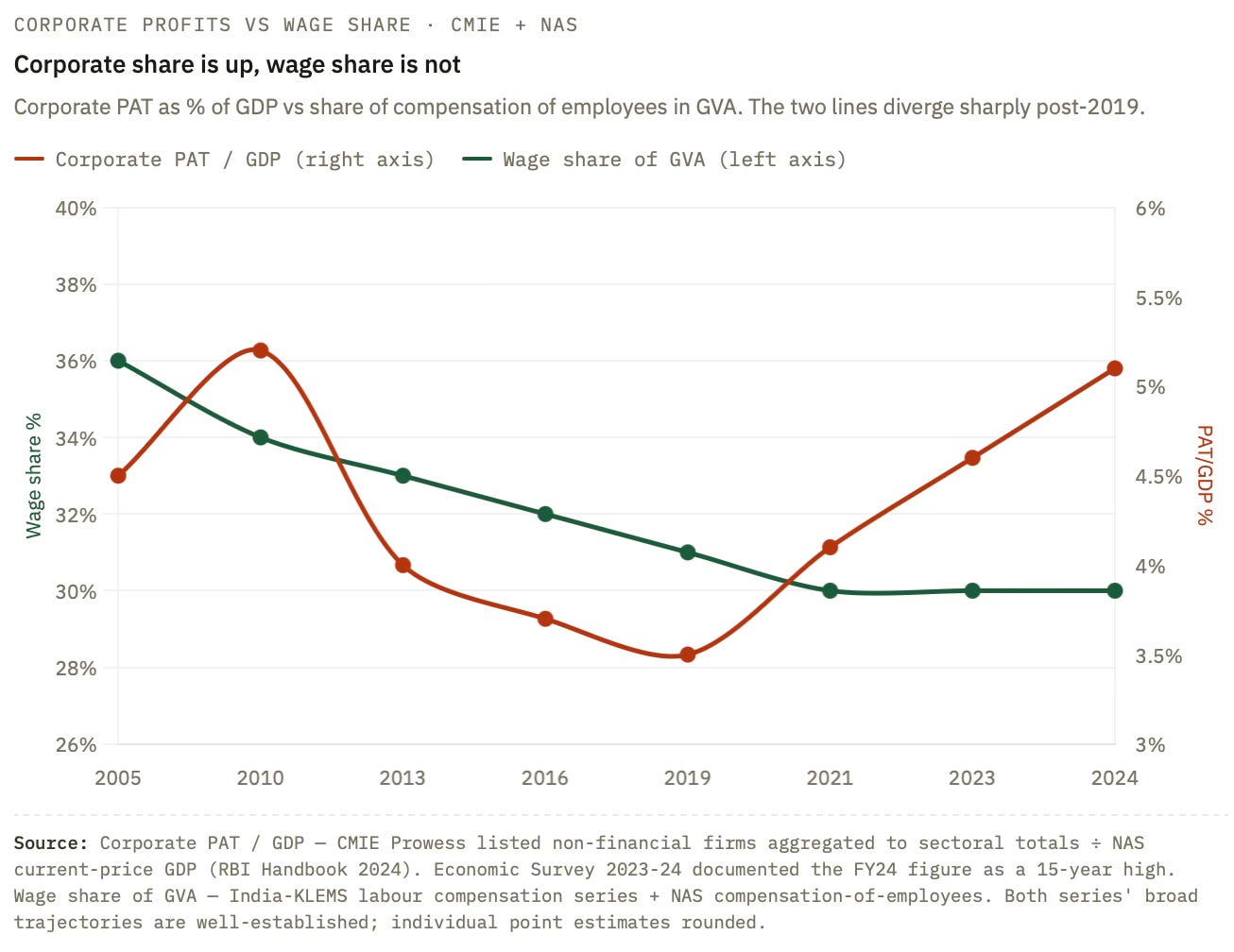
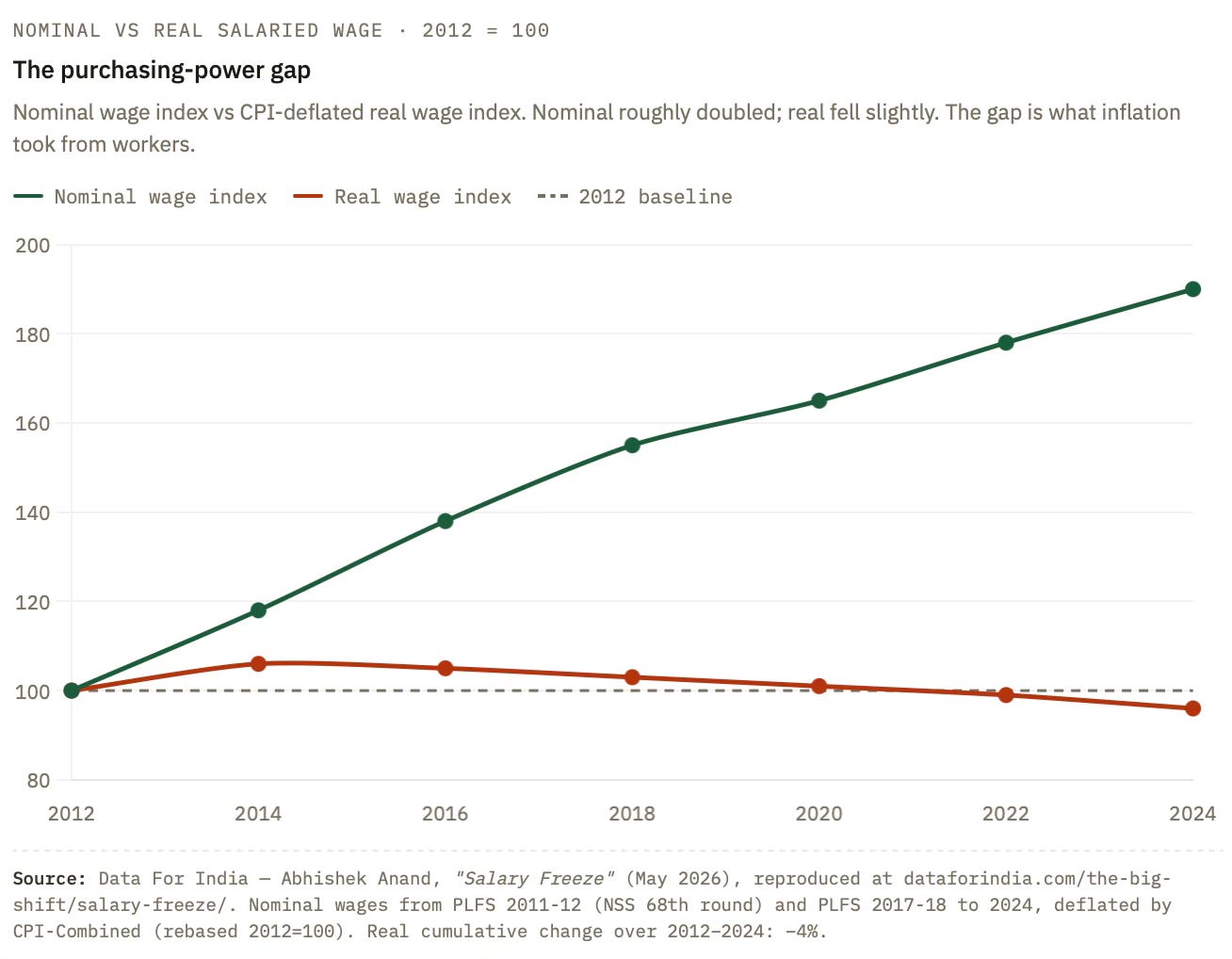
This brings us to the intensive margin, involving wage trends of existing employees. Are incomes rising for those already in work? Nominal wages roughly doubled 2012–2024 but inflation ate almost all of it. In FY24 corporate profits grew 22.3% and reached a 15-year high.
Real salaried wages fell -4% cumulatively 2012–2024. Real wages for salaried workers were -1.7% lower in Q2 2024 than Q2 2019.
Rural real wages grew about 7% annually in the 2010–2015 period and have been near-zero since.
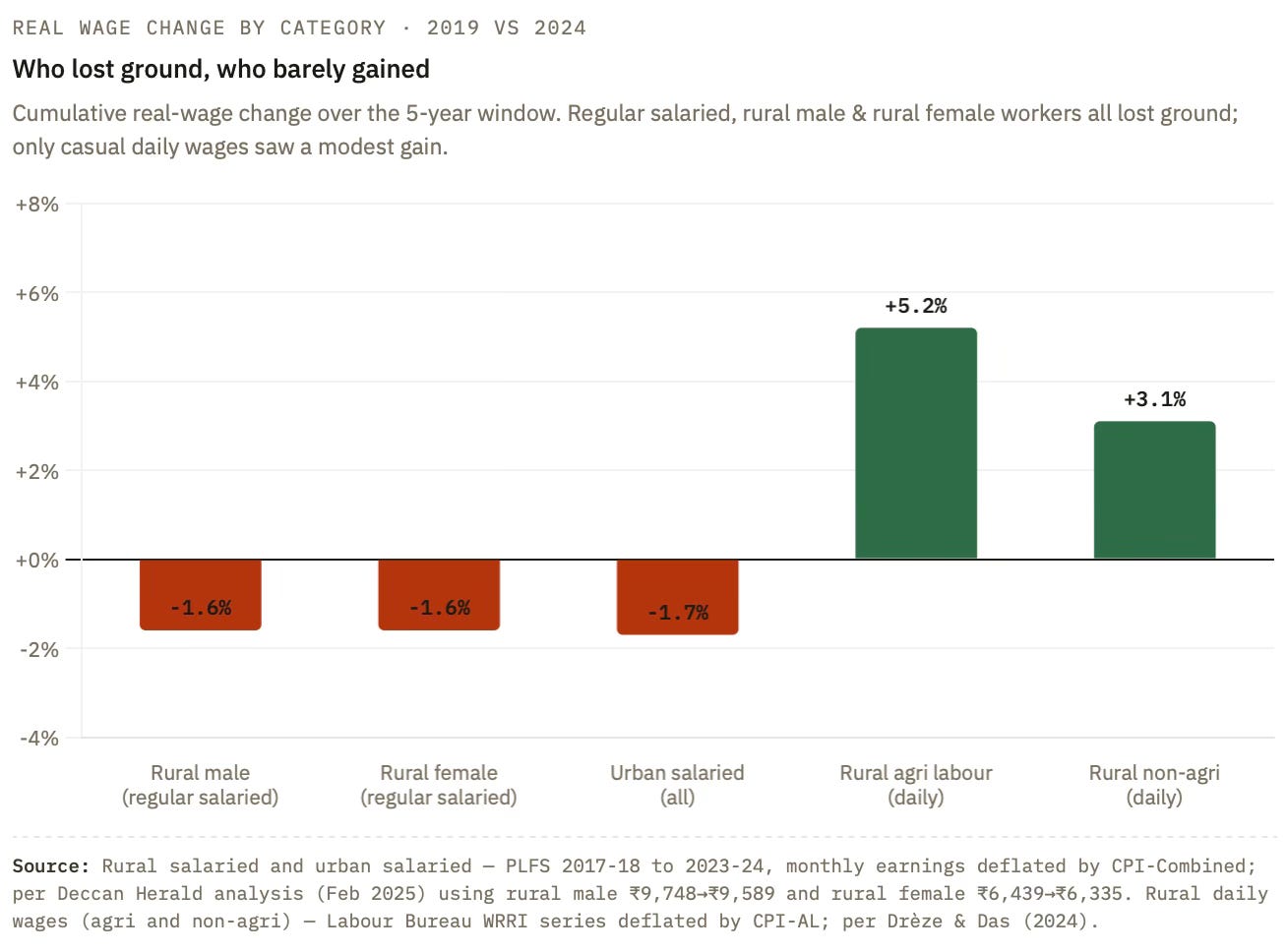
A decade of near-zero real wage growth means that even the workers who are employed are not getting the income-per-hour gains they need to expand consumption. The corporate sector is booking those productivity gains as profit rather than passing them into wages. This is the "consumption slowdown" that FMCG, auto and durables companies have been reporting from mid-2024 onwards, and is likely caused by the intensive-margin failure documented above. This failure at the intensive margin is a binding constraint to broad-basing economic growth and expanding the consumption class in a substantial manner.
Let’s round things off with the labour-intensity point raised in the Rao oped. The India-KLEMS database shows that labour per unit of capital has fallen steadily across all major sectors, and manufacturing and services have converged to a broadly similar labour intensity. In earlier decades, manufacturing was the obvious job-creation engine because it was more labour-intensive than services. That is no longer true and to that extent diminishes manufacturing value in absorbing agricultural surplus labour.
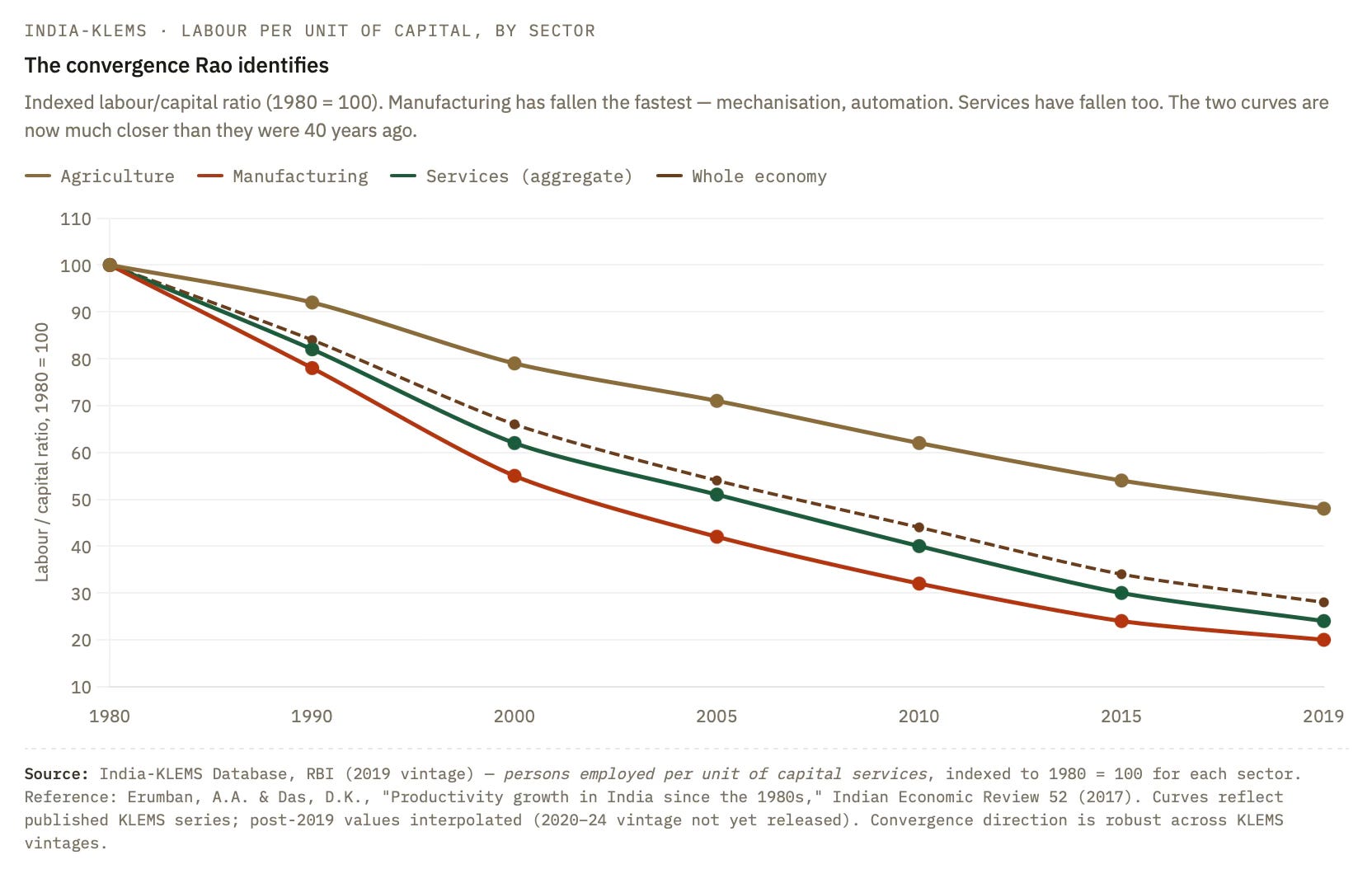
If labour intensities are similar, the sectors that expands the fastest are the natural venue for large-scale job creation. This points to the importance labour-intensive services like construction, trade, hotels, education, health, etc, as articulated by Rao.
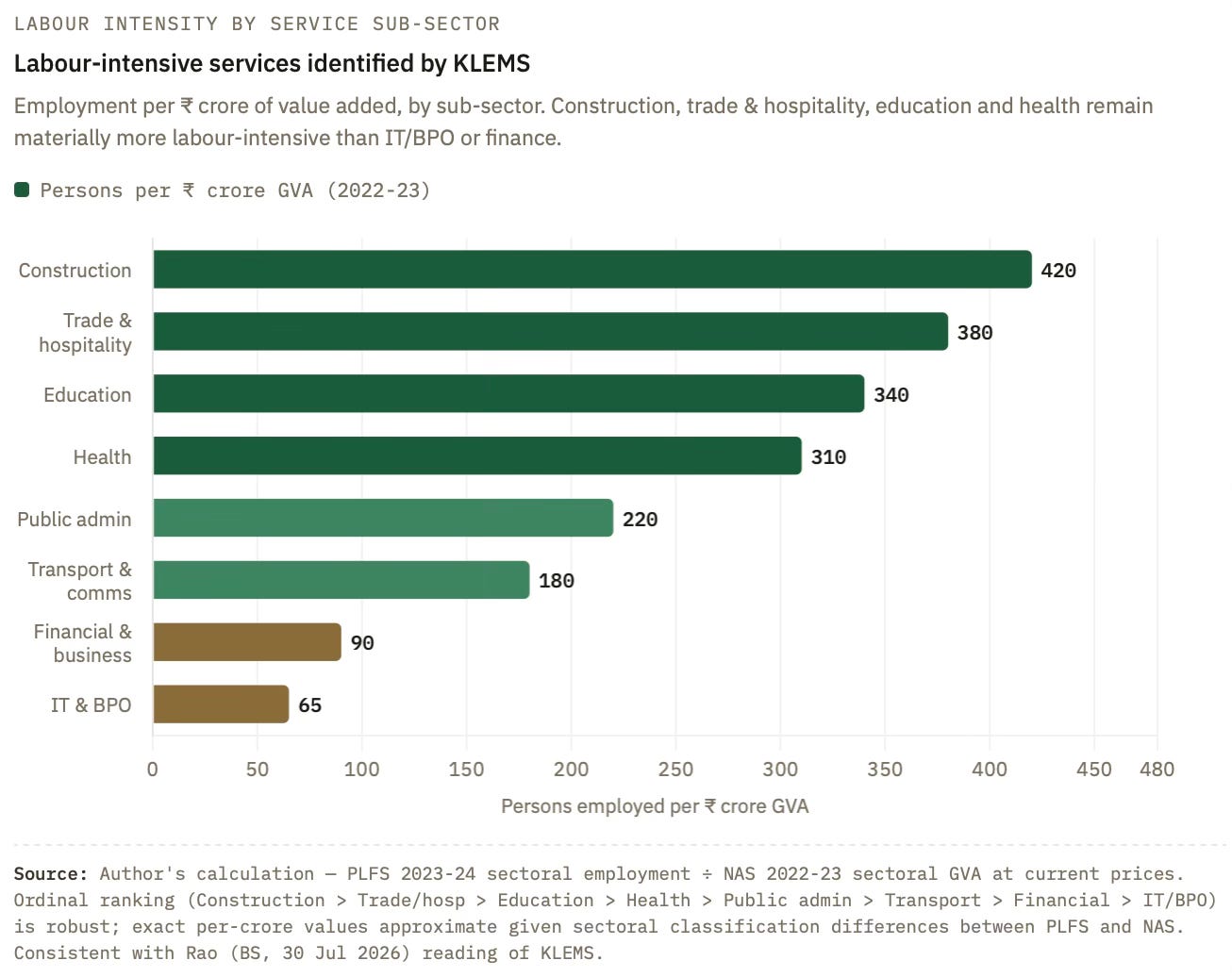
This reality demands a policy strategy that targets improving the quality of education and health services, and increasing their labour productivity. The quality of regulation and formalisation are two instruments in this regard.
To summarise, neither margin is currently operating as India is stuck with quantities of the wrong kind of jobs, qualities that are eroding, and flat real incomes.
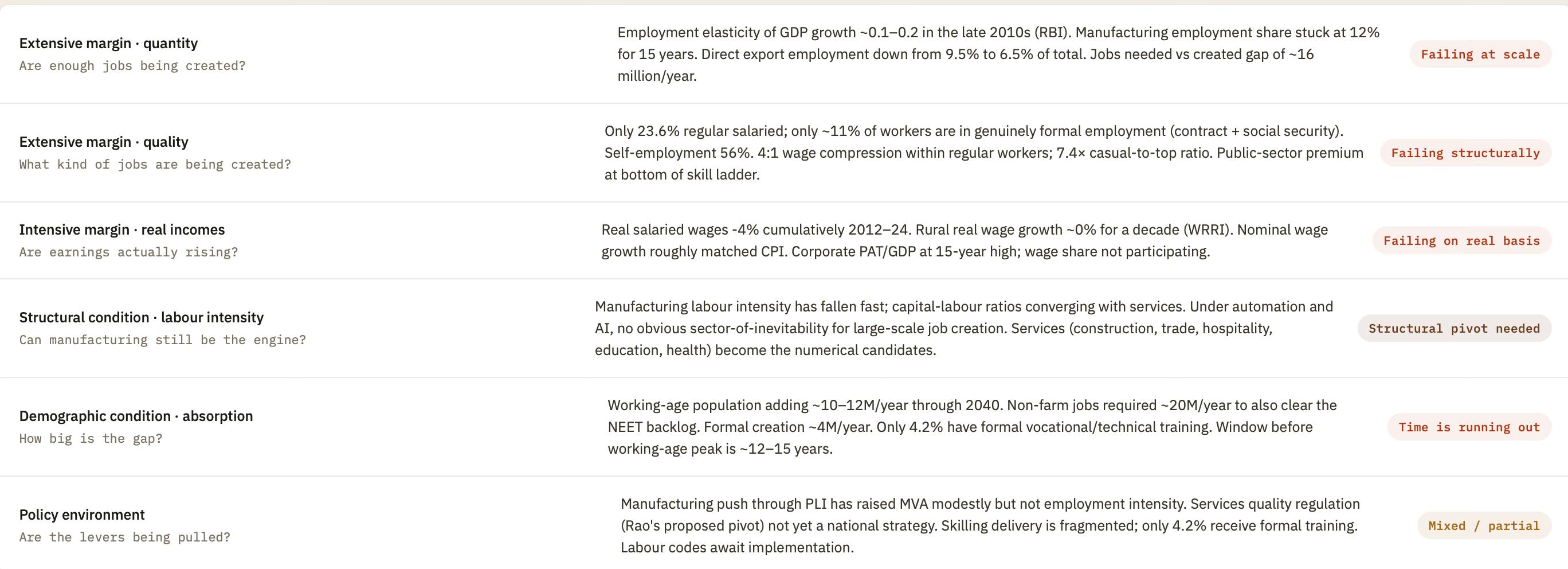
India is currently producing high GDP growth without producing either broad-based real income growth or broad-based good-job creation. This means that the growth is not translating into a widening consumption base, which in turn is a binding constraint on the private investment cycle that would generate more good jobs.
Breaking that loop requires action on both margins simultaneously: raising real incomes for those already in work (through productivity gains genuinely passed to wages, and formalisation) and expanding the base of good jobs (prioritising the sectors where labour-intensity remains, and through selective labour-intensive manufacturing where the global window has not fully closed).
India has company in China on the issue of good job creation. An FT long read highlights China’s “great job squeeze”, driving people into low-paying jobs like ride-hailing and food-delivery. This contrasts starkly with the productive factory and construction jobs that underpinned the emergence of China’s middle class and the country’s sustained high-growth era.
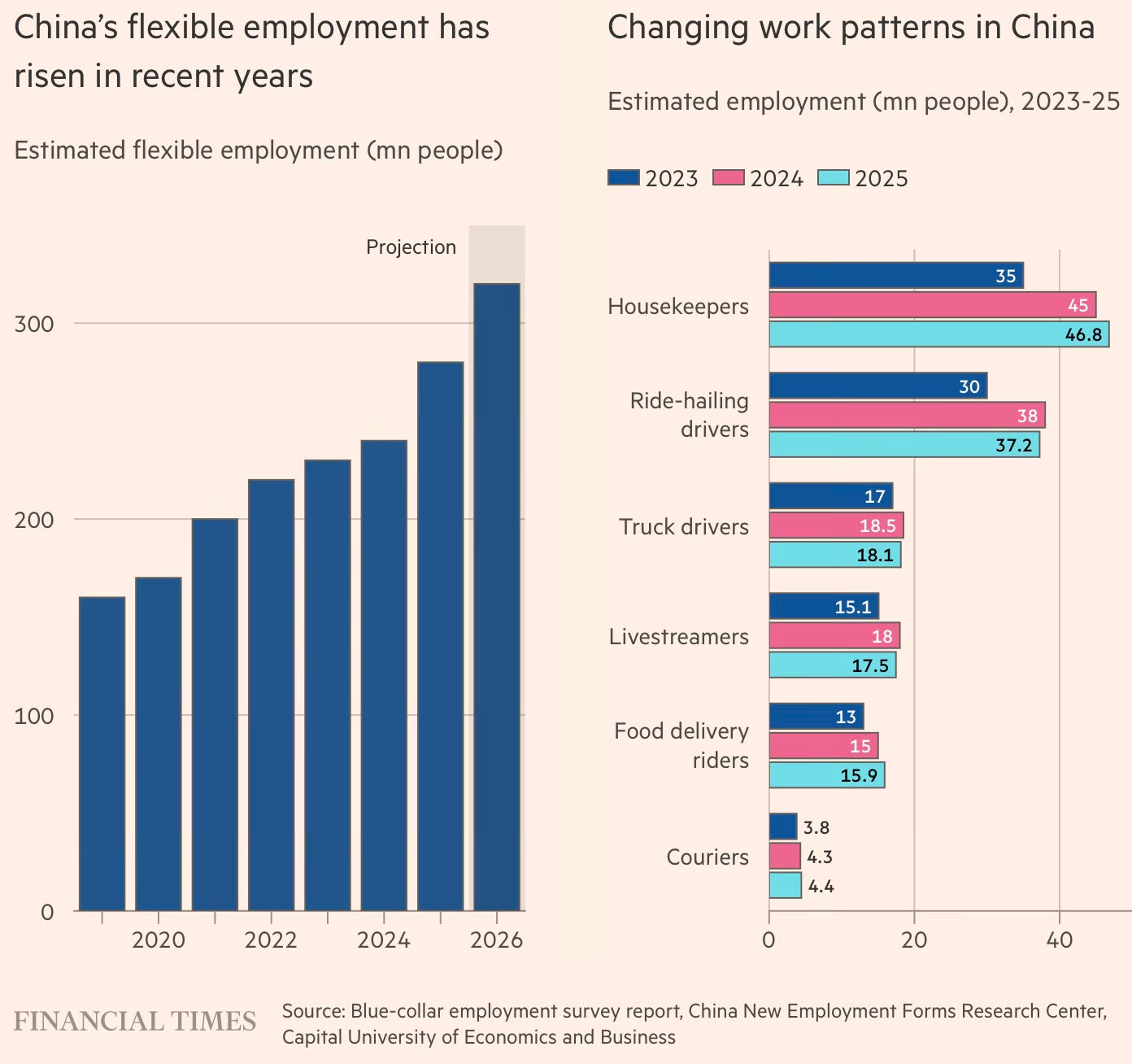
The property bust, consumer spending slowdown, and prolonged deflation have taken a toll on job creation. In this backdrop comes the backlash against exports, a major contributor to jobs and economic growth. The result of these trends is a labour market where low-paying gig jobs have become the major source of labour absorption. The number of gig workers has risen by 10 million in just two years.
A precarious gig economy of ridesharing drivers and delivery couriers has been soaking up China’s surplus labour. The labour market has long been at the heart of the social contract between China’s government, eager to maintain stability, and a vast population yearning for economic betterment. Today it is under strain as rarely before. While flexible work has served as an economic escape valve, it too now risks becoming overloaded by more people than it can provide jobs for… More than 53mn people as of 2025 work as food delivery or ridesharing drivers in China, up 10mn in two years… Several municipalities have reported an oversupply of ride-hailing drivers and in June, the southern city of Shenzhen declared its ride-hailing market saturated…“I would say the demand for labour is falling faster than the supply of labour is declining,” says HSBC’s Frederic Neumann, citing automation in factories, the property slowdown and the as-yet unquantified impact of AI…
Andrew Batson, China research director at Gavekal, an economic research firm, suggests flexible employment and gig work are “more of a symptom of broad-based labour market weakness in China than a totally independent development”, even if technology has aided the growth of platform workers. “Because aggregate demand is low, the bargaining power of workers is weaker and they have to accept more underemployment and less favourable working conditions,” he says… “The anecdotal evidence suggests that gig worker incomes are trending towards subsistence levels, given the competition among workers in China for jobs,” says Neumann… Gig work is increasingly drawing in graduates, of whom there are more than 12mn entering the labour market this year, as well as offering options for migrant workers.
In this context, John Burn-Murdoch has an excellent article of relevance which highlights the contrasting tales of US and UK labour markets. He makes the point that while the UK has done better than the US in school learning outcomes and adult skill acquisition (30 per cent of US adults have literacy skills typical of a 10-year-old), the latter has done well in labour market outcomes.
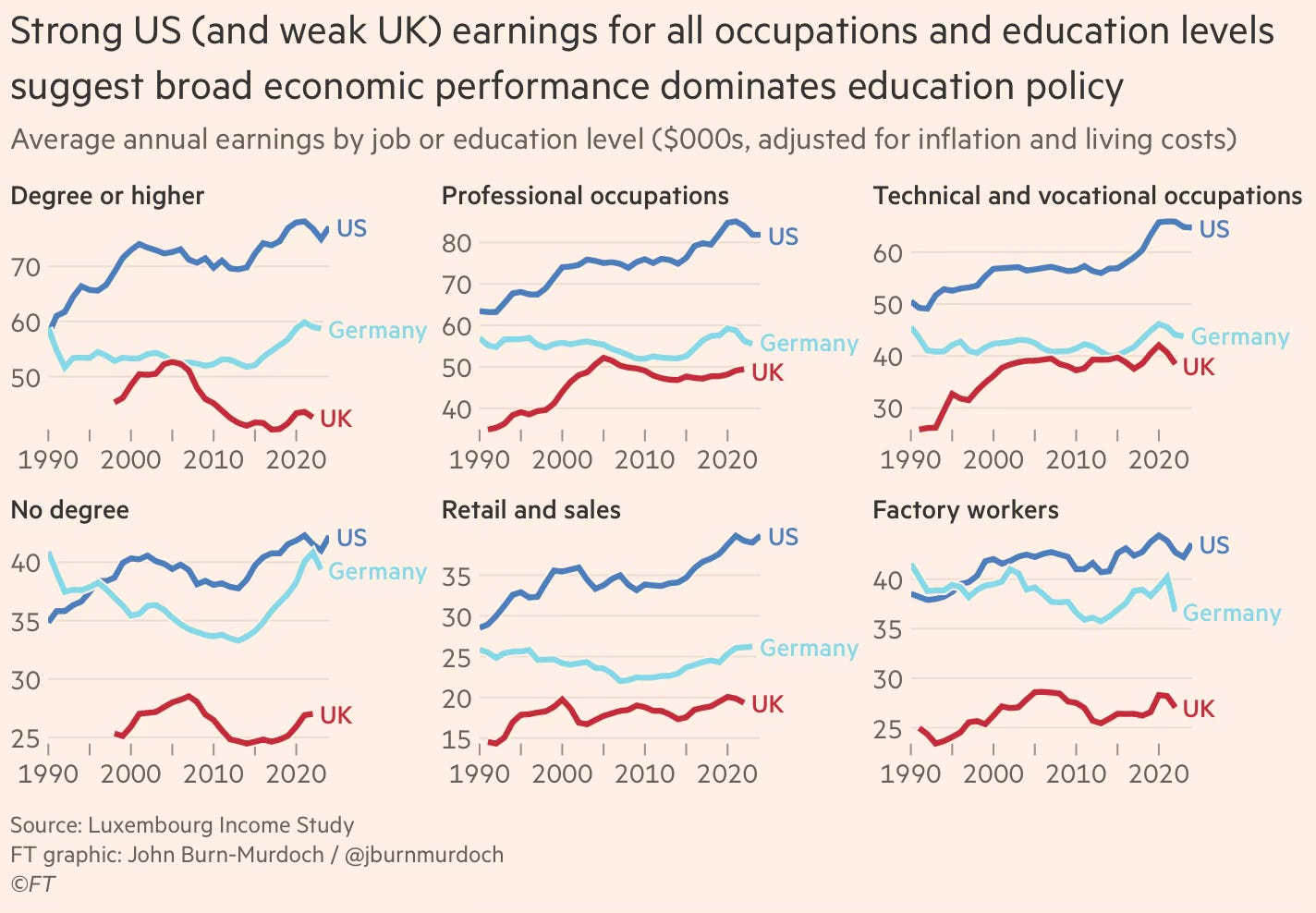
And this shows the higher wages received by US workers (it remains to be disaggregated as to how much of this is due to higher productivity, and how much due to labour market distortions).
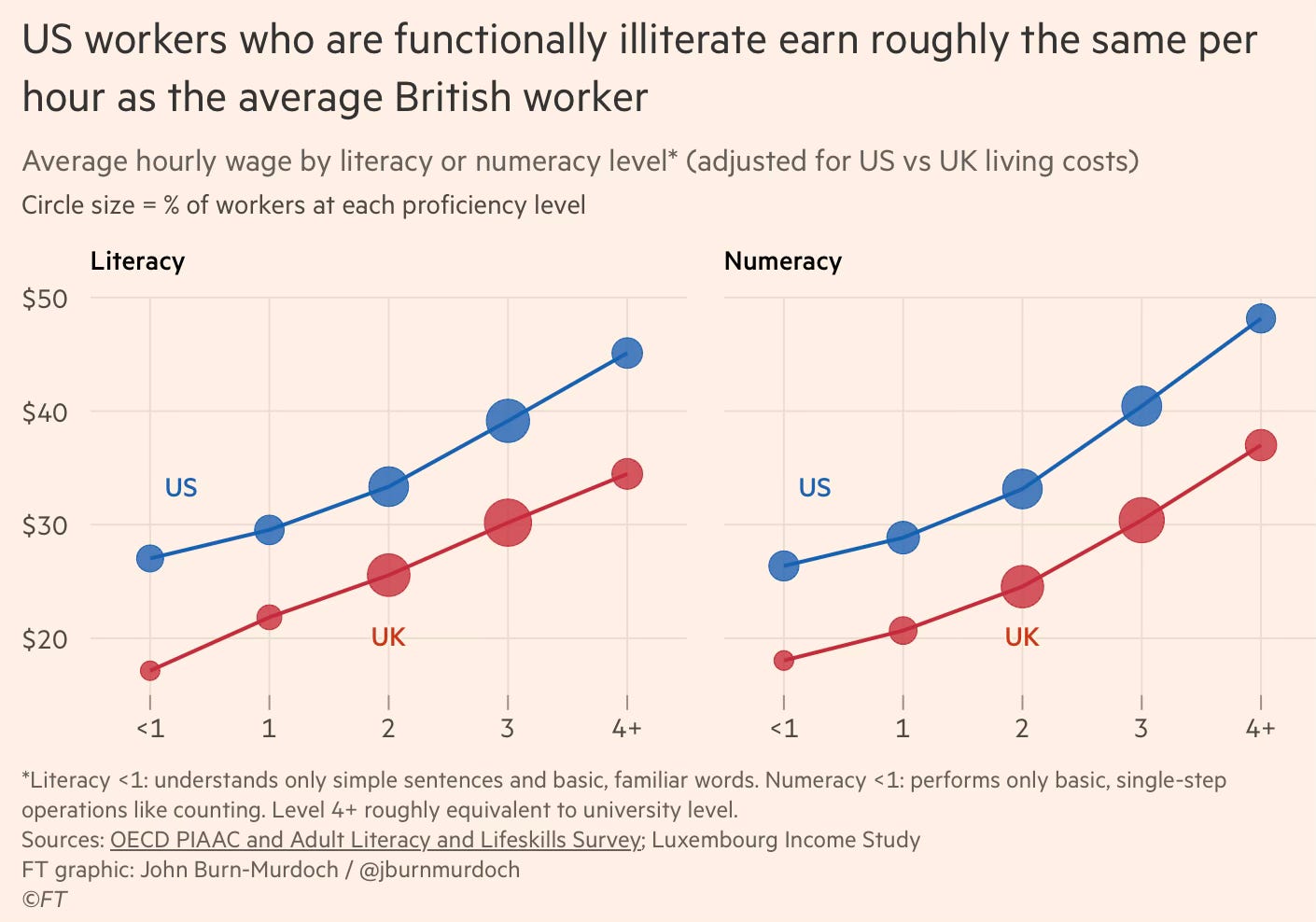
Similar to Germany, factory workers in the US earn 60 per cent more than in the UK after adjusting for differences in living costs. Plumbers and electricians earn 90 per cent more, and retail workers earn double. The same proportion of US workers who score stunningly low on literacy earn an average of almost $30 per hour, and two-thirds of them are in work. Their British counterparts make the equivalent of $20 and fewer than half are employed.
Like India, Britain has invested heavily in skill development, and Burn-Murdoch makes a very important point, of relevance to India.
But if we really want to deliver better outcomes, we must stop thinking of particular qualifications or forms of education as things that produce particular economic outcomes and deliver respect. Rather, we should view education as creating potential that a strong economy unleashes (and a weak one disappoints).
The main point is that, if you cut through everything, good job creation is all that matters. And India has much to do on this front, especially with all the headwinds from geopolitics, trade, technology, climate change, and antecedent problems.
No comments:
Post a Comment