I blogged here, highlighting the high cost structure that Indian businesses face. This post dives deeper and examines land cost.
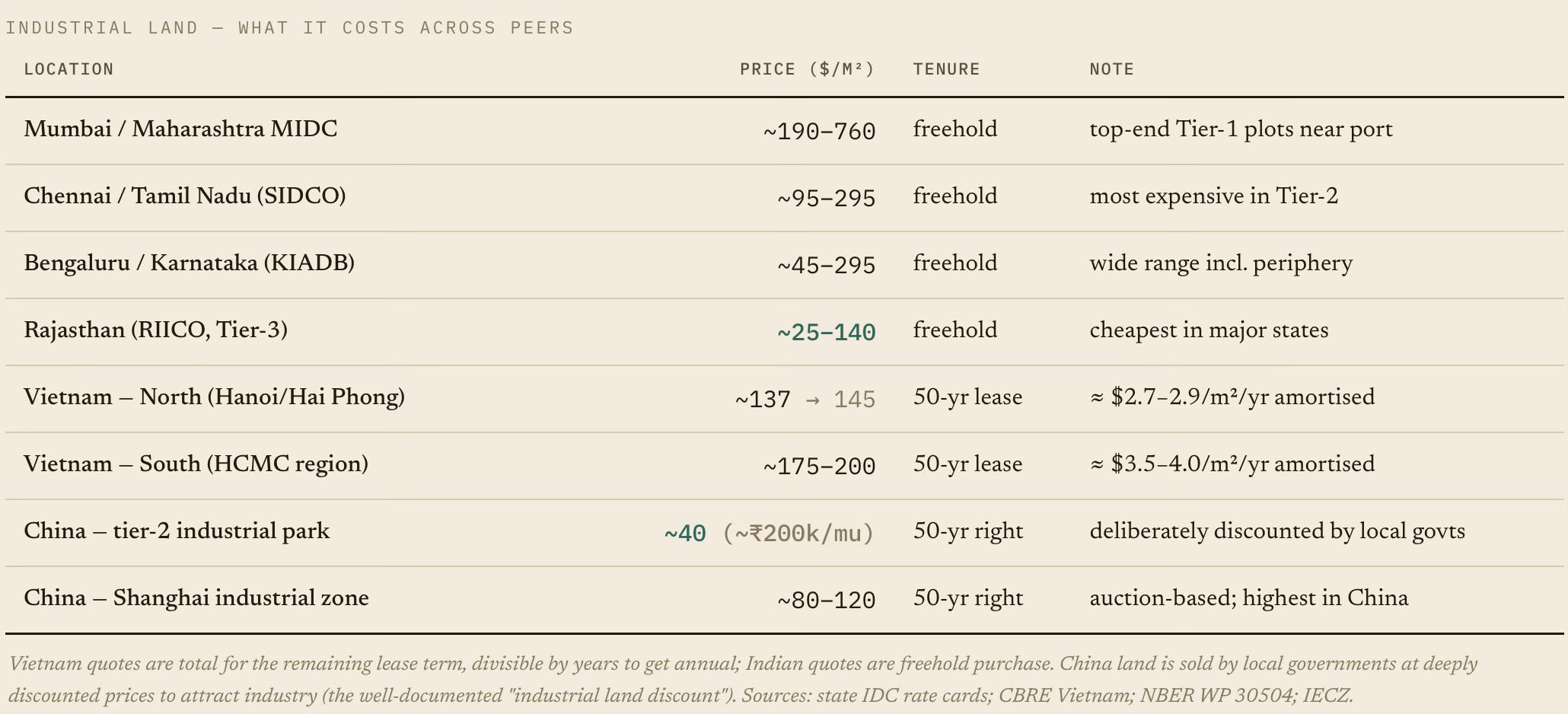
A comparison with peers shows that urban land is priced like that of a rich country and ends up hoarding the nation's savings, with 77% of the households parking their wealth in real estate. Mumbai ranks among the world's 20 most expensive prime markets. Industrial land across the major Indian cities is prohibitively expensive compared to peers.
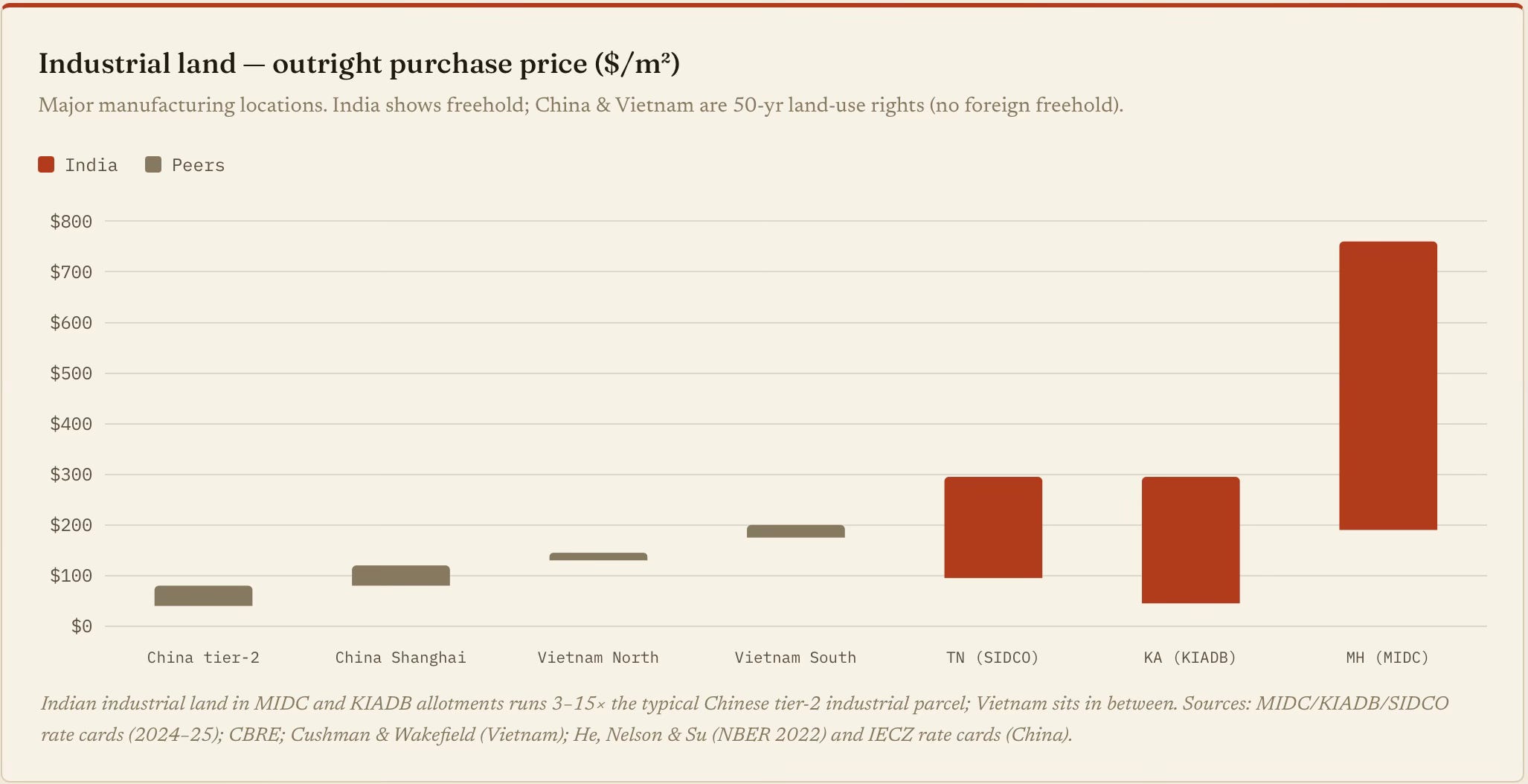
An Indian manufacturer pays roughly 5–15 times more for industrial land than a Chinese counterpart in a comparable tier-2 city and 1–4 times a Vietnamese peer.
I used Claude to generate the graphic below on the total land transaction cost across states, combining the stamp duty and registration fees and the change of land use fees for the conversion of agricultural land. While stamp duty has converged to 6-7% of land value, the total cost varies widely across states. Interestingly, the southern states have the highest transaction rates.
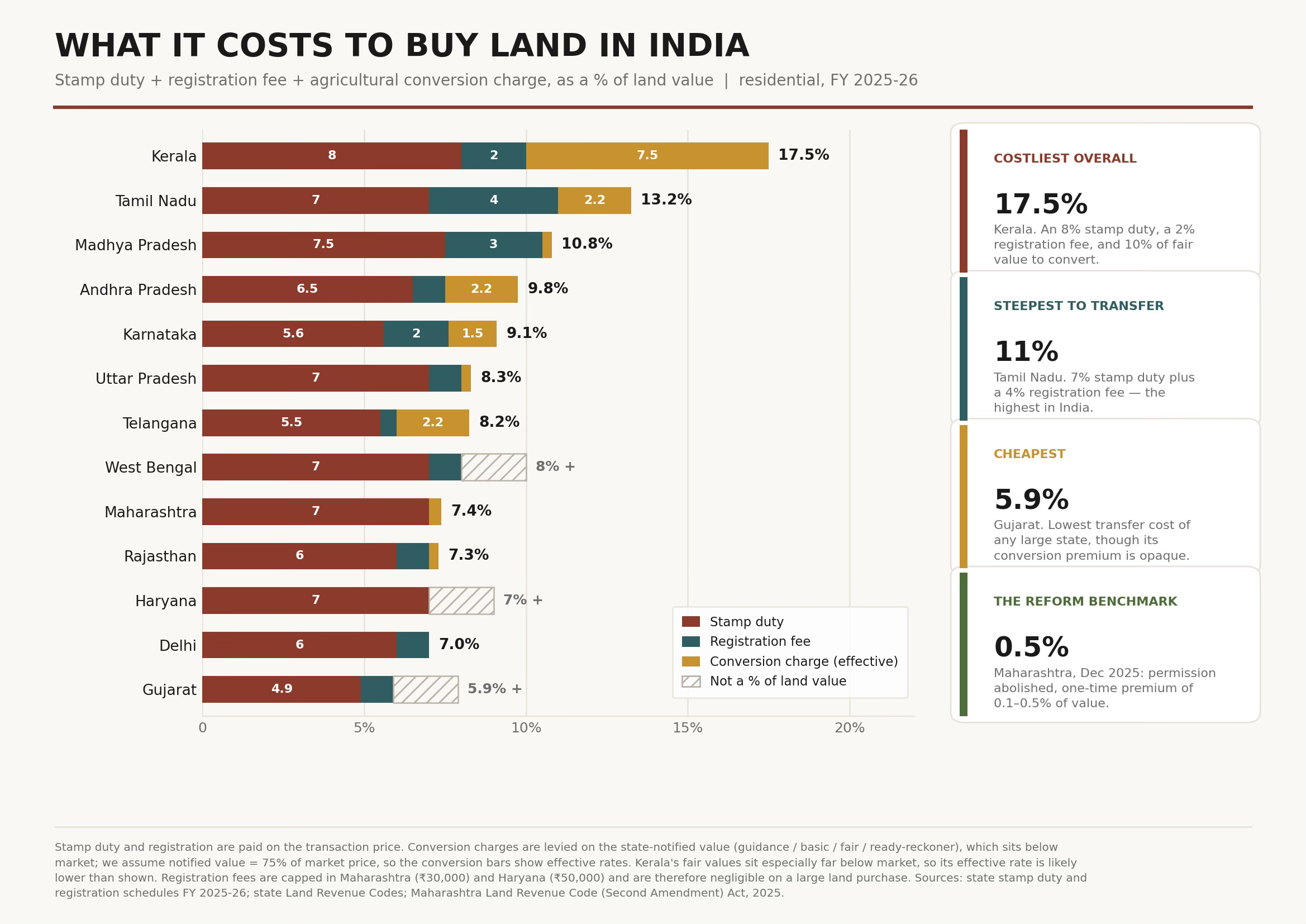
Four states can’t be reduced to a clean number - Maharashtra charges a premium of 25–100% of the ready-reckoner differential; Gujarat charges on the agri/non-agri differential; West Bengal rarely grants conversion at all; and Delhi’s urban land is already non-agricultural. For these, the combined figure shown is a floor, not a total (hence the ‘+’). Maharashtra, in particular, would likely top the chart if its premium were expressible as a share of land value.
Andhra Pradesh (deemed conversion since 2018, NALA Act now being scrapped) and Uttarakhand (permission eliminated for specified categories) are the only states that have removed conversion permission as a bureaucratic step. Assam, J&K, Odisha, Puducherry and Tripura have moved to negative lists.
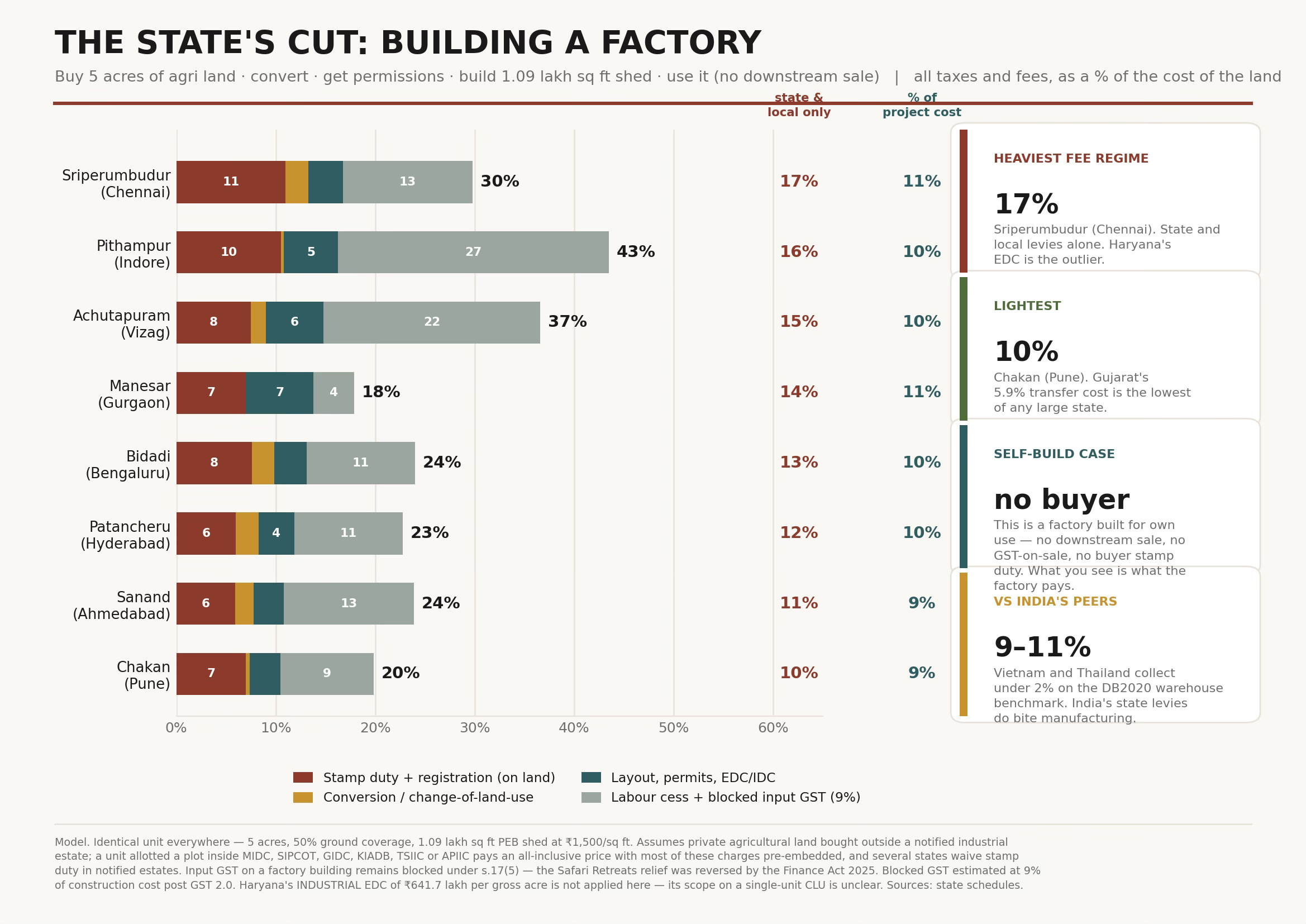
I then asked Claude to generate the typical cost of industrial land in some representative locations across India. The wide variations in the construction levies as a share of land value arise from the variations in the underlying land valuations (the % is higher in places with lower land values). While the state and local taxes make up 10-17% of the land value, all the land and building-related taxes make up a near-uniform ~10% of the industrial project cost (land, construction, taxes).
I did the same for residential land cost at representative locations in a few cities. Ignoring the Gurgaon outlier, the state and local taxes make up 16-26% of the land value, and all the land and building-related taxes make up 18-25% of the price paid by the homebuyer. In other words, the tax burden is a fifth to a quarter of what a homebuyer pays.
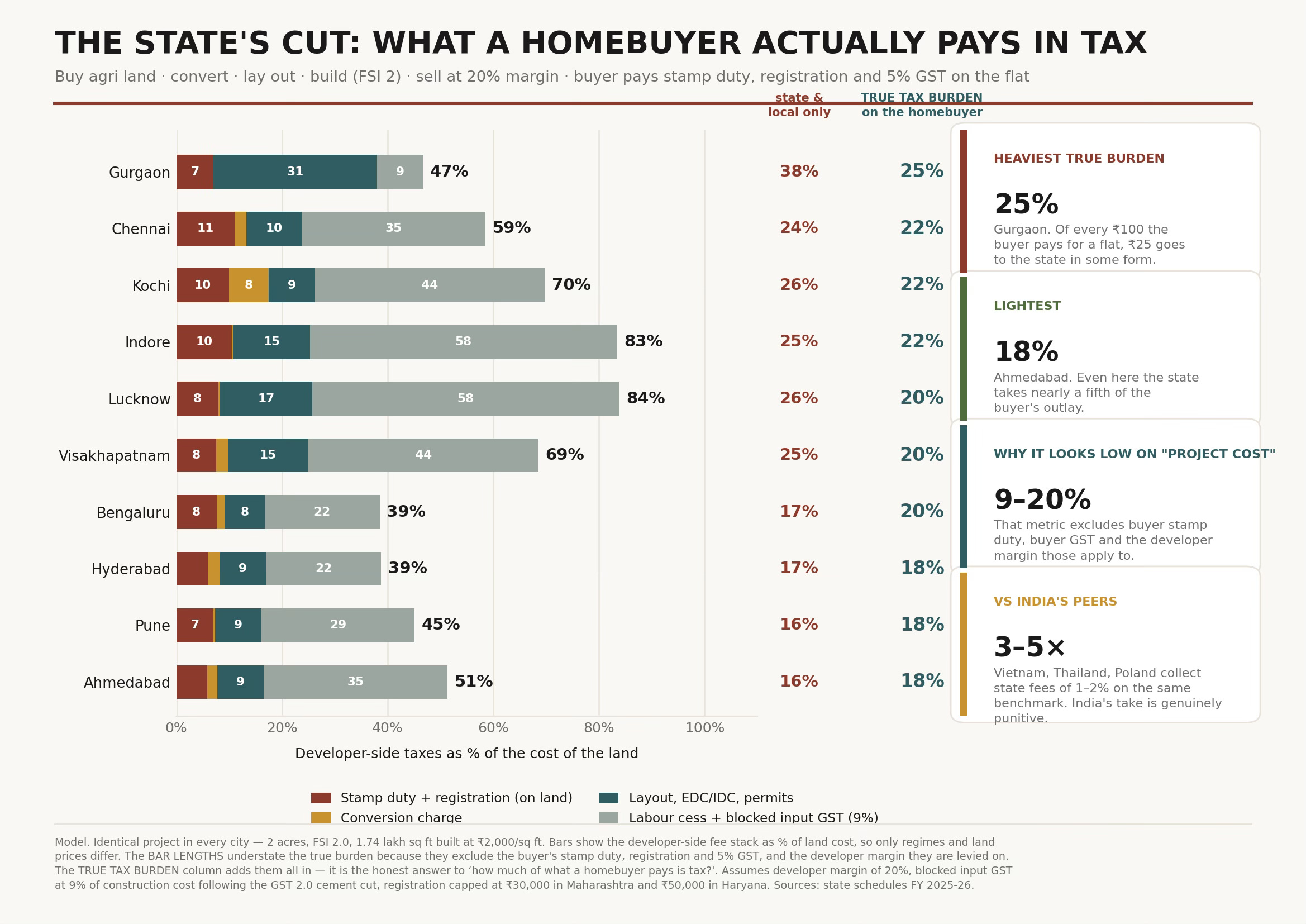
In both cases, the lower land valuations in places like Lucknow or Indore or Vizag mean that the share of the nationwide levies (GST and labour cess) is much higher. In other words, these levies bite more in the second-tier and below cities and end up eroding their comparative advantage.
A like-for-like global comparison for industrial land is difficult given the lack of data. The graphic below is a broader international comparison, using the World Bank’s last Doing Business 2020 survey, for the construction of a typical (2 storeys, 1,300 sq m, on a 929 sq m plot, valued at 50× GNI per capita) warehouse (as a % of the warehouse value) in each country’s largest business city. It measures every statutory licence, permit, inspection, utility connection, non-recurring tax and property registration fee, but importantly, excludes VAT, capital gains and the price of the land itself.
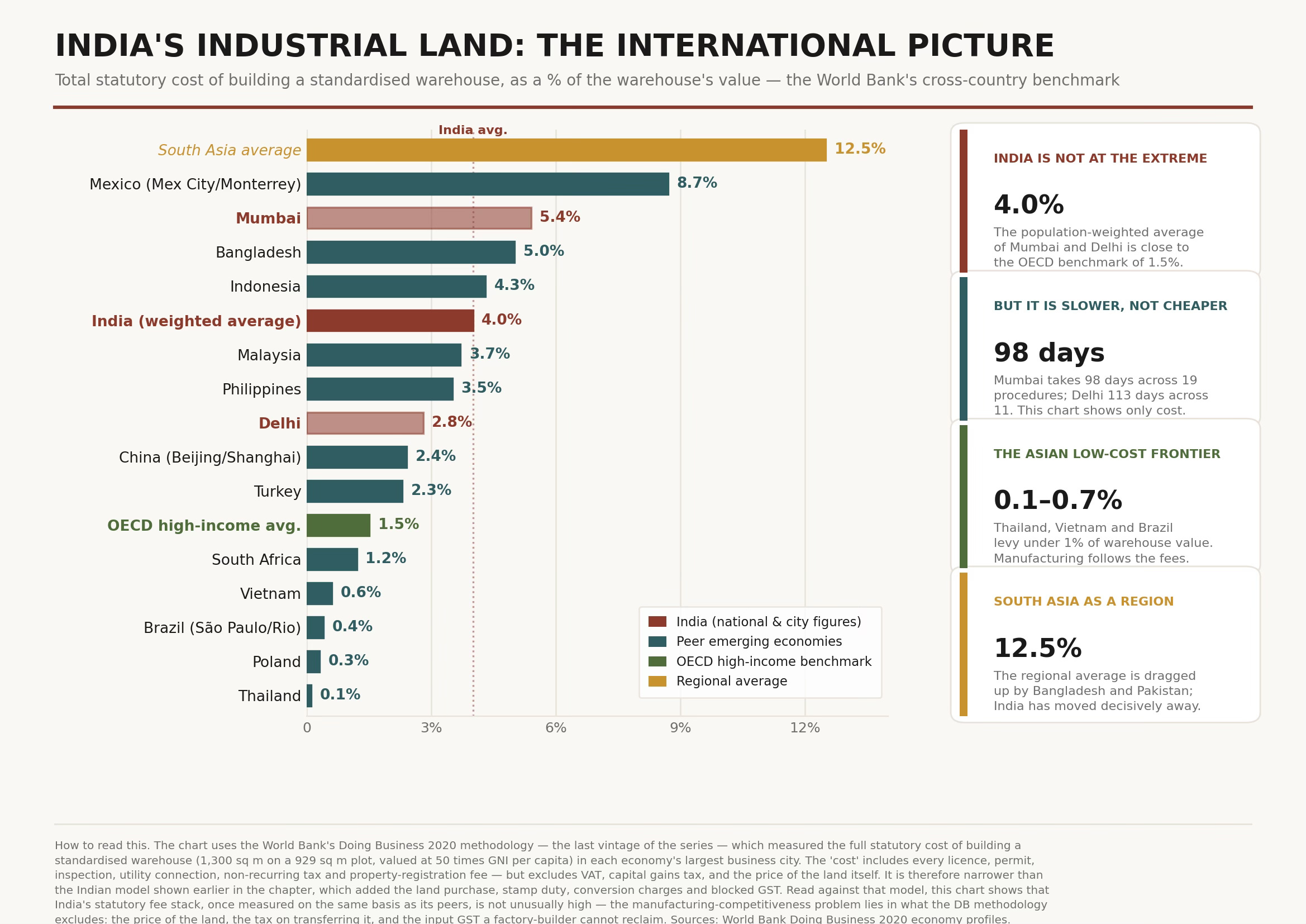
India’s statutory fee stack is middling, sitting below Mexico, Indonesia, Bangladesh, and Delhi at 2.8% is not too far from the OECD high-income benchmark of 1.5%. This questions the reasoning that Indian construction-permit fees alone make land prices uncompetitive. However, India’s manufacturing competitors like Vietnam, Thailand, Brazil, and Poland levy less than a fifth of what India does on the same measures.
More importantly, the DB survey data excludes land price, stamp duty, conversion charges, and the GST input credit, precisely the costs that were the basis for the discussion earlier. The state’s tax share at 18-43% of industrial land cost, or 9-11% of total project cost is where the land-related competitiveness gap sits, and not in the counter fees that the WB’s DB Survey tracked.
No comments:
Post a Comment